
The Invisible SEO Audit: Fixing Hidden Technical Problems Before Rankings Improve
Fifty-six percent of companies now run AI-driven SEO monitoring to catch invisible technical problems in real time, according to 2026 marketing data.
 Marcus Webb··8 min read
The Invisible SEO Audit: Fixing Hidden Technical Problems Before Rankings Improve
Fifty-six percent of companies now run AI-driven SEO monitoring to catch invisible technical problems in real time, according to 2026 marketing data. Yet the agencies they hire still deliver quarterly PDF audits that miss the exact crawlability, schema, and indexation failures dragging rankings down. The gap between what agencies report and what actually blocks organic growth is where most SEO budgets go to die.
Why Surface-Level Audits Cost You Twice
Every agency pitch deck includes a slide about "technical SEO audits." The problem is that most of those audits check the same 15 to 20 surface-level items: title tag length, meta description presence, broken links, image alt text. These checks matter, but they account for maybe 30% of the invisible SEO problems that actually suppress rankings. The other 70% sits in crawl directives, rendering issues, canonicalization conflicts, and structured data failures that never show up in a standard report. When you're evaluating an agency for hire, the depth of their technical SEO diagnosis tells you more about their competence than any case study slide ever will.
Thrive Agency's audit documentation describes a common scenario worth paying attention to: robots.txt files and meta directives that silently block important pages from search engines. Everything looks fine on the surface. The pages load, the content reads well, the design is polished. But search engines have been told to stay out. This kind of failure doesn't trigger a warning in most basic crawl tools. It requires line-by-line review of robots.txt rules and noindex directives across the entire site, which is exactly the work that separates a $500-per-month agency from a $3,000-per-month one.
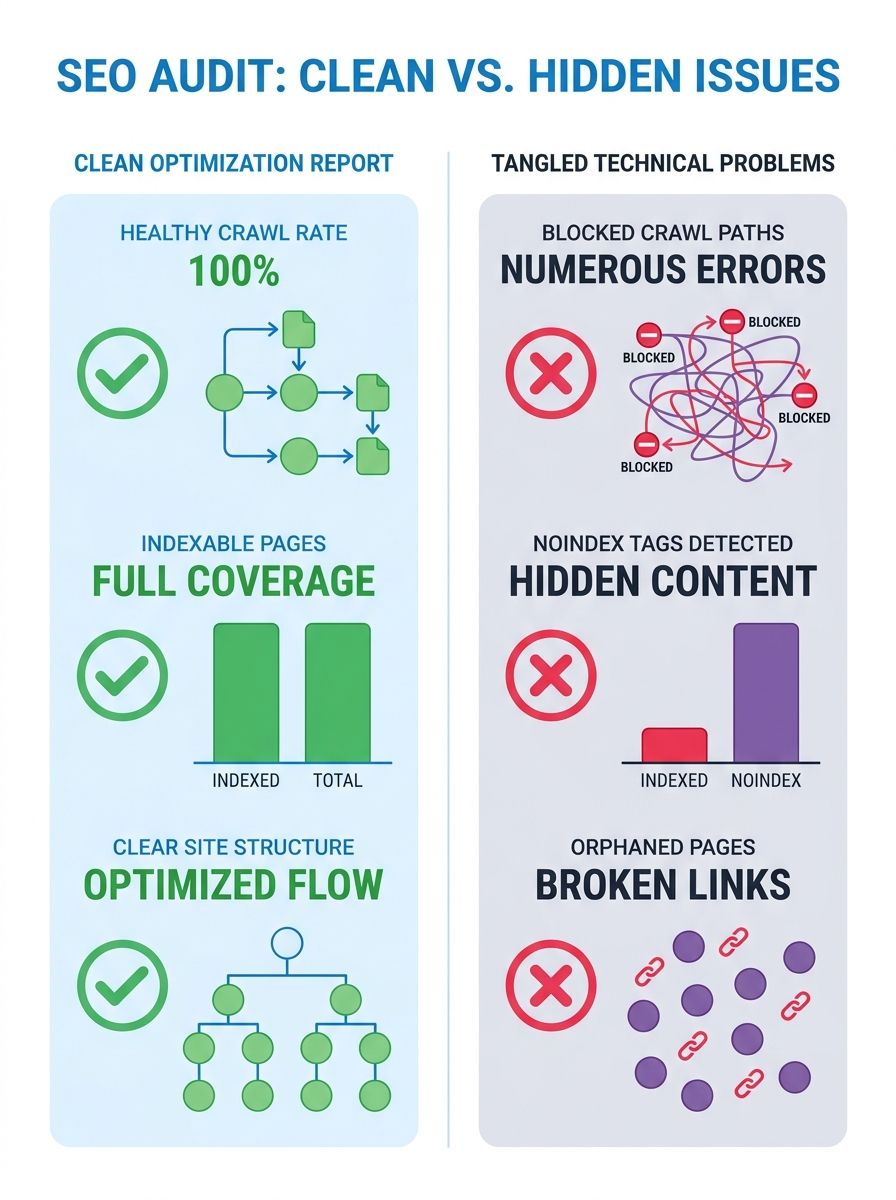
The financial math here is brutal. If your agency runs a checkbox audit that costs $1,500 and misses a canonicalization issue suppressing 40% of your product pages from indexation, you're paying for content, link building, and optimization work that physically cannot produce results. You pay once for the bad audit, then again for three to six months of wasted campaign spend before someone finally spots the real problem. According to DeltaV Digital, their audit methodology covers crawlability, site architecture, performance, on-page elements, and infrastructure across 800+ client locations using an Impact-Effort Prioritization Framework to rank fixes by business value. That framework concept is the key detail to look for when interviewing prospective agencies. Ask them: how do you prioritize what to fix first, and what does your prioritization model look like? If they can't articulate one, they're running checkbox audits.
The 65% of companies reporting better SEO results from continuous monitoring aren't getting those gains from fancier tools alone. They're getting them because continuous monitoring catches problems like duplicate canonical tags, JavaScript rendering failures, and accidental noindex deployments within hours instead of quarters. When you're evaluating an agency's real track record, ask specifically about their monitoring cadence. A quarterly crawl is a rearview mirror. A weekly or continuous crawl is a dashboard.
Crawl Efficiency Debugging on eCommerce Sites
Why does crawl efficiency matter so much for online stores? Because Google allocates a limited crawl budget to every site, and eCommerce architectures are uniquely designed to waste it. Faceted navigation generates thousands of parameter-based URLs. Color filters, size selectors, price ranges, and sort options each create distinct URLs that search engines treat as separate pages. A store with 5,000 products can easily generate 50,000 or 100,000 crawlable URLs through faceted navigation alone. Google's own guidance says sites with fewer than a few thousand URLs don't need to worry about crawl budget. But any eCommerce site worth auditing blows past that threshold on day one.
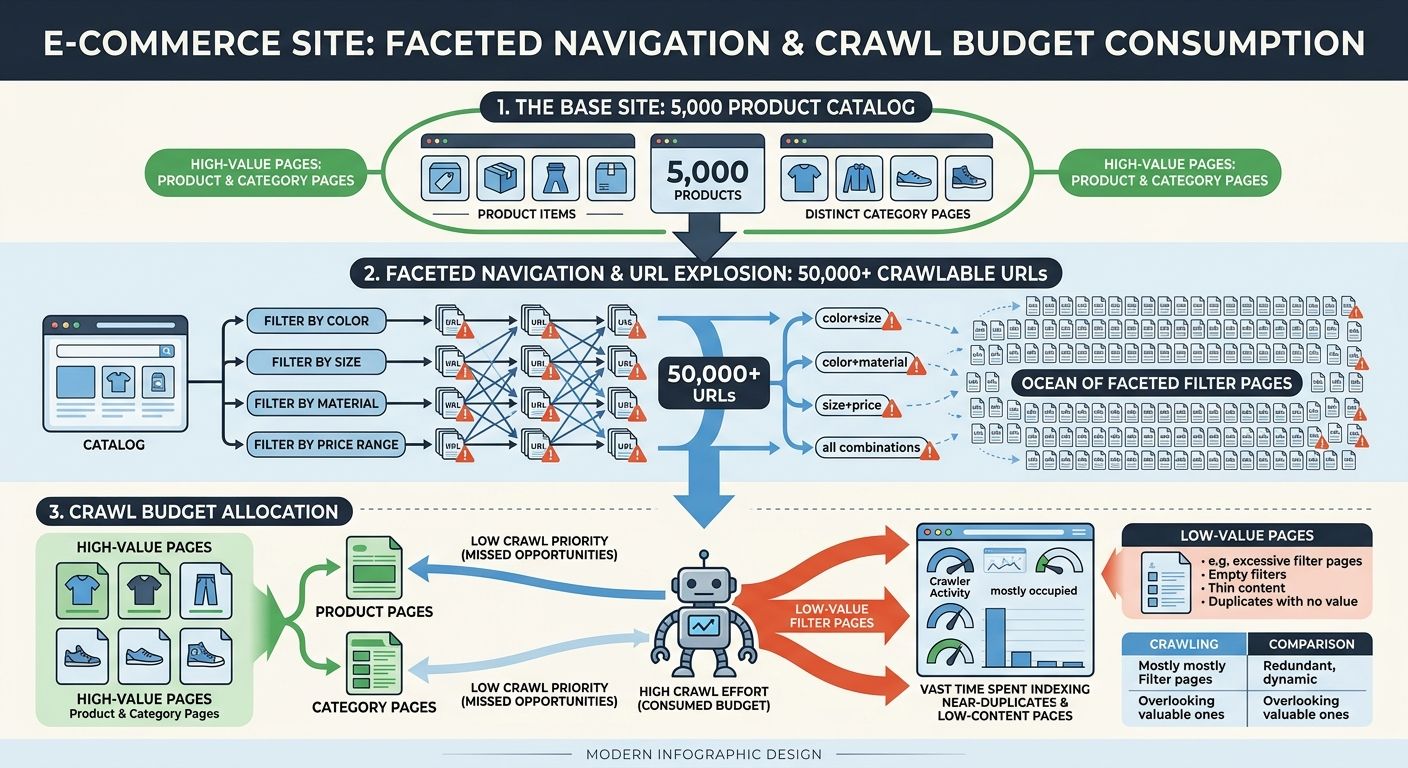
Ice Cube Digital's research on large eCommerce crawl budget issues identifies the four primary culprits: faceted navigation, duplicate URLs, broken links, and low-value pages. When search engines spend their limited crawl allocation on these unnecessary pages, the important product and category pages get crawled less frequently or not at all. Straight North's eCommerce SEO analysis reinforces this point: a strong site architecture distributes link equity throughout the site, improves crawl efficiency, and helps search engines identify your most valuable pages. On eCommerce sites specifically, they note it's "surprisingly easy" to waste crawl budget on low-value pages.
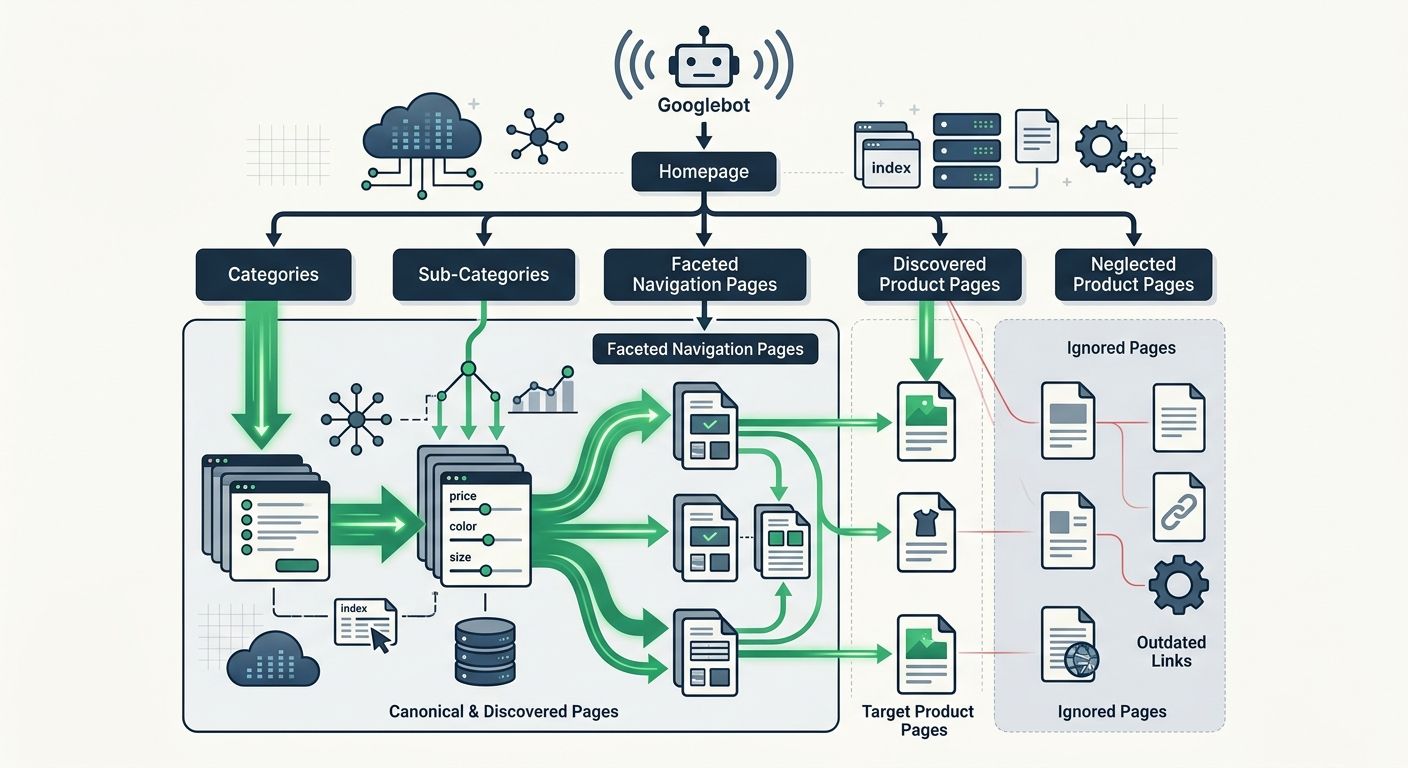
This is where your eCommerce SEO audit framework needs to go deeper than most agencies are willing to dig. An effective crawl efficiency debugging process examines server log files to see which pages Googlebot actually requests, how often it returns, and where it stops. Log file analysis tells you the truth that no crawl simulation tool can replicate. If Googlebot visited your faceted navigation pages 12,000 times this month but only hit your new product pages 200 times, you have a crawl budget problem that no amount of content optimization will fix. The agency you hire should be able to show you this data and explain what they'd do about it. Common fixes include adding noindex directives to filter pages, implementing canonical tags on parameter URLs, and restructuring internal linking to push crawl priority toward revenue-generating pages. If you've been debugging ranking drops without examining server logs, you've been working with incomplete information.
One detail that agencies often overlook in eCommerce audits is pagination handling. A category page with 500 products spread across 25 paginated pages needs consistent canonical treatment and proper internal linking to ensure crawlers reach deep inventory. Sites using infinite scroll without proper progressive rendering create pages that appear empty to search engine crawlers, effectively hiding hundreds of products from indexation. These are the kinds of invisible SEO problems that separate an agency doing real technical work from one running automated scans and reformatting the output into a branded PDF.
Schema Markup Validation as an Agency Competence Test
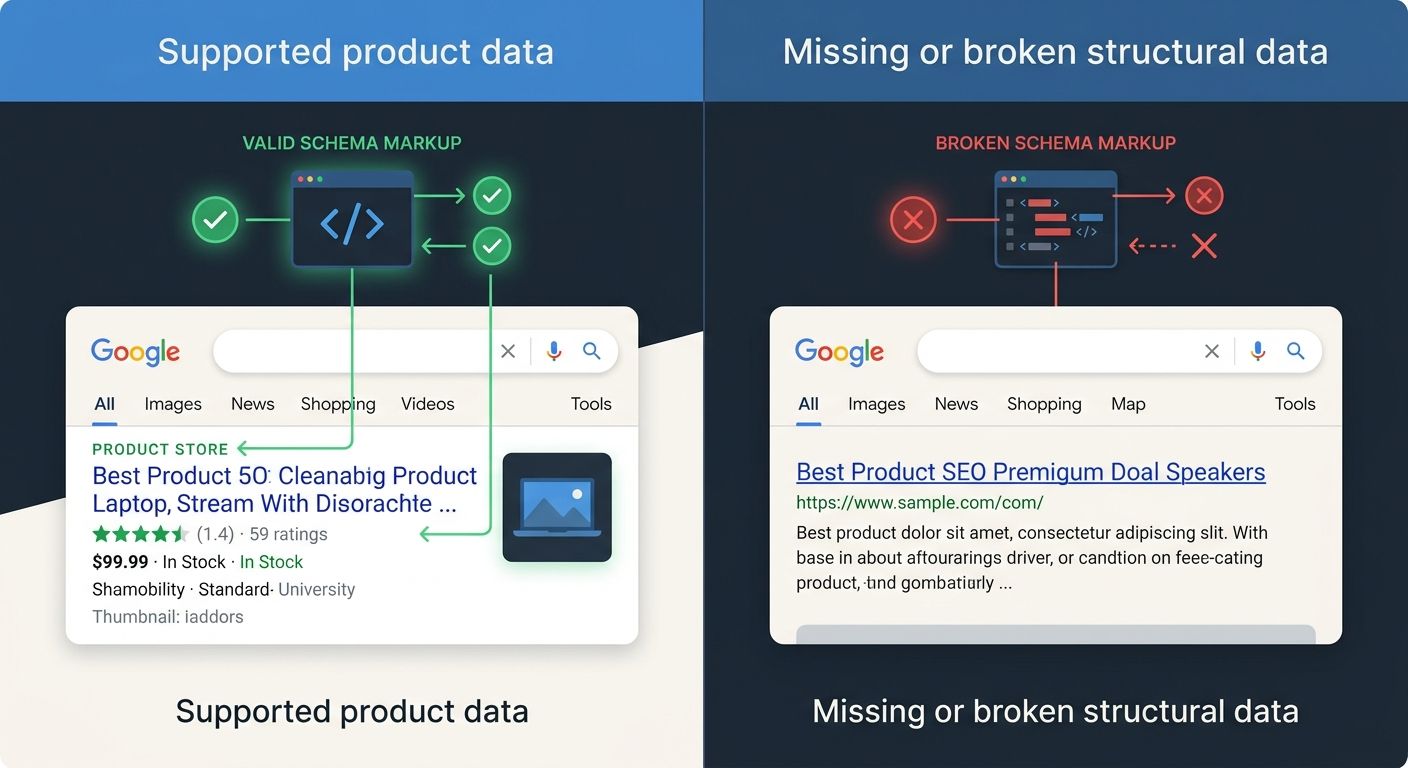
Schema markup validation has become one of the clearest indicators of an agency's technical depth. The gap between "we add schema" and "we validate, test, and maintain schema across every template" is enormous, and it shows up directly in whether your pages qualify for rich results, AI Overviews, and featured snippets. Google's own Schema Markup Testing Tool validates structured data against Google-specific requirements for rich results eligibility. The Schema.org Validator handles broader validation, extracting JSON-LD 1.0, RDFa 1.1, and Microdata markup to identify syntax errors. These are two different tools with two different purposes, and an agency that treats them as interchangeable doesn't understand schema well enough to implement it correctly.
The practical reality on most sites is grim. Product pages carry schema with missing required properties like price, availability, or review aggregates. Article pages use NewsArticle schema when they should use Article schema, or vice versa. LocalBusiness schema lists hours of operation that haven't been updated in 18 months. These errors don't throw visible warnings in the browser, and they don't break anything users can see. They silently disqualify pages from rich results and reduce visibility in AI-powered search interfaces that rely on structured data to generate answers. SparkToro data shows Google now delivers only 232 clicks per 1,000 queries to external websites, and a16z research documented a 25% decline in search traffic to websites over the past year as AI Overviews absorb clicks. In that environment, the pages that do earn clicks are overwhelmingly the ones with properly validated schema that qualifies them for enhanced SERP features.
When interviewing agencies, ask them to walk you through their schema markup validation process on a live site. Not a case study, not a slide deck. Pull up your site, run it through Google's testing tool together, and watch how they interpret the results. An agency worth hiring will spot issues like missing aggregateRating properties, incorrect @type declarations, or schema that doesn't match visible page content within minutes. They should also explain how they handle schema across template types. An eCommerce site needs Product schema on product pages, BreadcrumbList schema on category pages, Organization schema on the homepage, and FAQ schema where applicable. Each template requires separate validation. Agencies that build SEO into the development workflow treat schema as infrastructure that ships with every template change, not a one-time implementation that decays silently over the following 12 months.
The connection between schema validation and the broader AI search ecosystem deserves attention from anyone hiring an agency right now. AI crawlers from ChatGPT, Perplexity, and other platforms rely on structured data to understand page content and generate citations. A site with broken or incomplete schema is less likely to appear in AI-generated answers regardless of its traditional ranking position. If your agency isn't adapting their SEO checklist for AI search visibility, their technical audits are solving problems from 2023 while missing the problems that matter in 2026.
Where the Hiring Conversation Still Falls Short
The uncomfortable truth about hiring for technical SEO competence is that most evaluation processes aren't designed to test it. Agencies showcase ranking improvements and traffic graphs during pitches, but rarely walk through the specific technical findings that made those results possible. A 40% traffic recovery sounds impressive until you learn it came from removing an accidental noindex tag that a competent audit would have caught on day one. The metrics that matter during agency evaluation are diagnostic in nature: What percentage of your crawl budget reaches revenue-generating pages? How many of your schema implementations pass validation without errors? What's the ratio of indexed pages to total crawlable URLs, and is that ratio healthy?
These questions don't have universally correct answers, which is exactly why they're useful for separating agencies that think technically from those that don't. An agency that responds with specific thresholds, references to their audit framework, and examples of how they've diagnosed similar issues on comparable sites is demonstrating real capability. An agency that pivots back to keyword rankings and content calendars is telling you where their expertise actually lives. The Ahrefs 16-step SEO audit framework has become something of an industry standard for systematic evaluation of search performance, and any agency claiming technical audit competence should be able to describe how their process compares to or improves upon that baseline.
I remain genuinely unsure whether the market will correct this evaluation gap on its own. The agencies doing the deepest technical work tend to be the worst at marketing themselves, because the problems they solve are invisible by definition. And the agencies with the best pitch decks tend to focus on the visible, measurable outputs that clients already understand. The hiring decision often rewards the wrong skills. If you're evaluating agencies for technical SEO work, the single most revealing exercise is to hand them a staging URL and ask for a preliminary technical diagnosis within 48 hours. What they find, what they miss, and how they prioritize the findings will tell you more than any proposal document ever could. The invisible problems are the ones that determine whether your SEO investment produces returns, and the agency you hire needs to see what you can't.
Marcus Webb
Digital marketing consultant and agency review specialist. With 12 years in the SEO industry, Marcus has worked with agencies of all sizes and brings an insider perspective to agency evaluations and selection strategies.
Related Articles

The SEO Debugging Workflow: A Framework for Diagnosing Visibility Drops in Under 48 Hours
A five-layer diagnostic sequence (crawl, render, index, rank, click) applied in strict dependency order isolates the root cause of organic visibility drops faster than any other method I've tested across 200+ agency evaluations.

The Niche-Specific SEO Audit Checklist: Beyond Generic 100-Point Frameworks for Architecture and Design Firms
Generic 100-point SEO audit frameworks consistently hand architecture and design firm websites passing scores while those same sites lose organic visibility on the pages that actually win clients: project portfolios, case studies, and studio landing pages.
The Technical SEO Workflow Gap: Why Agencies Miss Critical Infrastructure Tasks Before Publishing
Content published without pre-flight technical checks is the single largest source of fixable ranking failures I find when auditing white-label SEO operations. Not thin content, not bad link profiles, not poor keyword targeting.
Explore more topics