
Beyond Fake Reviews: How to Audit an SEO Agency's Real Track Record Using Benchmarks and Client Data
Of the 200-plus SEO agencies I've evaluated over 12 years, fewer than 30 provided prospective clients with baseline performance data tied to actual business outcomes before signing a contract.
 Marcus Webb··9 min read
Beyond Fake Reviews: How to Audit an SEO Agency's Real Track Record Using Benchmarks and Client Data
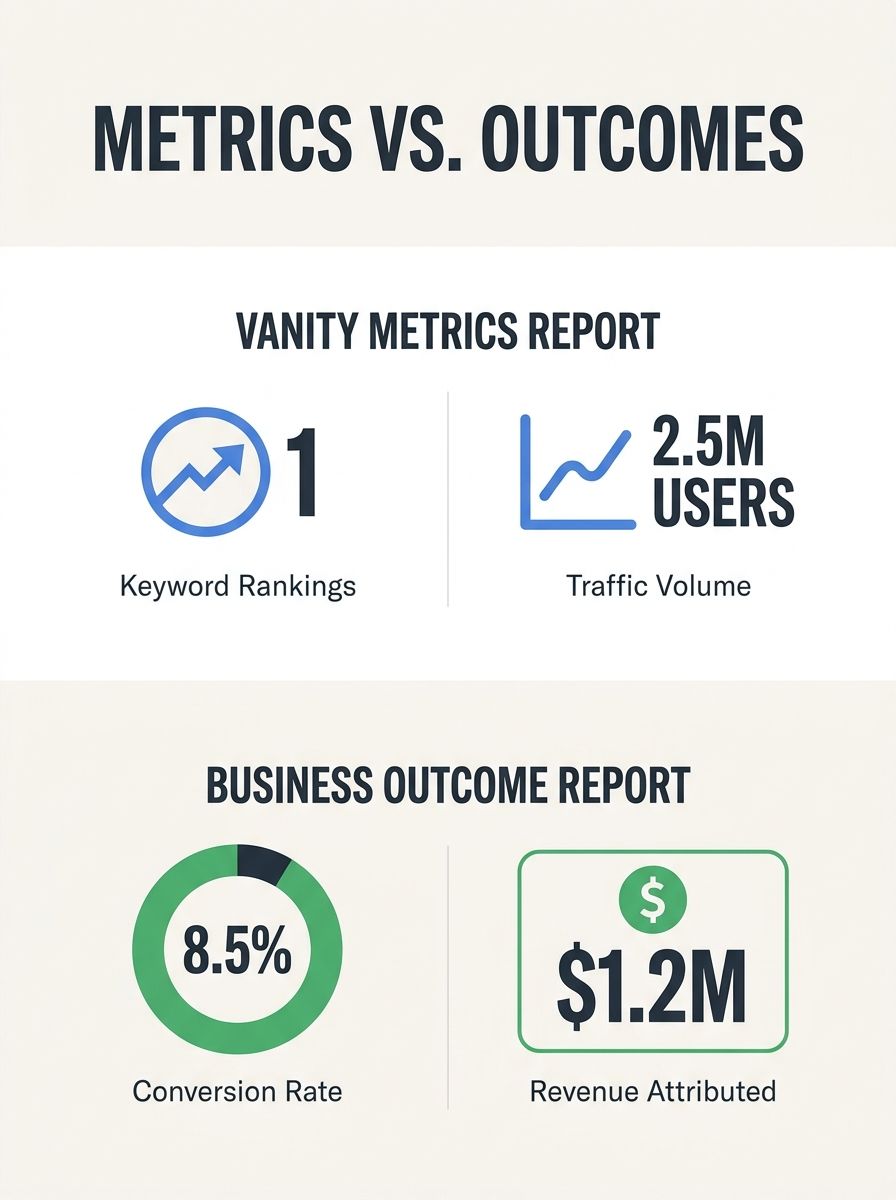
Of the 200-plus SEO agencies I've evaluated over 12 years, fewer than 30 provided prospective clients with baseline performance data tied to actual business outcomes before signing a contract. The rest led with keyword rankings, traffic graphs, and link counts: lagging vanity metrics that reveal almost nothing about whether an agency can move revenue.
The gap between what agencies report and what actually correlates with business growth is enormous. As Stridec's buyer-side evaluation framework puts it, the honest assessment requires "looking past vanity metrics and into the leading and lagging indicators that connect SEO activity to revenue or pipeline." That distinction is the foundation of every audit technique in this article. If you don't grasp why a ranking report is structurally different from a revenue-attribution report, you'll keep hiring agencies based on the wrong evidence.
Why Agency Proposals Lean on Metrics That Don't Matter
Agencies default to vanity metrics because they're easy to produce and hard for non-technical buyers to challenge. A report showing 47 keywords moved to page one looks impressive. But which keywords? At what search volume? With what conversion intent? And did those rankings translate to a single qualified lead?
Quake Media's agency performance guide is blunt about this: "Traffic without conversions is a vanity metric. Your agency should track organic-sourced leads, form submissions, phone calls and e-commerce transactions." GA4's attribution models make this tracking straightforward. If your agency hasn't configured conversion tracking or connected organic sessions to revenue, they're managing traffic numbers, not business results.
This matters during the hiring process because the metrics an agency highlights in its pitch reveal its operational priorities. An agency that leads with "we ranked 300 keywords on page one" is telling you how they measure their own success. An agency that leads with "we increased organic-sourced pipeline by 34% over 9 months for a B2B manufacturer" is telling you something different. Your job during the vetting process is to separate those two categories and weigh them correctly.
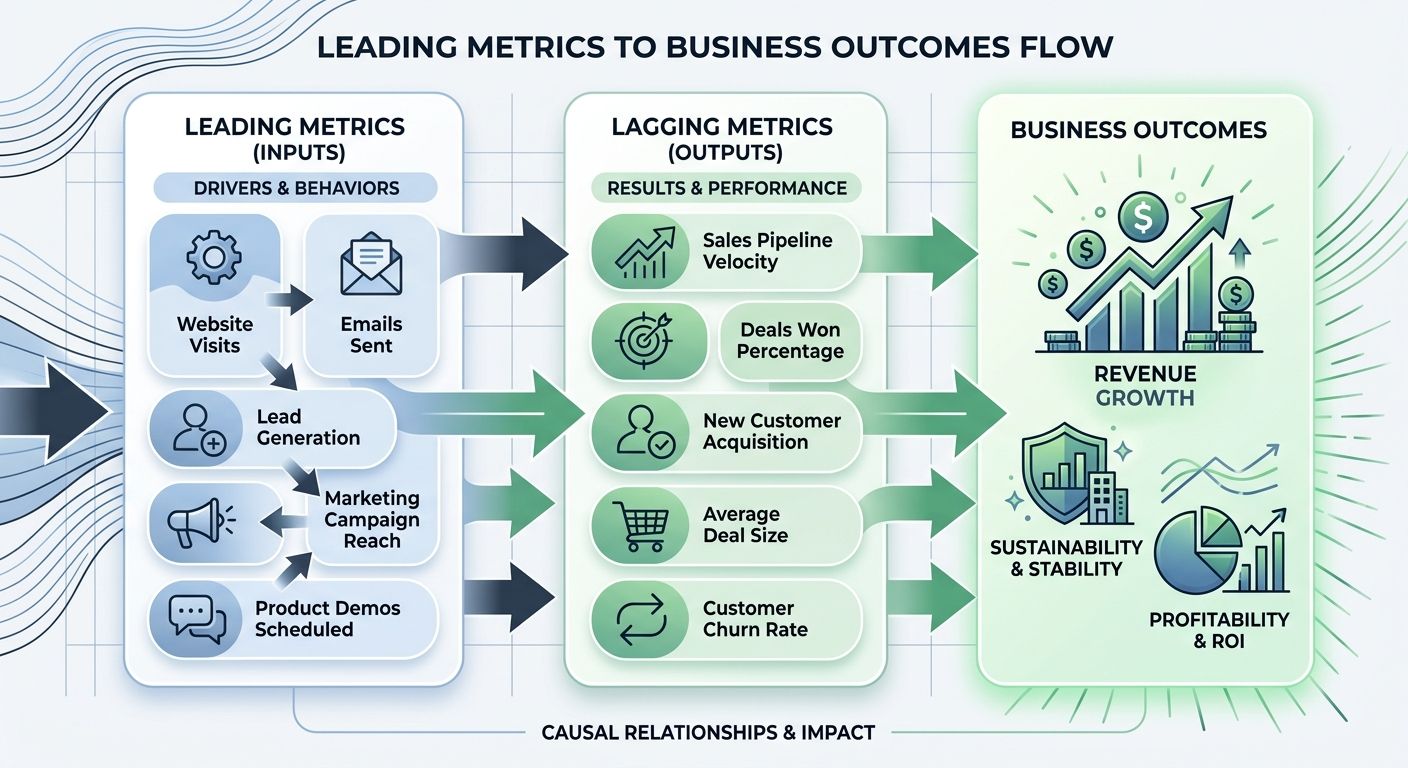
Leading Metrics vs. Lagging Metrics in SEO Agency Benchmarking
Why does this distinction trip up so many buyers? Because agencies rarely explain it, and buyers rarely ask. According to AgencyAnalytics' SEO benchmarking guide, effective agencies distinguish between these two metric types to show "where your clients currently stand, where they should be based on their business objectives, and most importantly, how your agency's strategy will bridge the gap."
Leading metrics predict future performance. They include page load speed improvements, crawl budget optimization, internal linking restructuring, content gap coverage, and indexation health. These are inputs the agency controls and that signal directional momentum.
Lagging metrics describe historical results. Organic traffic, keyword positions, backlink totals, and domain authority scores all fall here. They're useful context, but they measure what already happened. An agency that reports exclusively on lagging metrics is showing you a rearview mirror.
The audit question to ask: does the agency's reporting package contain both categories, and are the leading metrics explicitly tied to specific lagging outcomes? If page speed improvements aren't connected to crawl efficiency gains or bounce rate reductions, the agency is tracking inputs without connecting them to outputs.
Metric Type | Examples | What It Tells You | Red Flag If Missing |
|---|---|---|---|
Leading (inputs) | Page speed, crawl budget, content gap coverage, schema implementation | Direction of future performance | Agency can't explain why results changed |
Lagging (outputs) | Organic sessions, keyword positions, backlink count | What already happened | No context for whether trends will continue |
Outcome (business) | Organic leads, pipeline value, conversion rate, revenue per session | Whether SEO connects to money | Agency is managing traffic, not results |
The Five-Point Agency Track Record Audit
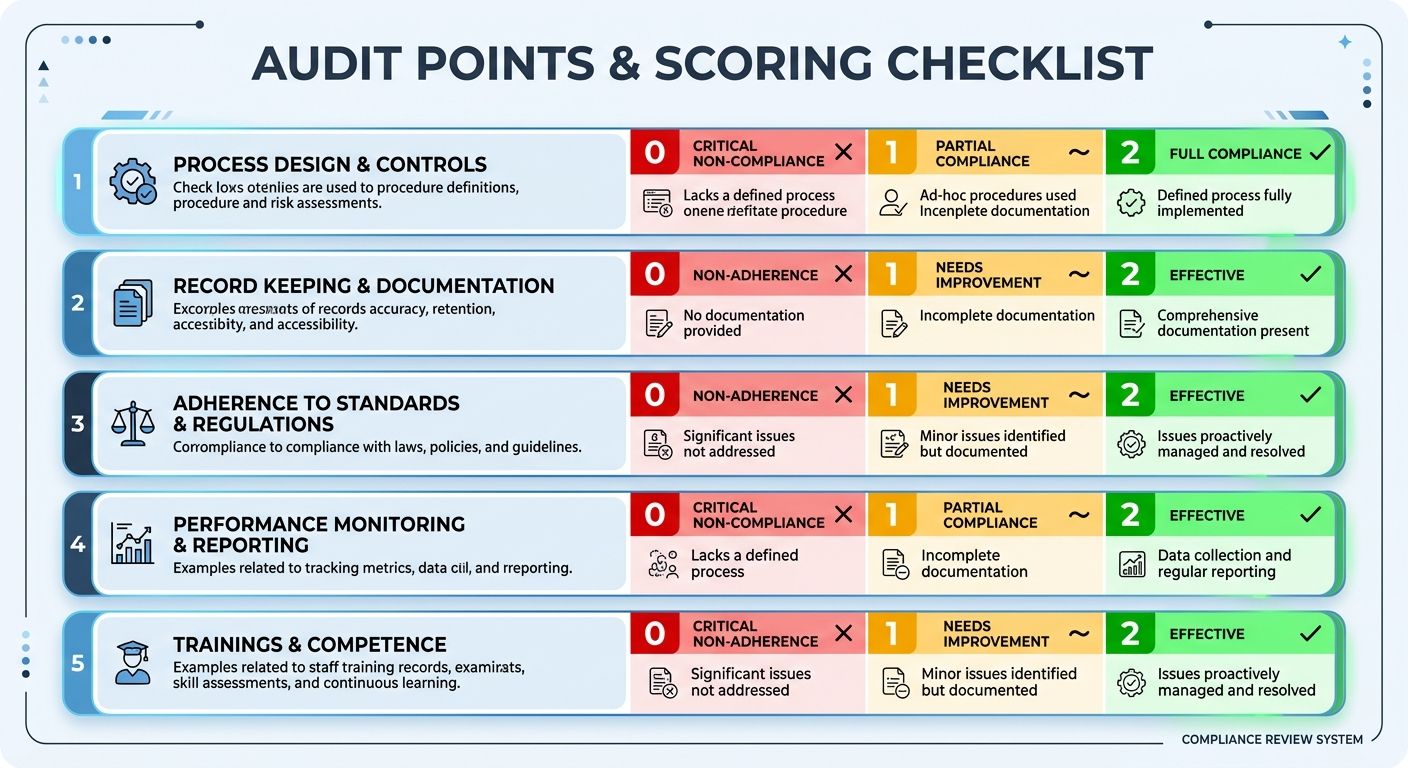
I've distilled 12 years of agency red flag analysis into a scoring framework I use with every client engagement. Each component scores 0 to 2 (0 = absent, 1 = partial, 2 = fully present). Any agency scoring below 6 out of 10 warrants serious reconsideration.
1. Baseline Documentation
Cometly's 2026 guide on measuring SEO performance sets the standard clearly: "You should have a written document with 3-5 measurable goals, each tied to a business outcome, with baseline numbers and target numbers including timeframes." Ask the agency for an example baseline document from a current or past client (anonymized is fine). You're checking for specificity: "increase organic-sourced demo requests from 23/month to 45/month within 8 months" beats "improve organic traffic" in every measurable way.
2. Conversion Tracking Configuration
Before evaluating any results the agency claims, confirm whether GA4 conversion tracking was properly configured. Did the agency set up event tracking for form submissions, phone calls, chat initiations, and e-commerce transactions? According to The 215 Guys' analysis of SEO scam detection, "by measuring sales and conversion rates alongside traffic metrics, you can gain further insight into the authenticity of your views." If the agency never set up conversion tracking for a previous client, their traffic numbers are unverifiable as business outcomes.
3. Leading-to-Lagging Metric Connection
Review 3-6 months of reports from the agency (request samples during the sales process). Count the ratio of leading metrics to lagging metrics. A healthy ratio sits around 40/60: 40% of the report covers what the agency did and why it should work, 60% covers what resulted. Reports that are 100% lagging metrics offer no strategic visibility.
4. Reporting Transparency and Tool Access
Does the agency give clients direct access to Google Search Console, GA4, and any rank-tracking platforms? Or do they filter everything through proprietary dashboards? Agencies using tools like Whatagraph or AgencyAnalytics can automate client-facing reports with real-time data integrations across Google Analytics, Ahrefs, and SE Ranking. But the question isn't which tool they use. The question is whether you, as the client, can independently verify every number in the report by logging into the same data source.
5. Verified Client Outcomes
This is where most audits fail. An agency shows you a case study claiming "400% traffic increase." Your audit checklist: Over what timeframe? From what baseline? Was the baseline artificially low (post-migration, post-penalty, brand-new domain)? Did traffic increases correspond to conversion increases, or did bounce rates climb in parallel? Can you speak to the client directly?
How to Verify SEO Agency Results During the Sales Process
SEO performance metrics validation doesn't end with reviewing reports. You need to cross-reference agency claims against independently verifiable data. Here's the process I walk clients through.
First, ask for 3 reference clients in your industry vertical or a similar one. Not testimonials on a website. Actual humans you can call. An agency with genuine results will have clients willing to confirm them. If the agency pushes back or offers only written testimonials, that tells you something about how confident they are in their own track record.
Second, run the agency's claimed client domains through Ahrefs or Semrush yourself. Check organic traffic trends over the period the agency claims to have managed SEO. Compare those trends against industry-wide search volume shifts. If organic traffic grew 30% but the industry's search volume for relevant terms grew 35%, the agency underperformed the market. Context matters. Agencies that understand SEO agency benchmarking present their results against competitor and industry baselines, not in isolation.
Third, verify ranking claims for specific keywords. An agency that says they "ranked a client #1 for [term]" should be able to tell you the exact keyword, the date the ranking was achieved, whether it held for 30+ days, and the monthly search volume. Rankings that lasted 3 days during a Google index fluctuation don't count.
And here's where guaranteed rankings enter the picture. As OuterBox Design's analysis states, "an SEO company can influence these inputs, but it cannot force Google to rank a page in a specific position for a specific keyword by a specific date." Any agency offering ranking guarantees is either targeting keywords so obscure that ranking is trivial, or they're making promises they structurally cannot keep. I've covered how retainer models create accountability gaps in detail before, and ranking guarantees are the most extreme version of that structural misalignment.
Client Outcome Tracking Beyond Traffic Numbers
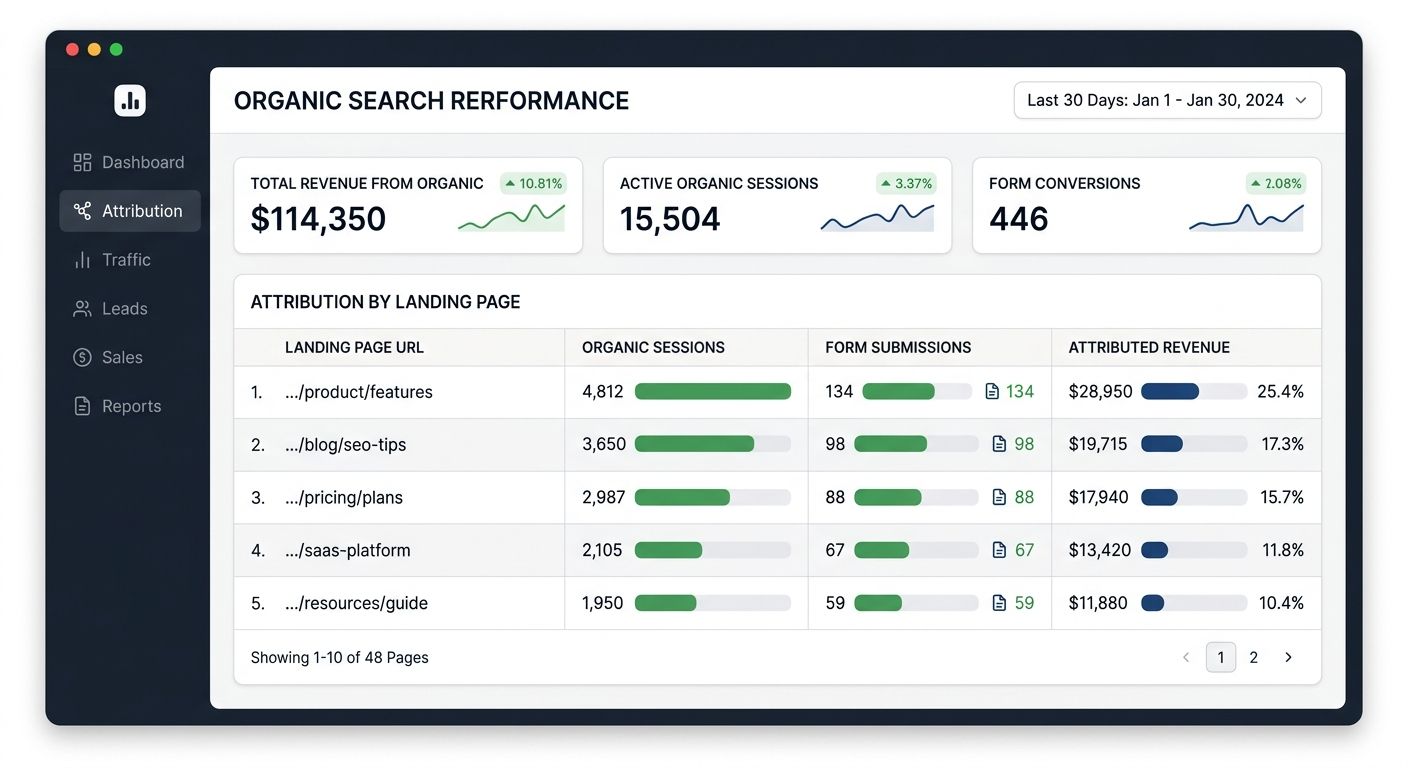
The agency accountability framework I recommend centers on a single question: can you trace a dollar of revenue back to an organic search session? If the answer is yes, the agency's work is measurable. If the answer is no, you're operating on faith.
GA4 makes this tracing possible through event-based conversion tracking. Organic-sourced leads, form submissions, phone calls from organic landing pages, and e-commerce transactions attributed to organic channels all provide hard revenue data. According to Swydo's guide on SEO metrics, agencies should also track AI visibility alongside traditional metrics, because citations in AI-generated responses now provide measurable traffic advantages.
This connects to a broader hiring consideration. When you're weighing an agency engagement against building an in-house team, client outcome tracking becomes a critical differentiator. An in-house team gives you complete data visibility by default. An agency has to earn it through transparent reporting and shared tool access. If an agency can't demonstrate outcome tracking from previous engagements, that gap in accountability is a hiring signal you shouldn't ignore.
According to Digital Thrive's guide on SEO reporting, "effective reporting creates accountability. When both agency and client agree on specific metrics," retention rates and satisfaction scores both climb. The alignment on what gets measured and reported matters as much as the measurements themselves.
Fake Reviews, Fabricated Case Studies, and How to Spot Them
Review manipulation isn't limited to Yelp and Google Business Profiles. Agencies fabricate case studies, inflate testimonials, and cherry-pick data periods to construct track records that look stronger than reality. I've seen agencies present a client's post-rebrand traffic surge as "SEO results" when the traffic spike came entirely from branded search driven by a PR campaign. The organic strategy had nothing to do with it.
Here's what to look for. Case studies that don't name the client industry, don't specify the timeframe, and don't show baseline data are almost always constructed to be unfalsifiable. If you can't independently verify a single claim in the case study, treat it as marketing copy, not evidence. We've written about how AI-generated content exposes an agency's real competitive advantage through genuine client reviews, and the same principle applies here: authentic results leave verifiable traces. Fabricated ones don't.
Review ecosystems also reveal patterns. Clustered review posting dates, identical phrasing across reviews, reviews from accounts with no other activity, and sudden rating jumps from 3.2 to 4.8 within 60 days all signal manipulation. Cross-reference the agency's Google Business Profile reviews against their Clutch or G2 profiles. Genuine agencies have review histories that accumulate gradually with varied language and specific project details.
What Hasn't Been Settled
The SEO industry still lacks a standardized reporting framework that all agencies follow. There's no equivalent of GAAP for SEO metrics. Every agency defines "organic lead" slightly differently, configures attribution models with different lookback windows, and presents results against different competitive benchmarks. Until some industry body establishes binding reporting standards, the burden of verification falls entirely on the buyer.
AI-generated search responses add another unresolved layer. Swydo's metrics guide flags that agencies should track AI visibility alongside traditional metrics, but there's no consensus on how to benchmark AI Overview citations, how to attribute traffic from conversational search engines, or how to value a citation that doesn't generate a click. Agencies that claim AI search visibility wins are operating in a measurement gray area where verification is genuinely difficult.
The five-point audit framework above won't eliminate all risk from hiring an SEO agency. It will, however, surface the agencies that can defend their track records with data and separate them from the ones whose pitch decks fall apart under scrutiny. The agencies that score well on this framework tend to welcome the questions. The ones that don't score well tend to change the subject.
Marcus Webb
Digital marketing consultant and agency review specialist. With 12 years in the SEO industry, Marcus has worked with agencies of all sizes and brings an insider perspective to agency evaluations and selection strategies.
Related Articles

The SEO Agency Trust Verification Framework: Auditing Real Results Beyond Monthly Reports
Verifying an SEO agency's real performance requires auditing three things their monthly reports rarely show: revenue attribution from organic search, ranking movement on terms that actually convert, and independent third-party traffic validation.
The SEO Agency Vetting Checklist: How to Spot Performance Data Manipulation in Client Case Studies
RankTruth's database of over 400 agency due diligence reports surfaces a reliable signal: agencies whose case study numbers collapse under verification almost always share three traits.
The SEO Agency Red Flag Audit: How to Spot Track Record Manipulation in Monthly Reports
Fake SEO metrics appear in monthly reports as proprietary-sounding graphs labeled "link velocity index," "domain trust trajectory," or "semantic authority score" that can't be verified in Google Analytics or Search Console.
Explore more topics