
The SEO Agency Trust Verification Framework: Auditing Real Results Beyond Monthly Reports
Verifying an SEO agency's real performance requires auditing three things their monthly reports rarely show: revenue attribution from organic search, ranking movement on terms that actually convert, and independent third-party traffic validation.
 Marcus Webb··8 min read
The SEO Agency Trust Verification Framework: Auditing Real Results Beyond Monthly Reports
Verifying an SEO agency's real performance requires auditing three things their monthly reports rarely show: revenue attribution from organic search, ranking movement on terms that actually convert, and independent third-party traffic validation. Agencies that resist this scrutiny are telling you something important about their measurable SEO results.
The monthly report is the single most effective shield bad agencies have. I've evaluated over 200 SEO agencies across 12 years, and the pattern repeats with alarming consistency: 30-page PDF decks packed with charts showing keyword position improvements, traffic graphs trending upward, and confident summaries about "momentum building." The client reads the report, sees green arrows, and renews the contract. Six months later, revenue from organic search hasn't moved. Sometimes it's lower than when the engagement started. The agency's report wasn't lying, exactly. It was answering questions the client never thought to ask while ignoring the ones that matter. An SEO agency evaluation framework built around independent verification catches this problem before it costs you $30,000 to $120,000 in wasted retainer fees.
Why Monthly Reports Create a False Sense of Progress
The standard agency report tracks metrics the agency controls, not outcomes the business cares about. As one practitioner noted on Reddit, the "best test we tell prospects is ask the agency to predict specific revenue impact from their SEO work over 6 months. Good agencies can estimate this based on keyword volume and conversion data." That prediction test is revealing because it forces the agency to connect their work to dollars. About 70% of the agencies I've reviewed during client consultations won't make that prediction. They'll cite "too many variables" or "Google's unpredictability." Those excuses sound reasonable until you realize that any competent agency doing proper keyword research already has search volume data, click-through rate estimates, and your site's conversion rate.
The core problem with monthly reports is selection bias in the metrics they highlight. An agency might show you that 45 keywords moved into the top 20 positions over 90 days. That sounds great. But if those 45 keywords have a combined monthly search volume of 200, and the 8 keywords that actually drive your revenue dropped from position 3 to position 12, the report is technically accurate and practically useless. According to AgencyAnalytics' benchmarking guide, SEO benchmarking should evaluate a website "against competitors and industry standards" to create "a measurable starting point." When the agency sets its own starting point and chooses which metrics to track, that benchmarking process gets compromised from day one.
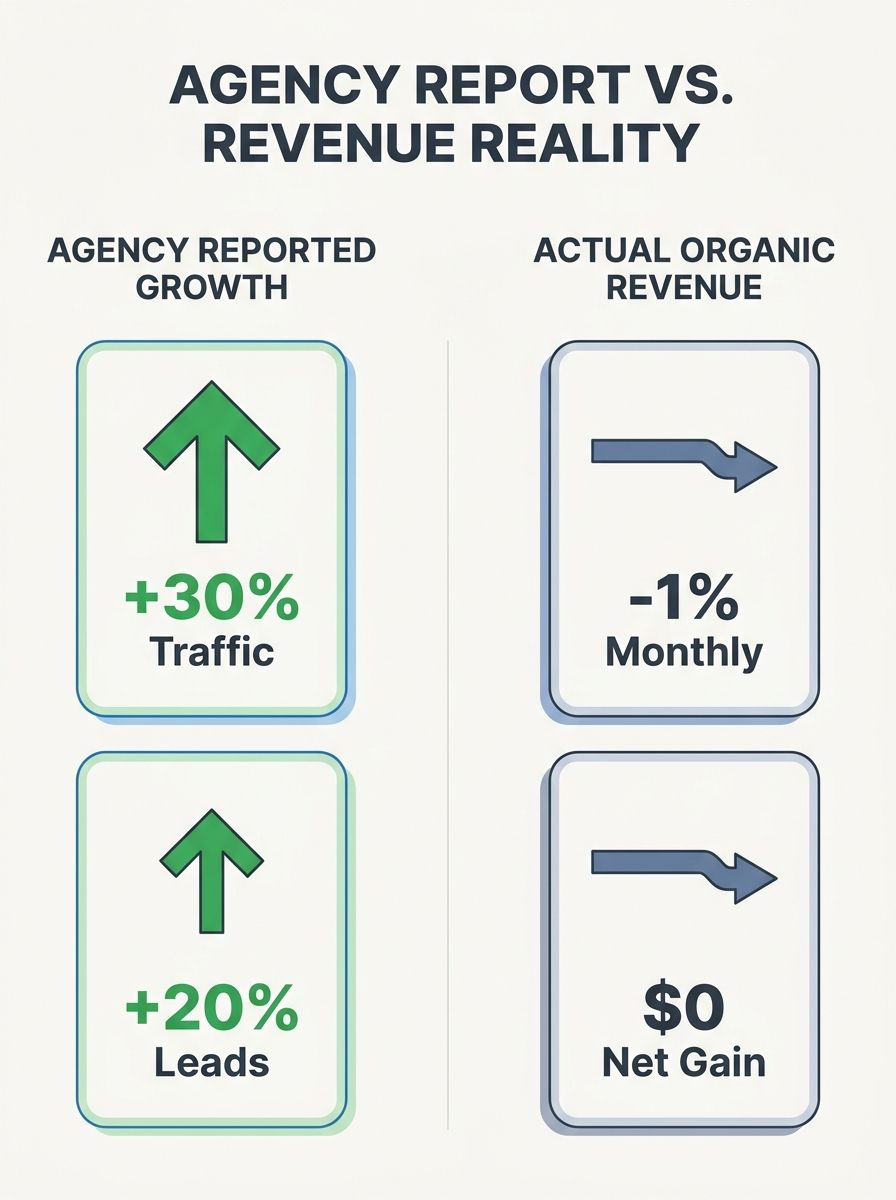
I've seen agencies report 150% increases in organic traffic that, upon closer inspection, came entirely from branded search terms the client's own TV campaign was driving. The SEO agency had nothing to do with that traffic. They just claimed it because their contract measured "organic sessions" without distinguishing branded from non-branded queries. This brings us to the first pillar of verifying real performance.
Revenue Attribution as the Real Accountability Test
The most reliable way to verify agency track record is to connect SEO work directly to revenue through attribution modeling. This means setting up tracking that follows a visitor from organic search all the way through to a completed purchase, signed contract, or qualified lead submission. If your agency hasn't helped you build this tracking within the first 60 days, that's a problem worth confronting. According to a GoBig Systems analysis, "an SEO report should tell you what was done, what changed, and what's next, all in plain language." Revenue attribution adds a fourth requirement: what it earned.
I propose evaluating agency due diligence through what I call the Revenue-Verification Triad: three independent checks that together expose whether an agency's work produces financial results. The first check is revenue from non-branded organic search, isolated in your analytics platform. If you're an e-commerce company doing $500,000 per month in total revenue, and your agency claims organic is "growing," you need to see that non-branded organic revenue figure moving from, say, $85,000 to $97,000 over a quarter. The second check is new customer source tracking. Ask every new customer how they found you. If 35% or more say "Google" and that number is rising quarter over quarter, the agency is contributing something real. The third check is independent traffic validation using a tool the agency doesn't control. Pull your own data from Google Search Console. Compare it against what the agency reports. Discrepancies above 10% to 15% between the agency's reported traffic numbers and your Search Console data deserve an explanation.
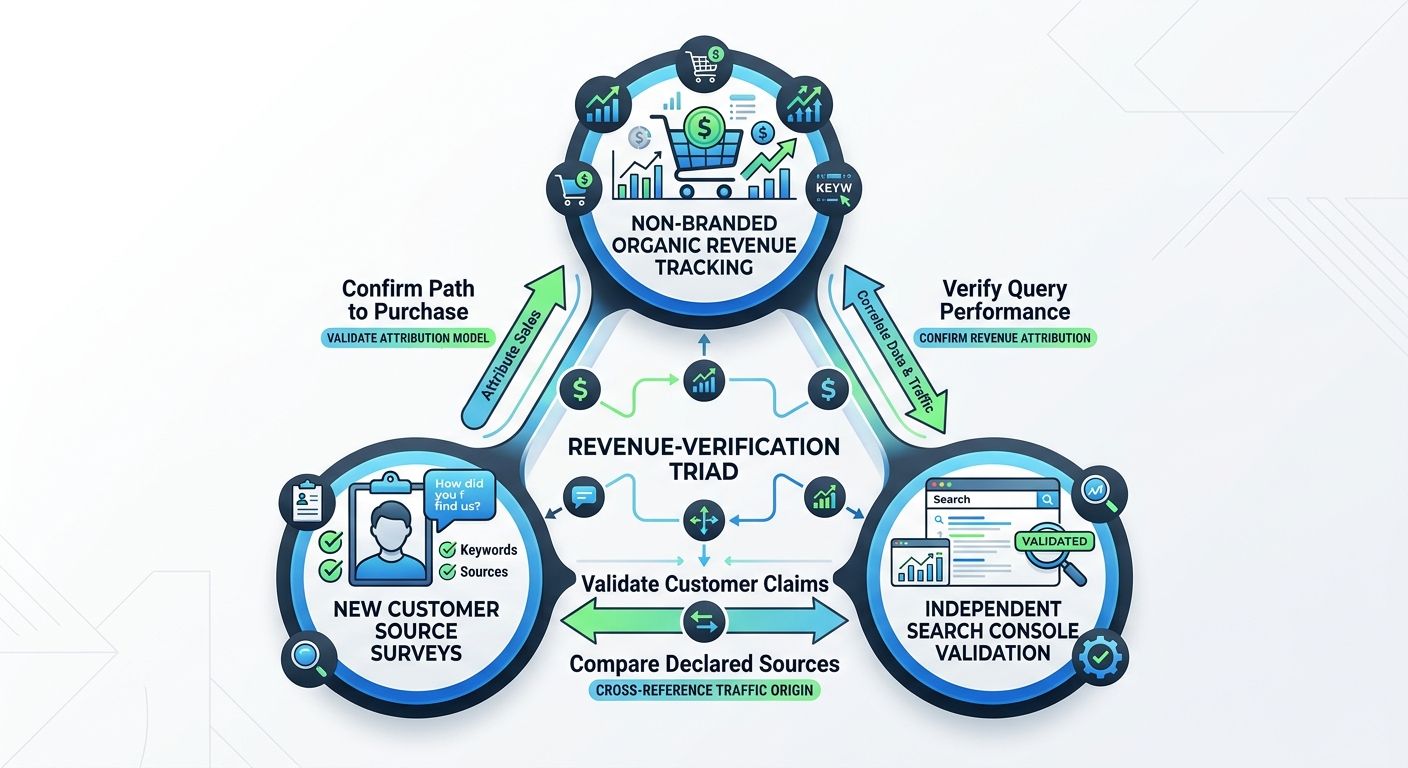
This three-check approach works because each element catches a different kind of reporting distortion. Agencies that inflate traffic numbers get caught by the Search Console comparison. Agencies that count branded traffic get caught by the non-branded revenue filter. And agencies whose "traffic growth" never translates into customers get caught by the source survey. The Higglo Digital deep-dive on agency track records reinforces this point: "client reviews and testimonials can serve as valuable tools to verify an agency's claims about their track record." But reviews alone are easy to curate. Pairing them with independent data verification creates a much more honest picture. If you've already started evaluating an agency and noticed suspicious patterns, the process of auditing an agency's real track record using benchmarks and client data can give you a structured way to validate or invalidate what you're seeing.
Industry Benchmarks Replace Agency Self-Grading
SEO performance benchmarks exist for almost every meaningful metric, and agencies that don't reference them are grading their own homework. The SEOmator 2025 Benchmarks Report established baseline measurements for average page speed, click-through rates, and backlink growth rates across industries. When your agency tells you they built 12 new backlinks this month, the relevant question is whether 12 is good, bad, or average for your industry and your domain authority level. Without benchmark data, you can't answer that question, and neither can the agency (or they can but choose not to).
The RankTruth SEO agency hiring checklist outlines a 90-day evaluation plan specifically designed for the early stages of an agency relationship. That 90-day window matters because it's long enough for initial technical fixes to take effect but short enough to catch agencies that are stalling. During those first 90 days, you should see measurable improvements in at least 3 of 5 core metrics: crawl error reduction (target: 50% or greater decrease), page speed improvements (target: under 2.5 seconds for Largest Contentful Paint), indexation growth of target pages (target: 90%+ of priority pages indexed), click-through rate improvements on existing rankings (target: 15% to 25% improvement on pages already ranking positions 4 through 10), and initial ranking movement on 20% to 30% of target keywords. An agency that hits 0 or 1 of these benchmarks in 90 days is either under-resourced or unfocused.
There's an important nuance to benchmarking that many businesses miss. The Sandler Digital due diligence checklist warns that "not all SEO strategies age well" and that "some companies may have relied on aggressive or outdated tactics to build rankings quickly." This applies to agency work too. An agency might show you a case study where they grew a client's traffic by 400% in 6 months. If that growth came from aggressive link-building tactics that Google's recent spam updates now penalize, that case study is a liability, not an asset. Google's recent enforcement actions against manipulative link schemes make this concern concrete rather than theoretical. When you verify an agency's past results, check whether those results survived algorithm updates. Pull the client's traffic graph for the 12 months after the agency's engagement ended. A 400% growth that collapsed 3 months later tells a very different story than one that held steady.
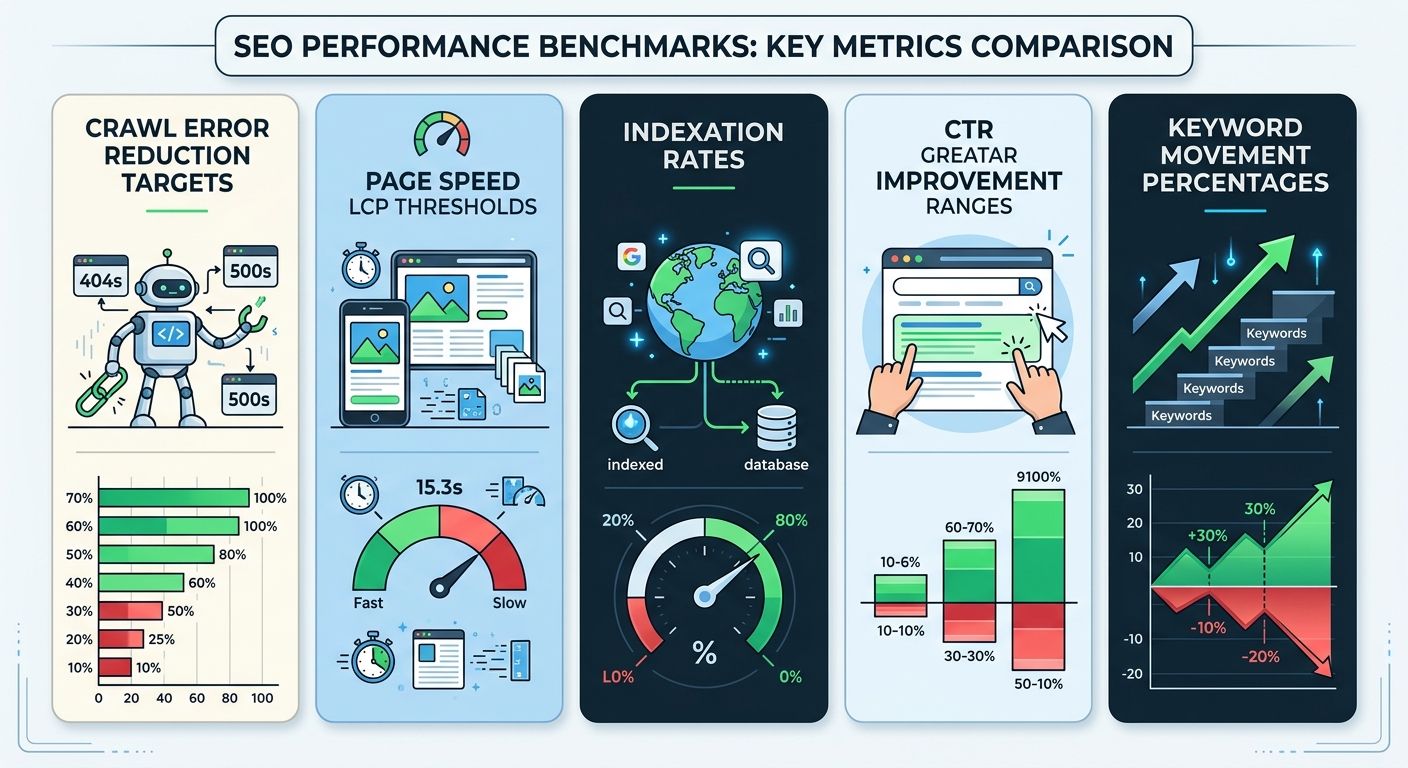
This benchmarking approach also protects you during contract negotiations. If an agency quotes $8,000 per month but can't articulate which of these 5 benchmark categories they expect to move within 90 days, you're paying for activity rather than outcomes. I've reviewed contracts where agencies committed to delivering "20 blog posts per quarter" or "10 backlinks per month" without any connection to ranking targets or revenue goals. Those deliverable-based contracts are comfortable for agencies because they get paid regardless of whether the work produces results. Outcome-adjacent contracts, where at least 20% to 30% of compensation ties to benchmark performance, change the incentive structure entirely. Understanding hidden blockers in agency relationships before you sign helps you structure contracts that protect your investment. And if you're weighing whether an agency's reports contain manipulated track record data, benchmarking gives you the independent yardstick to know for sure.
Where This Verification Still Breaks Down

This framework has real limits, and I want to be honest about them. The Revenue-Verification Triad works well for e-commerce businesses and lead-generation companies where organic search connects directly to revenue. It works less well for brand-awareness campaigns, content publishers monetizing through ads, or companies with 12-month sales cycles where attributing a deal to a specific organic search visit 9 months ago requires sophisticated multi-touch modeling that most mid-market companies don't have. The 90-day benchmark evaluation assumes the agency inherits a site in reasonable technical shape. If your site has 4,000 crawl errors, a manual penalty from a previous agency's link-building, and 300 orphaned pages, the first 90 days will be cleanup work that doesn't show up in ranking improvements. Penalizing an agency for slow progress when you handed them a mess isn't fair evaluation.
There's also the attribution problem that keeps getting harder. The ThatWare SEO audit checklist recommends "analyzing the traffic and engagement metrics of individual pages" as a core audit step. But with Google shifting more answers into AI Overviews and zero-click results accounting for a growing share of searches, traffic to your site from a query your agency helped you rank for might be declining even as your visibility increases. An agency could be doing excellent work that doesn't show up in your Google Analytics because Google is answering the query directly on the results page. This framework, like most performance frameworks, struggles to measure value that doesn't produce a click.
The most uncomfortable part of this entire verification exercise is that it puts the burden of proof on the business, not the agency. You have to set up revenue tracking. You have to pull your own Search Console data. You have to research industry benchmarks. You have to survey new customers about how they found you. A good agency will welcome all of this and help you build the infrastructure. But the work of verification ultimately falls on the buyer. After 12 years of watching these relationships play out, I've come to accept that the companies who do this verification work consistently end up with better agency partnerships, not because the framework is perfect, but because the act of asking hard questions filters out agencies that can't answer them. The ones left standing tend to be the ones worth paying.
Marcus Webb
Digital marketing consultant and agency review specialist. With 12 years in the SEO industry, Marcus has worked with agencies of all sizes and brings an insider perspective to agency evaluations and selection strategies.
Related Articles

Beyond Fake Reviews: How to Audit an SEO Agency's Real Track Record Using Benchmarks and Client Data
Of the 200-plus SEO agencies I've evaluated over 12 years, fewer than 30 provided prospective clients with baseline performance data tied to actual business outcomes before signing a contract.

The SEO Agency Vetting Checklist: How to Spot Performance Data Manipulation in Client Case Studies
RankTruth's database of over 400 agency due diligence reports surfaces a reliable signal: agencies whose case study numbers collapse under verification almost always share three traits.
The SEO Agency Red Flag Audit: How to Spot Track Record Manipulation in Monthly Reports
Fake SEO metrics appear in monthly reports as proprietary-sounding graphs labeled "link velocity index," "domain trust trajectory," or "semantic authority score" that can't be verified in Google Analytics or Search Console.
Explore more topics