
The SEO Agency Vetting Checklist: How to Spot Performance Data Manipulation in Client Case Studies
RankTruth's database of over 400 agency due diligence reports surfaces a reliable signal: agencies whose case study numbers collapse under verification almost always share three traits.
 Marcus Webb··7 min read
The SEO Agency Vetting Checklist: How to Spot Performance Data Manipulation in Client Case Studies
RankTruth's database of over 400 agency due diligence reports surfaces a reliable signal: agencies whose case study numbers collapse under verification almost always share three traits. They strip out client names, block Google Search Console access, and present traffic gains disconnected from revenue.
The Mechanics of Case Study Inflation
Performance data manipulation in SEO case studies follows four patterns with enough consistency that you can screen for them systematically: cherry-picked date ranges, inflated keyword counts built on branded or zero-volume terms, traffic screenshots from tools that estimate rather than measure, and the quiet omission of business outcomes like leads or revenue. Each pattern leaves a forensic trace that supports reliable fake SEO metrics detection when you know where to look.
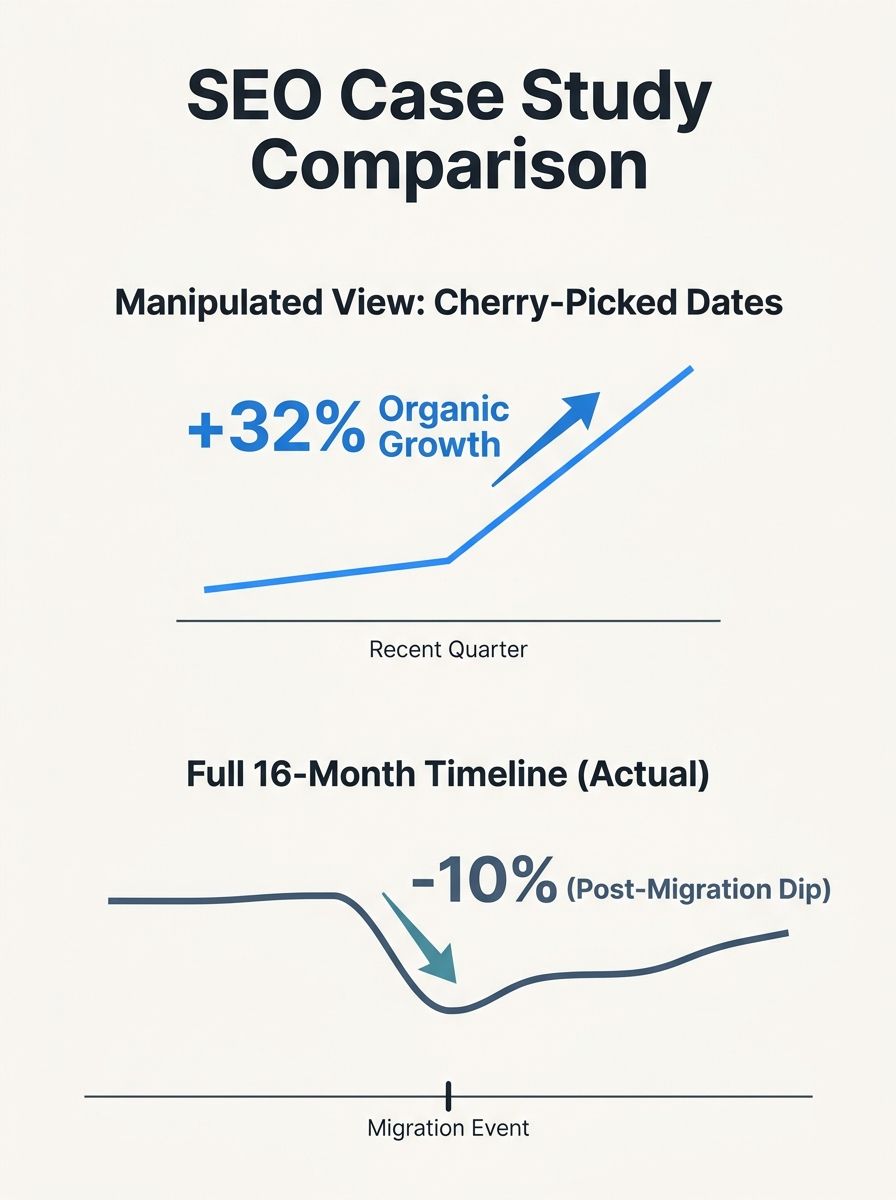
The selective date range is the most common trick. An agency shows organic traffic climbing from January through August, but the graph conveniently starts right after a site migration tanked performance by 60%. The "growth" they're showcasing is recovery to a prior baseline, not new improvement. I've encountered this in roughly 1 in 5 case studies across my evaluations of over 200 agencies. The fix is straightforward: ask for the full 16-month view in Search Console, not the agency's chosen window. Any reluctance to produce that view tells you what you need to know.
Keyword count inflation works differently but misleads just as effectively. An agency claims they rank a client for 4,000 keywords. What they don't mention is that 3,200 of those are branded terms the client already owned, another 500 have monthly search volumes under 10, and the remaining 300 keywords are doing the actual commercial work. As a critical guide on evaluating agency case studies puts it: "If an agency cannot connect their SEO work to business outcomes in their case studies, ask why. Either they do not track it, the client would not share it, or the traffic improvement did not translate into meaningful commercial results." That direct connection between SEO activity and business results is the line separating useful case studies from marketing decoration.
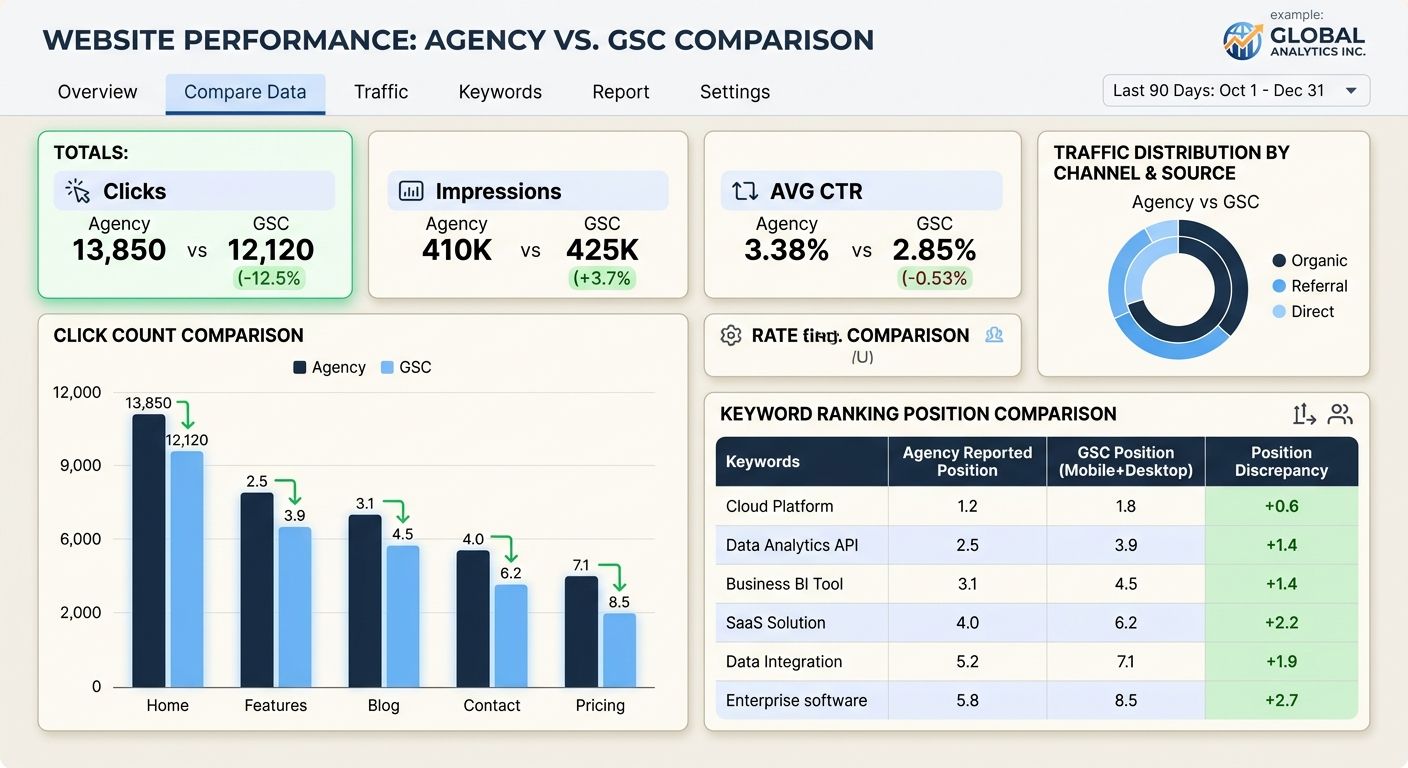
Then there's the screenshot problem. Agencies love showing Ahrefs or Semrush traffic estimates as proof of performance. These tools model organic traffic based on keyword rankings and average click-through rates; they don't measure actual visits. Google has confirmed that third-party SEO tools lack access to internal search metrics, which means a Semrush screenshot showing "150,000 organic visits" is a modeled projection. The gap between estimated and actual traffic can reach 40% or higher, depending on SERP feature distribution and the niche's click-through profile. Any case study anchored exclusively to third-party tool data rather than first-party analytics is a case study that hasn't been verified by anyone, including the agency presenting it.
Why Benchmarking Exposes What Raw Numbers Hide
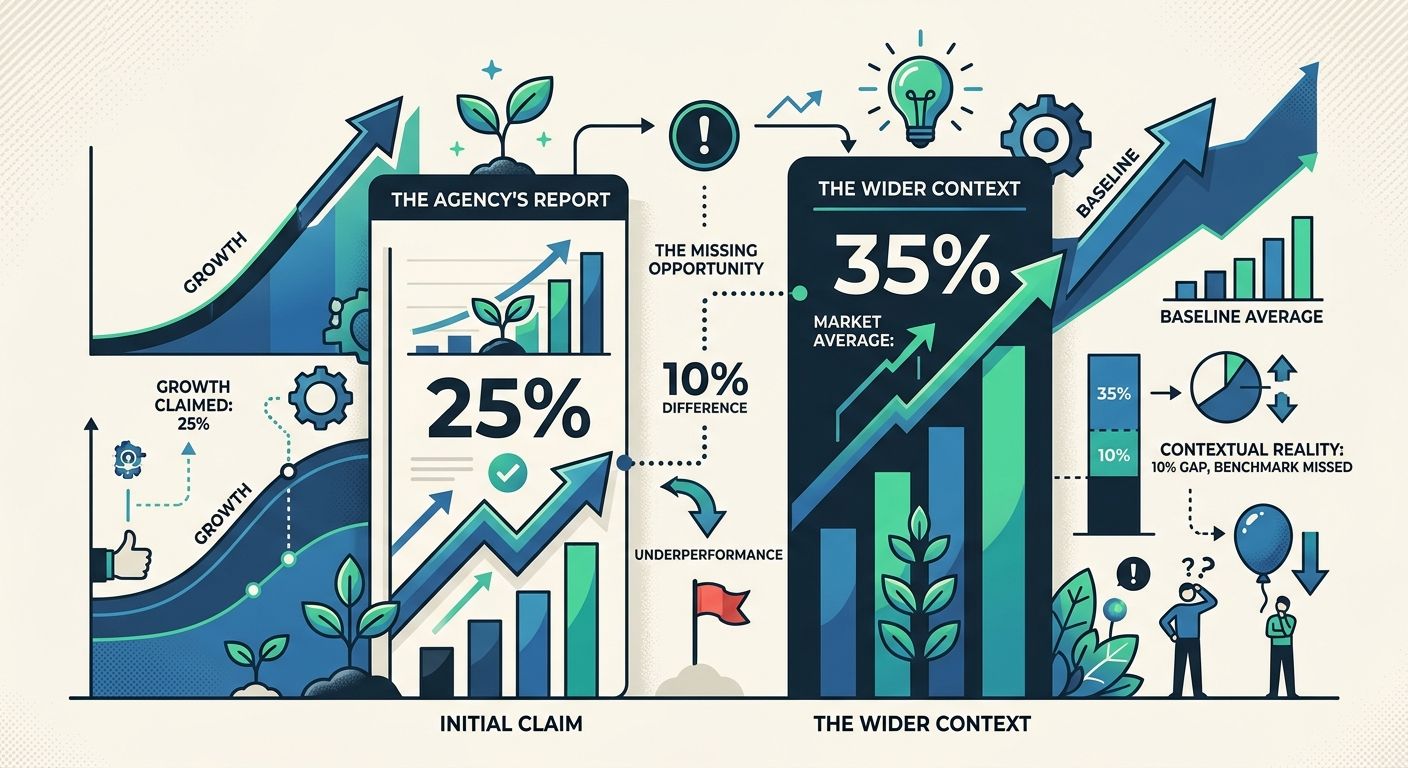
Factors.ai's SEO benchmarking guide frames the core problem precisely: "SEO performance doesn't exist in a vacuum. Let's say your organic traffic grew 10% but your competitors grew 40% during the same period. In reality, you're actually losing market share." This principle applies directly to agency case study validation. A case study claiming 25% organic traffic growth sounds strong until you discover the client's industry saw an average growth rate of 35% during the same window, driven by seasonal demand or a shifting market. The agency underperformed the baseline, then packaged the result as a win.
Benchmarking SEO results against industry and competitive context is the most effective way to pressure-test a case study's claims. Real performance numbers broken down by industry, channel, and search intent are available from sources like Semrush, Ahrefs, BrightEdge, and First Page Sage, as documented in ClickRank's 2026 benchmarks compilation. When an agency presents a case study, three questions collapse most inflated claims within minutes: what was the industry average growth rate during that period, how did the client's direct competitors perform on the same keywords, and what percentage of the reported traffic increase came from non-branded queries with commercial intent.
The competitive context check is particularly revealing for agencies specializing in specific verticals. An agency focused on law firms, for example, should demonstrate how their client performed relative to other firms targeting the same practice areas in the same geography. If they show aggregate organic growth but can't break it down against the local competitive set, the case study is decorative rather than diagnostic. I've written about how to audit an agency's real track record using exactly this kind of competitive benchmarking approach, and the pattern holds across verticals: agencies confident in their results welcome competitive context, while agencies inflating their numbers avoid it.
The Three-Layer Verification Stack
RankTruth's verification framework recommends checking "business legitimacy (real address, phone, team), proof (case studies with metrics and dates), and transparency (owner access to GSC, reproducible reporting)." These three layers form a reliable SEO agency performance verification stack because they catch manipulation at different altitudes. An agency can fabricate a screenshot, but they can't fabricate your own access to Google Search Console data.
The first layer filters out obvious frauds. Does the agency have a verifiable office address? Can you find LinkedIn profiles for their named team members with employment histories that match the agency's claimed tenure? Are client testimonials attributed to identifiable people at real companies? RankTruth's approach of referencing specific client URLs and displaying verifiable testimonials sets a minimum bar. In my experience, this step alone eliminates 15% to 20% of agencies from serious consideration, which is a sobering number given that these agencies are actively pitching clients.
The second layer, proof, is where most manipulation lives. Case studies should name clients (or at minimum identify industries with enough specificity to cross-reference), include date ranges tied to specific campaigns, and source metrics from first-party data. Search Scale AI's analysis of common agency red flags identifies the warning signs at this layer as "secrecy, vague reporting, and promises of guaranteed rankings." An agency guaranteeing page-one rankings is either confused about how Google works or willing to say whatever closes the deal. Google deployed 12 confirmed algorithm updates between 2024 and 2025 alone. Sites with strong E-E-A-T signals have roughly a 30% higher chance of ranking in the top 3 positions, but that's a probability advantage, not a guarantee. Anyone promising specific ranking positions against that volatility is selling fiction.
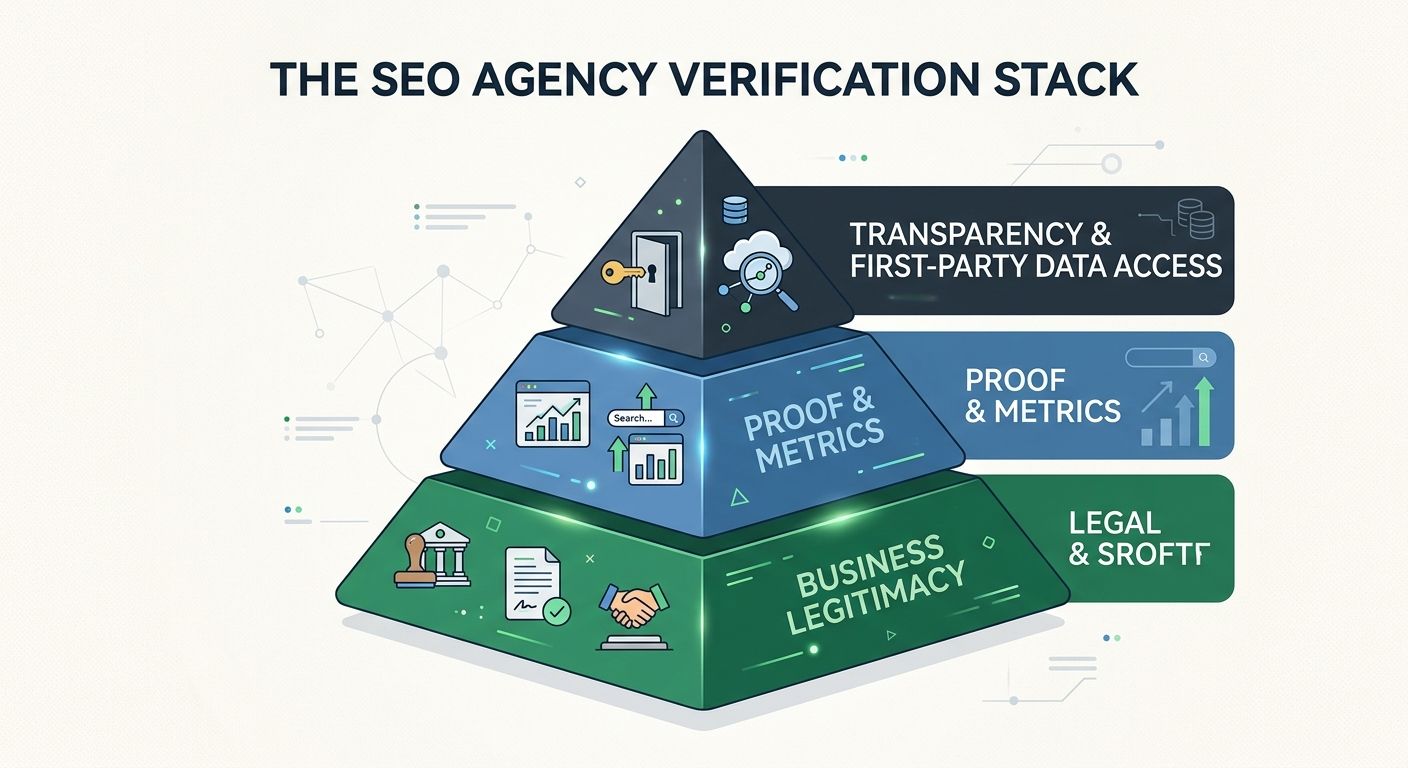
The third layer is the decisive one for catching manipulated data. SEO reporting transparency, as Reportr.agency's guide on transparent reporting and client retention describes it, means "measuring progress against specific, agreed-upon objectives, not just generic metrics. If you promised to increase qualified leads from organic search, show progress toward qualified leads, not just traffic volume." When you insist on owner-level access to Google Search Console and Google Analytics from day one of an engagement, you remove the agency's ability to curate which data you see. Every number in their monthly report becomes verifiable against a source they don't control. The trust verification framework I've discussed previously goes deeper into what owner-level access should look like in practice, including how to cross-reference reported conversions against actual CRM records.
The transparency question extends to link building as well. The Visual Communication Guy's analysis of agency red flags makes a point worth internalizing: a link from a respected, relevant publication carries real weight, while a link from an unrelated, low-authority site carries almost none and may signal manipulation to search engines. Ask any prospective agency how they earn links and request specific placement examples from current clients. Agencies confident in their link quality name the publications. Agencies padding their numbers talk about monthly link counts without discussing where those links appear.
Where Verification Still Has Gaps
Even a rigorous vetting process leaves blind spots. The three-layer framework catches overt manipulation (fabricated screenshots, cherry-picked date ranges, inflated keyword counts), but it struggles with subtler forms of misrepresentation. An agency that legitimately grew a client's organic traffic by 30% can still mislead you if that traffic came from informational queries that never converted, or if the gains were concentrated in a single month driven by a viral blog post that won't repeat. The numbers are real. The implied promise that they represent sustainable, repeatable performance is where the dishonesty hides, and no verification checklist fully addresses that gap.
There's also a structural problem with how the SEO industry handles case study data. Clients often prohibit agencies from sharing names or detailed metrics publicly, for legitimate competitive reasons. This creates a paradox: agencies with the best client relationships and strictest NDAs sometimes produce the least impressive-looking case studies, while agencies with fabricated or embellished results face no restrictions on what they publish. I've watched agencies with genuinely strong track records lose pitches to competitors whose case studies were more polished but less truthful. The verification process described here helps, but it demands real work from the buyer: requesting Search Console access, pulling competitive benchmarks, cross-referencing dates, and spotting red flags in track record manipulation across multiple data sources.
The uncomfortable reality of SEO agency performance verification is that the buyer carries most of the burden. Agencies control the narrative in their sales materials. The industry lacks standardized certification for case study accuracy. Google's own tools remain the closest thing to ground truth, and accessing them during the sales process requires the agency's cooperation. Until independent auditing standards emerge for the SEO industry, the checklist-driven approach here remains the best available defense. It won't catch every form of manipulation, and the subtler varieties of misrepresentation will continue to reward agencies willing to exploit ambiguity. But a buyer who applies this process consistently will filter out the worst offenders before signing a contract, and that's a meaningfully better position than trusting a polished deck at face value.
Marcus Webb
Digital marketing consultant and agency review specialist. With 12 years in the SEO industry, Marcus has worked with agencies of all sizes and brings an insider perspective to agency evaluations and selection strategies.
Related Articles
Transparent vs. Inflated: How to Audit an SEO Agency's Client Success Claims Using Independent Verification Tools
Ahrefs, SEMrush, and SE Ranking give any prospective client the ability to cross-reference an SEO agency's traffic and ranking claims against independent data in under 30 minutes, yet fewer than 1 in 5 buyers run these checks before signing contracts worth $3,000–$10,000 per month.

The SEO Agency Trust Verification Framework: Auditing Real Results Beyond Monthly Reports
Verifying an SEO agency's real performance requires auditing three things their monthly reports rarely show: revenue attribution from organic search, ranking movement on terms that actually convert, and independent third-party traffic validation.

Beyond Fake Reviews: How to Audit an SEO Agency's Real Track Record Using Benchmarks and Client Data
Of the 200-plus SEO agencies I've evaluated over 12 years, fewer than 30 provided prospective clients with baseline performance data tied to actual business outcomes before signing a contract.
Explore more topics