
Transparent vs. Inflated: How to Audit an SEO Agency's Client Success Claims Using Independent Verification Tools
Ahrefs, SEMrush, and SE Ranking give any prospective client the ability to cross-reference an SEO agency's traffic and ranking claims against independent data in under 30 minutes, yet fewer than 1 in 5 buyers run these checks before signing contracts worth $3,000–$10,000 per month.
 Marcus Webb··10 min read
Transparent vs. Inflated: How to Audit an SEO Agency's Client Success Claims Using Independent Verification Tools
Ahrefs, SEMrush, and SE Ranking give any prospective client the ability to cross-reference an SEO agency's traffic and ranking claims against independent data in under 30 minutes, yet fewer than 1 in 5 buyers run these checks before signing contracts worth $3,000–$10,000 per month.
Why Agency Case Studies Collapse Under Verification
The gap between what agencies present in their pitch decks and what independent tools report is often staggering. A 2026 ranking study of the top 30 white label SEO agencies used real metrics from SEMrush, LinkedIn, Clutch, G2, DesignRush, Glassdoor, and Indeed to evaluate performance and found that agencies scoring highest on brand authority and client satisfaction were the ones whose numbers held up across multiple independent platforms. The agencies that inflated their claims had metrics diverging wildly depending on which platform you checked.
I've personally evaluated over 200 agencies across my career, and the pattern is consistent: agencies with genuine results welcome SEO agency verification. Agencies with inflated claims get defensive when you mention running their numbers through Ahrefs or asking to speak with the client featured in their case study. That defensive reaction alone tells you plenty.
Verification options for agency claims include speaking directly to the featured client, checking the client's website in tools like Ahrefs or SEMrush, and reviewing the domain's historical performance data. Agencies that refuse all three of these routes are broadcasting a signal about their confidence in their own numbers.
The Three-Signal Verification Protocol
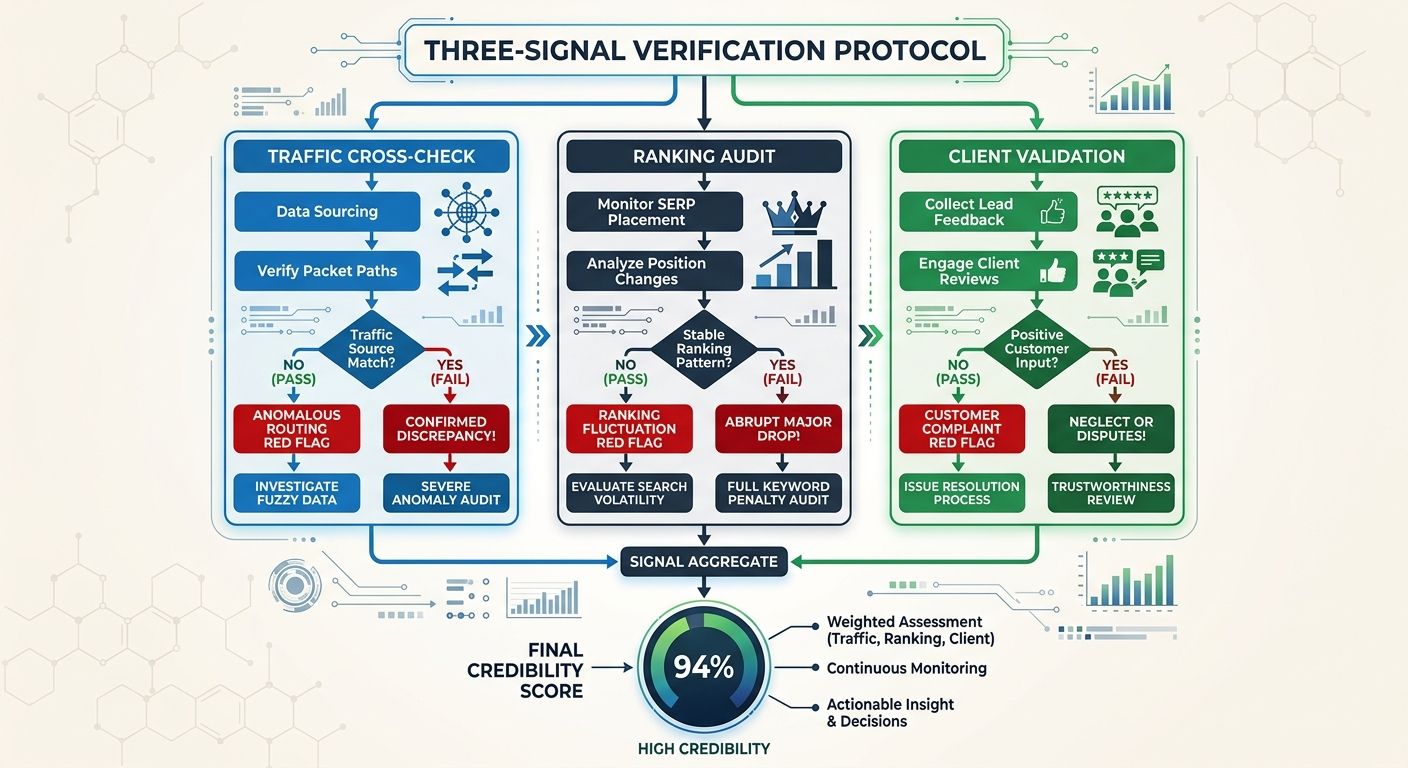
I use what I call the Three-Signal Verification Protocol when auditing agency claims for clients considering new contracts. Each signal tests a different dimension of a case study, and all three need to pass for the claim to hold up.
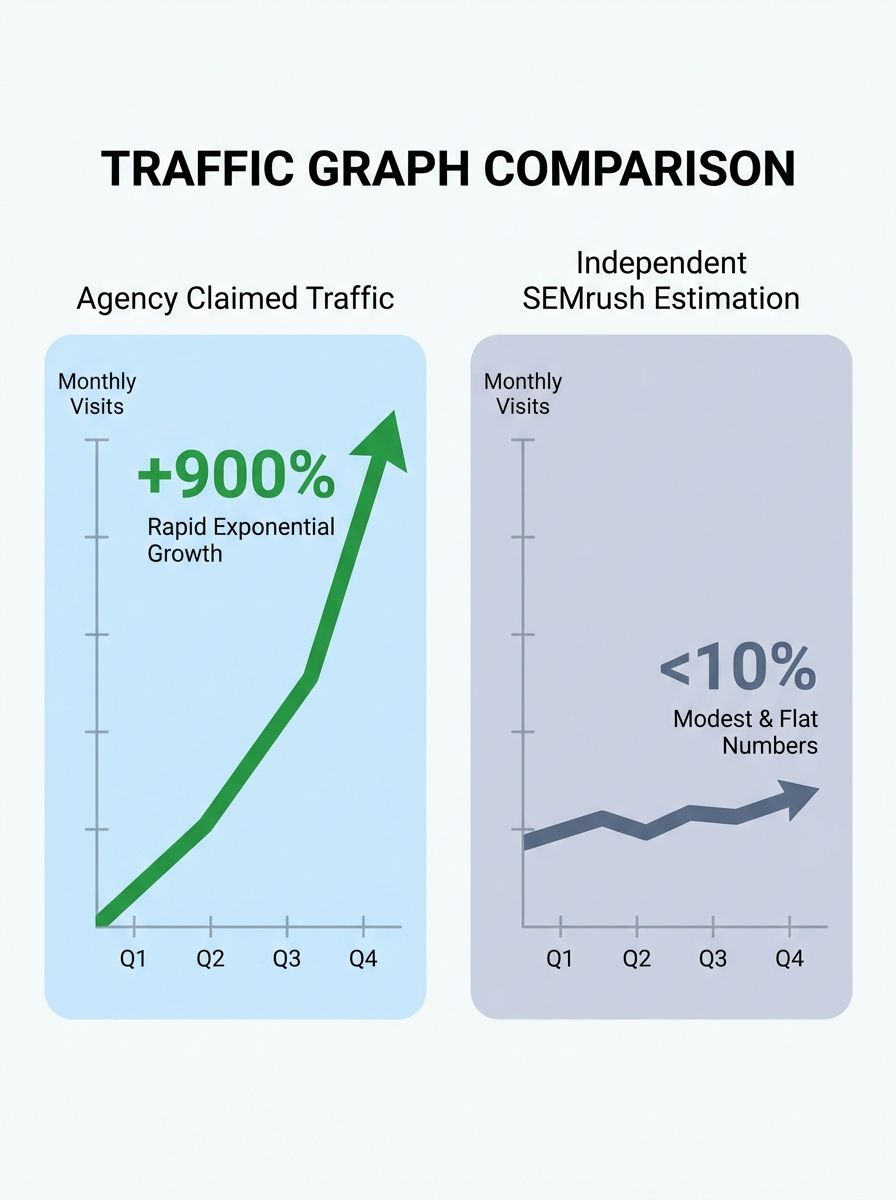
Signal 1: Traffic estimation cross-check. Pull the client domain mentioned in the case study into Ahrefs, SEMrush, or SE Ranking and compare the estimated organic traffic trend against the agency's claimed growth timeline. Third-party estimates are imperfect and typically undercount actual traffic by 30–60%, but the direction and timing of growth should match. If the agency claims they drove a 200% traffic increase between March and September 2025, and Ahrefs shows the domain's estimated traffic was flat during that exact window, you have a credibility problem.
Signal 2: Ranking claim audit. Agencies love to showcase specific keyword rankings. Use a tool like SE Ranking, which runs more than 115 audit parameters, to check historical ranking positions for those exact keywords. Pay attention to whether the agency is reporting peak positions (which might have lasted two weeks) versus sustained rankings. A keyword that hit position 3 for 14 days and then fell to page 3 is very different from a keyword sitting at position 4 for eight months.
Signal 3: Direct client validation. Ask the agency whether you can contact the client featured in the case study. If they say the client is under NDA, ask for a different reference. If every reference is somehow unavailable, treat that as a strong negative signal. The best case studies show their work openly. Buffer publicly shares all metrics including failures and setbacks, HubSpot provides detailed Analytics screenshots with attribution data, and Ahrefs uses their own tools to verify and demonstrate results.
Running a Traffic Estimation Cross-Check Step by Step
Here's the actual process I walk clients through when they want to verify an agency's traffic claims. You don't need a paid subscription to start. Semrush offers a free account that lets you audit up to 100 URLs, and SEOptimer provides free audit reports covering basic traffic and ranking data.
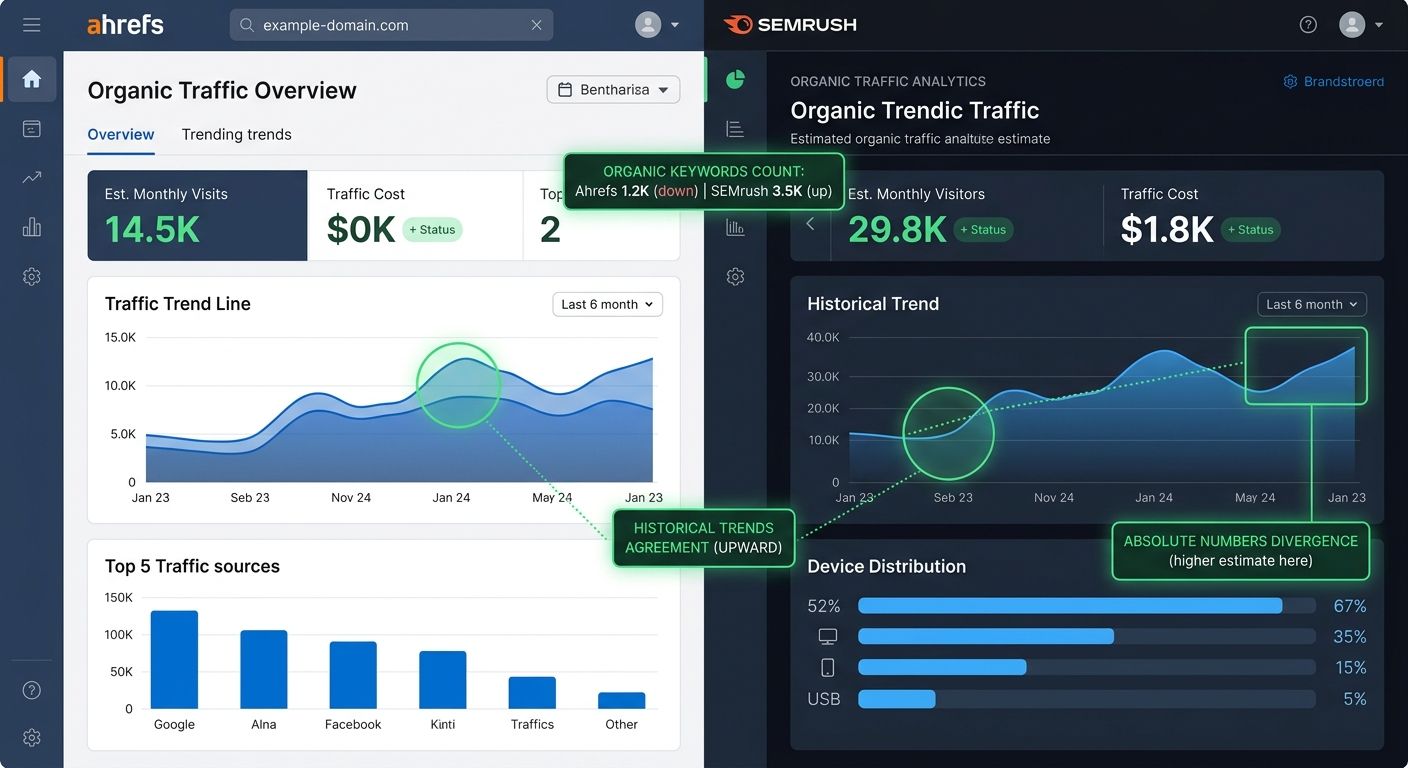
Take the URL from the agency's case study. Enter it into at least two different SEO tools. I recommend Ahrefs and SEMrush together because their data sources differ, giving you a broader triangulation point.
Set the date range to match the agency's claimed performance window. If they say "we grew organic traffic 150% in 12 months starting January 2025," pull data from December 2024 through January 2026.
Compare the organic traffic trend line. You're looking for directional consistency, not exact numbers. A 150% claimed increase should show up as a clear upward trend in at least one tool's estimate, even if the absolute numbers are lower.
Check the referring domains trend during the same period. Organic traffic growth almost always correlates with link acquisition. If traffic supposedly tripled but referring domains stayed flat, the agency might be counting paid or referral traffic as organic.
Look at the top pages driving estimated traffic. Do they align with the keywords and content strategy the agency says they implemented? If the agency claims they drove growth through blog content, but the top traffic pages are product pages that existed before the engagement started, the narrative doesn't add up.
If you've already gone through our agency vetting checklist for spotting data manipulation, you'll recognize some of these signals. The difference here is that you're pulling your own data from independent sources instead of relying on what the agency chooses to show you in their polished reports.
What "We Ranked #1" Actually Means
"We ranked our client #1 for [keyword]" is the most common claim in SEO agency case studies, and it's the easiest to inflate. Ranking data is inherently variable. Positions fluctuate by device, location, personalization, and time of day. An agency can screenshot a position 1 ranking that appeared for a specific device in a specific city at a specific hour and present it as a stable achievement that lasted months.
When conducting a ranking claim audit, check these five things:
Keyword difficulty and search volume. Ranking #1 for a keyword with 10 monthly searches and zero competition is meaningless. The claim should specify search volume, and you should verify that number against tool estimates independently.
Ranking stability over time. Use a rank tracking tool to check position history. A ranking that bounced between positions 1 and 47 over six months is volatile, not a win anyone should be showcasing.
Geographic scope. "Ranked #1" in which market? National rankings carry different weight than local pack results for a single city. An agency claiming #1 for "personal injury lawyer" when the actual ranking is for "personal injury lawyer in Boise" is misrepresenting scope.
SERP feature context. Position 1 below an AI Overview, a featured snippet, three ads, and a local pack means the actual click-through rate might be 2–3%. As we've covered in our analysis of how AI Overviews affect click-through rates, organic position 1 in 2026 captures far fewer clicks than it did even two years ago.
Attribution clarity. Did the agency's work actually cause the ranking improvement, or did the domain benefit from a competitor's drop, a favorable algorithm update, or brand search growth driven by offline marketing?
Verification Tools Compared
When you're conducting SEO agency verification on your own, different tools serve different parts of the audit. Here's a breakdown:
Tool | Free Tier | Best For | Key Limitation |
|---|---|---|---|
Ahrefs Webmaster Tools | Yes (own site only) | Backlink analysis, referring domain history | Can't check competitor/client domains free |
SEMrush (free account) | Yes (up to 100 URL audits) | Traffic estimation, keyword position tracking | Limited historical data on free plan |
SE Ranking | 14-day trial | 115+ parameter site audits, rank tracking | No permanent free tier |
SEOptimer | Yes | Quick site health scores, basic traffic data | Less depth on historical trends |
Screaming Frog (free) | Yes (up to 500 URLs) | Technical audit verification | No traffic or ranking data |
Google Search Console | Yes (own site only) | Actual click and impression data | Only available if you own the domain |
The ideal stack for fake case study detection combines at least one traffic estimation tool (SEMrush or Ahrefs), one rank tracking tool (SE Ranking), and direct access to the client's Google Search Console data if the agency is willing to provide it. Agencies that share read-only Search Console access with prospects demonstrate a level of confidence in their agency transparency metrics that's uncommon and genuinely impressive.
What Transparent Reporting Looks Like
The difference between transparent and inflated agencies shows up clearly in how they structure their reports. Transparent reporting connects actions to results, explains why changes happen, and shows next steps. This structure keeps clients confident and aligned on what SEO is actually delivering rather than burying them in vanity metrics.
According to a 2026 analysis of agency client retention, the agencies thriving in competitive markets aren't necessarily delivering the best technical SEO. They're communicating their value clearly. Transparent reporting has become a competitive advantage that attracts better clients and reduces churn.
Here's what I look for when evaluating an agency's reporting approach during the sales process:
Raw data access. Do they offer read-only access to GA4 and Google Search Console? Or do they only provide curated screenshots in a branded PDF?
Methodology documentation. Can they explain exactly how they calculate ROI, attribute conversions, and define "organic traffic" in their reports?
Failure acknowledgment. Do their case studies include setbacks, failed experiments, or periods of decline? Real performance data includes down months. An agency that only shows up-and-to-the-right charts for every single client is either cherry-picking or fabricating.
Third-party platform presence. Are they listed and reviewed on Clutch, G2, or DesignRush with verified reviews from named clients? The white label agency ranking study used metrics from seven independent platforms simultaneously, which is a solid template for your own client result validation process.
If you're working through this evaluation alongside the trust verification framework for auditing results beyond monthly reports, you'll have a thorough picture of whether an agency's claims survive scrutiny.
Six Inflation Patterns That Come Up Repeatedly
After 12 years of evaluating agencies and running client result validation checks, I've catalogued the inflation techniques that appear in pitch decks with alarming regularity.
Cherry-picked date ranges. The agency selects a reporting window that starts at the client's traffic low point (often right after a Google core update penalty) and ends at a natural recovery peak. The "growth" they claim credit for was already happening due to algorithmic recovery, not their intervention.
Blended traffic reporting. Organic, direct, and branded search traffic are combined into a single "search traffic" number. Since branded searches often grow due to offline marketing, PR, or seasonal factors, the agency takes credit for traffic they didn't influence. When you see a case study that doesn't segment organic traffic from other channels, that's a red flag.
Vanity keyword targeting. The case study highlights rankings for long-tail keywords with minimal search volume. Position 1 for "best artisanal dog treats in northeast Portland" is achievable in a week and commercially worthless, but it looks great in a pitch deck slide.
Before/after without context. The "before" screenshot shows a site riddled with critical technical errors. One documented case showed an agency using Screaming Frog to identify critical on-site issues, leading to a 50% reduction in page errors and significant ranking improvements. That's legitimate work. But if the "before" state was a broken site any competent developer could have fixed, the agency's contribution is less distinctive than they're making it sound.
Unverifiable client names. The case study refers to "a major e-commerce brand" or "a leading SaaS company" without naming the client. While confidentiality agreements exist, an agency portfolio containing zero named clients makes independent fake case study detection impossible. That's the point.
Percentage growth without baselines. "We increased organic traffic 300%" sounds impressive until you learn the baseline was 50 visits per month. Three hundred percent growth from a tiny baseline is still a tiny number, and any competent SEO effort on a neglected site will produce eye-popping percentage gains.
The Open Threads
Several aspects of SEO agency verification remain genuinely unsettled, and any honest guide should acknowledge them.
Third-party traffic estimation tools disagree with each other significantly. In my testing, Ahrefs and SEMrush estimates for the same domain routinely differ by 40–80%. This means a traffic claim that looks inflated in one tool might look reasonable in another. The directional trend is more reliable than absolute numbers, but the margin of uncertainty is real and worth accounting for in your evaluation.
Google has confirmed that third-party SEO tools have no access to internal search metrics, which means every verification method described here works with estimated data. The only ground-truth traffic data comes from a client's own Google Analytics and Search Console. If you can't get access to those, your verification will always carry some uncertainty.
And the line between legitimate case study presentation and inflation is blurry. Every agency curates their best results for their portfolio, and selecting your strongest outcomes for a pitch deck isn't dishonest on its own. Claiming credit for outcomes you didn't drive is the problem. The Three-Signal Verification Protocol helps you figure out which side of that line a specific claim falls on, but it won't catch every form of exaggeration. Use it as one input in a broader evaluation that includes contract terms, pricing transparency, reference conversations, and the agency's willingness to let you look behind the curtain before you sign.
Marcus Webb
Digital marketing consultant and agency review specialist. With 12 years in the SEO industry, Marcus has worked with agencies of all sizes and brings an insider perspective to agency evaluations and selection strategies.
Related Articles
The SEO Agency Vetting Checklist: How to Spot Performance Data Manipulation in Client Case Studies
RankTruth's database of over 400 agency due diligence reports surfaces a reliable signal: agencies whose case study numbers collapse under verification almost always share three traits.

Beyond Fake Reviews: How to Audit an SEO Agency's Real Track Record Using Benchmarks and Client Data
Of the 200-plus SEO agencies I've evaluated over 12 years, fewer than 30 provided prospective clients with baseline performance data tied to actual business outcomes before signing a contract.

The SEO Agency Trust Verification Framework: Auditing Real Results Beyond Monthly Reports
Verifying an SEO agency's real performance requires auditing three things their monthly reports rarely show: revenue attribution from organic search, ranking movement on terms that actually convert, and independent third-party traffic validation.
Explore more topics