
Google States Third-Party SEO Tools Have No Access to Internal Search Metrics
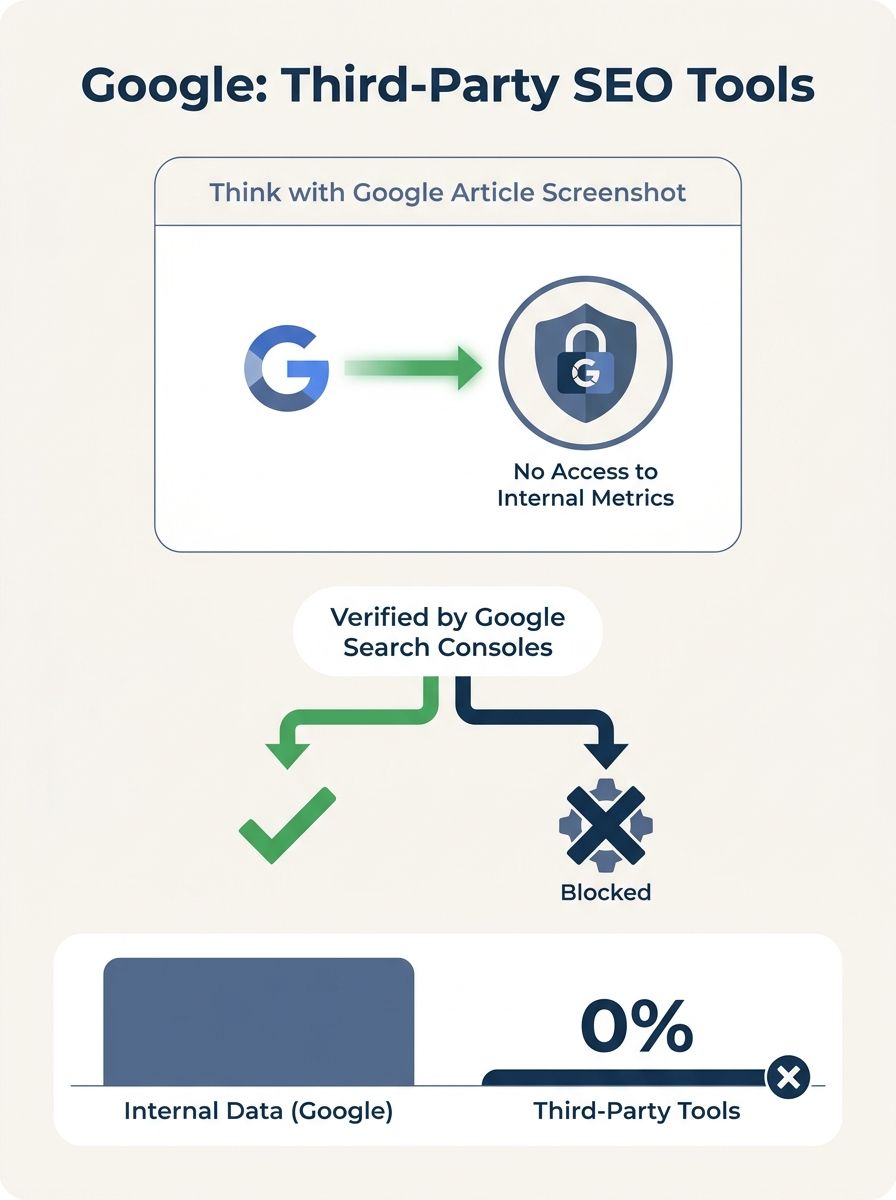
Google clarified June 22, 2026 that it does not evaluate third-party SEO tools and that these vendors have no access to its internal search metrics, according to guidance published on Think with Google by Brendon Kraham, the company's VP of Search and Commerce for Global Ads Solutions. The statement
 Marcus Webb··3 min read
Google States Third-Party SEO Tools Have No Access to Internal Search Metrics
Google clarified June 22, 2026 that it does not evaluate third-party SEO tools and that these vendors have no access to its internal search metrics, according to guidance published on Think with Google by Brendon Kraham, the company's VP of Search and Commerce for Global Ads Solutions. The statement addresses a growing market of AI visibility tools that claim to measure brand performance in AI Overviews and AI Mode search results.
What Google's Guidance Says About Tool Limitations
Kraham's article instructs marketing teams to measure outcomes such as leads, sales, and sign-ups using Google's first-party reporting for visibility data. Search Console reports impressions from AI Search features, while Merchant Center displays product listings, according to the guidance. Google positioned these reports as a baseline for tracking SEO performance, stating the company plans to add more metrics over time.
"Google does not evaluate third-party SEO tools or vendors directly, and they have no access to our internal metrics," Kraham wrote in the measurement section of the article.
The guidance largely reiterates statements Google made in May 2026 regarding AI Engine Optimization (AEO) and Generative Engine Optimization (GEO), including recommendations for LLMs.txt files and content chunking. The June article places greater emphasis on measurement capabilities and metric attribution.
The Gap Between Vendor Dashboards and Search Console
The disclosure creates a potential conflict for agencies and in-house teams evaluating AI visibility tools. Dozens of vendors now offer dashboards tracking brand mentions in ChatGPT, Perplexity, and Google AI Overviews, often presenting data that diverges from Search Console figures.
Google's statement does not address what third-party tools can measure independently through their own observation methods. The company clarified only its own stance when vendor data conflicts with official Search Console reporting. Agencies selling consolidated SEO tool stacks to clients will need to explain which metrics derive from Google-controlled sources and which stem from third-party inference.
Marketing managers evaluating tools face a transparency gap: if a vendor reports 127 AI Overview appearances for a brand in a given week but Search Console shows 89 impressions from AI features, the client has no Google-backed method to verify which count is accurate. The June 22 guidance positions Search Console as the authoritative source without addressing the broader ecosystem of AI visibility measurement.
How Agencies Should Position Third-Party Tools After the Clarification
The statement does not invalidate third-party tools that measure elements Google does not track—competitive benchmarking across AI platforms, content source attribution in Perplexity citations, or query-level visibility in ChatGPT responses. Google's Search Console does not currently report which specific queries triggered AI Overview appearances or how often a brand was cited versus merely mentioned.
Agencies should audit their tool recommendations for clients by separating Google-derived metrics from independently observed data. A dashboard showing "your brand appeared in 43 AI-generated answers this month" may carry value if the vendor explains its sampling methodology, but it cannot be reconciled against Search Console figures because Google does not publish per-brand AI citation counts.
CMOs evaluating agency proposals can now ask a specific question: "Which metrics in your reporting come directly from Search Console or Merchant Center, and which are inferred from third-party observation?" The distinction matters for budget allocation decisions when building an agency tech stack that balances cost against data reliability.
What Happens Next
Google indicated its Search Console reporting for AI features remains under development and will expand over time. The company has not committed to a timeline or specified which AI search metrics it will eventually surface. Marketing teams waiting for comprehensive first-party AI visibility reporting may continue relying on third-party tools to fill gaps Google has not yet addressed—particularly for cross-platform AI search tracking beyond Google's own properties.
The practical implication for agencies is that client reporting must now distinguish between official Google metrics and vendor-inferred estimates. Agencies presenting AI visibility gains should cite Search Console impressions for AI features when discussing Google performance, reserving third-party tool data for platforms like ChatGPT and Perplexity where no official metrics exist. The June 22 guidance makes explicit what was previously implied: when vendor dashboards conflict with Search Console, Google expects marketers to trust its first-party data.
The larger question—whether Google will eventually publish the granular AI citation and query-level metrics that third-party tools attempt to approximate—remains unanswered. Until that reporting arrives, the market for AI visibility tools persists, with the caveat that their claims about Google's search results cannot be verified against internal company data.
Marcus Webb
Digital marketing consultant and agency review specialist. With 12 years in the SEO industry, Marcus has worked with agencies of all sizes and brings an insider perspective to agency evaluations and selection strategies.
Related Articles
Google Publishes Guidance Positioning Itself as Sole Authority for SEO and AI Optimization Practices
Google published documentation on June 7 positioning itself as the sole authoritative source for SEO practices and distancing the company from third-party tools and agencies, according to new guidance on Google Search Central that explicitly warns businesses to evaluate outside advice against Google
Google's June 2026 Spam Update Targets AI Citation Manipulation as Violation of Core Search Policies
Google's June 2026 spam update, which began rolling out on June 24, explicitly treats efforts to manipulate AI-generated search responses—including buying citations or altering AI Overviews—as violations of the company's spam policies, according to Search Engine Journal. The update expands Google's
Google Marketing Live 2026 Confirms End of Traditional Search as Agency Study Shows Top-Ranked Brands Invisible to AI 69% of Time
Google announced at Marketing Live 2026 that traditional search has ended and all search on the platform now operates through AI-based systems, according to NP Digital's APAC managing director Dan Kalinski writing in Marketing-Interactive. The announcement validates what an NP Digital experiment mea
Explore more topics