
Google Publishes Guidance Positioning Itself as Sole Authority for SEO and AI Optimization Practices
Google published documentation on June 7 positioning itself as the sole authoritative source for SEO practices and distancing the company from third-party tools and agencies, according to new guidance on Google Search Central that explicitly warns businesses to evaluate outside advice against Google
 Marcus Webb··4 min read
Google Publishes Guidance Positioning Itself as Sole Authority for SEO and AI Optimization Practices
Google published documentation on June 7 positioning itself as the sole authoritative source for SEO practices and distancing the company from third-party tools and agencies, according to new guidance on Google Search Central that explicitly warns businesses to evaluate outside advice against Google's official recommendations.
The documentation represents Google's strongest assertion to date of its primacy over SEO information, explicitly extending that authority to emerging AI search optimization disciplines including Answer Engine Optimization (AEO) and Generative Engine Optimization (GEO). The guidance divides SEO information into two categories: third-party opinion based on data or experience, and Google's own guidelines and recommendations.
Five Core Claims in Google's New Documentation
Google's guidance advances five primary positions, each establishing boundaries around how businesses should evaluate SEO practices. The document claims authority on SEO advice generally, asserts authoritativeness over AI search optimization specifically, distances Google from third-party SEO tools, recommends Google's own tools as alternatives, and urges businesses to think critically about third-party SEO services.
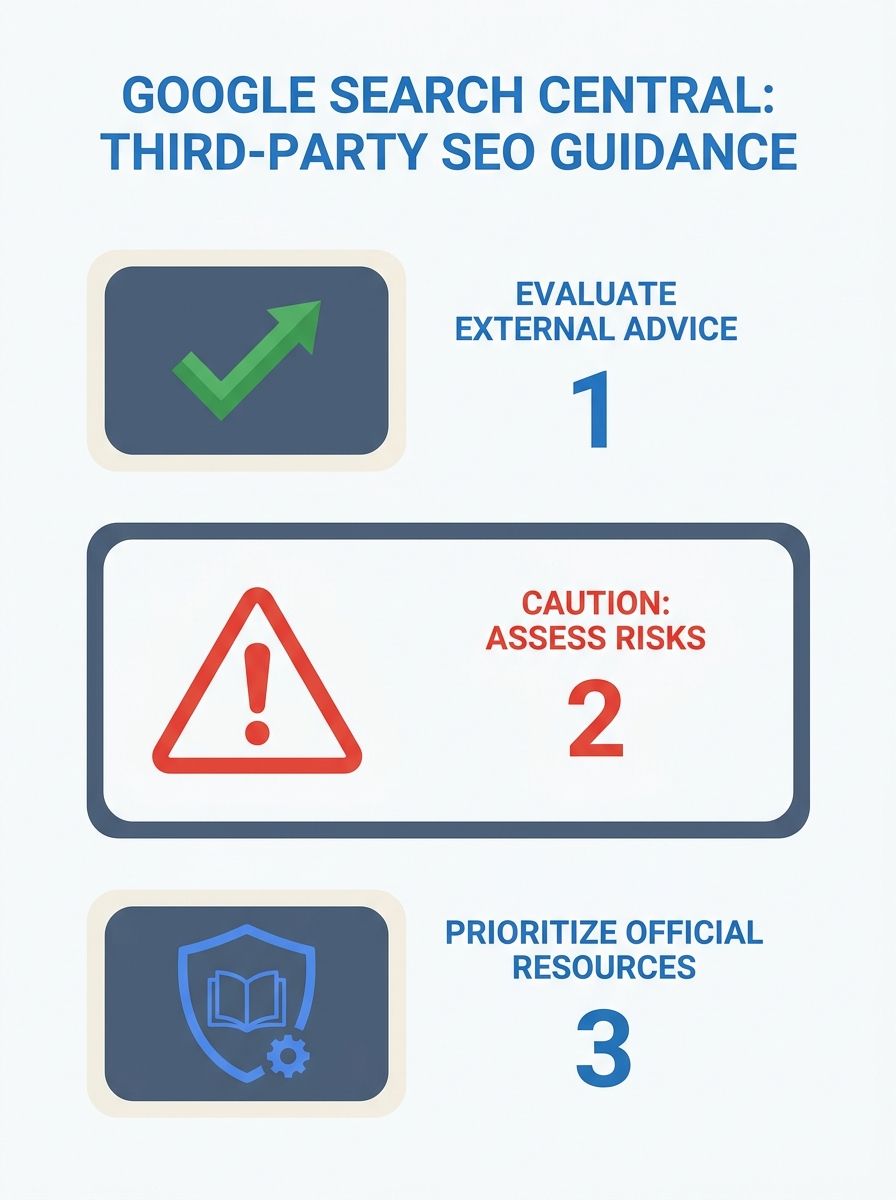
The guidance states: "While some advice is helpful, others may misinterpret or make claims about what 'Google says' or how Google ranking systems work. In general, good advice either qualifies their claims as opinion based on data or experience, or backs up their claims by citing official Google Search guidance." The document recommends "carefully evaluating any advice you might be considering implementing against our official SEO guidance, including our guidance on optimizing for generative AI."
Google explicitly names AEO and GEO optimization practices in the guidance, stating: "There's plenty of third-party SEO advice on the internet related to SEO, search listings, and AI experiences (sometimes called AEO for 'answer engine optimization' or GEO for 'generative engine optimization')."
Google Warns Against Third-Party Tool Claims of Approval
The strongest language in the June 7 document targets third-party SEO services that imply Google approval or acceptance. Google lists examples including sitemap tools, indexing tools, content generation services, ranking advice services, and tools promising improvements for AEO and GEO optimization.
"Some of these services may be helpful in your work, while others may make claims or imply that what they do is somehow 'acceptable' or 'approved' by Google Search," the guidance states. It follows with a direct warning: "Google doesn't evaluate third-party services, so be wary of such claims and those making them."
The document stops short of criticizing SEO tools categorically, acknowledging that "some may be useful." However, it clearly distances Google from vendors and services that suggest any level of official endorsement. This distinction matters for agencies and businesses evaluating SEO tools and platforms for 2026 implementations.
Ambiguous Phrasing Creates Uncertainty for Agency Services
Google's guidance appears to address agencies and individuals providing SEO services, though whether that represents the documentation's intent remains unclear. The phrasing creates uncertainty for the agency services market.
The guidance states: "Think critically about using third-party SEO tools and services," with the conjunction "and" explicitly linking tools and services in a single caution. It continues: "If you're considering hiring a company to perform SEO services, check out our guide that includes more tips on how to choose and evaluate their work."
The repeated references to evaluating third-party services—both direct and indirect—give the impression that Google is urging caution about hiring SEO agencies generally. The language doesn't distinguish between low-quality providers and established agencies with track records, creating a blanket advisory that applies to the entire category. Business owners evaluating agency relationships now face documentation that positions any outside SEO counsel as requiring validation against Google's own materials.
Google Extends Authority Claim to AI Search Optimization
The guidance explicitly extends Google's authority claim to AI search optimization advice, positioning Google Search Central documentation as the reference point for AEO and GEO practices. This represents Google's first official acknowledgment of these optimization disciplines in published guidance.
"We recommend carefully evaluating any advice you might be considering implementing against our official SEO guidance, including our guidance on optimizing for generative AI, and making your own informed decisions," the documentation states. The phrasing establishes a hierarchy: third-party AI optimization advice exists as opinion-based data, while Google's guidance represents the canonical standard.
This framing arrives as agencies debate AI Overview optimization versus traditional blue-link strategies. Google's documentation doesn't resolve that strategic question but asserts that any AI optimization approach must align with Google's published materials to be considered valid.
Why This Matters Now
Google's June 7 guidance creates immediate evaluation burdens for business owners, marketing managers, and CMOs working with SEO agencies or considering third-party tools. The documentation positions every outside recommendation—from keyword strategies to technical implementations—as requiring validation against Google Search Central materials before implementation. This shifts accountability: agencies must now demonstrate not just that their advice works, but that it aligns with Google's published guidance.
The extension of Google's authority to AEO and GEO optimization matters because these disciplines lack established best practices. Google's guidance doesn't provide detailed AI optimization instructions—it simply asserts authority over them. Agencies navigating the shift from traditional search to AI-generated results now operate in a framework where Google claims definitional control over optimization approaches that Google itself hasn't fully documented.
The practical impact lands on vendor evaluation processes. Any SEO tool or service that claims "Google approval" or suggests its approach aligns with Google's systems now faces explicit contradiction from Google's documentation. Business owners conducting cost-benefit analyses between tools and agency services must factor in that Google distances itself from third-party providers categorically—a stance that doesn't help distinguish between credible partners and ineffective vendors.
Marcus Webb
Digital marketing consultant and agency review specialist. With 12 years in the SEO industry, Marcus has worked with agencies of all sizes and brings an insider perspective to agency evaluations and selection strategies.
Related Articles

Google Publishes Official AI Search Guidance, Rejects Industry's GEO and AEO Optimization Frameworks
Google has published official documentation clarifying how its AI Overviews and AI Mode function, explicitly stating that "Generative Engine Optimization" and "Answer Engine Optimization" are not distinct practices from traditional SEO, according to guidance published on Cyber Kendra analyzing the 2
Google Updates Official AI Search Documentation, Clarifies Agency Optimization Practices Are Not Separate Disciplines
Google updated its official guidance on AI-generated search results in 2025, explicitly stating that "Generative Engine Optimization" and "Answer Engine Optimization" are not distinct practices from traditional search engine optimization, according to documentation published by the company. The upda

Google States Third-Party SEO Tools Have No Access to Internal Search Metrics
Google clarified June 22, 2026 that it does not evaluate third-party SEO tools and that these vendors have no access to its internal search metrics, according to guidance published on Think with Google by Brendon Kraham, the company's VP of Search and Commerce for Global Ads Solutions. The statement
Explore more topics