
Google's Shift From Search Tool to AI Agent Signals Fundamental Web Economics Change, According to Demand Gen Analyst
Google is replacing its search engine with an autonomous AI agent system rather than updating the existing platform, according to an analysis published May 25, 2026 by Veronika Höller, Head of Demand Generation at Tresorit and co-founder of Your PPC Doctor. The assessment on ppc.land characterizes G
 Marcus Webb··4 min read
Google's Shift From Search Tool to AI Agent Signals Fundamental Web Economics Change, According to Demand Gen Analyst
Google is replacing its search engine with an autonomous AI agent system rather than updating the existing platform, according to an analysis published May 25, 2026 by Veronika Höller, Head of Demand Generation at Tresorit and co-founder of Your PPC Doctor. The assessment on ppc.land characterizes Google's I/O 2026 announcements as a structural break in how the internet functions, not an incremental product improvement. Google introduced persistent background agents on May 19, 2026 that monitor user preferences continuously and execute multi-step tasks without requiring manual queries.
The shift threatens the click-based economic model that has funded website publishing for 25 years, according to the analysis. Google AI Mode already exceeds one billion monthly active users globally, with queries running three times longer than conventional searches and total volume more than doubling quarterly since launch, based on data Google published May 19, 2026.
Background Agents Replace Manual Search Workflow
The product Google demonstrated at I/O 2026 operates without users submitting queries. An information agent can continuously monitor apartment listings against stated user requirements and send notifications when matches appear. The user never returns to Search to reformulate requests. Google plans to launch the feature for AI Pro and Ultra subscribers during summer 2026, though pricing for those tiers was not disclosed in the May 19 announcement.
Höller illustrated the behavioral compression with a travel booking example. The previous workflow for booking a Barcelona hotel involved opening 15 browser tabs, comparing reviews, checking availability, reading blogs, searching Maps, and watching TikTok reviews. "The agent increasingly handles those steps itself," Höller wrote, framing the compression of multi-step research journeys into single delegated instructions as the core change.
The autonomous model eliminates the traditional sequence where users search, Google returns links, users click, websites convince, and conversions happen. That sequence "became the foundation of the modern internet," according to Höller's analysis, which argues the exact model is now breaking. Google's shift from search-as-tool to continuous background monitoring directly impacts how agencies must rebuild SEO strategy beyond traditional SERP rankings.
Traffic Data Shows 61% Organic CTR Drop for AI Overview Queries
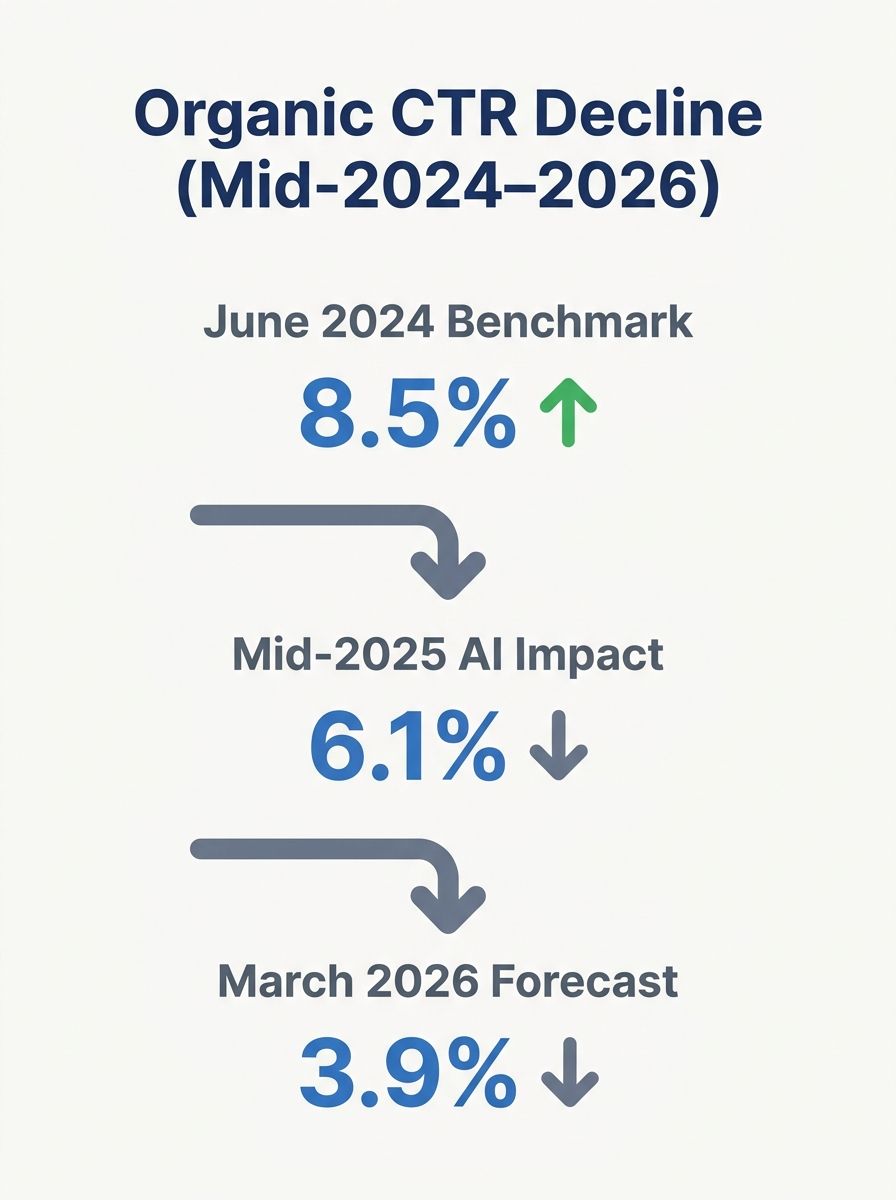
Organic click-through rates for informational queries featuring AI Overviews fell 61% between June 2024 and September 2025, from 1.76% to 0.61%, according to Seer Interactive research covering 3,119 queries across 42 organizations cited in the analysis. Paid click-through rates on the same queries dropped 68%, from 19.7% to 6.34%. SISTRIX data from March 2026 showed the click-through rate at position one falling from 27% to 11% when an AI Overview appears—a loss of nearly 60% of clicks a top-ranking page would otherwise receive.
Small publishers have lost 60% of search traffic over two years, according to data referenced in the ppc.land piece. The arrival of agents that compare, filter, prioritize, summarize, book, contact, and purchase on behalf of users makes this trajectory irreversible and accelerates it, Höller argued.
Google AI agents began experimenting with table reservations and task completion directly within search results as early as November 2025, when John Mueller described agentic features as allowing the AI to "navigate your website and help users with tasks there." The website still exists in that model, but the visitor is not human—the agent navigates on the user's behalf.
Google launched agentic checkout tools for the 2025 holiday season, with its product database holding more than 2 billion listings updated hourly according to Google's technical specifications. The Universal Cart announced at I/O 2026 extends that logic across Search, YouTube, Gmail, and the Gemini app—a single cross-merchant cart that checks for price drops in the background once an item is added.
Website Role Shifts From Destination to Data Source
Websites increasingly become "trust signals, data sources, entity hubs, AI verification layers" rather than "digital brochures for humans," according to Höller's framing. The piece does not claim websites disappear, but argues their purpose fundamentally shifts when AI systems execute tasks on behalf of users.
Whether website owners see sessions in Analytics depends on implementation; whether they see conversions may depend on whether checkout infrastructure integrates with Google's payments layer. The shift from reactive to continuous search represents a technical architecture change Google's search chief Nick Fox outlined in April 2026, describing query fan-out, agentic features, and personal intelligence in granular detail. Background agents announced at I/O 2026 are the consumer-facing product of that architecture.
The system monitors preferences, behaviors, contexts, tasks, schedules, and interests without requiring active searching. Search is "designed to continuously assist," according to Höller's characterization of the May 19 announcements. The discrete, on-demand model that defined what a search engine was has been replaced by persistent monitoring.
Context and Outlook
The I/O 2026 announcements mark the transition point where Google's AI Mode user base—already exceeding one billion monthly active users—receives autonomous agent capabilities that operate independently of manual queries. For SEO agencies and the businesses that hire them, the click-based traffic model that has funded content strategies and organic visibility tactics faces structural replacement by a system where the AI completes research and purchase journeys without sending users to websites.
The 61% organic CTR decline documented between mid-2024 and late 2025 occurred before persistent background agents launched. Summer 2026 deployment of monitoring agents that track listings, compare options, and notify users without search queries will compress the visibility window further. Agencies evaluating 2026-2027 campaign strategies face a market where traditional SEO playbooks centered on link acquisition and content targeting may no longer align with how users actually interact with search results.
The shift requires agencies to position websites as entity validation layers and structured data sources for AI consumption rather than persuasive destinations for human visitors. Businesses evaluating agency capabilities should prioritize providers who demonstrate fluency with schema markup, entity structuring, and AI search visibility optimization practices—the technical infrastructure that determines whether autonomous agents surface a brand's offerings when executing tasks on behalf of users who never click through to a website.
Marcus Webb
Digital marketing consultant and agency review specialist. With 12 years in the SEO industry, Marcus has worked with agencies of all sizes and brings an insider perspective to agency evaluations and selection strategies.
Related Articles
Google Deploys Autonomous Search Agents in Largest Platform Redesign Since 2001
Google announced its largest search engine update in 25 years on May 19, 2026, integrating autonomous AI agents that execute multi-step tasks, monitor topics in the background, and deliver proactive alerts without requiring user-initiated queries, according to the company's blog announcement at Goog
Google I/O Demos Show AI Search Agents Are Eliminating Business Control Over Purchase Intent Data
Google's I/O conference demonstrations revealed agent-driven features that complete commercial transactions without directing users to business websites, according to Search Engine Journal's analysis published May 30, 2026. Universal Cart, agentic booking for local services, and background informati
Google Announces AI-Powered Search Engine Running on Gemini Model at I/O 2026
Google announced at its I/O 2026 developer conference that Search will transition to an AI-powered answer engine running on the Gemini 2.5 Flash model, marking what the company described as its largest search overhaul in 25 years, according to coverage published July 13 by Laire Digital.
Explore more topics