
Google I/O Demos Show AI Search Agents Are Eliminating Business Control Over Purchase Intent Data
Google's I/O conference demonstrations revealed agent-driven features that complete commercial transactions without directing users to business websites, according to Search Engine Journal's analysis published May 30, 2026. Universal Cart, agentic booking for local services, and background informati
 Marcus Webb··4 min read
Google I/O Demos Show AI Search Agents Are Eliminating Business Control Over Purchase Intent Data
Google's I/O conference demonstrations revealed agent-driven features that complete commercial transactions without directing users to business websites, according to Search Engine Journal's analysis published May 30, 2026. Universal Cart, agentic booking for local services, and background information agents allow Google to manage the customer journey from initial query through checkout, creating a measurement gap for businesses that traditionally relied on click-through data to understand search performance.
Infrastructure Preceded Consumer Launch
The I/O demonstrations made visible infrastructure Google had deployed over the preceding months. In late 2025, Google rolled out agentic checkout capabilities that allow the company's AI to add items to merchant carts and complete purchases, the analysis shows. In 2026, Google launched the Universal Commerce Protocol, an open standard providing agents and merchant systems with a common integration language rather than requiring individual connections for each agent.
AI Mode, Google's agent-driven search interface, has surpassed one billion monthly users, with queries more than doubling every quarter since launch, according to statements made during the I/O keynote. In April 2026, Sundar Pichai told Stripe CEO Patrick Collison that search would become an "agent manager," a shift Search Engine Journal has tracked through Google's agentic search patents and task-based features since January 2026.
Merchant Data Access Problem Surfaces
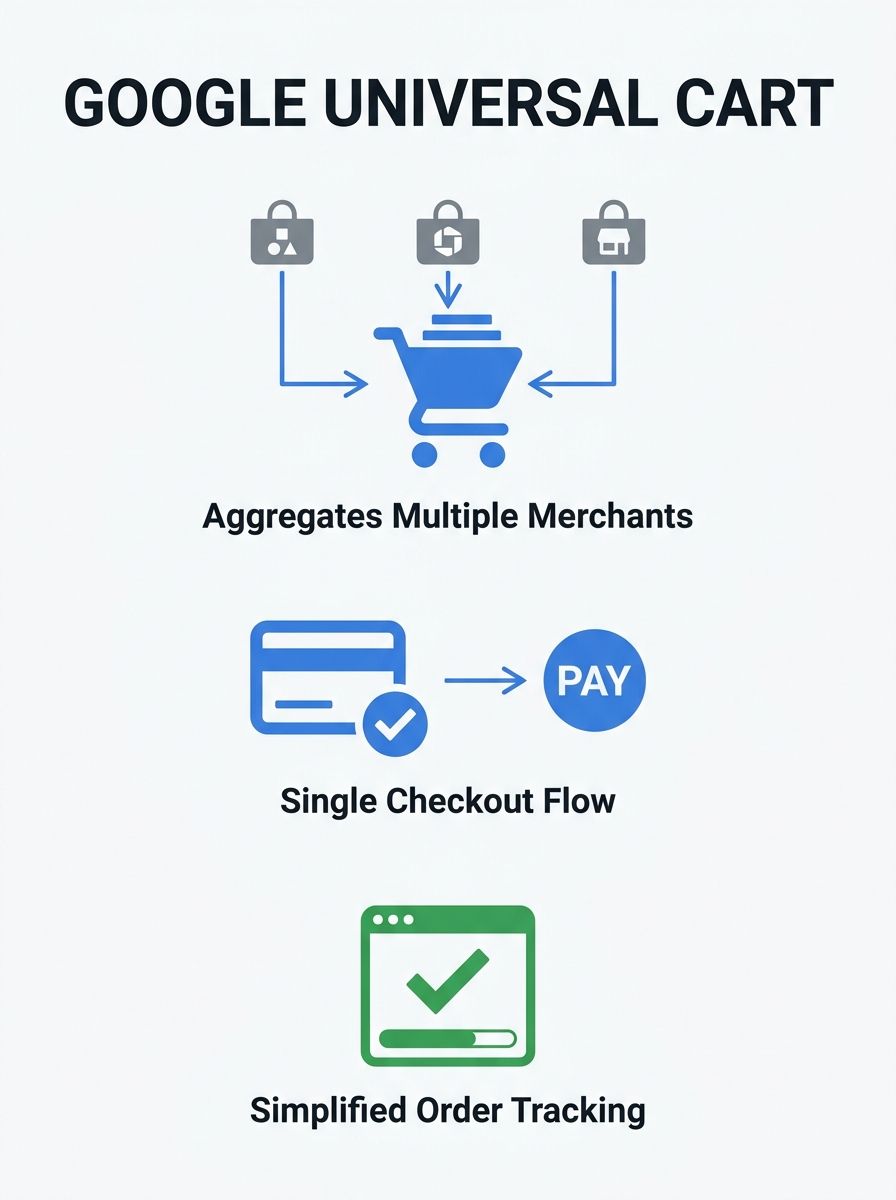
Universal Cart allows users to add products into a single cart that persists across Google surfaces, while agentic booking aggregates pricing and availability with direct links to complete reservations. Google maintains that businesses remain the merchant of record under the Universal Commerce Protocol, with shoppers able to check out through Google Pay or transfer items to the business's website.
"In Google's model, merchants still own the transaction, but not the purchase intent or product discovery," stated Armando Roggio, Senior Contributor at Practical Ecommerce, in the analysis.
Jay Jaffin, CMO & Strategic Advisor at Visor Strategic Advisors, described the condensed adaptation timeline: "Universal Cart doesn't just colonize the bottom of the funnel. It colonizes the whole thing, from the first search query to the final checkout, without your customer ever landing on your site."
Signal Requirements Shift for Ecommerce
Aleyda Solís, SEO Consultant and Founder of Orainti, noted on LinkedIn that "ecommerce SEO and AI search optimization can't be reduced to 'content around products.'" The post outlined signals including accurate product feeds, consistent attributes, clear pricing structures, and detailed content that provides agents with reasoning material—requirements distinct from traditional keyword targeting approaches that agencies documented in previous enterprise SEO playbook analyses.
The optimization challenge intensifies without data from Google on how different signals are weighted in agent-mediated flows, according to the Search Engine Journal analysis. Haroon Qureshi, Global Retail Experience & Partnerships Lead at WPP Media, framed the changed competitive environment: "In the future, are brands competing for clicks? Or competing to be recommended?"
Local Service Readiness Becomes Visibility Factor
For local businesses in categories including home repair, beauty, and pet care, Google's agent features aggregate pricing and availability with booking links. In select cases, users can request Google to call businesses directly on their behalf. If calls reach voicemail or staff cannot provide clear answers, businesses may lose the conversion opportunity before users visit a website.
"When Google's agent is the one calling, disorganization becomes an automatic disqualification," stated Karim Al Chamaa, Founder of Implemnt, on the company's blog. The dynamic transforms operational readiness into a visibility factor alongside traditional ranking signals.
Measurement Gap Emerges
Information agents that monitor apartment listings or track product availability over multi-day periods extract value without generating conventional click paths. Jake Ward, Co-Founder of Mentions, posted on X that businesses are "moving further into a world of visibility > clicks."
Agencies can track organic sessions and referral clicks, but cannot measure how often products were considered and rejected by agents, or how frequently businesses appeared in agentic booking recommendations. The metrics that explained search performance over the past decade may not capture agent-mediated journeys with the same clarity, according to the analysis—a gap that complicates the transparent reporting frameworks agencies built for traditional search.
Google has not yet published weighting methodologies for agent recommendation algorithms or provided businesses with visibility into agent-level consideration data.
Why This Matters Now
The shift from search interface to agent manager represents a structural change in how businesses capture demand, not an incremental feature update. Agencies advising ecommerce and local service clients face a dual challenge: traditional SEO metrics remain necessary for direct search traffic, while agent-mediated flows require a different signal strategy—accurate structured data, operational readiness, and content depth—without clear measurement feedback.
The one billion monthly AI Mode users and quarterly query doubling indicate adoption velocity that compresses the typical multi-year adaptation window businesses experienced during previous search platform shifts. Marketing managers evaluating SEO agency strategies should ask how agencies plan to optimize for agent recommendation dynamics when the industry lacks standardized measurement for agent-level visibility.
For businesses in categories where Google has deployed agentic booking and cart features, the infrastructure is already live. The visibility problem isn't theoretical—it's operational, and the gap between what agencies can optimize and what they can measure is widening without additional data access from Google.
Marcus Webb
Digital marketing consultant and agency review specialist. With 12 years in the SEO industry, Marcus has worked with agencies of all sizes and brings an insider perspective to agency evaluations and selection strategies.
Related Articles
Google's Shift From Search Tool to AI Agent Signals Fundamental Web Economics Change, According to Demand Gen Analyst
Google is replacing its search engine with an autonomous AI agent system rather than updating the existing platform, according to an analysis published May 25, 2026 by Veronika Höller, Head of Demand Generation at Tresorit and co-founder of Your PPC Doctor. The assessment on ppc.land characterizes G
Google Deploys Autonomous Search Agents in Largest Platform Redesign Since 2001
Google announced its largest search engine update in 25 years on May 19, 2026, integrating autonomous AI agents that execute multi-step tasks, monitor topics in the background, and deliver proactive alerts without requiring user-initiated queries, according to the company's blog announcement at Goog
Google Marketing Live 2026 Confirms End of Traditional Search as Agency Study Shows Top-Ranked Brands Invisible to AI 69% of Time
Google announced at Marketing Live 2026 that traditional search has ended and all search on the platform now operates through AI-based systems, according to NP Digital's APAC managing director Dan Kalinski writing in Marketing-Interactive. The announcement validates what an NP Digital experiment mea
Explore more topics