
Google Deploys Autonomous Search Agents in Largest Platform Redesign Since 2001
Google announced its largest search engine update in 25 years on May 19, 2026, integrating autonomous AI agents that execute multi-step tasks, monitor topics in the background, and deliver proactive alerts without requiring user-initiated queries, according to the company's blog announcement at Goog
 Marcus Webb··4 min read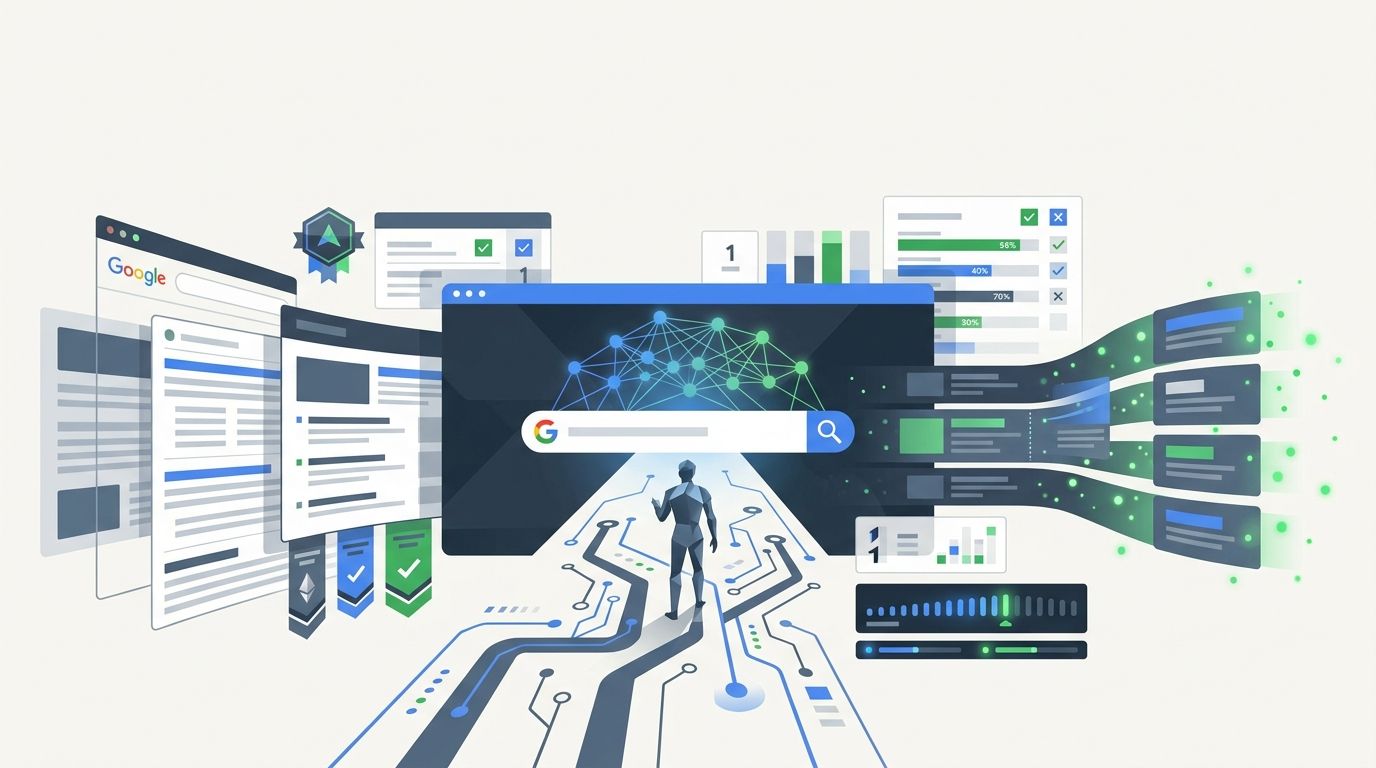
Google Deploys Autonomous Search Agents in Largest Platform Redesign Since 2001
Google announced its largest search engine update in 25 years on May 19, 2026, integrating autonomous AI agents that execute multi-step tasks, monitor topics in the background, and deliver proactive alerts without requiring user-initiated queries, according to the company's blog announcement at Google I/O 2026. The redesign introduces AI Mode, powered by the new Gemini 3.5 Flash model with a one-million-token context window, marking a fundamental shift from reactive keyword searches to agent-driven task execution across the platform's 2 billion daily searches.
AI Overviews Now Appear on 48 Percent of Searches
AI Overviews currently appear on 48 percent of Google searches, up from 34.5 percent in December 2025, according to the source material. The May 2026 Core Update rollout began May 21 and will complete within two weeks, coinciding with the broader search redesign. Google has moved beyond simple keyword matching toward what the company describes as "agentic AI"—systems that reason, plan, and execute multi-step tasks autonomously without requiring users to formulate traditional search queries.
The search box itself receives its first major interface redesign in over 25 years, though Google noted the core experience remains recognizable. The substantive transformation occurs in the underlying architecture, where Gemini 3.5 Flash delivers reasoning capabilities matching larger flagship models while operating at speeds four times faster than previous models. This technical advancement enables Google to deploy agents across billions of daily searches without infrastructure constraints that limited earlier AI features.
Agencies and marketing teams evaluating how Google's AI-powered search redesign affects optimization strategies now face clients whose traffic sources may shift from traditional organic results to agent-synthesized responses that bypass destination websites entirely.
Search Agents Execute Background Monitoring and Proactive Alerts
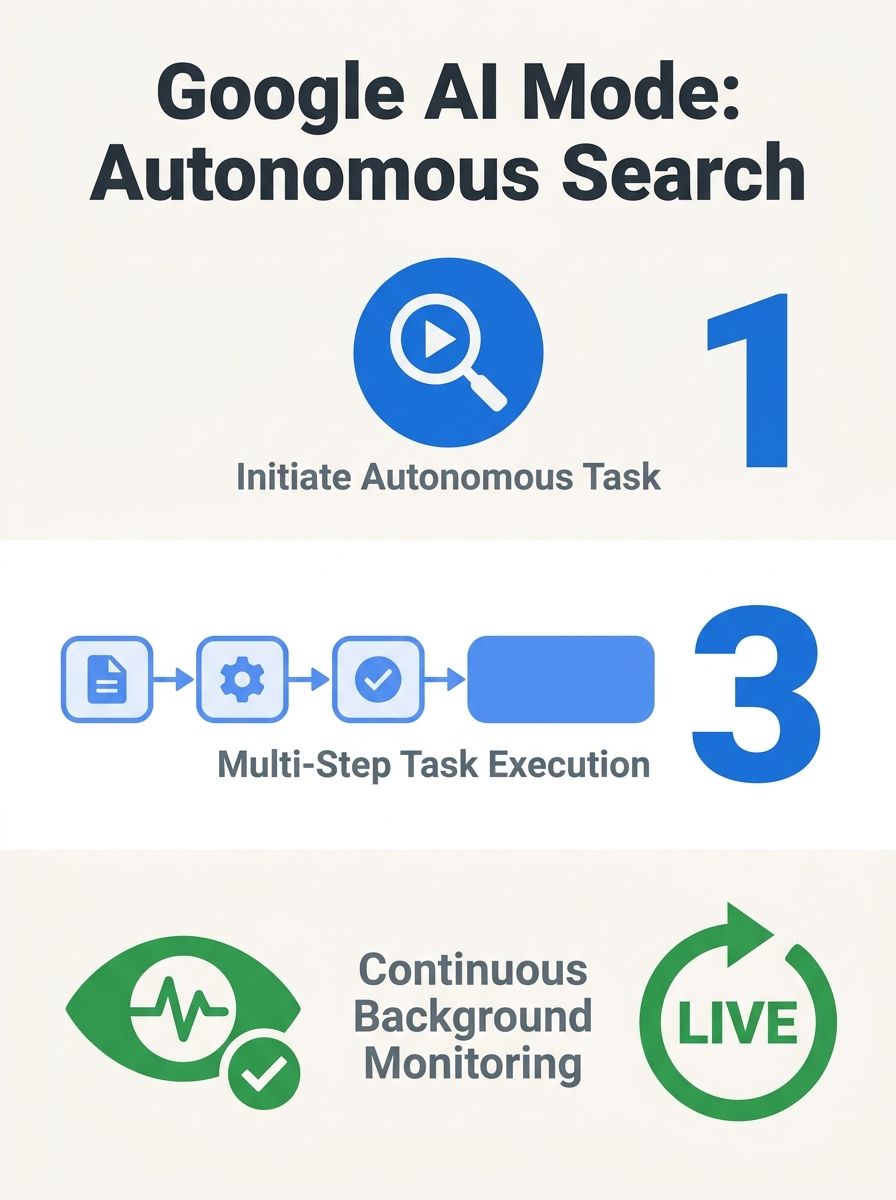
Information agents represent the breakthrough innovation in Google's update. These autonomous systems run continuously in the background, monitoring topics users designate—stock price movements, breaking news, research developments, or competitor announcements. When relevant updates occur, agents proactively alert users rather than requiring active searches, inverting 25 years of user-initiated, reactive search behavior.
"We're bringing our advanced model capabilities to Search with new AI features, enabling you to use agents just by asking a question," Google Search Leadership stated in the May 19 blog announcement. Unlike previous AI Overviews that summarize results, the new approach enables agents to take action: booking parking before events, tracking price changes on products, and answering follow-up questions without manual re-queries.
The May 2026 Core Update that began rolling out May 21 runs parallel to these agent capabilities, creating compounded ranking volatility for sites that haven't adapted content strategies to agent-driven discovery patterns.
Gemini 3.5 Flash Delivers Flagship Performance at 4x Speed
Gemini 3.5 Flash achieves frontier-level reasoning while maintaining the speed profile of smaller models, according to technical specifications disclosed at Google I/O. The one-million-token context window allows agents to analyze entire research documents, financial reports, webpage archives, and conversation histories in single processing passes—capabilities that previously required multiple API calls or fragmented workflows. The model outperforms Gemini 3.1 Pro across multiple benchmarks while processing queries four times faster than previous models.
Google's cloud infrastructure supporting these agents processes customer data with enhanced encryption and privacy controls, addressing enterprise concerns about agent autonomy and data handling. The system processes text, images, audio, and video simultaneously as multimodal input, compared to limited multimodal support in earlier versions. Native support for autonomous task execution replaces the chatbot-first design paradigm that characterized earlier AI implementations.
Website publishers and e-commerce platforms monitoring answer engine optimization versus traditional SEO approaches now contend with agents that generate summaries of product information, pricing comparisons, and shipping details without directing users to destination sites.
Services Implications
SEO agencies advising clients on content strategy face immediate pressure to audit whether existing organic assets will surface in agent-synthesized responses or remain trapped below the visibility threshold. The 48 percent AI Overview penetration rate means nearly half of all searches now bypass traditional blue-link results, reducing click-through opportunities for sites that haven't structured content for agent extraction. Agencies that continue optimizing solely for SERP rankings miss the agent-discovery layer where Google now routes growing query volume.
The autonomous monitoring capability creates a secondary challenge: brands that previously relied on users actively searching company names or product categories must now optimize for agent-initiated alerts triggered by competitive moves, industry developments, or market shifts. Marketing teams should work with technical SEO specialists to ensure structured data, entity relationships, and contextual signals enable agents to connect brand assets to relevant monitoring triggers rather than surfacing competitor information by default.
Agencies evaluating how to position AI search optimization guidance should expect client questions about traffic attribution when Google agents answer queries without generating measurable site visits. The two-week core update rollout window offers a compressed timeline to baseline current visibility metrics before agent-driven traffic patterns fully stabilize, making immediate measurement infrastructure a tactical priority over theoretical strategy debates.
Marcus Webb
Digital marketing consultant and agency review specialist. With 12 years in the SEO industry, Marcus has worked with agencies of all sizes and brings an insider perspective to agency evaluations and selection strategies.
Related Articles
Google Redesigns Search Around AI Agents in Largest Platform Overhaul Since 2001
Google announced a fundamental redesign of its Search platform at Google I/O 2026, introducing AI agents, conversational interactions, and custom-generated interfaces in what the company described as the biggest update to the search box in more than 25 years, according to Storyboard18.
Google's Shift From Search Tool to AI Agent Signals Fundamental Web Economics Change, According to Demand Gen Analyst
Google is replacing its search engine with an autonomous AI agent system rather than updating the existing platform, according to an analysis published May 25, 2026 by Veronika Höller, Head of Demand Generation at Tresorit and co-founder of Your PPC Doctor. The assessment on ppc.land characterizes G
Google Announces AI-Powered Search Engine Running on Gemini Model at I/O 2026
Google announced at its I/O 2026 developer conference that Search will transition to an AI-powered answer engine running on the Gemini 2.5 Flash model, marking what the company described as its largest search overhaul in 25 years, according to coverage published July 13 by Laire Digital.
Explore more topics