
Google Launches May 2026 Core Update During I/O Week as Search Box Gets AI-Powered Redesign
Google began rolling out its May 2026 core update on May 21, the second core update this year and the fourth confirmed ranking update of 2026, according to the Google Search Status Dashboard. The rollout coincides with Google I/O announcements including the largest Search box redesign in over 25 yea
 Marcus Webb··4 min read
Google Launches May 2026 Core Update During I/O Week as Search Box Gets AI-Powered Redesign
Google began rolling out its May 2026 core update on May 21, the second core update this year and the fourth confirmed ranking update of 2026, according to the Google Search Status Dashboard. The rollout coincides with Google I/O announcements including the largest Search box redesign in over 25 years and new AI Mode usage data showing queries have doubled each quarter since launch.
Core Update Timing Complicates Performance Attribution
The May 2026 core update rollout period extends up to two weeks from May 21, overlapping with multiple interface and algorithmic changes announced during Google I/O. Google has not published a companion blog post or stated specific goals for the update, following the pattern established with previous 2026 algorithm changes.
Marie Haynes, founder of Marie Haynes Consulting Inc., connected the timing to the I/O announcements. "Makes sense seeing as Gemini 3.5 Flash is now powering the AI features of Search," Haynes stated in response to the update notification.
Harpreet Singh Chatha, SEO & AI Search Consultant, suggested the update may target sites optimizing specifically for AI citations. "Calling it now. If you've been doing dumb [things] to show up in AI answers this one's coming for you," Chatha wrote.
The overlap creates attribution challenges for agencies monitoring client rankings. Performance shifts visible in Search Console during the two-week window may stem from the core update, the Search box redesign prompting different query patterns, or the Gemini 3.5 Flash integration changing AI Mode results. Establishing a pre-May 21 baseline and waiting at least one week after rollout completion before analysis reduces misattribution risk.
Search Box Redesign Expands Query Input and AI Integration
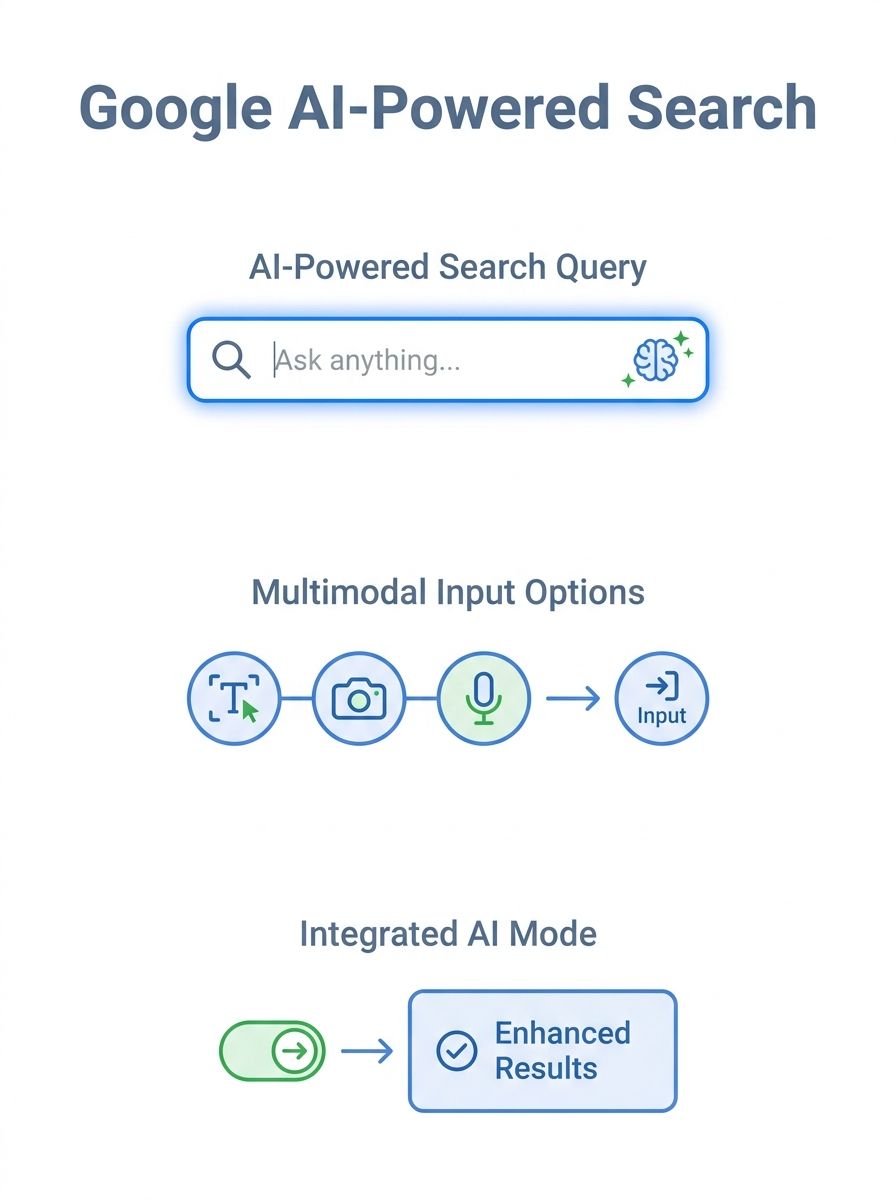
Google described the Search box redesign as its biggest upgrade in over 25 years. The interface now expands dynamically, accepts multimodal inputs including images and uploaded files, and surfaces AI-powered suggestions beyond traditional autocomplete functionality.
The redesign pairs with Gemini 3.5 Flash as the new default model in AI Mode. Information agents, previewed for summer 2026 launch, will monitor web sources and deliver proactive updates without user queries. Additional features include agentic booking capabilities, generative UI elements, and Personal Intelligence expansion to nearly 200 countries.
Jake Ward, SEO and content entrepreneur building Mentions, contextualized the changes within declining click-through patterns. "My feed is full of 'SEO is dead' posts today. But none of this should be a surprise," Ward wrote. "Clicks were already dying. We've watched CTR decline for 2-3 years straight now. However, search is very much alive, just different. We're moving further into a world of visibility > clicks."
The expanded Search box interface encourages longer, conversational queries that differ structurally from traditional keyword targeting. Content optimized for short-tail keywords may not surface effectively when users describe needs in full sentences prompted by the new interface design.
AI Mode Usage Data Reveals Behavioral Shift to Longer Queries
Google released internal usage data showing AI Mode has surpassed 1 billion monthly users, with query volume doubling each quarter since the feature's May 2025 launch. Searches submitted through AI Mode average three times the length of traditional Search queries, and follow-up query rates increase 40% monthly in the United States.
Over 16% of AI Mode searches use multimodal inputs combining voice, images, or video. Planning queries (product comparisons, service evaluations, research tasks) grew at 80% the rate of overall AI Mode usage in the six months preceding I/O.
Jeffrey Cohen, chief business development officer at Skai, highlighted the commercial implications of planning query growth. "Shoppers aren't typing 'running shoes.' They're asking 'what are the best running shoes for a wide foot that I can wear for a half marathon training on pavement under $150,'" Cohen wrote. "That's not a keyword. That's a brief. The brand that shows up during research owns the consideration phase."
Alisa Scharf, CAIO at Seer, pointed to measurement gaps. The usage metrics Google released derive from internal, unverifiable data, and AI Mode search trends remain unavailable in public tools including Search Console. Third-party AI search visibility tracking requires paid monitoring platforms, creating cost barriers for smaller agencies evaluating client performance in AI Mode.
The behavioral data indicates queries structured as questions or detailed descriptions rather than keyword phrases. Content formatted as direct answers to conversational queries has structural advantages in AI Mode extraction, consistent with generative engine optimization research showing quotation and statistic density drive citation rates.
The Takeaway
The May 2026 core update launches agencies into a two-week attribution blackout where ranking shifts, interface changes, and AI Mode model updates all affect visibility simultaneously. Businesses evaluating SEO agency performance during this period should baseline against pre-May 21 data and defer conclusions until at least one week post-rollout. Agencies rushing to interpret mid-rollout fluctuations risk misdiagnosing signal from noise.
The concurrent announcements reveal Google's directional commitment. The redesigned Search box structurally prompts longer queries. AI Mode usage data confirms users already submit 3x longer searches and follow up 40% more often. Information agents arriving this summer will synthesize web content proactively, reducing user initiation of searches altogether. Content strategies built exclusively on short-tail keyword targeting face declining match rates to actual query patterns, while competitors optimizing for conversational queries and answer extraction gain ground during this transition period.
Agencies should audit client content against AI Mode query patterns now documented at scale rather than waiting for visibility drops to force reactive changes. The planning query growth rate (80% of AI Mode's overall growth) signals high commercial intent shifting into AI-mediated research phases where brand mentions during consideration matter more than final-click attribution. Traditional analytics tying ROI solely to last-click conversions will undervalue this upstream visibility, creating board-level misalignment on SEO investment returns unless measurement frameworks expand to track AI Mode citation rates alongside organic traffic.
Marcus Webb
Digital marketing consultant and agency review specialist. With 12 years in the SEO industry, Marcus has worked with agencies of all sizes and brings an insider perspective to agency evaluations and selection strategies.
Related Articles

Google Announces AI-Powered Search Engine Running on Gemini Model at I/O 2026
Google announced at its I/O 2026 developer conference that Search will transition to an AI-powered answer engine running on the Gemini 2.5 Flash model, marking what the company described as its largest search overhaul in 25 years, according to coverage published July 13 by Laire Digital.
Google Deploys Autonomous Search Agents in Largest Platform Redesign Since 2001
Google announced its largest search engine update in 25 years on May 19, 2026, integrating autonomous AI agents that execute multi-step tasks, monitor topics in the background, and deliver proactive alerts without requiring user-initiated queries, according to the company's blog announcement at Goog
AI Mode Queries Now Triple Traditional Search Length as Non-Text Inputs Reach 16% of Volume
AI Mode queries average three times the length of traditional search inputs and incorporate non-text elements in more than 16% of searches, according to a May 19, 2026 analysis published by Shivani Mohan, Google's vice president of Data Science and UXR.
Explore more topics