
AI Search Visibility Gaps Are Reshaping Agency Skill Requirements: Why Your Team Needs These New Competencies Now
Five authority gaps keep professional service businesses invisible to ChatGPT, Gemini, and Perplexity, and the first one—absent entity recognition—is a competency that virtually no one on a typical SEO team was trained to address.
 Marcus Webb··10 min read
AI Search Visibility Gaps Are Reshaping Agency Skill Requirements: Why Your Team Needs These New Competencies Now
Five authority gaps keep professional service businesses invisible to ChatGPT, Gemini, and Perplexity, and the first one—absent entity recognition—is a competency that virtually no one on a typical SEO team was trained to address. That finding, published by AI Search Engineers, describes a mechanism most agency leaders haven't fully internalized: AI search engines don't rank pages. They build models of trusted entities from structured, consistent information scattered across authoritative sources, and then decide which entities deserve to be cited in an answer. The skill set required to influence that decision is fundamentally different from traditional search optimization, and that difference is now a hiring problem.
I've evaluated over 200 SEO agencies in my career, and in the past twelve months, the single biggest predictor of whether an agency can deliver results for clients isn't their link-building process or their content volume. It's whether they have anyone on staff who understands how AI systems select, verify, and cite brand entities. The agencies that do are winning new business. The agencies that don't are losing existing accounts to competitors who figured this out six months earlier.
How AI Search Engines Build Entity Models
Traditional search engines crawl pages, index content, and return a ranked list. AI search engines do something structurally different. They construct an internal representation of entities—companies, people, products, concepts—by synthesizing information from dozens or hundreds of sources. When a user asks ChatGPT "What's the best CRM for small law firms?" the model doesn't look up a ranked page. It consults its entity model to determine which brands have enough consistent, corroborated information to be cited with confidence.
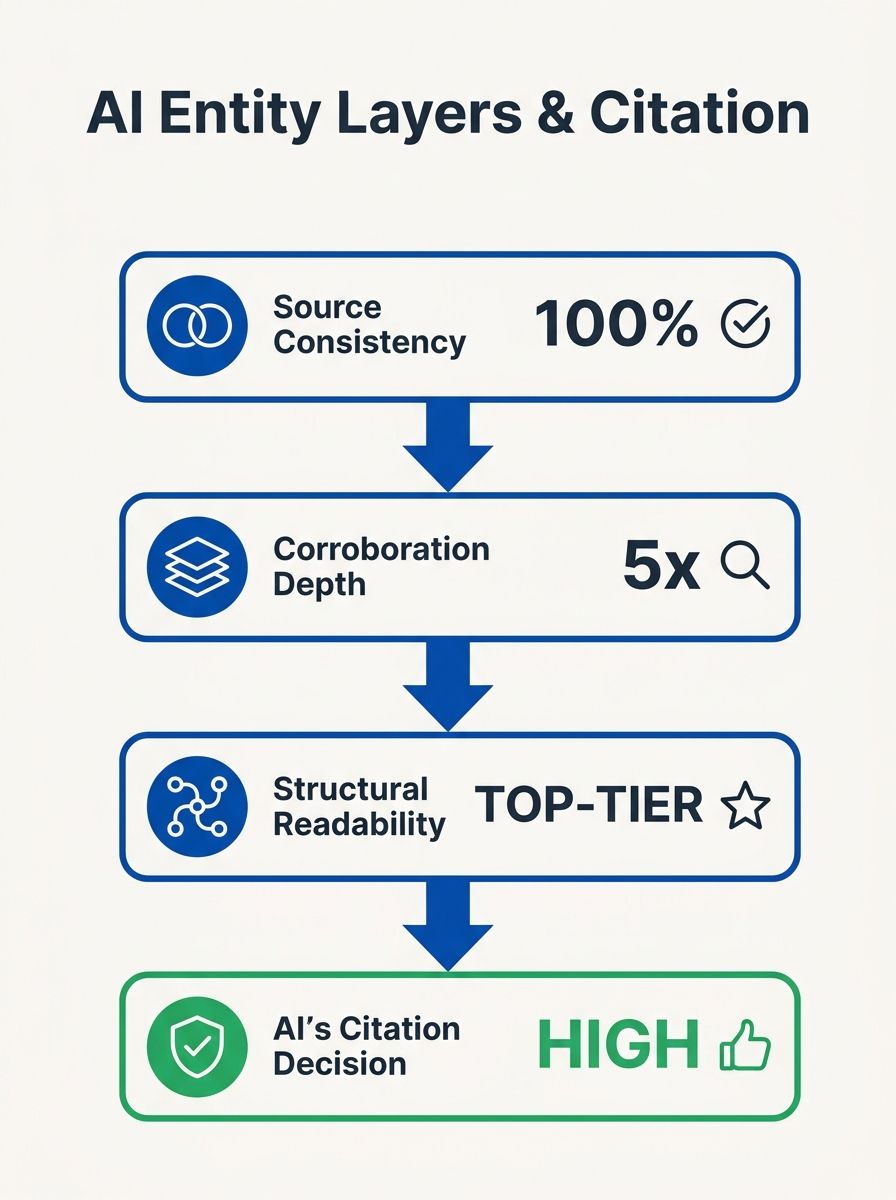
This is the core mechanism your team needs to understand before you can hire for it. As Frase.io's practitioner guide puts it, entity optimization is how you make AI search engines recognize, trust, and cite your brand. The process works in layers:
Source consistency: Does the brand's name, description, and core claims appear the same way across its website, Wikipedia, LinkedIn, industry directories, press mentions, and review platforms?
Corroboration depth: How many independent, authoritative sources mention this entity in a relevant context?
Structural readability: Can the AI system's retrieval layer parse this information cleanly, or is it buried in ambiguous paragraphs with no schema markup?
When any of these layers is weak, the entity model for that brand stays thin. A thin entity model means the AI won't cite that brand, even if the brand's website ranks on page one of Google for every relevant query.
This is why the fragmentation of the SEO agency market has accelerated so quickly. Agencies built for page-level ranking optimization are discovering that their entire operational model targets the wrong unit of analysis. The unit that matters in AI search is the entity, and the skills required to optimize at that level look different from anything in a traditional SEO playbook. If you're evaluating agencies right now, the ones shifting toward AI-driven market positioning have a structural advantage over generalist shops still running the 2020 playbook.
Entity Recognition Optimization as a Hiring Competency
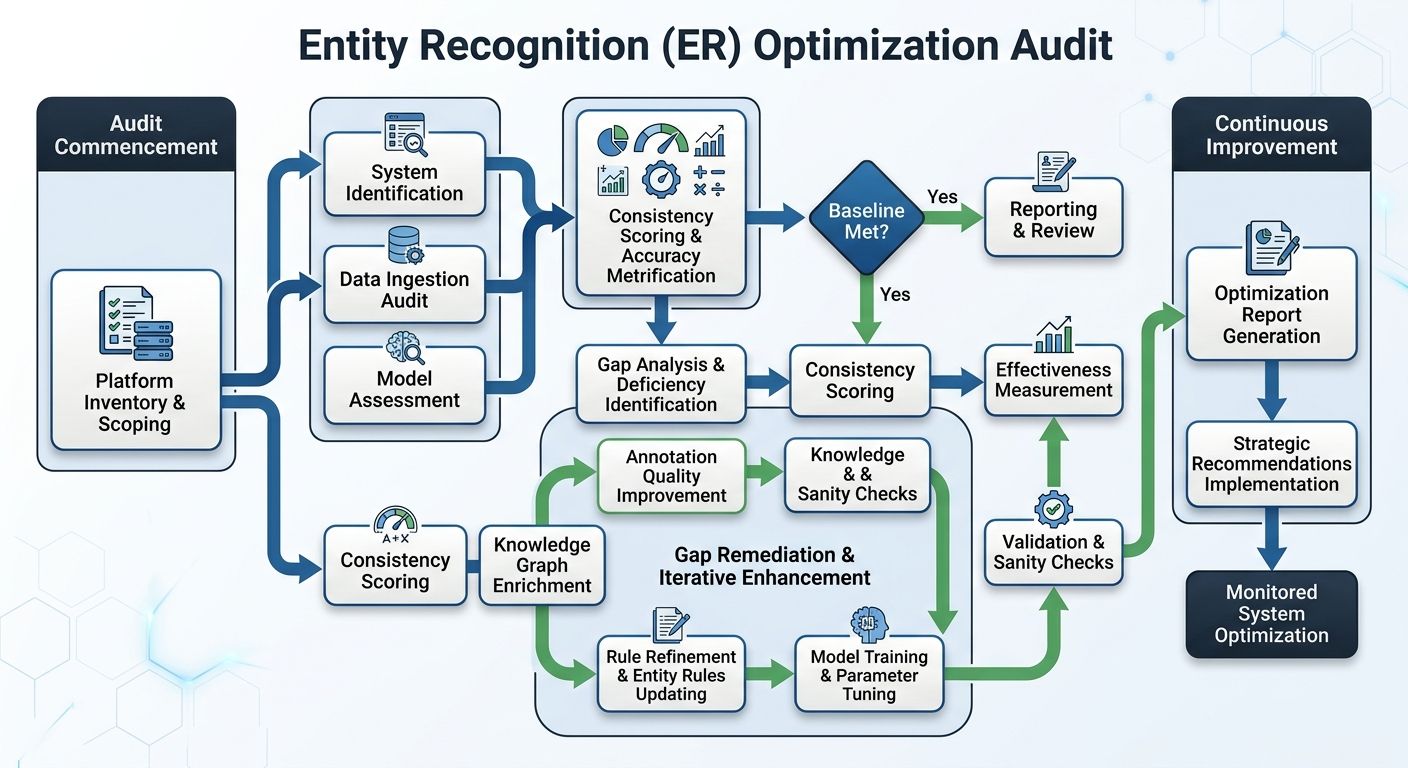
So what does entity recognition optimization actually require from a practitioner? It's a blend of structured data expertise, brand consistency auditing, and knowledge graph literacy that doesn't map neatly onto any existing SEO role.
The person doing this work needs to be able to:
Audit a brand's presence across 15-20 authoritative platforms and identify inconsistencies in naming, descriptions, categories, and claims
Implement and validate Organization, Person, Product, and FAQ schema across all owned properties
Evaluate whether a brand has a Knowledge Panel and, if not, diagnose what's missing from Google's entity understanding
Map the competitive entity landscape by querying AI systems directly and documenting which competitors get cited and from which sources
Build a cross-platform entity alignment strategy that treats Wikipedia, Wikidata, Crunchbase, LinkedIn, and industry directories as part of a unified signal set
Search Engine Land's reporting on entity authority confirms this pattern: the brands establishing AI-era dominance are engineering entity authority by moving beyond page-level thinking entirely.
When I'm reviewing an agency's team structure, I look for whether they've created a dedicated role or at least a defined responsibility area for this work. The agencies charging $5,000-$15,000/month for AI visibility services typically have at least one person whose primary job is entity management. The agencies trying to bolt this onto an existing technical SEO role are consistently underdelivering, because the workflows compete for attention and the entity work gets deprioritized in favor of familiar tasks with more obvious short-term metrics.
The AI Search Visibility Audit: A Different Kind of Technical Review
A traditional SEO audit checks crawlability, indexation, page speed, internal linking, and content quality. An AI search visibility audit overlaps with maybe 30% of that checklist and then diverges sharply into territory most SEO professionals haven't been trained on.
The audit needs to answer questions like: When a user asks an AI system about your client's industry, does the client get mentioned? If yes, from which training sources is the AI likely pulling? If no, which of the five authority gaps (absent entity recognition, inconsistent brand signals, missing structured data, low third-party corroboration, or stale content) is the primary blocker?
Running an effective AI search visibility audit requires a person who can systematically query ChatGPT, Gemini, Perplexity, and Claude with dozens of prompts relevant to the client's business, document the results, identify patterns in which competitors are cited, and trace those citations back to source material. This is methodical, analytical work that shares more DNA with competitive intelligence than traditional SEO auditing.
The practical skills involved include:
Prompt engineering for diagnostic queries (not creative prompts, but structured queries designed to expose how AI models categorize an industry)
Source attribution analysis, particularly understanding when an AI cites from a press release versus an earned media mention versus a product page
Gap mapping between Google SERP visibility and AI citation frequency, because the correlation between the two is weaker than most people assume
If your team already has people skilled at diagnosing visibility drops in traditional search, they have a foundation to build on. But the diagnostic framework for AI visibility is different enough that dedicated SEO agent skills training is necessary to bridge the gap.
Tracking AI Referral Traffic Without Guessing
Here's where most agencies fall apart operationally: they can't measure what's working. AI referral traffic tracking is genuinely difficult because AI systems don't always send traffic with clean referrer data. Some AI-generated answers satisfy the user's query entirely, producing zero clicks. Others send traffic that shows up in Google Analytics as direct or unassigned.
According to Contentsquare's analysis, you can track AI-originated visitors using Google Analytics and product analytics tools, but it requires deliberate setup. The default GA4 configuration doesn't segment AI referral traffic meaningfully. You need custom channel groupings that capture referrals from chat.openai.com, perplexity.ai, claude.ai, and other AI platforms. And even then, Yotpo's research confirms that tools like BrightEdge and various AI-specific rank trackers are needed to automate the monitoring, because manual tracking across multiple AI platforms doesn't scale.
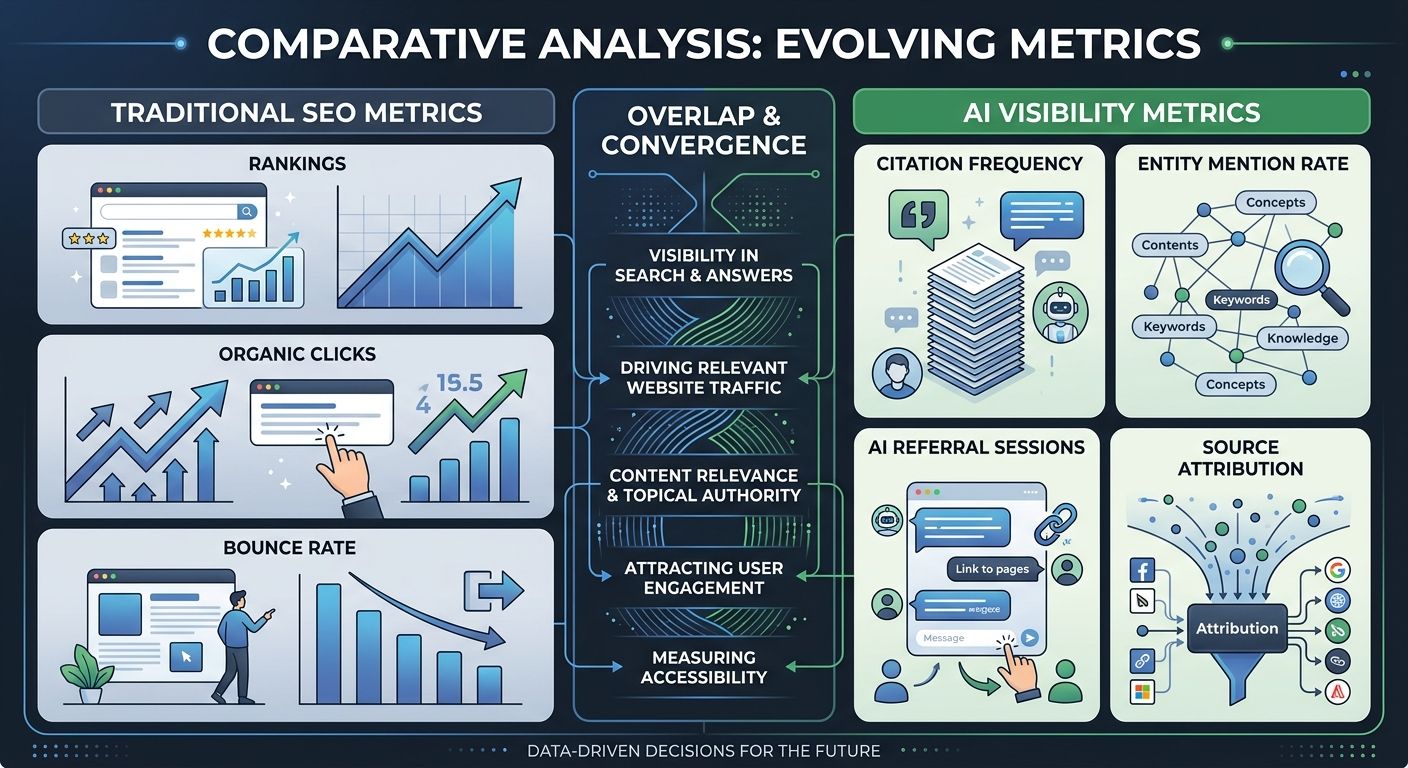
The hiring implication is significant. The person who sets up and maintains AI referral traffic tracking needs to be comfortable in GA4's custom channel configuration, familiar with regex-based referrer filtering, and capable of building dashboards that separate AI-attributed sessions from other traffic. They also need to understand that citation tracking (is the brand being mentioned in AI answers?) is a parallel metric to traffic tracking (are users clicking through from those answers?). These are related but distinct measurements, and the team member responsible needs to track both.
For agencies building this capability, the measurement layer is where I see the most hiring gaps. Technical SEO specialists can learn entity optimization relatively quickly. But the analytics and attribution work requires someone who already has strong data skills and can adapt them to a new channel with messy, incomplete data.
Where the Hiring Pipeline Actually Exists
If you're looking to staff these roles today, you'll find the candidate pool is thin and the salary expectations reflect that scarcity. The people who have genuine experience in entity recognition optimization and AI visibility auditing tend to come from one of three backgrounds:
Knowledge graph specialists who worked in enterprise SEO or data engineering roles, building and maintaining structured data systems. They understand ontologies, schema hierarchies, and how search engines construct entity relationships. Salary range I'm seeing: $90,000-$140,000 for mid-level, $150,000+ for senior roles at agencies in major markets.
Technical SEO practitioners who self-taught AI visibility work in the past 18 months. These folks typically came from agencies that were early movers on AI-driven search strategy and had the opportunity to experiment. They're the most immediately productive hires but also the hardest to find, because their current employers know what they have.
Digital PR professionals who understand source attribution. The research is clear that over 75% of AI-generated brand references originate from earned media, third-party mentions, and PR-driven content. People who already think in terms of "where is our brand mentioned and by whom" can transition into AI visibility roles faster than traditional SEO practitioners, especially if they have some technical aptitude.
What I'd caution against is hiring purely based on certification programs. The Coursera and Udemy courses covering GEO and AEO fundamentals provide useful introductions, and I recommend them for upskilling existing team members. But completing a course doesn't substitute for the pattern recognition you develop from running actual AI visibility audits across multiple client verticals. Training is the starting point for SEO agent skills training, not the finish line.
How These Roles Interact with Existing SEO Teams
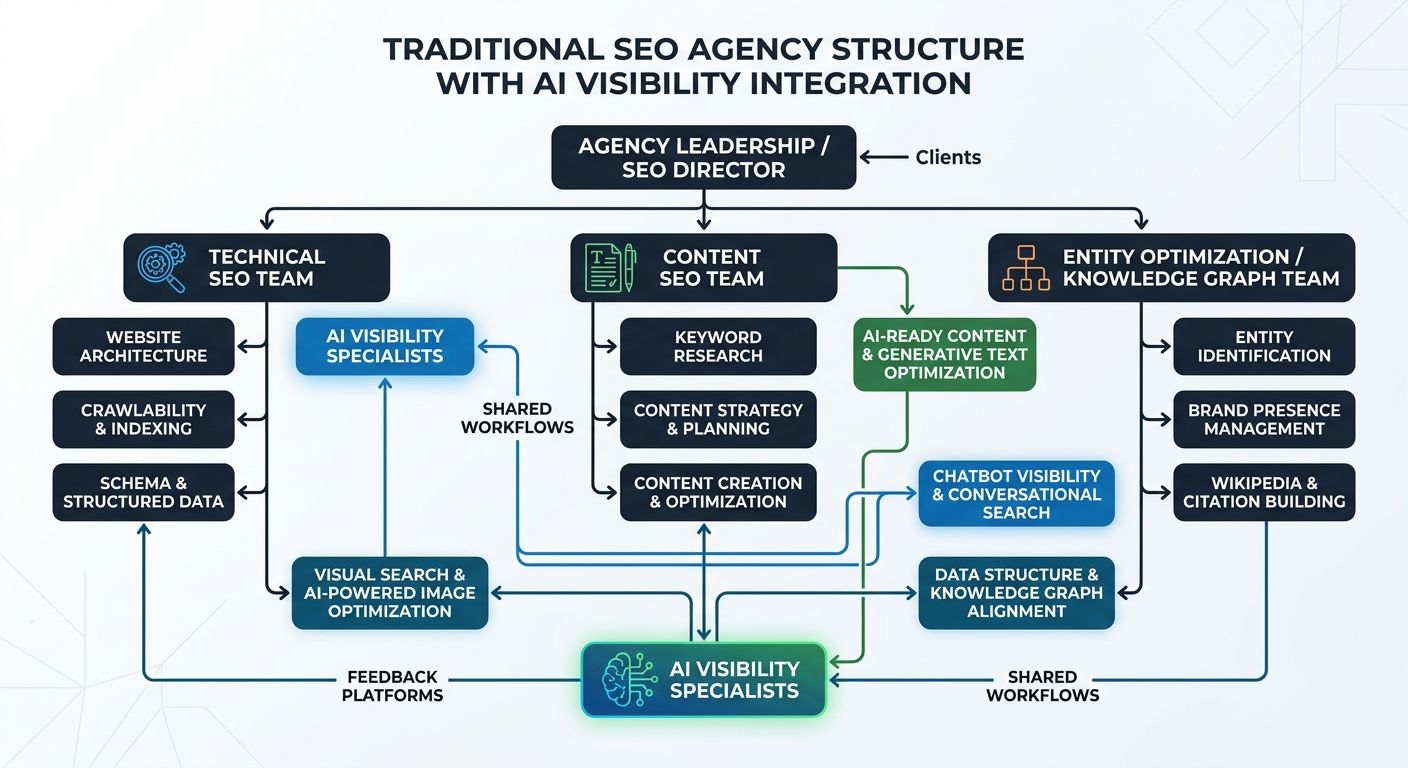
One mistake I see agencies making is creating an isolated "AI visibility team" that operates separately from the core SEO function. This creates coordination problems, because entity optimization and traditional SEO share dependencies. Your site architecture decisions affect both channels. Your content strategy feeds both channels. Your technical infrastructure either supports or undermines both.
The mechanism that works better in practice: embed the AI visibility competencies within existing teams, but with clear ownership. One person (or a small pod on larger accounts) owns the AI visibility audit, entity consistency tracking, and AI referral measurement. They sit inside the same workflow as the technical SEO team and the content team, participating in the same planning cycles and sprint reviews. Their work generates tasks that flow into the existing production pipeline rather than creating a parallel one.
This integration model requires that everyone on the team has at least baseline literacy in how AI search engines work, even if they're not the specialist. Your content writers need to understand that AI systems extract answers from clearly structured paragraphs, not keyword-optimized walls of text. Your technical SEO team needs to understand that schema markup errors don't just affect rich snippets anymore; they affect whether AI systems can parse the entity information at all. Your link builders need to understand that the expanded ranking factors in AI search weight third-party corroboration differently than traditional backlink profiles.
The Tradeoffs in Building This Team
Building AI visibility competencies is expensive, the measurement frameworks are immature, and the return on investment is harder to prove than traditional SEO work where you can point to ranking improvements and organic traffic graphs. These are real constraints, and agencies that ignore them will either overspend or oversell.
The measurement immaturity is the biggest operational risk. When 80% of companies don't monitor their AI brand mentions at all, you're operating in an environment where benchmarks barely exist and client expectations haven't been calibrated by market norms. Promising a specific percentage increase in AI citations during a sales pitch is reckless, because the baseline data is usually nonexistent and the variables that influence AI citation are partially opaque.
The skill obsolescence risk is also real. AI search engines are iterating their retrieval and citation mechanisms rapidly. The specific entity signals that drive citations in Gemini today might shift in six months. The team you build needs to be composed of people who can adapt to changing systems, not people who memorized a static playbook.
And the ROI conversation with clients is genuinely hard. A client whose brand starts appearing in ChatGPT answers for high-intent queries is getting value, but quantifying that value in dollar terms requires attribution models that are still being developed. The agency needs to set expectations honestly: we believe this drives business outcomes, here's our logic, and here's how we'll measure what we can. The agencies that oversell AI visibility as a guaranteed pipeline driver are setting themselves up for the same credibility collapse that happened with agencies guaranteeing rankings a decade ago.
Despite these tradeoffs, the direction is clear. Over 60% of Google queries now result in zero clicks due to AI Overviews. The brands that build entity authority and maintain AI visibility are positioned for a search landscape that increasingly favors citation over clicks. The agencies that build teams capable of delivering this work will capture the accounts that matter most. The agencies that wait for the playbook to stabilize will find that their competitors already wrote it.
Marcus Webb
Digital marketing consultant and agency review specialist. With 12 years in the SEO industry, Marcus has worked with agencies of all sizes and brings an insider perspective to agency evaluations and selection strategies.
Related Articles

Why Recognition Beats Rankings in 2026: How SEO Agencies Should Pivot Their Authority Strategy
The slide deck that convinced a $4M ARR fintech company to sign a 12-month agency retainer showed fourteen keyword ranking improvements, zero AI citation metrics, and no mention of entity authority anywhere in the strategy section.
From Google Search to AI Assistants: How B2B Agencies Must Rebuild SEO Strategy Beyond Traditional SERP Rankings
Three of the five B2B agency contracts sitting on my desk right now define success exclusively as Google organic ranking improvements and click-through traffic growth. The agencies that wrote those contracts aren't incompetent.

Answer Engine Optimization vs. Traditional SEO: How AI Search Engines Are Rewriting the Rules (And What Your Agency Should Do Now)
Paid click-through rates have dropped 68% on Google queries that trigger AI-generated summaries, according to tracking data compiled this spring across multiple enterprise SEO platforms.
Explore more topics