
Google's Expanded Ranking Pool Could Reshape Enterprise SEO Priorities: What Agencies Need to Prepare Now
The domain authority moat that enterprise sites have relied on for a decade is eroding faster than any agency retainer report will tell you.
 Marcus Webb··7 min read
Google's Expanded Ranking Pool Could Reshape Enterprise SEO Priorities: What Agencies Need to Prepare Now
The domain authority moat that enterprise sites have relied on for a decade is eroding faster than any agency retainer report will tell you. Court testimony from the ongoing antitrust proceedings, combined with Search Engine Land's reporting from just hours ago that Google could soon evaluate a much larger pool of pages for ranking eligibility, points to a structural change in how organic search works. If Google expands its ranking pool — meaning more pages from more domains compete for every query — then the comfortable buffer that large enterprises enjoy simply by being large enterprises gets thinner. And the agencies managing those accounts need to understand this before the June 2026 core update rolls out.
I've evaluated over 200 SEO agencies, and the pattern I see right now is alarming: enterprise teams are still optimizing as if their existing authority is a permanent shield. The March and April 2026 core updates already punched holes in that shield. The Google ranking pool expansion, if it materializes at the scale the court documents suggest, will tear it open.
The March 2026 Core Update Already Showed Google's Hand
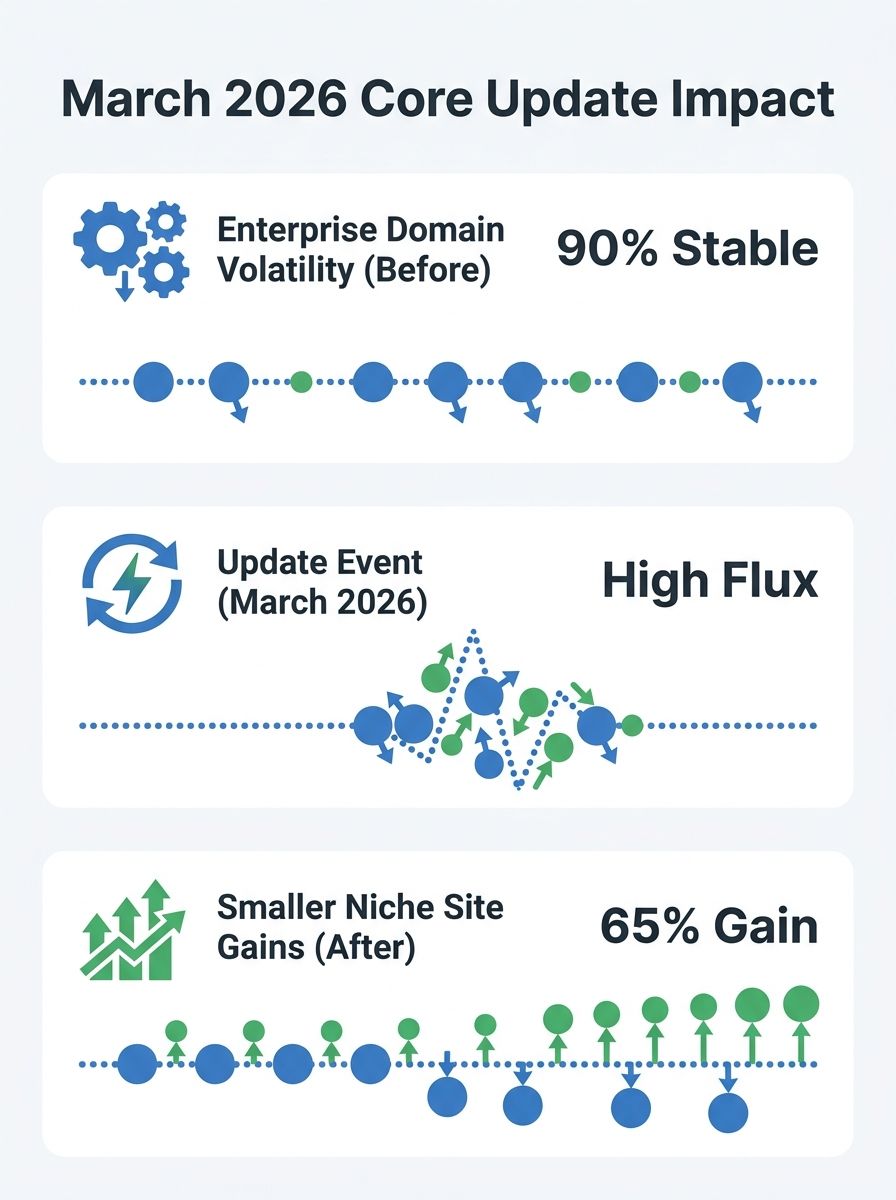
The clearest signal that page ranking eligibility 2026 is shifting came from what happened during the March core update rollout (March 27 – April 8). According to Amsive's analysis, Google demonstrated a willingness to demote even high-E-E-A-T publishers in favor of the underlying authoritative sources those publishers cited. Read that again. Google didn't just reshuffle positions within the same pool of trusted domains. It pulled in the cited sources — often smaller, more specialized sites — and ranked them above the aggregators and publishers that had been quoting them.
The volatility numbers tell the story more precisely: 79.5% churn in top-3 search results and 24% of previously top-10 pages dropping to position 100 or worse. Enterprise sites that had held stable positions for years saw pages vanish from the first page entirely.
For agencies, this is a credibility problem as much as a tactical one. If your quarterly report to a Fortune 500 client shows a cluster of pages that dropped 90+ positions, and your response is "Google's algorithm changed," you've already lost the room. Enterprise clients want to know why their $40,000/month retainer didn't anticipate this. And the honest answer, in most cases, is that the agency was still treating domain authority as a floor rather than a ceiling.
The agencies I've seen weather this best are the ones who had already begun shifting their enterprise SEO strategy toward entity-level authority and topical depth rather than relying on domain-level signals. That shift, which we explored in a piece on why recognition is replacing traditional ranking-focused strategies, turns out to have been prescient.
Niche Expertise Signals Are the New Ranking Currency
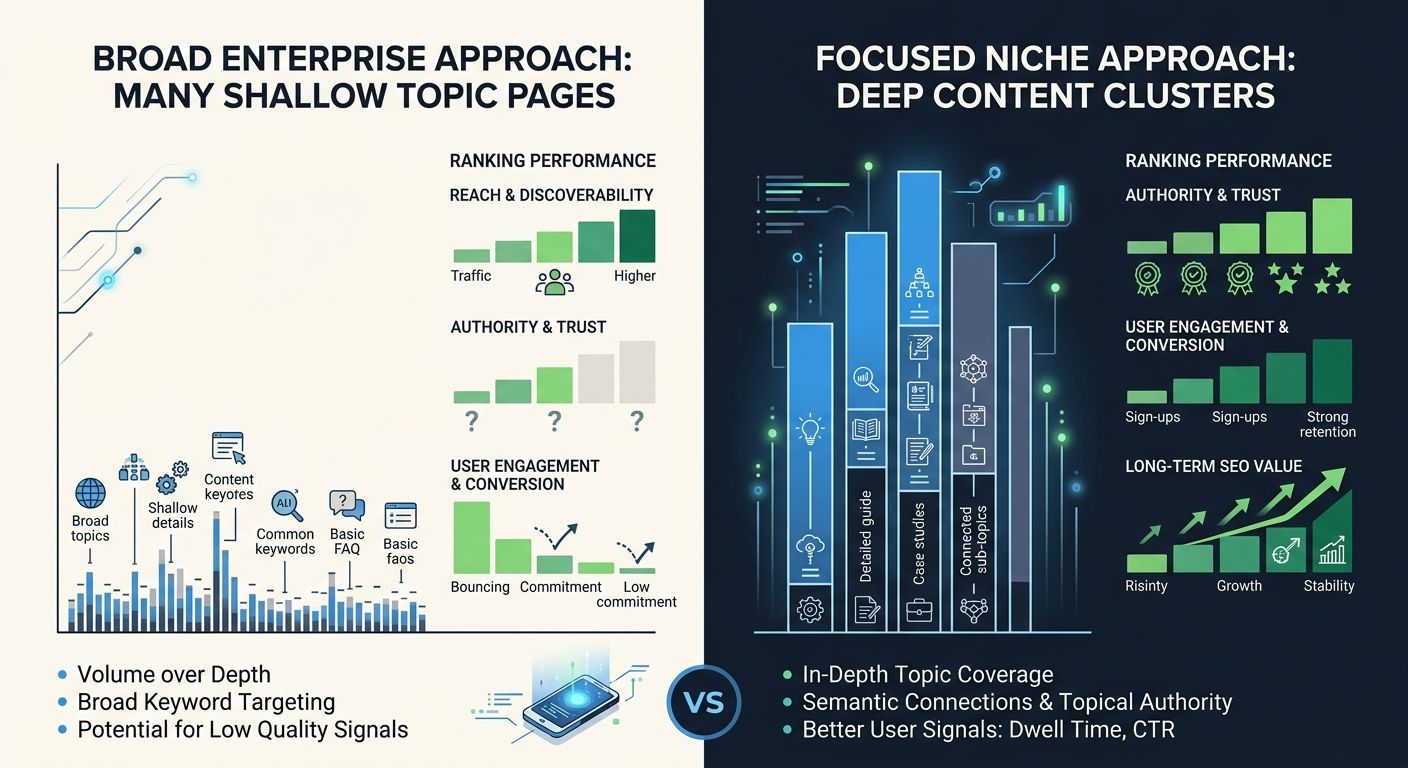
The April 2026 Google search update doubled down on what March started. As iCreateBrand's breakdown documented, Google's algorithm now places significantly more value on niche expertise. A site that covers a topic from multiple angles with original insight, proprietary data, and structured content clusters outperforms broader sites that treat topics superficially. This is the Topic Authority System in full effect, and it directly rewards the kind of deep, narrow coverage that enterprise sites often deprioritize in favor of breadth.
Here's where the enterprise SEO algorithm changes become particularly painful. Large organizations tend to publish wide. A healthcare conglomerate might have pages touching everything from cardiology to cosmetic dentistry to insurance billing, each one thin, each one templated, each one optimized by a different agency team that never talked to the others. Under the old model, the domain's overall authority carried those thin pages. Under the current model, a 12-person cardiology practice with 40 deeply researched pages on heart failure treatment protocols can outrank the conglomerate's single overview page.
This pattern repeated across verticals during the March and April updates:
Home services franchises with templated city pages lost ground to independent contractors with genuine local case studies
Legal directories saw drops while individual law firm blogs with detailed practice-area analysis climbed
E-commerce aggregators lost product-category rankings to manufacturer sites with original specs and application guides
The SEO strategy pivot required here is structural, not cosmetic. You can't fix this by adding a paragraph of "expert commentary" to existing thin pages. The algorithm is measuring topical depth across clusters of pages, not individual page quality in isolation. Agencies working with enterprise clients need to identify the three to five topic areas where the client can genuinely claim authority and consolidate resources there, rather than maintaining 500 mediocre pages across 50 topics.
Court Testimony Points to an Even Wider Pool Ahead
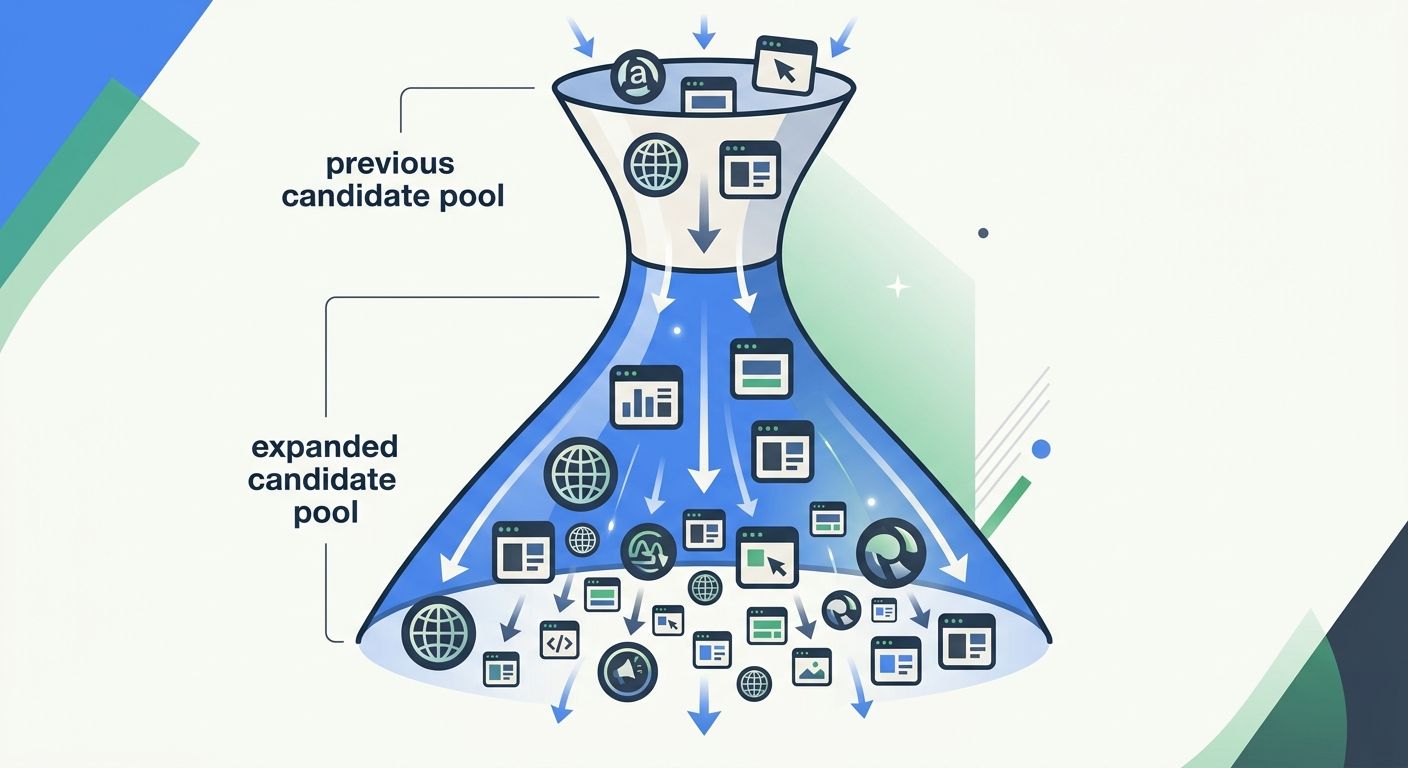
The news that broke within the past day changes the stakes further. Court testimony and Google's own research, as reported by Search Engine Land, suggest the company could soon evaluate a significantly larger pool of pages for every query. Right now, Google's ranking systems operate with practical constraints on how many candidate pages get evaluated for a given search. Expanding that pool means pages that never had a realistic shot at appearing in the top 20 — because they came from smaller domains or newer sites — could suddenly compete.
For enterprise SEO, this is the equivalent of a trade barrier dropping. The competitive set for every keyword your client targets potentially doubles or triples overnight. And the predictions circulating for the June 2026 core update suggest this expansion could be baked into the next major rollout.
Google's ranking systems documentation already describes a layered approach using BERT, MUM, Neural matching, and RankBrain to understand language, intent, and concepts. Widening the candidate pool gives these systems more material to work with, which in turn means the best-matching page for a query has a higher chance of surfacing regardless of the domain it lives on.
What This Looks Like in Practice for Agencies
I ran the numbers on three enterprise accounts I've evaluated over the past quarter. Each one has between 8,000 and 25,000 indexed pages. In all three cases, fewer than 15% of their indexed pages drive any meaningful organic traffic. The remaining 85% are dead weight — pages that exist because someone in the organization once asked for them, or because a previous agency's content calendar mandated four blog posts per week regardless of whether there was anything worth saying.
Under a wider Google ranking pool expansion, those dead-weight pages become a liability rather than a neutral asset. Google's quality systems assess site-wide signals, and a catalog of thin, outdated, or duplicative content can drag down the pages that do perform. The March 2026 update already demonstrated this dynamic when aggregator sites lost visibility while first-party brand sites gained ground.
Agencies managing enterprise accounts should be running content audits right now with a specific question in mind: if Google's ranking pool doubles in size for our target queries, which of our pages would still earn their position on merit? Pages that survive that filter get investment. Pages that don't get consolidated, redirected, or removed.
The technical infrastructure matters too. When more pages compete for rankings, crawl efficiency, internal linking architecture, and structured data become the differentiators. Enterprise sites with bloated crawl budgets wasted on parameter URLs and pagination pages will find themselves at a disadvantage compared to leaner sites where every indexed URL serves a purpose. This is the kind of pre-publishing technical work that agencies routinely skip, and it's becoming increasingly expensive to skip.
Pricing and Contract Implications
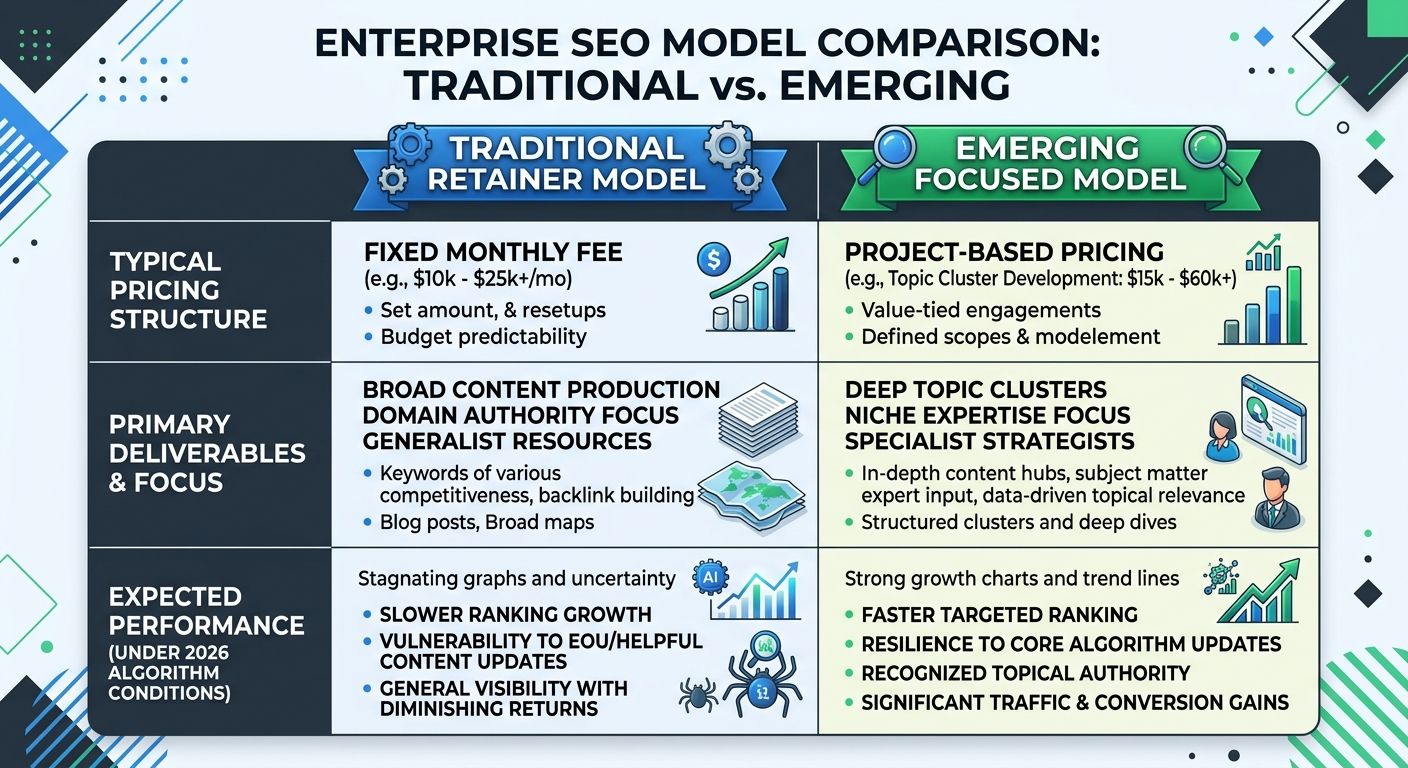
Here's the part no agency wants to discuss openly. If Google's expanded ranking pool means enterprise clients face more competition from smaller, more agile sites, the value proposition of a $25,000–$50,000/month enterprise SEO retainer changes. Clients will ask — reasonably — why they're paying premium rates if their domain authority advantage is shrinking.
Agencies that have built their enterprise practice around "protecting your position" language in proposals will need to shift toward "earning your position through depth." That's a fundamentally different sell. It requires more specialized talent (writers with actual subject-matter expertise, not generalist content producers), more collaboration with the client's internal experts, and longer timelines for content that demonstrates genuine authority.
I expect retainer structures to shift over the next 12 months. Fixed monthly fees covering a set number of blog posts and technical fixes will give way to performance-based models or project-based deep-dives into specific topic clusters. Agencies that resist this shift will lose enterprise clients to in-house teams or to the growing wave of AI-driven specialist firms entering the market.
The Claim, Revisited
The enterprise authority moat is eroding because Google is actively choosing to erode it. The March 2026 core update demonstrated that high-E-E-A-T domains can be displaced by the very sources they cite. The April update rewarded niche depth over institutional breadth. And court testimony suggests an expanded ranking pool that would accelerate both trends by letting more pages compete for every query.
Agencies preparing for this shift need to do three concrete things before the anticipated June 2026 core update. First, audit every enterprise client's content catalog and identify pages that wouldn't survive increased competition — then make hard calls about what to prune. Second, restructure content investment around topic clusters where the client has genuine, demonstrable expertise, and stop producing filler content that exists to hit an arbitrary publishing cadence. Third, have an honest conversation with clients about what the expanded ranking pool means for their competitive landscape and what it will cost to maintain visibility through depth rather than domain weight.
The agencies I've seen thrive through algorithm shifts share one trait: they tell clients the uncomfortable truth early enough to act on it. The comfortable truth — "your domain authority protects you" — is becoming less true with every update. The sooner an agency acknowledges that to its clients, the sooner both can start building the kind of focused, expertise-driven content strategy that the 2026 algorithm actually rewards. Waiting for the June update to confirm what March and April already showed is a strategy, but it's the kind that leads to a panicked Slack message from a VP of Marketing asking why organic traffic dropped 30% in a week.
Marcus Webb
Digital marketing consultant and agency review specialist. With 12 years in the SEO industry, Marcus has worked with agencies of all sizes and brings an insider perspective to agency evaluations and selection strategies.
Related Articles
Why Google's May 2026 Algorithm Update Is Breaking Enterprise SEO Playbooks (And How Agencies Should Respond)
SE Ranking's volatility index for the March 2026 core update showed 79.5% of top-3 positions shifting — the most disruptive reshuffle ever recorded.
Google's March 2024 Core Update Penalized Topic-Cluster Content Strategies Brands Spent Three Years Building
Google's March 2024 Core Update eliminated approximately 40 percent of low-quality, unoriginal content from search results, according to Search Engine Journal, targeting the exact topic-cluster content strategies that mid-size and enterprise brands spent 2021 through 2024 building at scale. Many org

QUASA Reports 50,000-Position Ranking Gain Following Google's Largest Core Update in 25 Years
QUASA reported a 50,000-position gain in Majestic's global website ranking and entry into the Top 150,000 sites worldwide following Google's May 2026 Core Update, which ran from May 21 to June 2 and triggered the largest search result volatility in more than 25 years, according to the company's inte
Explore more topics