
Google Publishes Official AI Search Guidance, Rejects Industry's GEO and AEO Optimization Frameworks
Google has published official documentation clarifying how its AI Overviews and AI Mode function, explicitly stating that "Generative Engine Optimization" and "Answer Engine Optimization" are not distinct practices from traditional SEO, according to guidance published on Cyber Kendra analyzing the 2
 Marcus Webb··4 min read
Google Publishes Official AI Search Guidance, Rejects Industry's GEO and AEO Optimization Frameworks
Google has published official documentation clarifying how its AI Overviews and AI Mode function, explicitly stating that "Generative Engine Optimization" and "Answer Engine Optimization" are not distinct practices from traditional SEO, according to guidance published on Cyber Kendra analyzing the 2025-updated documentation. The guidance debunks widespread industry advice about specialized AI optimization techniques, stating that the same Search infrastructure and ranking signals power both traditional results and AI-generated summaries.
The documentation carries immediate implications for SEO agencies that have built service offerings around AI-specific optimization strategies. Google's position undermines the market positioning of consultants selling "AEO audits" or "GEO strategies" as distinct from standard SEO services, suggesting these offerings lack technical differentiation that Google itself recognizes.
How AI Overviews Actually Retrieve Content
Google's guidance details two core mechanisms powering AI-generated search results. Retrieval-Augmented Generation (RAG) queries Google's primary Search index to fetch relevant pages, which the AI then reads before generating responses, the documentation explains. The clickable source links visible in AI Overviews represent the pages that were actually retrieved from this query.
Query fan-out operates by generating multiple related sub-queries simultaneously when users submit complex searches. A query such as "how to recover from a Google core update" triggers separate retrieval operations for related topics including recovery timelines, quality signals, and impact indicators, according to the guidance.
"There's no separate 'AI index' to get into," the documentation states. Pages that rank well in organic search and maintain crawlable snippets already qualify for AI Overview inclusion. The infrastructure remains identical to traditional Search systems.
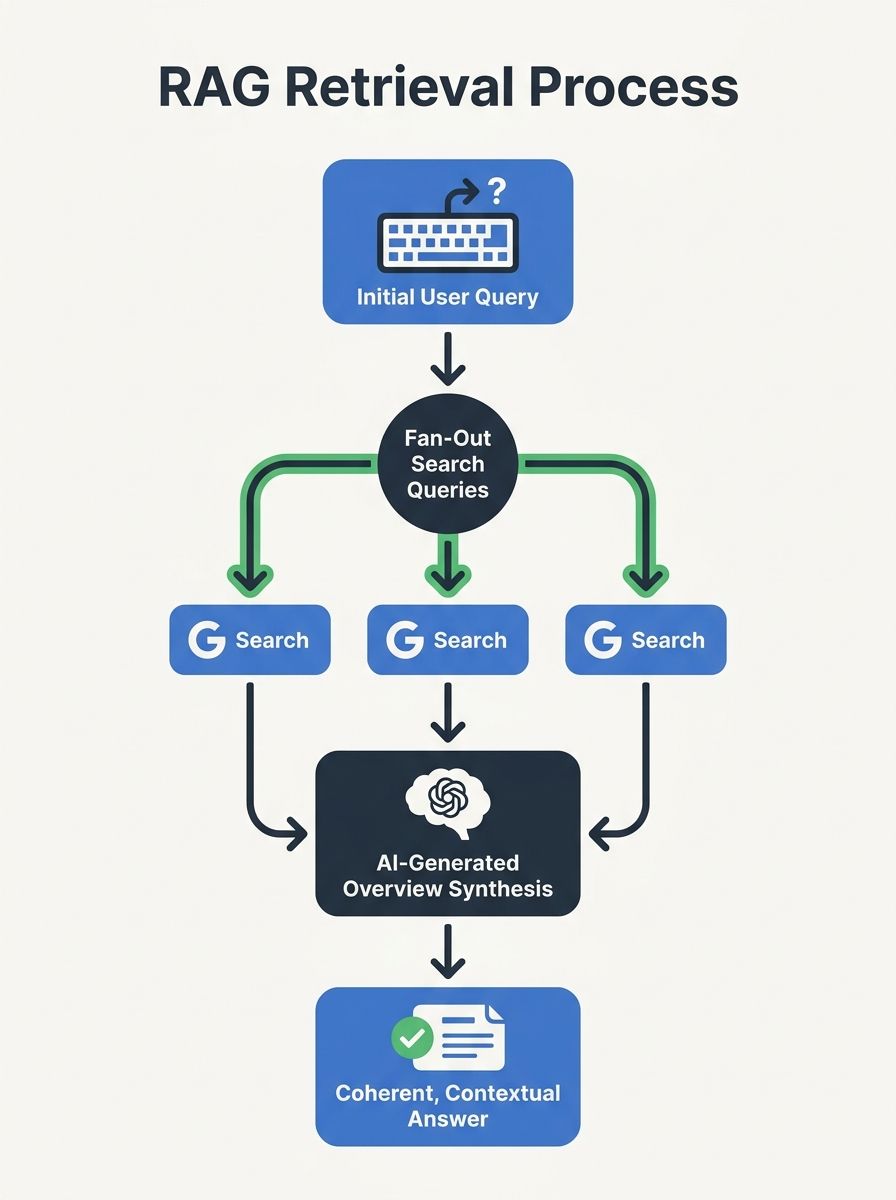
This technical explanation contradicts industry advice about creating specialized content formats for AI systems. The guidance indicates optimization efforts should target the same ranking infrastructure that has always existed, rather than imagining a parallel system with different requirements.
Commodity Versus Non-Commodity Content Distinction
Google's documentation introduces what it describes as "the single most important concept" for AI search visibility: the divide between commodity and non-commodity content. Commodity content consists of information that could originate from any source, the guidance explains. Topics such as "10 cybersecurity tips for small businesses" or "What is phishing?" have been covered extensively across the web, allowing AI models to generate answers without consulting specific sources.
Non-commodity content contains information that exists only because a particular publisher produced it. First-hand analysis of security incidents, documented test results using proprietary criteria, or breach post-mortems with root cause analysis qualify as non-commodity content, according to the documentation. "The difference isn't just about depth," the guidance states. "It's about whether your content contains information that exists only because you produced it."
Google provides a direct comparison: "7 Tips for First-Time Homebuyers" represents commodity content, while "Why We Waived the Inspection & Saved Money: A Look Inside the Sewer Line" demonstrates non-commodity content with a perspective that cannot be replicated. The second example reports specific decisions and outcomes that only the author experienced.
For publishers in technical fields, the distinction separates articles that rewrite vendor advisories from pieces that add timeline analysis, compare vulnerabilities to prior incidents, or provide independent reproduction steps. AI systems have no particular reason to cite commodity content when they can generate equivalent information themselves, the documentation explains.
Google's Position on AEO and GEO Services
The guidance directly addresses industry terminology around "Answer Engine Optimization" and "Generative Engine Optimization." Google's official position states these are "just SEO" using the same signals and systems as traditional search optimization, according to the documentation. This represents explicit pushback against the premise that AI search requires separate strategic frameworks.
The implication challenges consultants who have built service lines around these acronyms. Google does not recognize AEO or GEO as distinct technical practices requiring specialized audits or strategies beyond standard SEO methodology.
The documentation acknowledges one practical nuance: while underlying ranking signals remain identical, AI synthesis emphasizes citability. Pages must structure content clearly enough for AI systems to extract specific claims, quote explanations, or attribute data points. A page can rank well in organic results but never appear in AI Overviews if its content lacks extractable structure, the guidance notes.
"The distinction isn't about a different algorithm," the documentation states. "It's about readability and extractability — which are good writing practices anyway." This framing positions AI-friendly content as an extension of existing editorial quality standards rather than a new technical requirement.
The guidance's timing coincides with growing concern among agencies about how AI-driven search is fragmenting the SEO market, with some firms pivoting to specialized AI optimization offerings. Google's documentation suggests this pivot may rest on a technical misunderstanding of how AI search systems actually function.
Services Implications
SEO agencies that have launched dedicated GEO or AEO service lines face immediate positioning challenges. Google's explicit statement that these practices represent standard SEO rather than distinct disciplines undermines the value proposition of specialized AI optimization packages. Agencies charging premium rates for "AI-specific audits" must either rebundle these services as part of core SEO offerings or defend differentiation that Google does not acknowledge.
The commodity versus non-commodity framework provides clearer strategic direction. Agencies should audit client content portfolios to identify which pieces contain proprietary information, first-hand analysis, or original research that AI systems cannot replicate. Generic "best practices" content that mirrors thousands of existing pages offers minimal citation value in AI results, regardless of optimization technique. This shifts content strategy emphasis from volume production toward editorial differentiation and primary source development.
For agencies evaluating internal skill requirements, the guidance suggests investment in traditional SEO fundamentals remains more valuable than specialized AI optimization training. Content structure, entity clarity, and source authority — the same signals that have always driven search visibility — determine AI Overview inclusion. Firms that pursued separate answer engine optimization frameworks as distinct from core SEO practices should recalibrate resource allocation toward unified search strategies rather than parallel optimization tracks.
Marcus Webb
Digital marketing consultant and agency review specialist. With 12 years in the SEO industry, Marcus has worked with agencies of all sizes and brings an insider perspective to agency evaluations and selection strategies.
Related Articles
Google Updates Official AI Search Documentation, Clarifies Agency Optimization Practices Are Not Separate Disciplines
Google updated its official guidance on AI-generated search results in 2025, explicitly stating that "Generative Engine Optimization" and "Answer Engine Optimization" are not distinct practices from traditional search engine optimization, according to documentation published by the company. The upda

Google Publishes Guidance Positioning Itself as Sole Authority for SEO and AI Optimization Practices
Google published documentation on June 7 positioning itself as the sole authoritative source for SEO practices and distancing the company from third-party tools and agencies, according to new guidance on Google Search Central that explicitly warns businesses to evaluate outside advice against Google

Google Executives State AI Search and Traditional SEO Follow Same Optimization Principles
Google CEO Sundar Pichai and Search SVP Nick Fox both confirmed in spring 2026 interviews that optimizing for AI-powered search requires the same approach as traditional search engine optimization, according to statements published by Search Engine Journal. The alignment between the two executives'
Explore more topics