
How AI-Driven Search is Fragmenting the SEO Agency Market: Why Your Generalist Agency May Not Survive 2026
Forty-one white-label SEO contracts have crossed my desk for review since Google expanded AI Overviews to cover more than 40% of commercial queries in Q3 2025. Thirty of those contracts still listed "keyword ranking improvements" as the primary deliverable.
 Marcus Webb··10 min read
How AI-Driven Search Is Fragmenting the SEO Agency Market: Why Your Generalist Agency May Not Survive 2026
Forty-one white-label SEO contracts have crossed my desk for review since Google expanded AI Overviews to cover more than 40% of commercial queries in Q3 2025. Thirty of those contracts still listed "keyword ranking improvements" as the primary deliverable. Nine mentioned AI citation tracking as an add-on service. Two had restructured their entire fulfillment model around generative search visibility. Those two agencies are growing. The other thirty-nine are losing clients at a rate I haven't seen in twelve years of evaluating SEO vendors.
This article traces how we got here, phase by phase, and why the fragmentation of the SEO agency market has specific consequences for anyone buying or reselling white-label SEO services right now.
The Generalist Playbook That Peaked Around 2023
For nearly a decade, the standard white-label SEO fulfillment package looked roughly the same across hundreds of agencies: technical audit, keyword research, on-page optimization, monthly content production, link building, reporting. Pricing ranged from $1,500 to $8,000 per client per month depending on scale, and the deliverables were generic enough to apply to a dentist in Tampa or a SaaS company in Austin with minimal adjustment.
This model worked because Google's algorithm rewarded the same basic signals regardless of vertical. Domain authority, backlink profiles, technical health, and content volume predicted rankings with enough reliability that a generalist team could serve clients across twenty different industries without deep domain expertise.
Agencies that offered white-label fulfillment built their entire operations around this uniformity. One content writer could produce blog posts for a personal injury law firm on Monday and an orthopedic surgery practice on Tuesday without fundamentally changing their approach. The templated nature of the work was a feature, not a bug, because it enabled margin and scale.
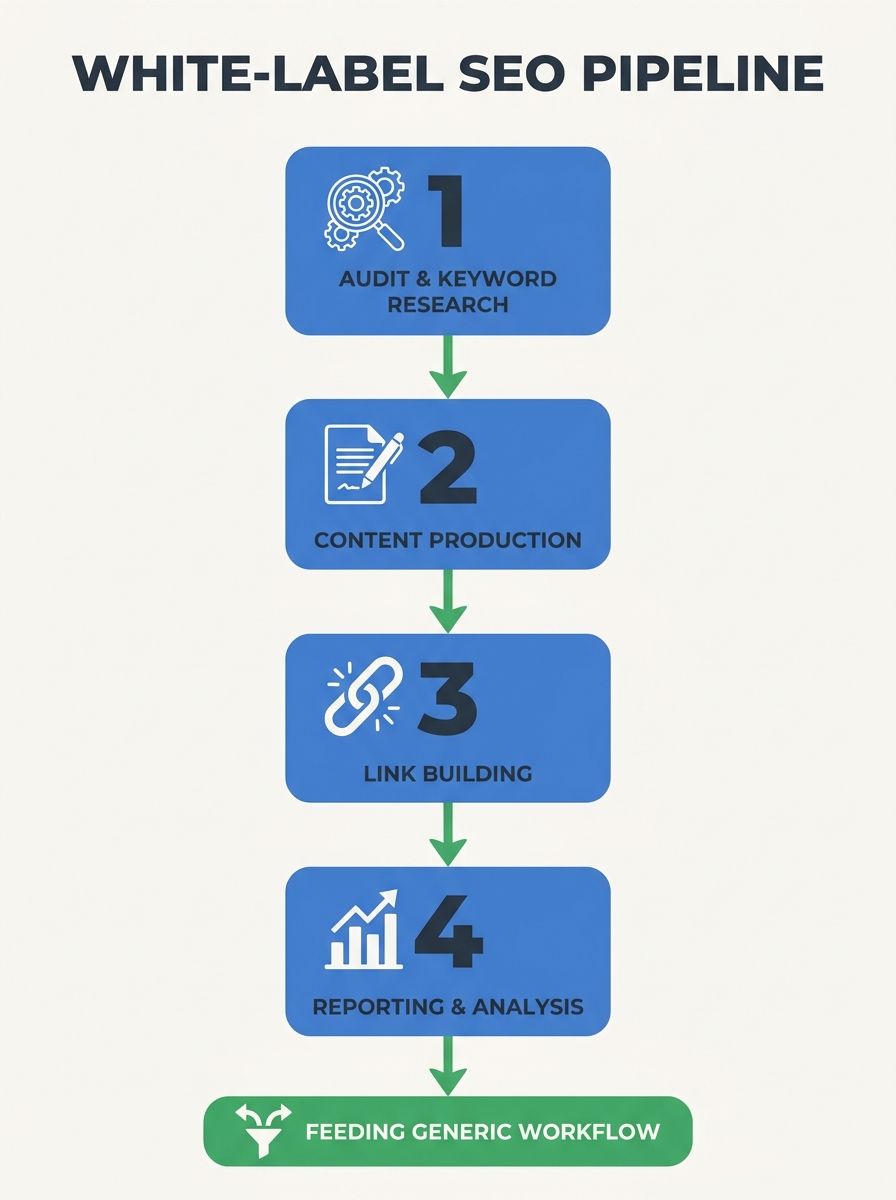
The agencies I audited during this period looked healthy on paper. Client retention sat at 70-80% annually. Deliverables shipped on time. Rankings moved in the right direction often enough to justify the monthly invoice. Nobody was asking hard questions about whether rankings alone translated to revenue because, for the most part, they did.
Google AI Overviews Cross Into Commercial Territory
The shift didn't happen overnight, but it accelerated faster than most agencies anticipated. When Google first rolled out AI Overviews in mid-2024, the impact concentrated on informational queries. Agencies shrugged it off. "Our clients rank for commercial terms," they told me during evaluations. "AI Overviews don't touch product pages."
That changed in Q3 2025. Google expanded AI Overviews into commercial and transactional query categories, and the data turned ugly fast. According to Adobe's analysis, visibility now depends less on page position and more on whether a brand gets cited within AI-generated responses. A brand could hold position one for a high-intent keyword and still lose the click if the AI Overview synthesized an answer from three other sources.
The zero-click problem, which had been building for years, crossed a threshold. Mobile searches resulting in zero clicks hit 77.1%, and desktop reached 58.5%. For agencies selling rankings as their core deliverable, these numbers created an existential problem: they could technically deliver on every line item in the scope of work while failing to deliver business results.
I started seeing this play out in the contract disputes that landed on my desk. Clients would show me dashboards full of green arrows on keyword rankings while their organic traffic cratered 30-40%. The white-label provider had fulfilled every obligation in the agreement. The client's phone still wasn't ringing. And nobody could explain the disconnect because nobody was measuring what actually mattered in the new search environment.
Enterprise Clients Start Firing Their Generalist Agencies
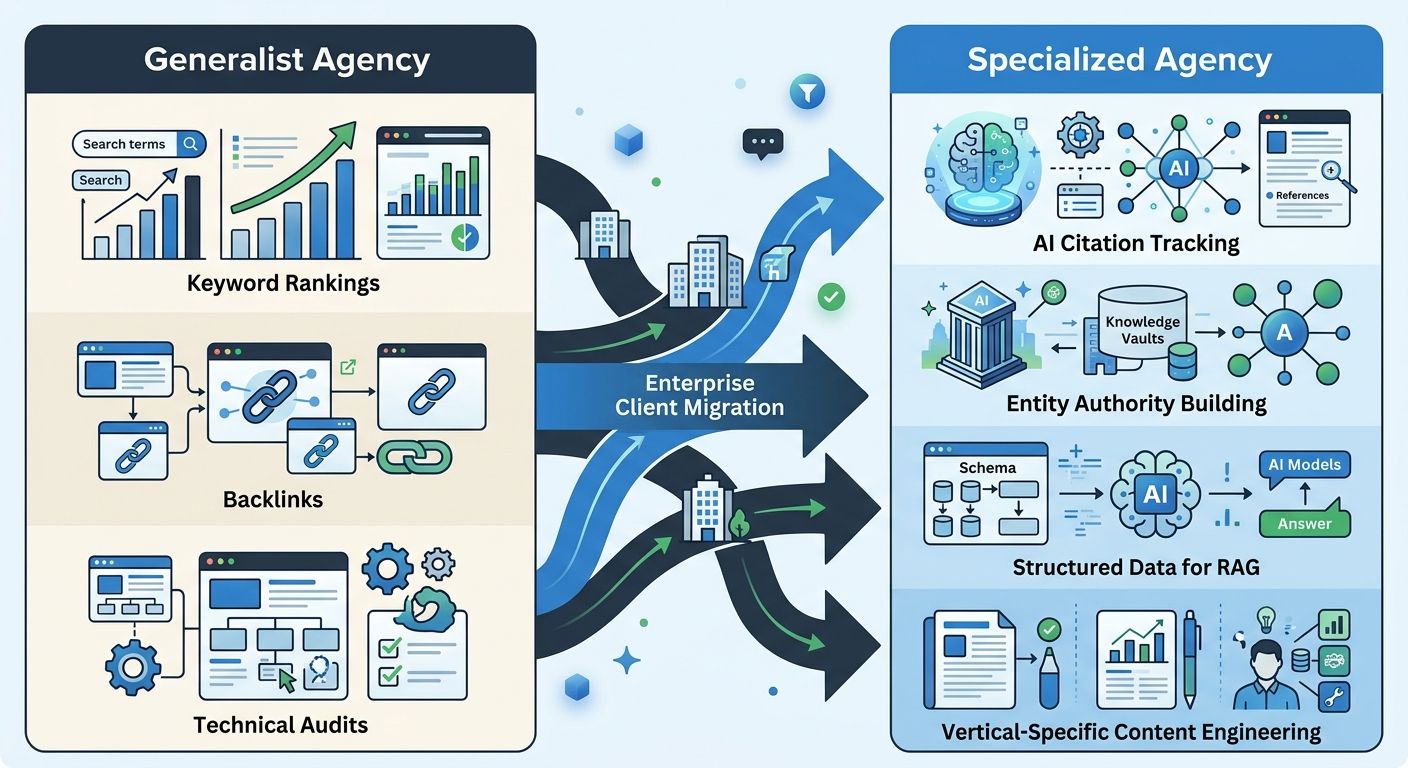
The wave of agency terminations I tracked through Q4 2025 and into early 2026 followed a consistent pattern. Enterprise clients with annual SEO budgets above $200,000 moved first. They had the data infrastructure to see exactly what was happening to their organic pipeline, and they didn't like what they found.
The enterprise evaluation criteria I've documented shifted in a specific way: procurement teams stopped asking about keyword ranking velocity and started asking about AI citation rates, entity authority signals, and structured data coverage for RAG systems. Only 12.4% of Fortune 1000 companies had valid Organization Schema linked to a Knowledge Graph ID, which meant most enterprise sites were functionally invisible to the retrieval-augmented generation systems powering AI answers.
Generalist agencies couldn't answer these questions because they hadn't built the capabilities. As one enterprise SEO agency review noted, the generalist approach "lacks deep SEO specialization" and offers "less innovation" compared to focused competitors. The versatility that once made generalists appealing became the exact liability that got them fired.
The firing wasn't always dramatic. Sometimes it was a quiet non-renewal at the end of a twelve-month contract. But the pattern was unmistakable: enterprise SEO agency specialization became a procurement requirement rather than a preference.
Vertical Specialists Fill the Vacuum
The agencies that picked up those enterprise contracts shared a common trait: they had gone deep on specific industries before the AI shift forced the issue. They understood regulatory language in healthcare. They knew the compliance requirements for financial services content. They had mapped the entire decision-making funnel for industrial manufacturing procurement.
This is the dynamic reshaping the market. As Search Engine Magazine documented, "an agency knowing their industry beats one that knows SEO in general." Competing as a generalist means competing on price. Competing as a vertical specialist means competing on results.
The vertical specialization search marketing trend has been accelerating across both local and enterprise segments simultaneously. But the AI search layer added a new dimension. Vertical specialists can build the kind of topical authority and entity relationships that AI systems rely on for citations because they understand which claims matter in their industry, which data points carry authority, and which sources AI models are likely to trust.
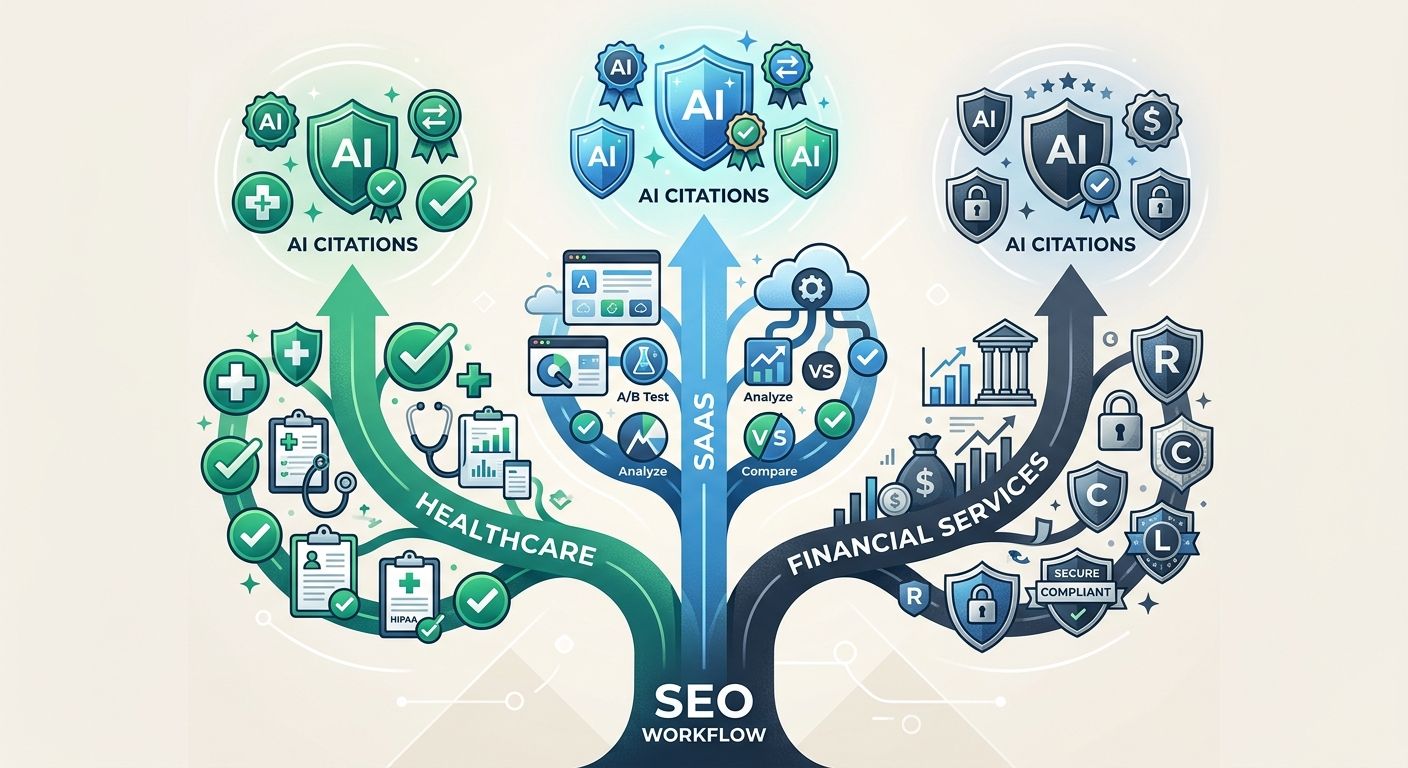
If you're evaluating agencies for a healthcare client, the gap between working with healthcare SEO companies that understand HIPAA-compliant content strategy versus a generalist shop writing medical blog posts from surface-level research has never been wider. The same applies to law firm SEO companies navigating bar association advertising rules and finance SEO agencies producing content that meets FINRA or SEC disclosure requirements.
These aren't cosmetic differences. AI systems are trained to weight authoritative, accurate content. Generalist content that skims the surface of regulated industries gets filtered out of AI citations because it lacks the depth and specificity that retrieval models prioritize.
Where SaaS SEO Broke Away From the Pack
The SaaS vertical deserves its own section because the divergence between SaaS SEO and generalist agencies became one of the starkest examples of why specialization matters in the current market.
SaaS companies require a distinct, specialized approach due to the complex nature of their products, user relationships, and recurring revenue models. The SEO strategy for a SaaS company selling project management software to mid-market teams looks nothing like the SEO strategy for a regional plumbing franchise. The keyword intent structures are different. The conversion paths are different. The content formats that drive pipeline are different.
The agencies winning SaaS SEO contracts in 2026 understand product-led growth mechanics. They know how to optimize for comparison queries where AI systems synthesize feature matrices from multiple sources. They build content that feeds into the AI recommendation layer because they understand which product attributes AI models extract and present to users evaluating solutions.
Generalist agencies handling SaaS clients through the same playbook they use for local service businesses are producing content that doesn't register in AI-driven search. As Search Engine Land reported, teams that automate repeatable digital marketing tasks and focus on AI-specific optimization are compounding their output advantage, while manual, undifferentiated teams fall further behind on both cost and time to impact.
The SaaS SEO vs generalist agencies split extends into the white-label layer too. White-label providers that built their content teams around $50-per-article blog posts can't produce the technical depth that SaaS content demands. You can't white-label a 3,000-word product comparison that requires genuine product knowledge any more than you can white-label a clinical trial analysis for a pharma company.
The White-Label Supply Chain Fragments Too
Here's where this gets personal for agencies that depend on white-label fulfillment.
The fragmentation happening at the agency-client level is cascading down into the white-label supply chain. White-label SEO providers built their businesses on the same generalist efficiency model that agencies used with their clients. One team, many verticals, standardized deliverables. The margins depended on that standardization.
But when agencies need to deliver an AI-driven SEO strategy for a healthcare enterprise, they can't fulfill that with a white-label team that writes generic blog content and builds directory links. The white-label provider either needs vertical expertise or it becomes a bottleneck that drives client churn.
I've watched this play out in contract negotiations over the past eight months. Agencies shopping for white-label partners are increasingly asking for vertical-specific writing teams, industry-specific structured data implementation, and AI citation monitoring. The white-label providers that can deliver this charge $4,000-$7,000 per client per month. The ones still offering the old model charge $1,200-$2,500 and they're losing accounts to the specialists.
The adoption of llms.txt files, as Search Engine Land tracked, represents another capability gap. Implementing an llms.txt strategy requires understanding how LLMs interact with your client's specific content type, which pages should be exposed to AI crawlers, and which shouldn't. A generic white-label team typically doesn't have the context to make those decisions for a client in a regulated industry.
The agencies successfully adapting to this shift are building hybrid models. They keep a generalist white-label partner for basic technical SEO maintenance and on-page optimization, then layer in vertical specialists for strategy work tied to AI-specific visibility. This costs more, but the alternative is losing enterprise clients who now demand a coherent AI-driven search optimization framework.
The Pricing Model Has to Change Too
The old pricing structure assumed roughly equal effort per client regardless of vertical. A $3,000/month retainer covered the same checklist whether the client sold industrial valves or artisanal candles. That assumption broke when AI citation optimization entered the scope of work.
Building entity authority for an AI-driven SEO strategy in 2026 requires industry-specific research, proprietary data development, and structured content engineering. These activities take longer and demand specialized knowledge. Agencies that continue pricing all clients the same are either undercharging their complex clients or padding the margins on their simple ones.
The white-label providers experiencing growth right now have tiered pricing by vertical complexity:
Local service businesses (restaurants, home services, retail): $1,500-$2,500/month, standard deliverables with local schema and review optimization
Professional services (law firms, accounting, consulting): $3,000-$5,000/month, compliance-aware content, entity authority building, AI citation monitoring
Enterprise verticals (healthcare systems, financial services, SaaS): $5,500-$8,000/month, dedicated vertical writers, RAG-optimized structured data, llms.txt strategy, proprietary data content development
The deliverables at each tier look completely different, and the teams producing them need different skill sets. Agencies that haven't restructured their pricing are trapped. They can't afford to deliver specialized work at generalist rates, but they can't raise prices without explaining why the old deliverables were insufficient. That conversation requires admitting something most agency owners would rather avoid until the client leaves on their own.
I've covered the gap between credentials and actual results extensively, and this pricing disconnect is the newest version of that same problem. Agencies with impressive certifications that still price and deliver like the 2023 model works are losing to smaller, focused competitors who charge more but demonstrate measurable AI search visibility.
The State of Play
The SEO agency market, as of spring 2026, has split into three tiers that I can identify clearly from the contracts and evaluations crossing my desk.
Tier one consists of vertical specialists who've built AI-driven SEO strategy capabilities native to their practice. They track AI citation rates alongside traditional rankings. Their content teams have genuine subject matter expertise. Their white-label partners, if they use them, are vertical-specific too. These agencies are winning enterprise contracts and charging $8,000-$25,000 per month per engagement. They're growing.
Tier two includes agencies in active transition. They've recognized the shift, they're hiring or training specialized talent, and they're rebuilding their white-label relationships around vertical expertise. Survival depends on speed. The window for this transition gets smaller every quarter as vertical specialists establish deeper competitive moats in their chosen industries.
Tier three is the generalist holdouts. They're still delivering the 2023 playbook, still pricing at $2,000-$4,000 per month, and still reporting on metrics that no longer correlate with business outcomes. Some will survive by serving small local businesses where AI search impact remains less acute. Many won't make it through the year at their current trajectory.
If you run an agency in tier two, the single most important decision you'll make this year is which verticals to commit to. You can't specialize in everything. Pick two or three industries where you have existing client relationships and some domain knowledge, then go deep. Restructure your white-label fulfillment to support those verticals specifically. Build the AI citation tracking and structured data capabilities those industries require.
If you're buying white-label SEO services for your agency, audit your provider against the same criteria your clients will use to evaluate you. Can they deliver vertical-specific content? Do they monitor AI visibility? Do they implement structured data that feeds RAG systems? If the answers are no across the board, you're reselling a commodity that depreciates in value with every quarterly expansion of AI Overviews into new query categories. The agencies that thrive in this environment will be the ones that chose specificity over comfortable scale at the exact moment it felt risky to do so.
Marcus Webb
Digital marketing consultant and agency review specialist. With 12 years in the SEO industry, Marcus has worked with agencies of all sizes and brings an insider perspective to agency evaluations and selection strategies.
Related Articles

Why Enterprise SEO Agencies Are Expanding Into AI-Driven Markets: What the San Francisco Shift Reveals About 2026 Competition
SEO.co announced its physical expansion into San Francisco on May 7, targeting venture-backed startups and enterprise brands with GEO consulting, AI-driven search strategies, and technical audits designed for generative platforms.
Why Google's May 2026 Algorithm Update Is Breaking Enterprise SEO Playbooks (And How Agencies Should Respond)
SE Ranking's volatility index for the March 2026 core update showed 79.5% of top-3 positions shifting — the most disruptive reshuffle ever recorded.

Why Recognition Beats Rankings in 2026: How SEO Agencies Should Pivot Their Authority Strategy
The slide deck that convinced a $4M ARR fintech company to sign a 12-month agency retainer showed fourteen keyword ranking improvements, zero AI citation metrics, and no mention of entity authority anywhere in the strategy section.
Explore more topics