
Hyper-Local SEO Agencies Are Fragmenting Into Vertical Specialists: What This Means for Generalist Shops in 2026
"Home service contractors don't need a marketing agency that also works with e-commerce brands and SaaS companies. They need someone who understands seasonal demand, high-intent local search, and what it actually takes to generate booked jobs, not traffic.
 Marcus Webb··8 min read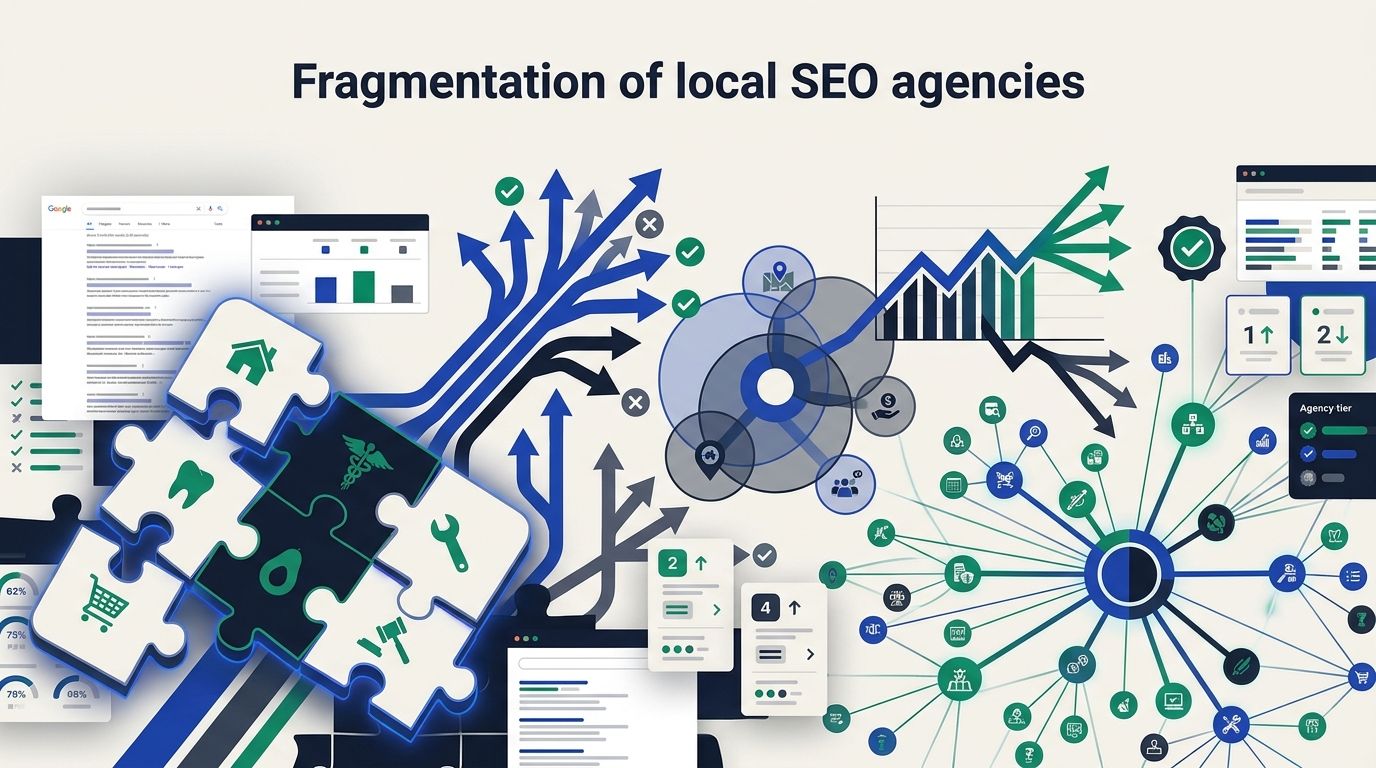
Hyper-Local SEO Agencies Are Fragmenting Into Vertical Specialists: 6 Rules for Generalist Shops
"Home service contractors don't need a marketing agency that also works with e-commerce brands and SaaS companies. They need someone who understands seasonal demand, high-intent local search, and what it actually takes to generate booked jobs, not traffic." Josh Blackburn said that on May 4 when he launched Hyper Local Marketing, a new agency that refuses to take clients outside HVAC, plumbing, roofing, and electrical. It's a pointed statement, and the business model behind it reflects a fracture running through the local SEO agency market that generalists can no longer ignore.
Local search agency fragmentation has been building for two years, but the pace accelerated sharply after Google's March 2026 core update cracked down on generic GBP optimization tactics like keyword stuffing in business names and templated location pages. Agencies that once competed on broad service menus are now losing pitches to shops that speak a single industry's language with fluency a generalist can't fake. If you run or work at a generalist local SEO agency, the six rules below should shape how you respond this quarter, not next year.
Recognize that vertical specialization is a pricing play, not a rebrand
When an agency like Hyper Local Marketing focuses exclusively on home service contractor SEO, the move restructures how they charge. A generalist shop typically prices local SEO packages between $1,500 and $5,000 per month based on deliverables: citations built, blog posts published, GBP posts scheduled. A vertical specialist prices based on outcomes that matter to the specific industry. For a plumber, that's dispatched calls and booked jobs. For a roofer, it's storm-season lead volume. The deliverable list is secondary to the industry metric.
That pricing shift is possible because niche agencies already have proven content templates, FAQ structures, and topic clusters built around their vertical, as Search Engine Magazine's local SEO playbook documents in detail. They don't start from zero for each client. A dental-focused agency has assets covering implants, veneers, and Invisalign ready before the first kickoff call. An HVAC-focused shop has seasonal content calendars for furnace tune-ups in October and AC installs in April already tested and refined across dozens of similar accounts.
The generalist, by contrast, has to research every new vertical from scratch. That research time gets baked into overhead, which either inflates prices or compresses margins. Vertical specialists convert that same learning curve into deeper execution for the same client type at equal or better margins.
If your agency is generalist and profitable, take a hard look at where the profit actually comes from. Odds are good that 60-70% of it traces back to two or three verticals you've quietly built expertise in without formally committing to any of them.
Audit your client roster for vertical vulnerability right now
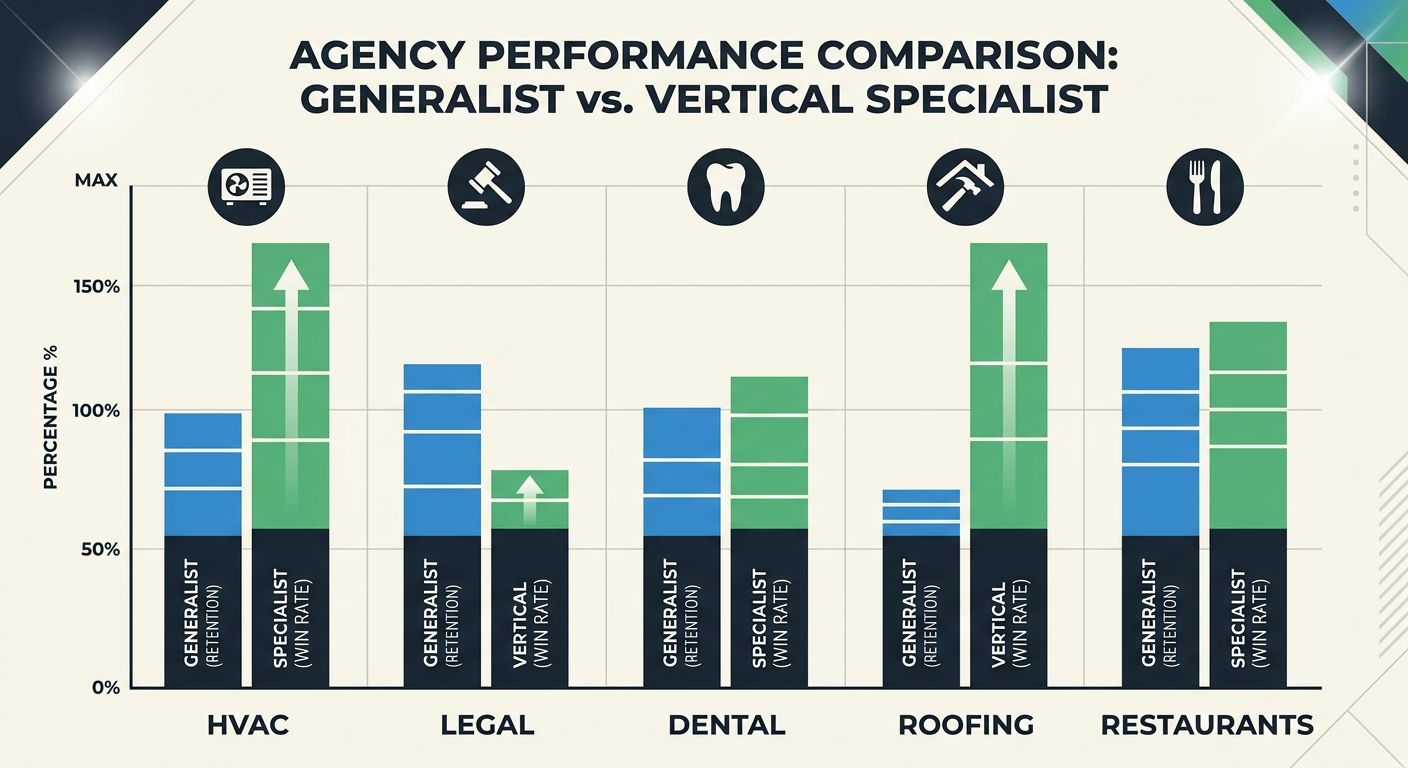
Here's the scenario playing out across dozens of mid-size agencies this spring: a generalist local SEO agency holds 40 clients spread across law, dental, HVAC, roofing, and restaurants. A vertical specialist enters one of those categories offering deeper industry knowledge, pre-built content frameworks, and case studies from identical businesses in neighboring markets. The specialist doesn't need to win all 40 clients. Picking off eight HVAC companies from that portfolio is enough to create a revenue problem.
Google's March 2026 trust enforcement changes made this dynamic worse. The update suspended hundreds of Google Business Profiles in contractor verticals for keyword stuffing and unverifiable business data. Generalist agencies that applied the same GBP optimization template across all verticals discovered that tactics which worked fine for a dental practice tripped spam filters on a locksmith profile. Vertical specialists, familiar with the specific compliance landmines in their niche, saw fewer suspensions and were positioned to pick up displaced clients whose generalist shops had gotten them into trouble.
Go through your client list today and identify which verticals are most exposed. Where are vertical specialists actively marketing in your geography? Where have you lost a pitch in the past six months to an agency that only serves one industry? Those are the sectors where your position is weakest.
Stop selling deliverables and start selling industry fluency
The deliverable-based proposal, with its line items for "12 blog posts per quarter" and "weekly GBP posts," is becoming a liability for generalist agencies. When a vertical specialist pitches the same prospect, they don't talk about blog posts. They talk about ranking for "emergency furnace repair" in the service area before heating season. They reference the specific call-tracking metrics that matter for HVAC dispatchers. They know what a "shoulder season" means for a roofing company and how lead volume shifts after a major hailstorm.
This is the core advantage that niche agencies hold over generalists: conversational fluency in the client's business. An agency founder who spent 10 years running an HVAC company before starting a marketing firm understands something a generalist project manager never will, no matter how many keyword research spreadsheets they produce. That understanding shows up in discovery calls, in the specificity of strategy decks, and in the small details of ad copy that convert browsers into phone calls.
Generalist shops can partially close this gap by organizing internal teams around verticals. Assign your best account manager to own all HVAC clients and give them time to attend trade shows, read industry publications, and build relationships in that space. But be honest about the limits of this approach. As we analyzed in a broader look at enterprise agencies shifting toward vertical specialization, the structural advantages of full vertical commitment are hard to replicate with a staffing reshuffle alone.
Accept that Google's trust signals now punish generalist shortcuts
The March 2026 core update didn't target generalist agencies explicitly, but the collateral damage landed disproportionately on their clients. The update prioritized what Google calls "genuine local signals," meaning consistent NAP data, fresh geotagged photos, timely review responses, and neighborhood-specific content. Templated approaches failed at scale.
Consider what this means for home service contractor SEO specifically. An HVAC company in Phoenix and an HVAC company in Minneapolis have radically different seasonal search patterns, different competitor landscapes, and different customer expectations. A generalist agency running both accounts off the same content calendar and GBP posting strategy will underperform a specialist who has spent years studying the Phoenix HVAC market and knows which zip codes convert best, which review platforms matter locally, and when the first big AC repair search spike hits each spring.
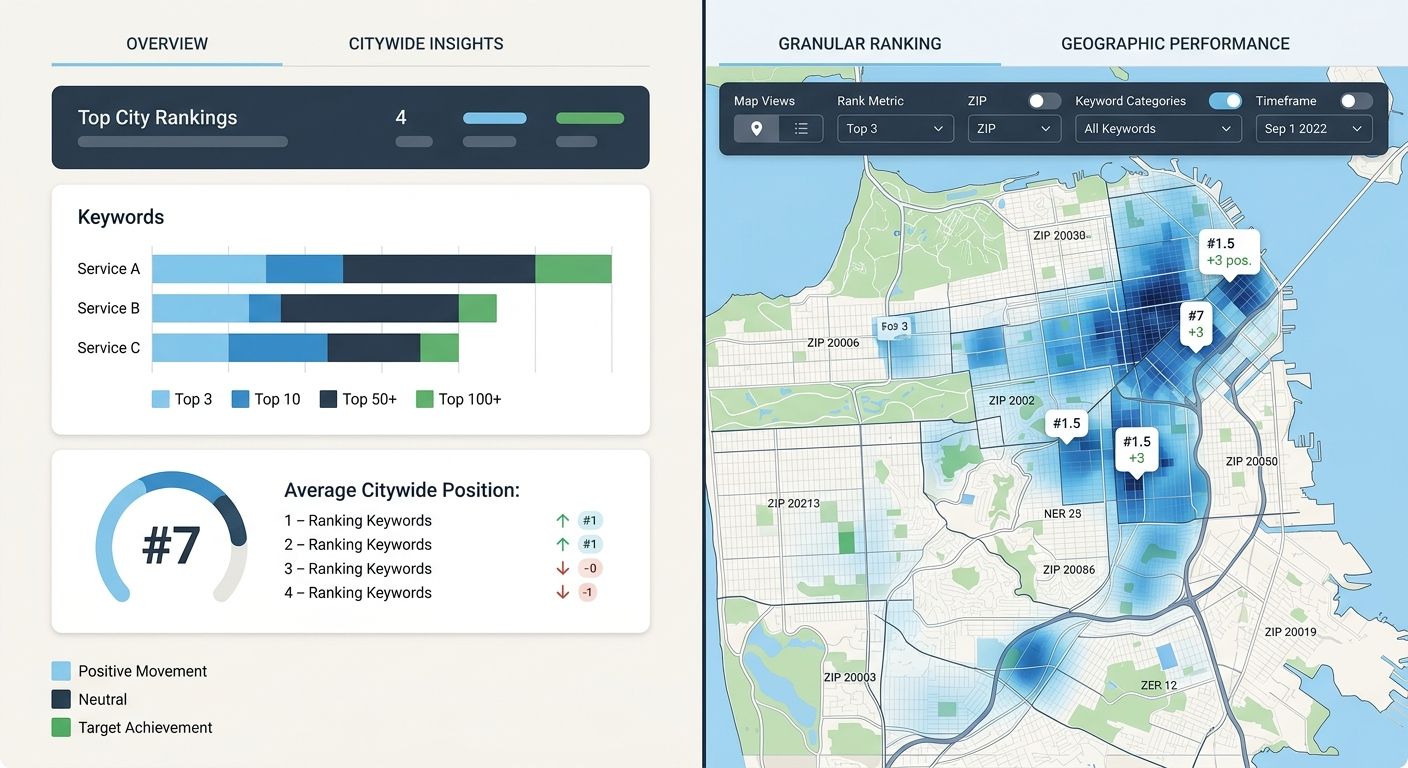
Platforms like BrightLocal, which serves over 10,000 agencies, now provide granular multi-location tracking that measures rank performance across different coordinates within a service area, not just city center positions. This kind of hyper-local measurement is standard practice at vertical specialists. Many generalist shops still report on city-level rankings, which masks the performance gaps their clients actually experience in the suburbs and exurbs where most home service work happens.
If you're still sending clients a monthly report that shows "Phoenix, AZ - Rank #4 for HVAC repair," you're leaving them blind to the fact that they might rank #22 three miles north in Scottsdale. Vertical specialists have already moved past this.
Decide whether to specialize or partner, but decide this quarter
Generalist agencies facing this fragmentation have three paths: specialize into one or two verticals, build formal partnerships with vertical specialists for referrals, or try to do everything and hope the trend reverses. The third option is the default, and it's the most dangerous.
Specializing means making hard choices. You might need to refer out clients that don't fit your chosen verticals, which feels counterintuitive when you're trying to grow. But the math often works in your favor. An agency that narrows from five verticals to two can typically raise prices 20-30% within six months because the perceived expertise justifies the premium. Client acquisition costs drop because your marketing speaks directly to one audience, and your case studies are immediately relevant to every prospect.
If full specialization feels too risky, formal partnerships offer a middle path. Some agencies are splitting their book of business deliberately, keeping the verticals where they have genuine depth and referring clients in weaker verticals to specialist partners in exchange for reciprocal referrals or revenue-sharing. White-label SEO companies have also adapted to this trend, with some now offering vertical-specific fulfillment services that let a generalist agency maintain client relationships while outsourcing the specialized execution.
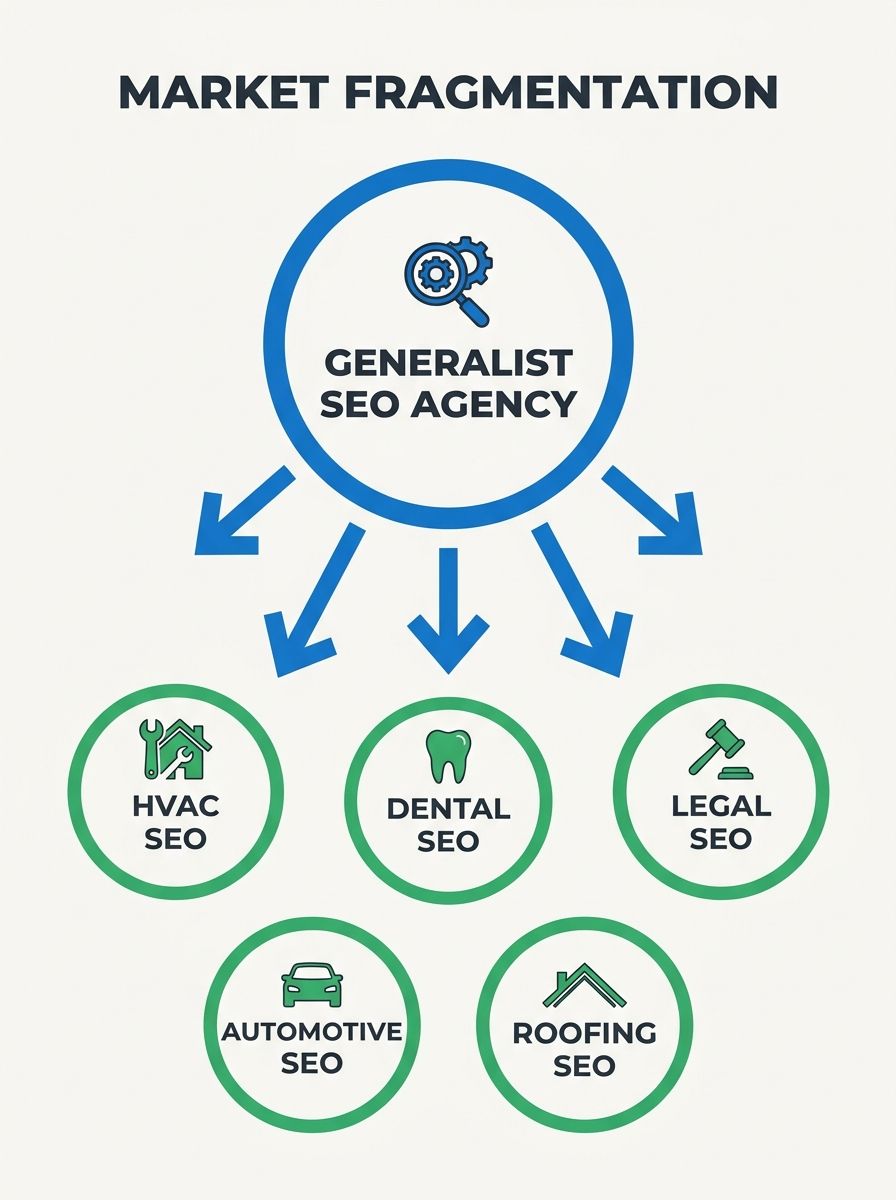
The same dynamic is playing out at the vertical level. Even within home services, we're seeing fragmentation into sub-verticals. Automotive SEO agencies have existed for years, but now the home services category itself is splitting into HVAC-specific, plumbing-specific, and roofing-specific shops. The more granular the specialization, the stronger the pitch to clients who feel underserved by generalists.
Track which verticals are consolidating before they lock you out
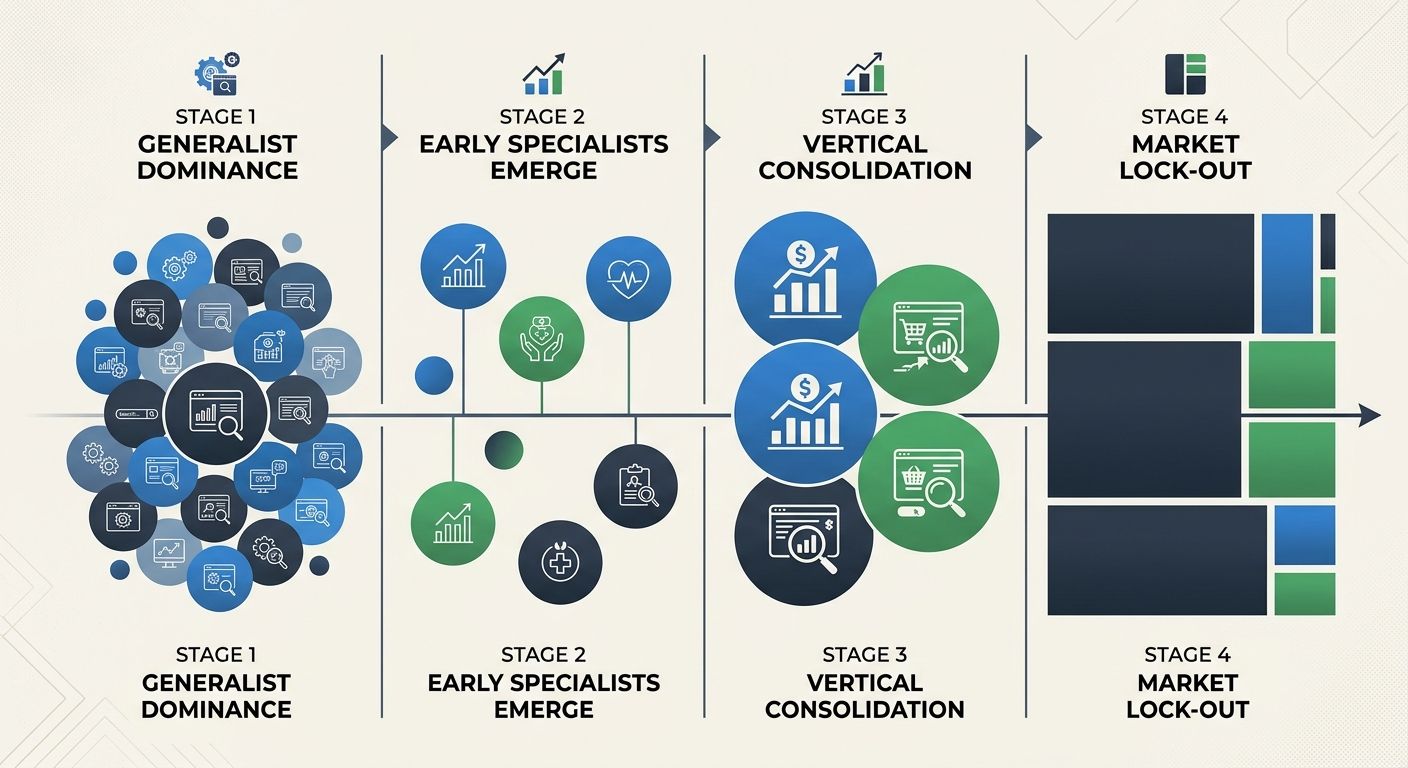
Local agency market consolidation follows a predictable pattern. First, one or two specialist agencies establish dominance in a vertical within a given metro area. Then they expand regionally, using their concentrated case study portfolio to win pitches in adjacent markets. By the time three or four specialists have divided up a vertical nationally, the cost of entry for a generalist trying to compete in that space has risen significantly.
Home service contractor SEO is deep into this consolidation cycle right now. Hyper Local Marketing's May 4 launch is the latest example, but they're entering a space where established players like LeadsNearby and Mediagistic have been building vertical-specific infrastructure for years. Legal SEO consolidated earlier, with firms like Rankings.io and LawRank carving out defensible positions. Dental is similarly locked up in many markets.
The verticals where generalists still have time to stake a claim are the ones where dedicated agencies haven't yet reached critical mass. Think specialty medical practices, niche B2B services, veterinary clinics, and certain trade contractor sub-categories. If you're going to make a move toward vertical SEO specialization, the window matters as much as the direction.
When Staying General Still Works
These rules describe a strong trend, not a universal law. Generalist local SEO agencies still hold structural advantages in several scenarios.
Small and rural markets don't generate enough business in any single vertical to sustain a specialist. A generalist serving the top 15 businesses in a town of 30,000 people will keep winning because the addressable market for "HVAC SEO in rural Iowa" can't support a dedicated agency.
Multi-location brands that span verticals often prefer a single agency relationship. A franchise group that owns both plumbing companies and fast-casual restaurants doesn't want to manage two agency relationships. The generalist who can serve both under one roof retains an advantage here.
Brand-new business owners frequently don't know what questions to ask and feel more comfortable with an agency that can handle "everything" during their first year. The specialist's depth is wasted on a client who doesn't yet understand the difference between organic and paid local results.
And generalist shops with genuinely strong operations, clean reporting, and a track record that survives scrutiny beyond surface-level credentials will always find clients who value reliability and relationship over niche expertise.
But if you're a generalist agency in a metro area over 250,000 people, operating without a deliberate vertical strategy, the honest assessment is that your competitive position is weakening each quarter. The agencies eating your lunch aren't bigger or better-funded. They're narrower and deeper. Whether you respond by specializing, partnering, or building internal vertical teams, the worst option is pretending the fragmentation isn't happening and hoping your next proposal wins on personality alone.
Marcus Webb
Digital marketing consultant and agency review specialist. With 12 years in the SEO industry, Marcus has worked with agencies of all sizes and brings an insider perspective to agency evaluations and selection strategies.
Explore more topics