
Agency Credentials vs. Real Results: Why Google Partner Status Doesn't Guarantee Client ROI
Google awards Premier Partner status to roughly the top 3% of agencies in each country based on ad spend, client retention, and certification completeness. That badge appears on agency websites, in pitch decks, and across LinkedIn profiles as shorthand for "trust us.
 Marcus Webb··8 min read
Agency Credentials vs. Real Results: Why Google Partner Status Doesn't Guarantee Client ROI
Google awards Premier Partner status to roughly the top 3% of agencies in each country based on ad spend, client retention, and certification completeness. That badge appears on agency websites, in pitch decks, and across LinkedIn profiles as shorthand for "trust us." But after evaluating over 200 agencies across twelve years in this industry, I've watched companies sign five-figure monthly retainers based primarily on a logo in a slide deck, only to discover six months later that their cost per acquisition hasn't budged and their organic pipeline is thinner than when they started. The badge tells you something. It tells you far less than you think.
These seven rules are what I give to every business owner or marketing director before they evaluate an agency's credentials against its actual capacity to generate revenue. Some of them are obvious in retrospect. All of them get ignored more often than they should.
Always verify the badge at its source
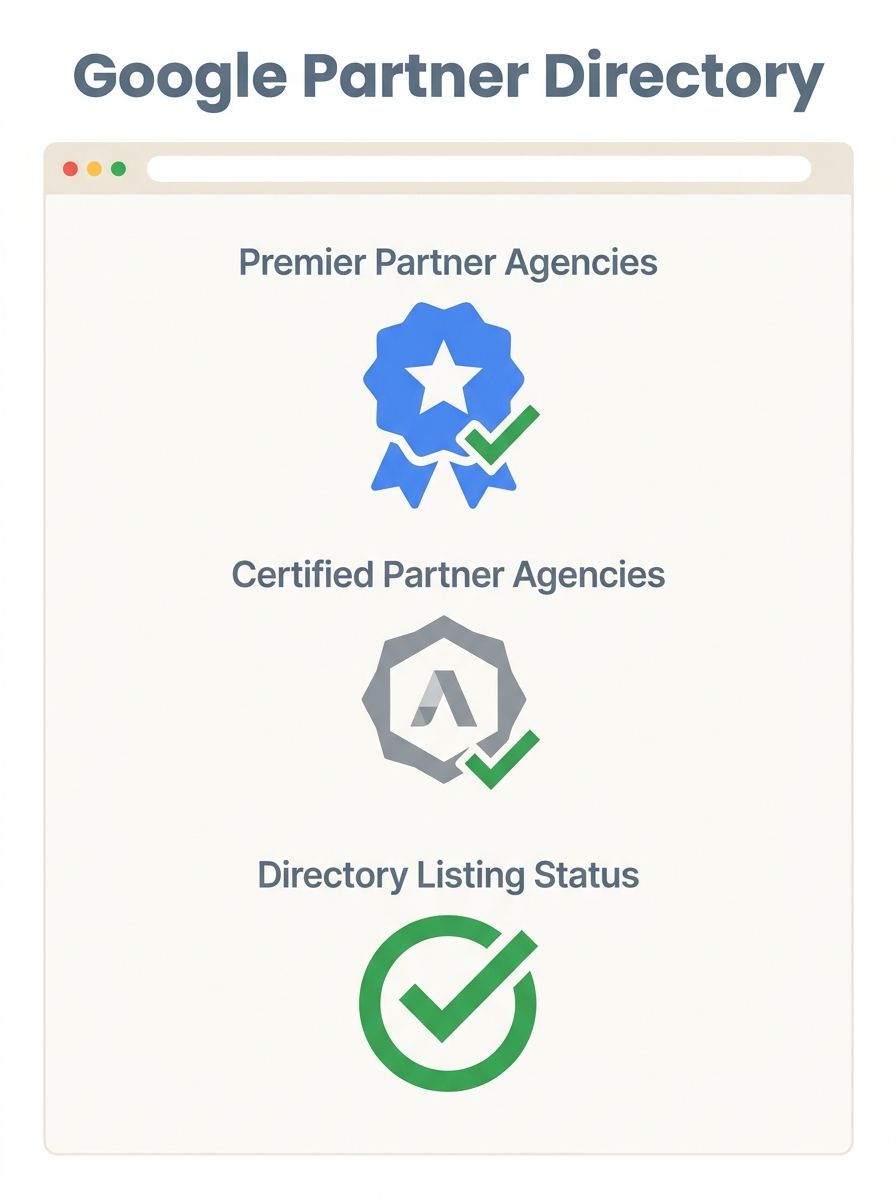
Agency websites display certification logos the way restaurants display health inspection grades, except there's no enforcement mechanism for accuracy. I've seen agencies display Google Partner badges months after losing their status, and I've seen others claim "Premier" when they hold standard Partner certification. The difference matters: Premier Partners must meet specific performance thresholds including client growth, client retention, and product diversification across Google's advertising platforms.
Google maintains an official Partner directory at partners.google.com where you can search for and verify any agency's current status. Use it. Status is re-evaluated annually, and agencies can lose it if their performance metrics slip. The verification takes about ninety seconds and eliminates an entire class of misrepresentation.
This rule extends beyond Google. Check HubSpot Partner tiers, Semrush certifications, and any other badge an agency puts in front of you. If an agency bristles when you ask for verification, that reaction is more informative than the badge itself.
Demand revenue metrics, not activity dashboards
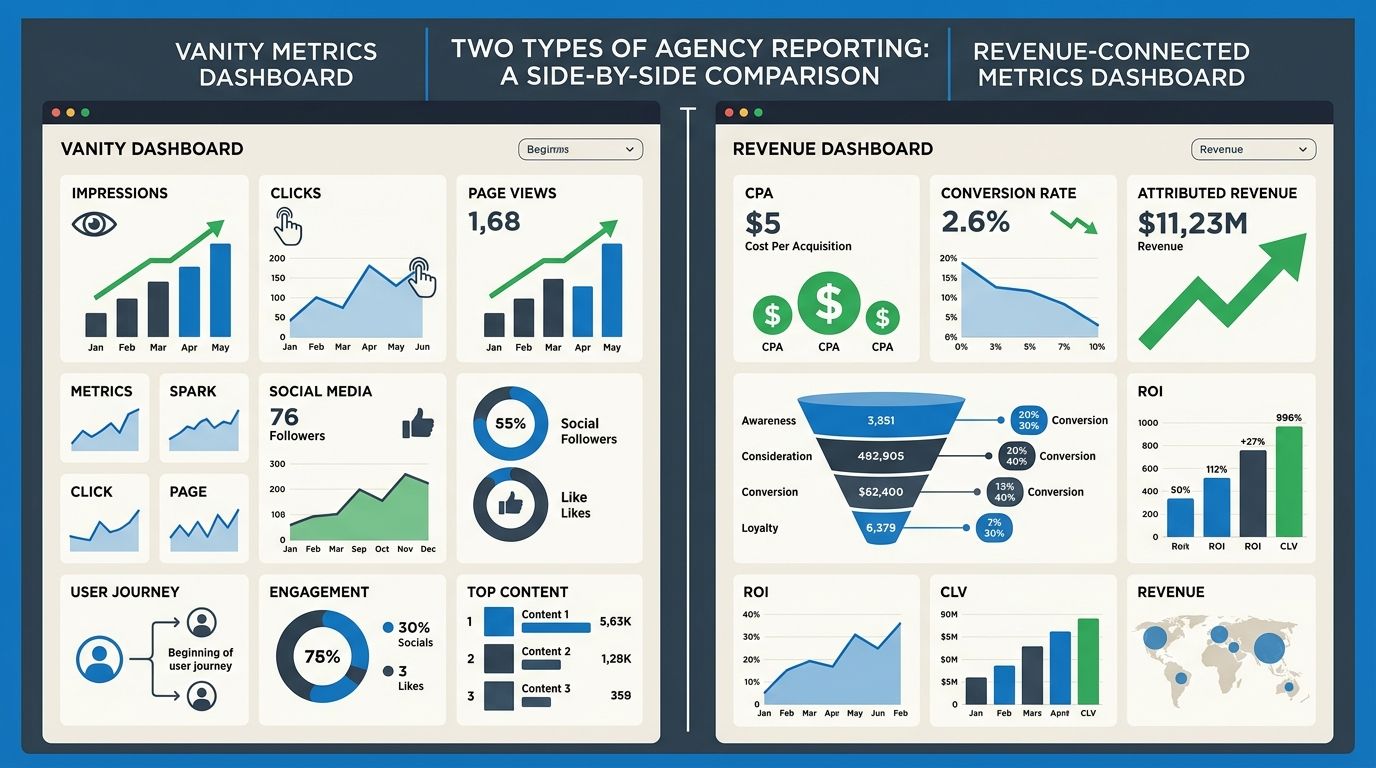
The single most reliable SEO contract red flag I encounter is an agency that reports on impressions, clicks, and keyword rankings without connecting any of those numbers to revenue. A Reddit thread on r/SEO captured this perfectly: agencies across the world define "success" differently, with some pointing to traffic, others to users, and remarkably few to actual conversions or revenue impact. One commenter described introducing a qualified buyer to a client, only for the client's pricing to kill the deal, which is exactly why many agencies avoid accountability for conversions altogether.
That avoidance is understandable. It's also unacceptable if you're spending $3,000 to $15,000 per month.
When measuring SEO agency impact, insist on seeing cost per acquisition, conversion rates, revenue generated, and how long it took to achieve those results. As one industry analysis noted, vague claims about "increased conversions" or "improved ROI" without specific numbers are meaningless. You need to see your GA4 data segmented by funnel stage: top-of-funnel organic traffic, mid-funnel engagement, and bottom-funnel conversions. If the agency can't walk you through that breakdown using your own Google Search Console and GA4 data, they're either hiding poor results or they don't know how to measure what matters.
I wrote about this measurement problem in depth when covering how to audit whether your agency actually drives revenue, and the core framework applies regardless of what certifications the agency holds.
Treat case studies as auditions, not advertisements
Every agency has case studies. The question is whether those case studies describe your situation or a completely different business in a completely different market with a completely different competitive landscape.
When reviewing agency credentials vs results, I look for three specific things in case studies. First, industry relevance. An agency that grew e-commerce revenue for a DTC skincare brand may have zero applicable experience for a B2B manufacturing company. Second, specificity of metrics. "We increased organic traffic 340%" means nothing without knowing the baseline, the timeline, the revenue impact, and whether that traffic converted. Third, recency. SEO has changed dramatically even in the past year, with AI overviews cutting organic clicks by 38% in some verticals and Google's trust enforcement rules reshaping local search entirely.
A case study from 2023 using tactics that worked in 2023 tells you very little about what the agency will do for you now. The shift toward AI-driven search optimization has created a gap between agencies that adapted and agencies still running the same playbook.
Client retention rate is another signal worth investigating. As one industry review noted, if an agency can't keep clients, that tells you everything. High retention usually signals trust, results, and strong working relationships. Low retention, or an unwillingness to discuss it, signals the opposite.
Check the contract for misaligned incentives
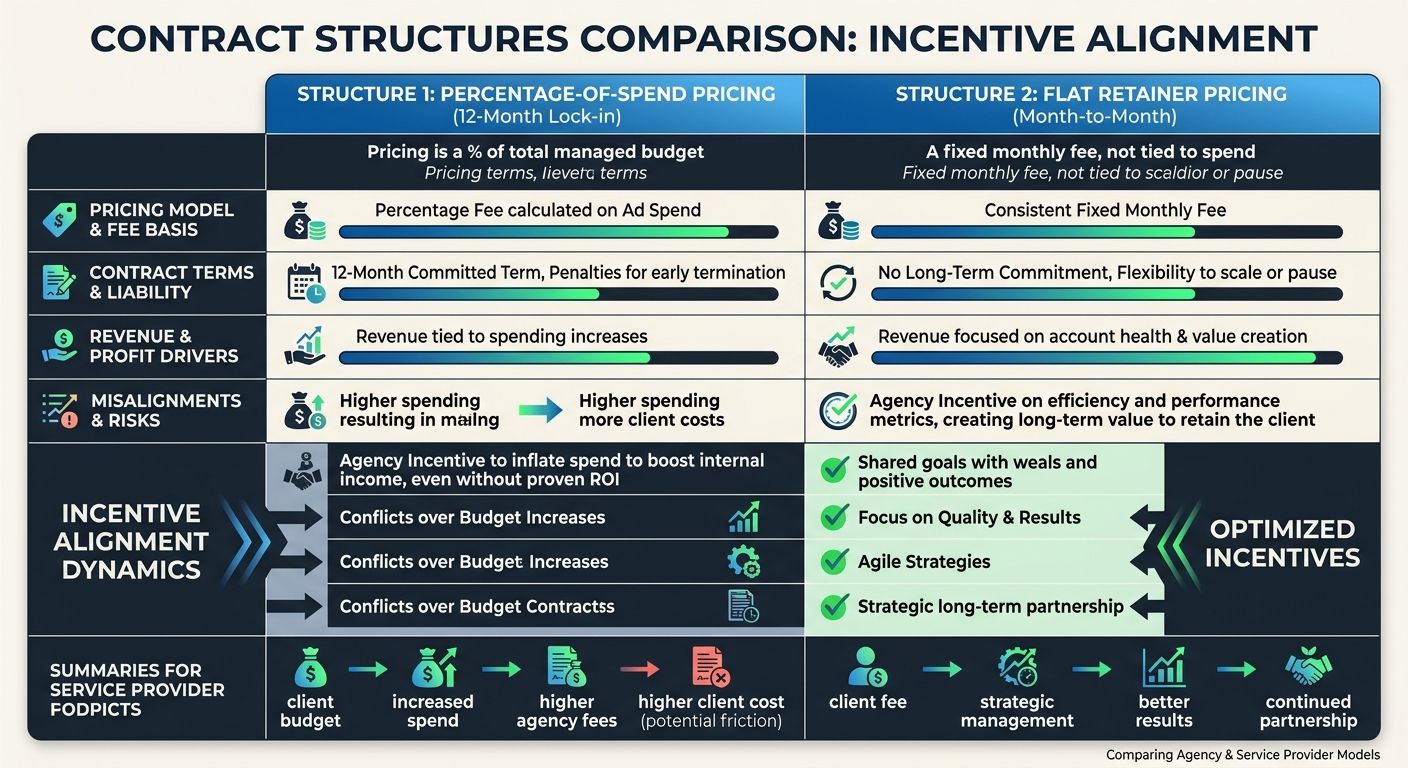
Pricing structure reveals more about an agency's priorities than any certification. Agencies that charge a percentage of ad spend have a built-in incentive to recommend higher budgets, regardless of whether that additional spend generates proportional returns. This creates a structural conflict of interest that no amount of Google Premier Partner performance data can resolve.
The agencies I've seen produce the best outcomes for clients tend to use flat retainers, typically ranging from $1,250 to $7,000 per month depending on scope, with month-to-month contracts after an initial commitment period. This structure means the agency earns the same fee whether your ad spend is $5,000 or $50,000, which aligns their incentive with efficiency rather than volume.
Watch for these specific contract red flags:
Twelve-month lock-in with no performance benchmarks. If the agency won't agree to quarterly performance reviews with defined exit criteria, they're protecting their revenue, not your results.
Restricted access to your own accounts. You should have full ownership of and access to your Google Ads, Analytics, and Search Console accounts at all times. Any agency that creates these accounts under their own credentials is building lock-in, and that's a red flag that transcends whatever badge they carry.
Guaranteed rankings. As one agency owner stated bluntly, the guarantee turns out to be either meaningless, impossible to verify, or backed by tactics that eventually cause more damage than they're worth. Agencies that guarantee rankings are selling certainty in a system where certainty doesn't exist.
If you're evaluating whether to switch providers, the parallel campaign approach can help you compare real performance before fully committing.
Test with a paid pilot before committing budget
A pilot engagement, typically 60 to 90 days with a defined scope, is the single best tool for evaluating SEO agency certifications ROI in practice rather than theory. One documented pilot found that the agency identified duplicate landing pages caused by the CMS, submitted three staging fixes, published a single optimized service page with clear micro-conversions, and secured one local press mention. Within eight weeks the client saw improved indexing and a measurable uptick in contact form submissions.
That's a pilot doing its job: testing process discipline, communication quality, and actual technical competence under real conditions. A badge can't tell you whether the agency will respond to your emails within 24 hours, whether they'll flag a CMS issue proactively, or whether their "senior strategist" from the pitch meeting will actually touch your account after signing.
The pilot also reveals whether the team doing the work matches the team that sold you. A persistent problem in the agency world, well documented on Reddit's r/Bloggers, is that large teams with junior execution, templated strategies, and software-driven link building create activity without accountability. When results don't appear, the agency changes the narrative rather than fixing the problem.
Weigh vertical expertise above platform certification
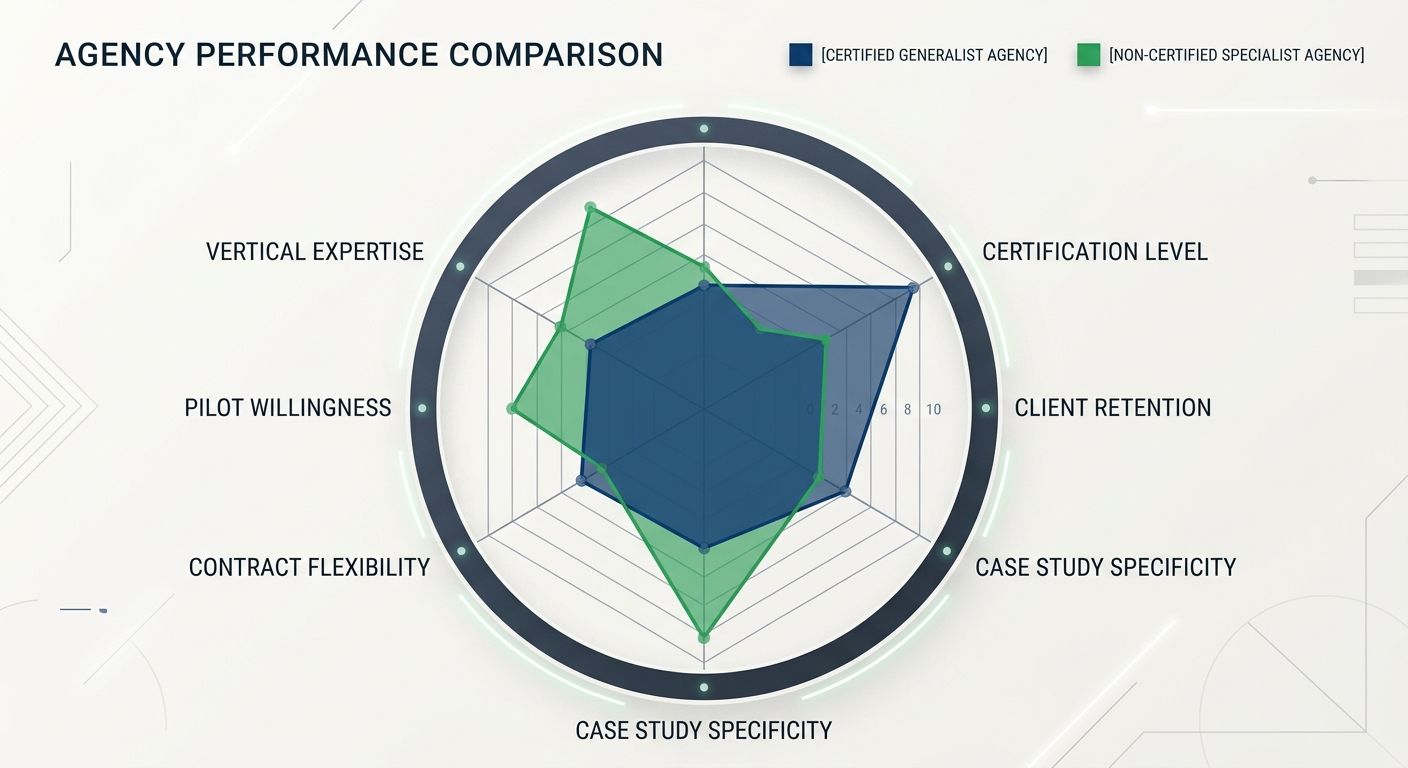
Google Premier Partner performance data, even when legitimate, measures an agency's relationship with Google's advertising platform. It tells you nothing about their understanding of your industry's buying cycle, competitive dynamics, or the specific content strategies that drive conversions in your vertical.
I've seen boutique agencies with no Premier Partner status consistently outperform certified agencies in specialized verticals like legal, healthcare, and architecture. Their advantage comes from understanding that SEO metrics in architecture firms look completely different from e-commerce metrics, and that the path from search ranking to signed contract varies enormously across industries.
When you're evaluating an agency, ask these questions before you ask about certifications:
How many clients do you currently serve in my industry?
What's the average client lifetime in my vertical specifically?
Can you walk me through the buying cycle for my type of customer and how your SEO strategy maps to each stage?
Which content formats have produced the highest conversion rates for businesses like mine?
An agency that answers these questions with specificity and evidence is more valuable than one that answers them by pointing at a badge on their website.
Require real-time reporting access, not monthly PDFs
Monthly PDF reports are where accountability goes to die. They're curated, they're delayed, and they present whatever narrative the agency wants you to see. The agencies I trust most give clients direct access to live dashboards connected to Google Search Console, GA4, and whatever rank tracking or attribution tools are in use.
Real-time access changes the relationship dynamic. You can see when traffic dips, when conversions stall, and when a core update impacts your visibility. You can ask informed questions in your next call instead of waiting three weeks to learn about a problem that started six weeks ago. And critically, you can independently verify every claim the agency makes about their work.
This transparency requirement, more than any certification check, separates agencies that deliver results from agencies that manage perceptions. The discussion on r/agency about quantitatively measuring agency performance converged on exactly this point: organic traffic, conversion rates, and engagement metrics broken out by funnel segment, visible to the client in their own tools, updated continuously.
When Credentials Do Earn Their Weight
These rules might read as anti-credential. They're not. Credentials carry real value in specific contexts.
Premier Partner agencies do get access to beta features, dedicated Google support lines, and advanced training that regular agencies don't receive. For large-scale paid media campaigns where early access to new bidding strategies or ad formats can mean a measurable edge, that access has genuine dollar value. Some data suggests Premier Partners deliver 3x to 5x ROI through smarter bidding and better targeting enabled partly by those exclusive tools.
The problem isn't that credentials are worthless. The problem is that credentials get treated as a substitute for the harder evaluation work described above. An agency can be a legitimate Google Premier Partner and still be wrong for your business because they lack vertical expertise, because their contract structure misaligns incentives, or because the junior team assigned to your account has none of the experience that earned the badge in the first place.
Treat certifications as one data point among many, weighted no more heavily than a strong pilot result, a relevant case study, or a contract structure that puts the agency's compensation at risk if they underperform. When you evaluate agencies this way, the ones worth hiring tend to be obvious, badge or no badge.
Marcus Webb
Digital marketing consultant and agency review specialist. With 12 years in the SEO industry, Marcus has worked with agencies of all sizes and brings an insider perspective to agency evaluations and selection strategies.
Explore more topics