
From Search Ranking to Signed Contracts: Why Traditional SEO Metrics Fail Architects (And How Agencies Are Fixing It)
Vernacular, a design-focused SEO agency reviewed in Siana Marketing's 2026 agency roundup, charges architecture firms a premium over generalist agencies and still maintains a waiting list.
 Marcus Webb··10 min read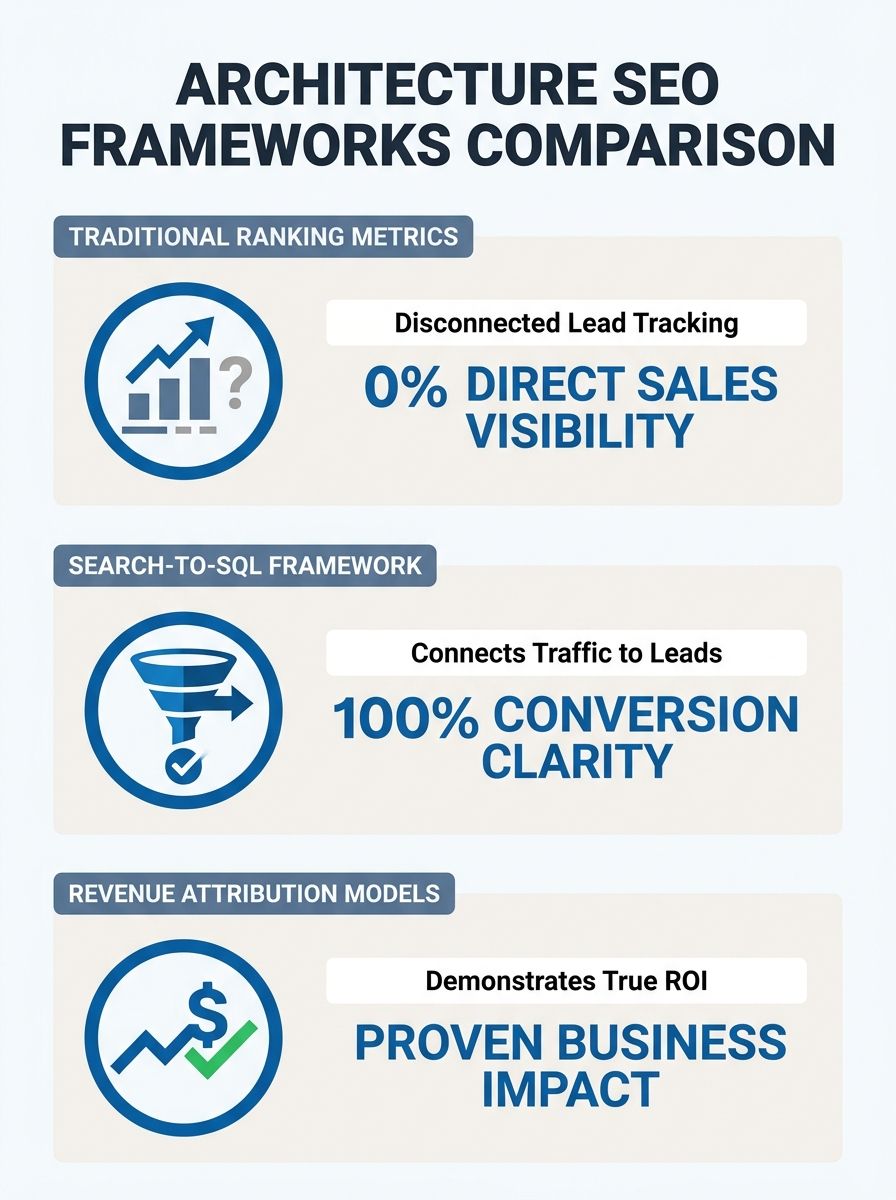
From Search Ranking to Signed Contracts: Why Traditional SEO Metrics Fail Architects (And How Agencies Are Fixing It)
Vernacular, a design-focused SEO agency reviewed in Siana Marketing's 2026 agency roundup, charges architecture firms a premium over generalist agencies and still maintains a waiting list. Client reviews praise their "clear ROI measurement with transparent dashboards" and "balanced approach to aesthetics and performance." Not one testimonial highlights keyword rankings. Not one mentions organic traffic volume. The clients paying those rates wanted proof that SEO spending connected to signed contracts.
This disconnect between what SEO agencies traditionally report and what architecture principals actually need has been widening for years. And now there are three competing measurement frameworks vying to replace the old model. Each demands different infrastructure, different agency capabilities, and different levels of client involvement. If you're running an architecture firm, or you're the agency trying to serve one, the framework you pick determines whether SEO stays a line-item expense or becomes a genuine business development function.
I've evaluated over 200 SEO agencies across dozens of industries, and architecture firms represent one of the clearest cases where standard reporting actively misleads clients. The typical architecture project runs $50,000 to $5 million+. Sales cycles stretch six to eighteen months. A firm might sign four to twelve new clients per year. When your entire annual revenue hinges on a handful of contracts, "you ranked #3 for 'modern commercial architect'" tells you almost nothing useful about whether your SEO investment is working.
Here's how the three dominant approaches stack up.
Framework One: Traditional Ranking Metrics (and Why They Persist)
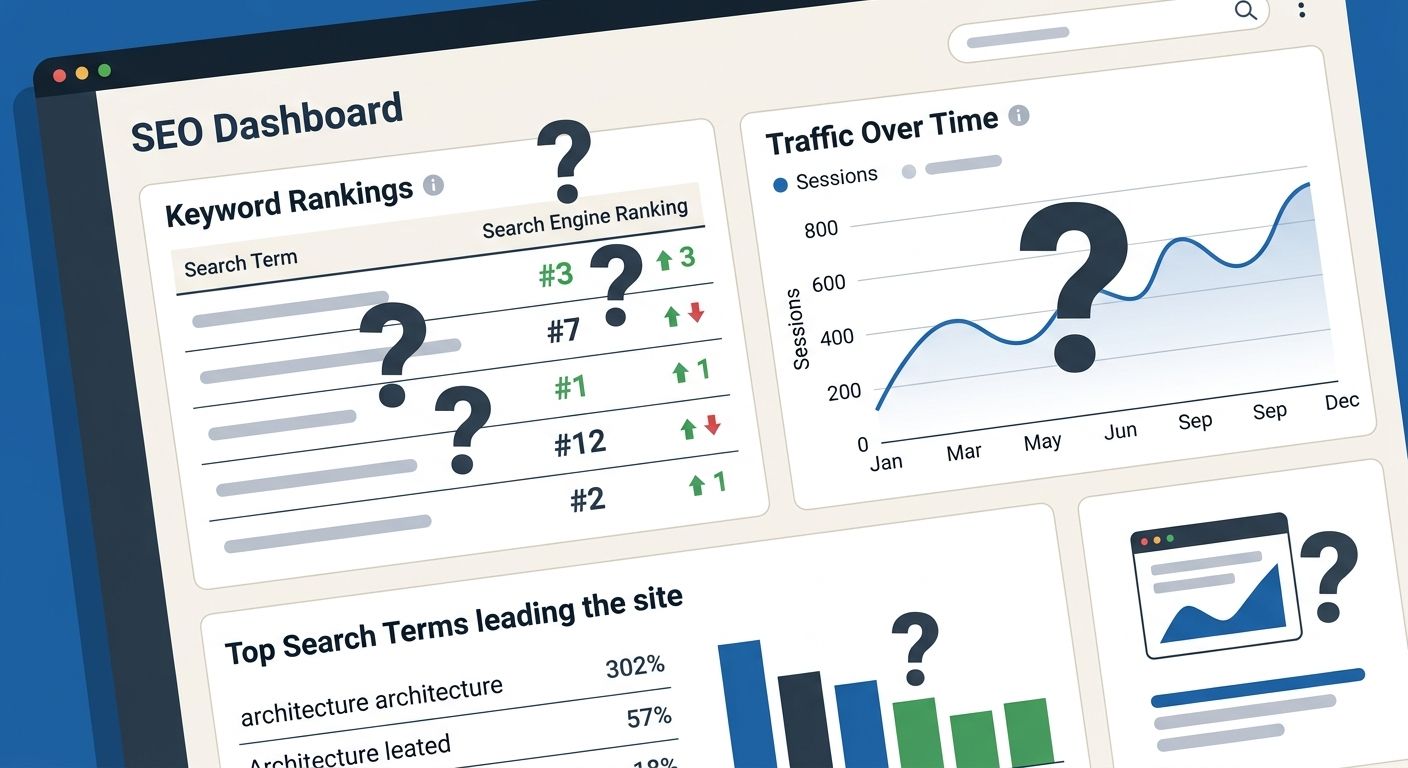
The default reporting package from most generalist SEO agencies looks roughly the same: keyword position tracking, organic traffic graphs, domain authority scores, and maybe a backlink count. These reports arrive monthly. They show lines going up. Principals glance at them, nod, and wonder privately whether any of it connects to the three RFPs they received this quarter.
Traditional ranking metrics aren't useless. They tell you whether your site is technically visible. They confirm that Google can find and index your pages. For an architecture firm that's never invested in SEO before, seeing your "healthcare architecture firm Boston" page climb from position 47 to position 11 provides legitimate signal that your content strategy is pointed in the right direction.
But here's where the framework breaks down for architects specifically:
Volume mismatch. High-intent architecture queries generate tiny search volumes. "Net-zero commercial architect Pacific Northwest" might get 30 searches per month. Traditional SEO reporting treats low-volume keywords as low-priority. For an architecture firm, those 30 searches might represent your entire addressable market in a given region.
Conversion invisibility. Ranking reports don't tell you whether anyone who searched that term actually contacted your firm, booked a consultation, or eventually signed a contract. You're measuring the top of a funnel that might have zero connection to your pipeline.
Vanity inflation. Domain Authority and total backlink counts have become increasingly disconnected from actual search performance, as we explored in our analysis of why performance metrics alone don't predict SEO success. An architecture firm with DA 35 can outrank a DA 60 competitor on the specific queries that matter, because topical relevance and E-E-A-T signals carry more weight in narrow verticals.
As Easy Marketing School's SEO guide for architecture firms puts it: "SEO without measurement is like designing without a brief — you might produce something beautiful, but you won't know if it solved the problem."
Who still benefits from this framework
Firms spending under $2,000/month on SEO, working with a generalist agency, and primarily concerned with basic local visibility. If you're a three-person residential firm in a mid-size market, traditional ranking metrics give you enough signal to know your investment is directionally correct. The cost of implementing more sophisticated measurement may exceed the insight you'd gain.
The real risk
Architecture firms with $10,000+ monthly SEO budgets that receive only ranking reports are flying blind on ROI. I've seen firms spend $150,000 over eighteen months, achieve strong ranking improvements, and have zero ability to attribute even a single signed project to organic search. That's an accountability failure, and it's the agency's fault for not building the measurement infrastructure.
Framework Two: The Search-to-SQL Approach
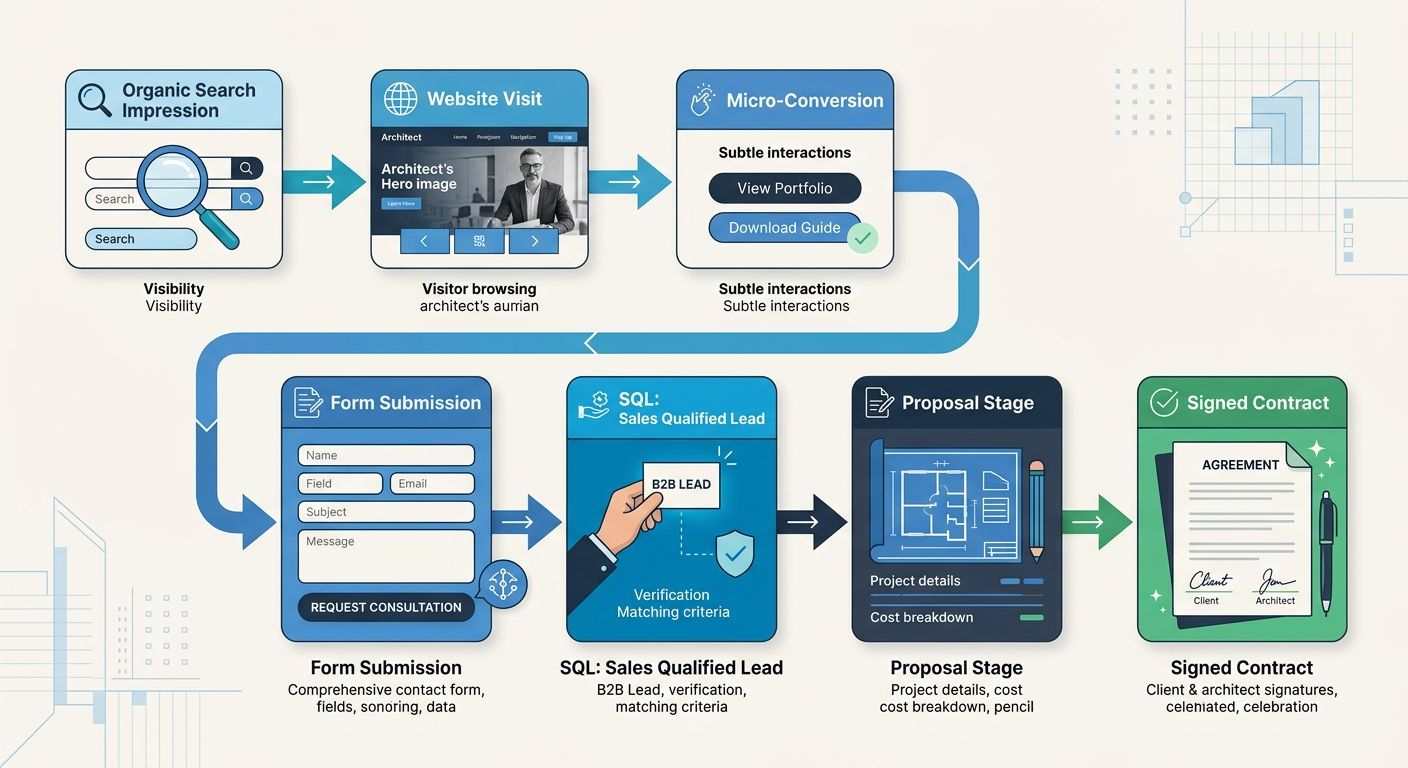
The search-to-SQL framework is the measurement approach gaining the most traction among agencies that specialize in professional services. SQL here means Sales Qualified Lead, and the framework tracks a prospect's path from initial search query through to becoming a lead that your business development team considers worth pursuing.
Instead of reporting "your organic traffic grew 23%," an agency using this framework reports "organic search generated 14 consultation requests this quarter, 8 of which your team qualified as genuine prospects, and 3 of those are now in active proposal stages."
The mechanics work like this. The agency sets up conversion tracking in Google Analytics tied to specific high-intent actions: contact form submissions, consultation booking completions, portfolio PDF downloads, and phone calls from organic landing pages. Each conversion gets tagged with the search query or landing page that initiated it. Then those digital conversions are cross-referenced against the firm's actual business development pipeline.
This is where the framework demands client participation. The architecture firm needs to close the feedback loop by reporting back which form submissions turned into real conversations, which conversations turned into proposals, and which proposals turned into contracts. Without that feedback, the agency is still measuring form fills, which is better than measuring rankings but still incomplete.
The micro-conversion layer
Smart agencies also track micro-conversions that indicate engagement short of a contact form fill. For architecture firms, these include:
Time spent on project case study pages (90+ seconds suggests genuine interest)
Portfolio gallery interactions (clicking through 5+ project images)
Team/about page visits following a project page view
Return visits from the same user within 30 days
These micro-conversions matter because architecture buying cycles are long. Someone researching firms in March may not submit a contact form until September. If your SEO reporting only counts form fills, you'll see months of apparent stagnation that actually represent a healthy pipeline building beneath the surface.
Tradeoffs and limitations
The search-to-SQL framework requires setup time and ongoing maintenance. Expect your agency to need four to six weeks to implement proper tracking, and expect them to charge $500-$1,500 for the initial configuration if it's not included in their retainer. You'll also need someone inside your firm who's willing to update lead status in a shared spreadsheet or CRM at least bi-weekly.
The bigger limitation: this framework still relies on last-touch attribution. If a prospect first discovered your firm through an AI search result, then visited your site directly two months later, and then filled out a contact form after clicking an organic result, the search-to-SQL framework credits organic search with the full conversion. The reality is more complicated, especially as AI-driven search continues to change how prospects discover firms.
Pricing expectations
Agencies offering search-to-SQL measurement typically charge $3,500-$8,000/month for architecture firms, with the tracking infrastructure built into the retainer. Some, like SeeResponse, position this as their core differentiator and charge accordingly. If an agency quotes you below $2,500/month and promises SQL-level reporting, ask exactly how they're tracking conversions. The answer often reveals they're still reporting form fills without the qualification layer.
Framework Three: Revenue Attribution Modeling
Revenue attribution is the measurement approach borrowed from enterprise B2B marketing and adapted for professional services firms. Where the search-to-SQL framework tracks a linear path from search to qualified lead, revenue attribution attempts to assign dollar values to every marketing touchpoint that contributed to a signed contract.
For a $2 million healthcare facility project, revenue attribution answers the question: what percentage of that contract's value should be credited to the blog post about healthcare design trends that the client's facilities director read eight months ago? What credit goes to the Google Business Profile listing they found first? What about the case study page they revisited three times before reaching out?
This is the most analytically rigorous framework, and it's also the most expensive and complex to implement. As OutPace SEO's enterprise framework describes it, effective enterprise SEO measurement requires "accountability structures that assign ownership of specific SEO KPIs to specific teams or individuals." For architecture firms, that means the marketing team, the principals doing business development, and the SEO agency all need to share data and agree on attribution rules.
The three models in practice
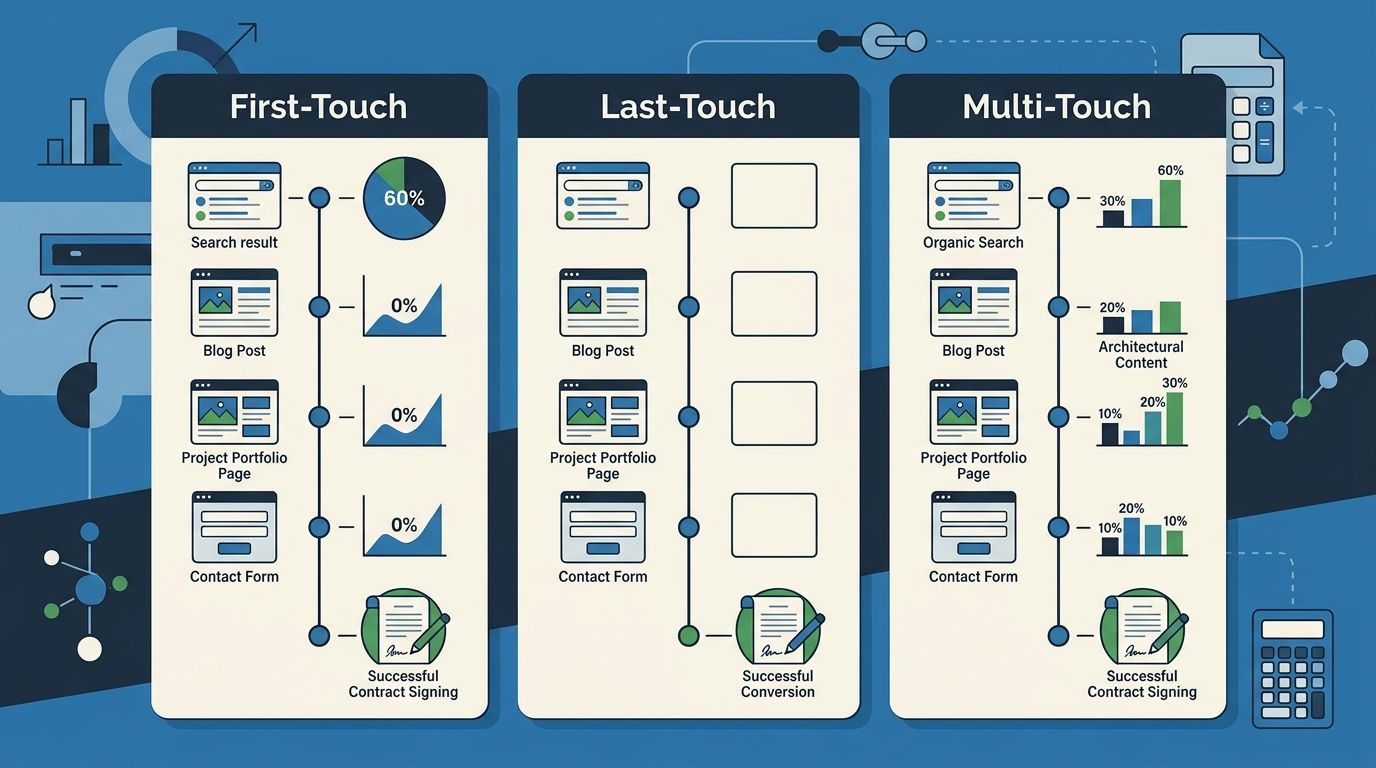
First-touch attribution gives full credit to the channel that introduced the client to your firm. If organic search was how they first found you, the entire project value gets attributed to SEO. This model is simple and tends to make SEO look very good, which is why some agencies prefer it.
Last-touch attribution credits whatever channel drove the final conversion action. This often favors direct traffic or referral traffic, since prospects who've done extensive research tend to type your URL directly or click a link from a colleague. SEO gets undervalued in this model.
Multi-touch attribution distributes credit across all touchpoints. A common approach is the time-decay model, which gives more weight to recent interactions while still acknowledging earlier touchpoints. For architecture firms with six-to-eighteen-month sales cycles, this is the most honest model, but it's also the hardest to implement correctly.
What implementation actually requires
Revenue attribution for an architecture firm typically needs:
A CRM system (HubSpot, Salesforce, or even a well-structured Airtable) where every lead's source and touchpoints are logged
Google Analytics 4 configured with proper UTM tagging across all marketing channels
Call tracking software to attribute phone inquiries to specific landing pages
An agency willing to integrate their SEO reporting with your CRM data
Quarterly reviews where the agency, firm principals, and marketing team reconcile attributed revenue against actual signed contracts
The Architect's SEO ROI Playbook from Adswom distills this into a straightforward ROI formula: track costs, project revenue, and close rates together. The formula sounds simple. Executing it requires discipline on both sides.
Tradeoffs and limitations
This is expensive. Agencies offering true revenue attribution modeling for architecture firms charge $8,000-$20,000/month, and the CRM and tracking software adds another $200-$1,000/month depending on your tech stack. For a firm billing $3 million annually, the investment can absolutely justify itself if it helps you understand which SEO activities contribute to winning $500,000+ projects. For a firm billing $800,000, the measurement framework might cost more than the insights are worth.
The other limitation is data quality. Architecture firms are notoriously informal about tracking where leads originate. If a principal meets someone at an AIA conference who later Googles the firm and fills out a contact form, is that an organic conversion or a networking conversion? Revenue attribution models are only as good as the data going into them, and most small-to-midsize architecture firms don't have the internal processes to maintain clean attribution data.
Architecture firms with image-heavy portfolios face additional tracking challenges, since much of the prospect's engagement happens through visual browsing that standard analytics tools capture poorly. Make sure your agency has a plan for tracking gallery engagement, not just page views.
How To Choose Between These Three
The honest answer depends on three variables: your firm's annual revenue, the number of new clients you need to win per year, and your willingness to participate in the measurement process.
Architecture firms billing under $1.5 million annually should start with the search-to-SQL framework. Traditional ranking metrics give you too little information, and full revenue attribution costs more than it's worth at your scale. Find an agency charging $3,500-$6,000/month that will track consultation requests from organic search and help you connect those to your pipeline. The different playbook that architects need compared to general B2B firms starts here, with measurement tailored to low-volume, high-value conversion patterns.
Architecture firms billing $1.5 million to $5 million sit in an interesting middle zone. The search-to-SQL framework will serve you well if your internal team can maintain the feedback loop. If you have a marketing coordinator or operations manager who can update lead status weekly, you'll extract most of the insight you need. Consider adding basic first-touch attribution tracking as a lightweight enhancement, without committing to a full multi-touch model.
Architecture firms billing above $5 million with dedicated marketing staff should evaluate full revenue attribution. At this scale, understanding which SEO activities contribute to winning $1 million+ projects justifies the investment. But be realistic about your data hygiene. If your principals track leads on sticky notes and don't use a CRM consistently, no attribution model will produce reliable results. Fix the data infrastructure first.
Across all three tiers, one principle holds: the agency you hire should report SEO accountability metrics that connect to your business outcomes, not to their activity log. Rankings, backlinks, and traffic volume are internal operational metrics for the agency. Your reports should show you qualified leads, pipeline influence, and, where possible, attributed revenue.
The gap between ranking vs. revenue attribution reporting is where most architecture-agency relationships break down. I've watched firms cycle through three or four agencies in five years, each time getting better rankings and no clarity on ROI. The measurement framework was broken from the start. Picking the right one before you sign an agency contract is far cheaper than discovering the mismatch twelve months in.
The best SEO ROI for architecture firms comes from matching your measurement sophistication to your firm's actual capacity to participate in the tracking. A simple framework executed consistently will always outperform a complex one that nobody maintains. Pick the approach that fits your firm's reality, negotiate it into your agency contract's deliverables, and hold both sides accountable for keeping the data clean.
Marcus Webb
Digital marketing consultant and agency review specialist. With 12 years in the SEO industry, Marcus has worked with agencies of all sizes and brings an insider perspective to agency evaluations and selection strategies.
Explore more topics