
Niche-Specific SEO Strategy: Why Architects and Design Firms Need a Different Playbook Than General B2B
---
 Marcus Webb··8 min read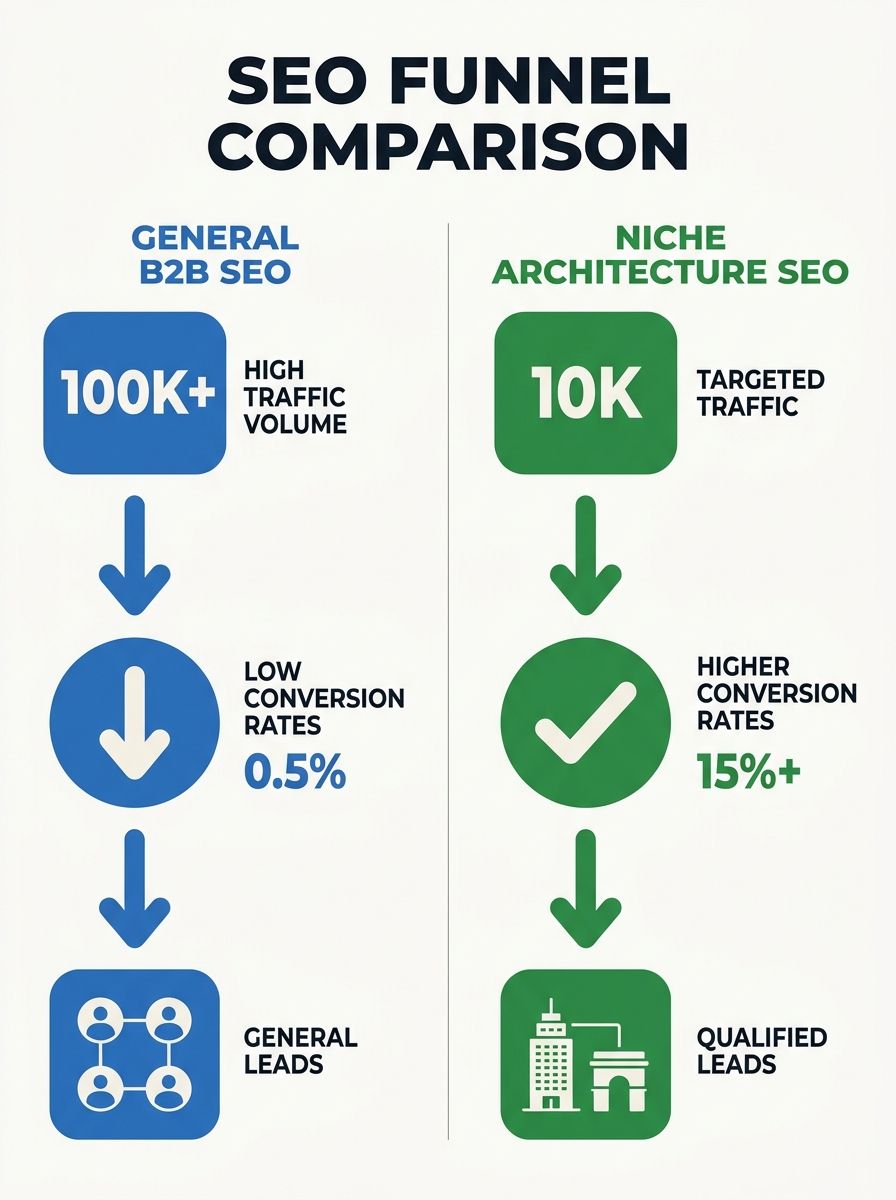
Niche-Specific SEO Strategy: Why Architects and Design Firms Need a Different Playbook Than General B2B
Adswom's architecture practice documented a pattern across 30+ firms that had previously worked with general B2B SEO agencies: firms using generic commercial keywords like "architecture services" or "design firm near me" were generating traffic, but their lead-to-project conversion rates sat below 2%. When those same firms shifted to what Adswom calls "style + location + intent" keyword combinations, conversion rates climbed by roughly 40%. The gap wasn't subtle. It pointed to a fundamental mismatch between how general B2B SEO agencies operate and what architecture and design firms actually need from search. This is the case I want to walk through, because I've seen this mismatch play out repeatedly in the agencies I evaluate, and it reveals something important about how professional services niche SEO gets handled when agencies aren't specialized enough.
What Happened
The typical scenario goes like this: a mid-sized architecture firm, say 10 to 40 people, signs a 12-month retainer with a B2B SEO agency. The agency is competent. They run a technical audit, fix crawl errors, build a content calendar centered on blog posts, and target keywords with decent monthly search volume. The firm starts ranking for terms like "commercial architect" or "residential design services." Traffic increases. Reports look healthy.
But the phone doesn't ring more often. Or when it does, the leads are tire-kickers looking for budget renovations, not the $500K custom home clients or boutique hotel developers the firm actually wants.
This is the disconnect I see agency after agency fail to address. General B2B SEO agencies optimize for visibility. Architecture firms need visibility that's filtered through aesthetic alignment, geographic relevance, and project specificity. Those are fundamentally different optimization goals.
The documented cases are consistent. One California firm working with a generalist agency saw 187% organic traffic growth over five months through targeted media outreach alone. That's impressive until you realize the traffic was largely informational, not transactional. A Denver studio, by contrast, focused specifically on Google Business Profile optimization and a structured client review campaign. They saw a 340% increase in local impressions, and more critically, the inquiries they received were project-ready. Same industry, wildly different SEO approaches, completely different outcomes.
What the Data Showed
The core data point from Adswom's analysis is worth sitting with: that 40% conversion rate improvement when firms moved from generic keywords to intent-specific combinations. Instead of targeting "architect near me," firms that targeted phrases like "luxury villa architect Bangalore" or "modern home renovation architect Seattle" attracted prospects who already knew what they wanted.
This matches what I've observed across other professional services verticals. When I've looked at how healthcare practices select SEO partners, the same principle applies: the more specialized the service, the more damage a generalist keyword strategy does. Architects aren't selling widgets. They're selling a relationship, a design philosophy, and a six-to-eighteen-month commitment. The search behavior reflects that.
Three data points from the research stood out to me:
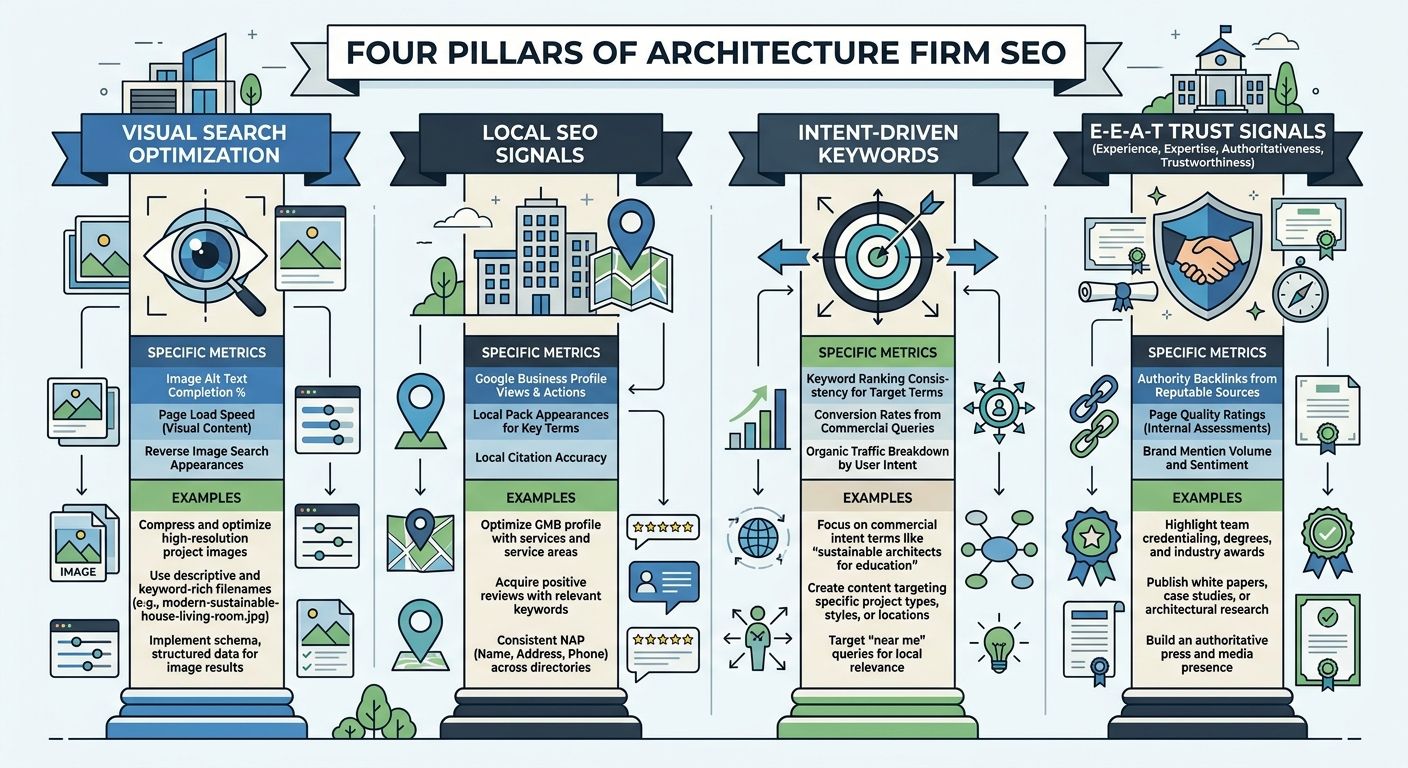
70% of architecture prospects browse on mobile. This isn't just a responsive design issue. It means portfolio pages need to load instantly on phones, and most architecture firm websites fail this test because they're loaded with uncompressed high-resolution images. One documented case showed a firm reducing load time from 8 seconds to under 2 seconds, which doubled their organic conversions.
Visual search is reshaping discovery. Clients are increasingly using image-based queries. They point their phone at a building and search for "design like this." Firms optimizing images with descriptive filenames like "luxury-villa-design-mumbai.jpg" and detailed alt text see up to 30% more engagement on portfolio pages compared to those using generic filenames like "IMG_4392.jpg."
Local SEO drives 80% of initial project inquiries, even for firms with national or international portfolios. This surprised me less than it might surprise you. Architecture is inherently local in its early discovery phase. People search for architects in their city, their region, their market.
The pattern across these data points tells a clear story: an architecture firm SEO strategy has to operate on multiple dimensions simultaneously, including visual, local, intent-driven, and trust-based. General B2B SEO typically operates on one, maybe two.
What Was Missed
When I evaluate agencies for architecture and design firms, three gaps come up with predictable regularity.
Portfolio-Based SEO Gets Ignored
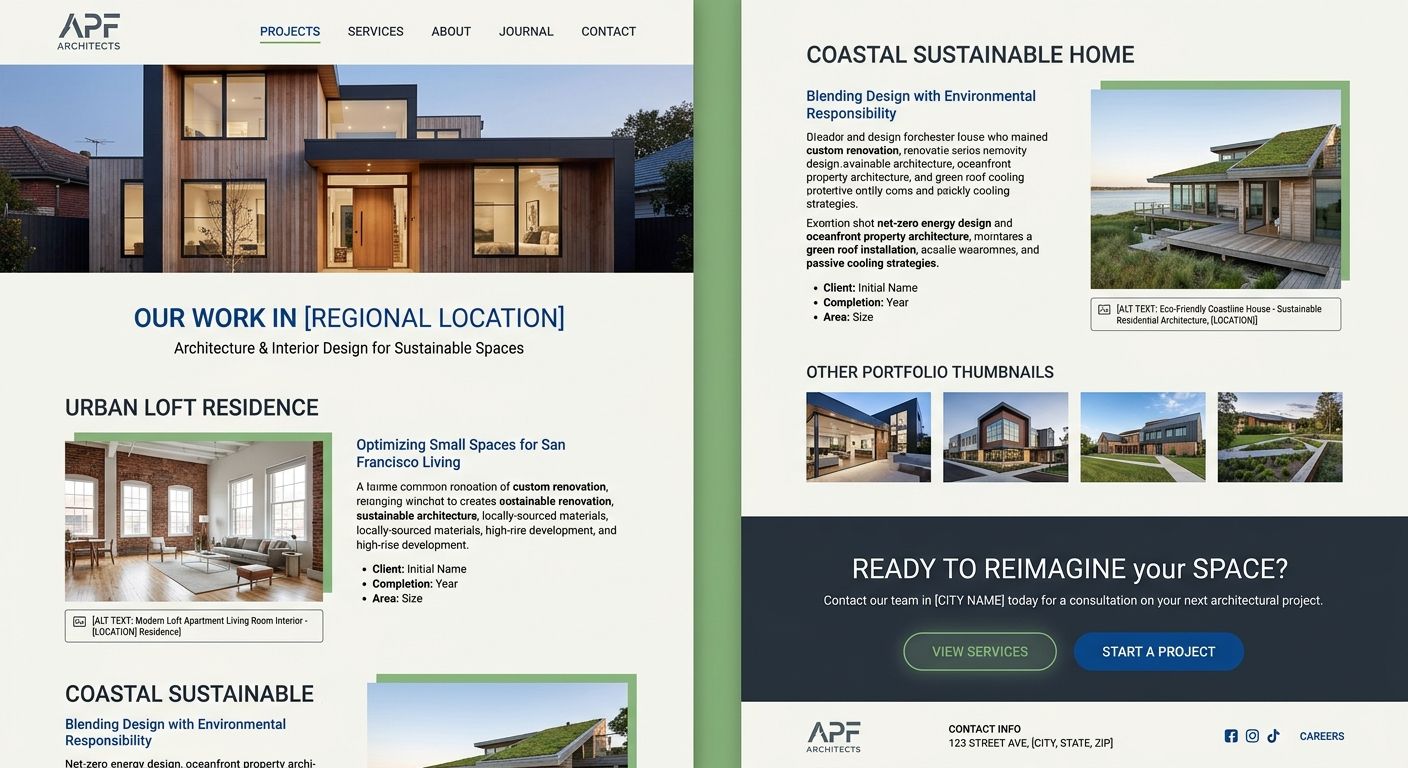
This is the biggest miss. Architecture firms live and die by their portfolios, yet most general B2B agencies treat portfolio pages as static image galleries. They're not optimized for search. They don't have structured content. They don't end with calls to action.
The Adswom guide is blunt about this: every portfolio project page should include a narrative arc of the client brief, the design challenge, the solution, and the outcome. Each page should target a specific keyword combination. Each should end with something like "Book a consultation for similar projects." This is practical, page-level guidance that most generalist agencies never implement because they don't understand that portfolio pages are the equivalent of product pages for an e-commerce site. They're where conversion happens.
Service pages need the same treatment. Not "We offer residential architecture services," but "Luxury resort architecture in Goa," with awards, testimonials, and recognitions backing up the claim. Specificity signals expertise. Generic copy signals a firm that takes any project.
Platforms like Archifolio exist specifically because architects need portfolio presentation that's both visually compelling and search-friendly. When your agency doesn't understand portfolio-based SEO, you're leaving your most powerful conversion asset unoptimized.
Local SEO Gets Treated as Optional
Even agencies that understand local SEO often treat it as a secondary concern for architecture firms. "You're a design firm, not a pizza shop," one agency told a client of mine. That thinking is dangerously wrong.
According to current local ranking factor research, dedicated local landing pages with unique content, specific NAP (Name, Address, Phone) details, and location-relevant project examples are critical for visibility. For multi-location firms, each office needs its own page. For single-location firms, the geographic service area still needs to be defined explicitly.
Google Business Profile optimization is non-negotiable. High-quality project photos, service descriptions with relevant keywords, and regular posts all feed into local ranking. The Denver studio's 340% improvement in local impressions came primarily from GBP optimization and a structured review strategy, not from traditional link building or blog content.
Grid-based local ranking tools, like Merchynt's Heatmap Audit Tool, show your actual visibility from different points in your service area. This kind of block-by-block analysis reveals that a firm might rank well from one neighborhood and be invisible from another, ten miles away. Most general agencies never run this analysis.
E-E-A-T Gets Lip Service
Google's E-E-A-T framework (Experience, Expertise, Authoritativeness, Trustworthiness) matters enormously for architecture firms, yet it's the area where I see the laziest implementation. A general B2B agency might add a team page with headshots and titles. That's not E-E-A-T. That's a directory listing.
Real E-E-A-T for an architecture firm means team bios that include credentials, project history, and design philosophy. It means publishing case studies with original photography and specific project metrics. It means earning features and backlinks from publications like ArchDaily, Dezeen, or Houzz, not generic business directories. As Search Engine Journal notes about niche specialization, the depth of industry knowledge directly impacts the quality of SEO execution. A general agency that takes on any client rarely builds the kind of domain expertise needed to execute E-E-A-T properly for design firms.
The Design Firm Search Optimization Gap in Agency Selection
So where does this leave you when you're actually choosing an agency? I've evaluated over 200 SEO agencies across my career, and the architecture and design vertical exposes weaknesses in agency capabilities faster than almost any other.
Here's what to look for:
Ask for architecture or design firm case studies specifically. Not "professional services." Not "B2B." If they can't show you a design firm search optimization case with measurable lead quality improvements, they're going to learn on your dime.
Check whether they understand visual search. Ask them how they'd optimize your portfolio images for Google Lens and visual search results. If the answer doesn't include filenames, alt text strategy, image compression, and schema markup, they don't understand the vertical.
Evaluate their local SEO depth. Do they run heatmap analyses? Do they know what NAP consistency means across Houzz, Archello, and AIA directories? Or do they just set up a Google Business Profile and call it done?
Look at pricing realistically. For architecture firms, expect to pay $3,000 to $7,000 per month for an agency that genuinely understands this niche. Below that, you're getting templated work. I've seen firms pay $1,500 per month and receive the same keyword research and blog calendar they'd get if they were a plumbing company.
The agencies that serve this vertical well tend to be small and specialized. They understand that long-tail comparison keywords drive the highest-quality traffic in design. They know that a blog post about "5 trends in kitchen design" isn't content strategy; it's filler. Real content for architects is project-driven storytelling that ranks for the intersection of style, location, and building type.
And with AI-driven search increasingly reshaping how agencies approach visibility, this gap is getting wider, not narrower. AI overviews favor structured, specific, expert content. Generic B2B blog posts get summarized and forgotten. Detailed project case studies with original data get cited. The firms that win in 2026 are the ones whose SEO agencies understand that distinction.
What the Evidence Reveals About Vertical Expertise
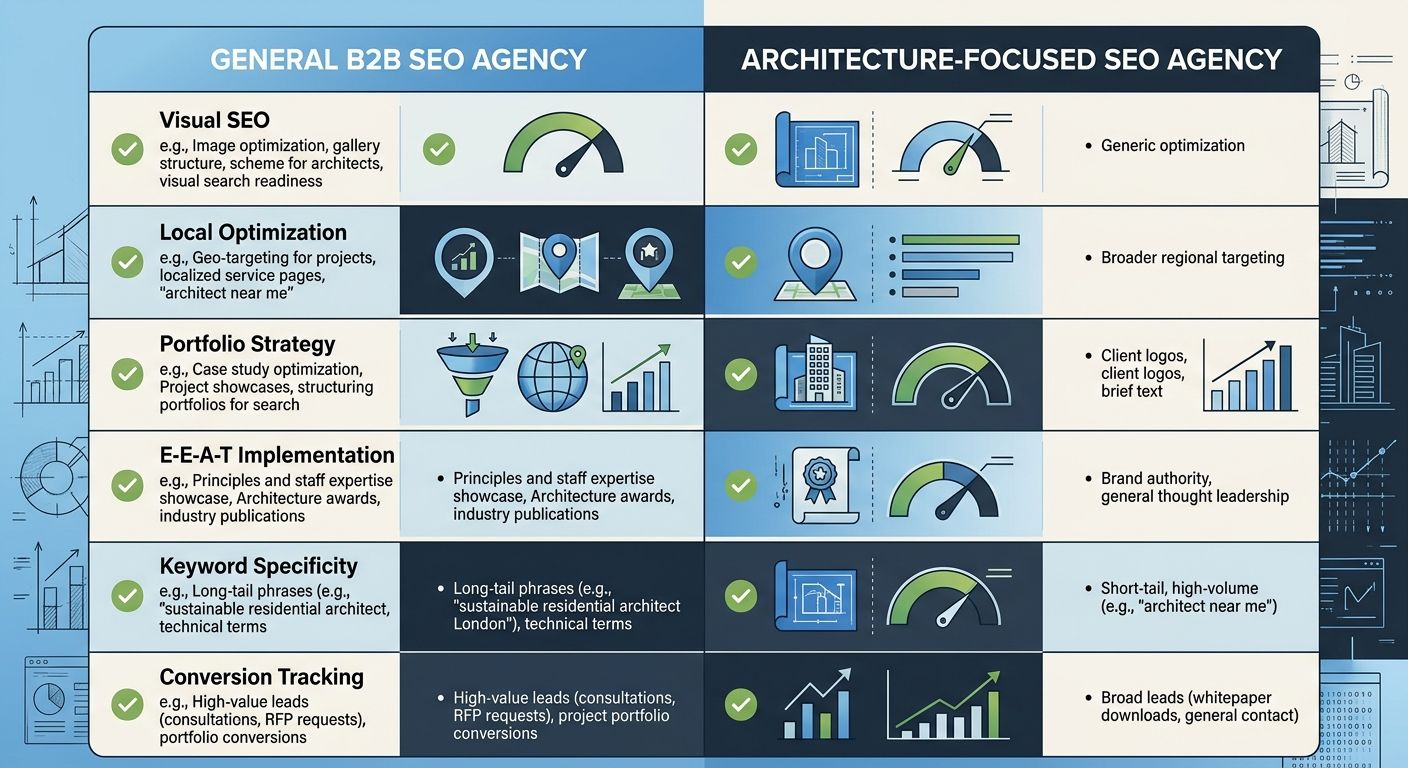
The case data tells a consistent story. Architecture and design firms don't fail at SEO because search doesn't work for them. They fail because they hire agencies that apply the wrong playbook.
General B2B SEO is built for companies selling subscriptions, software, or scalable services. The funnel is different. The content types are different. The conversion signals are different. An architecture firm that lets a generalist agency treat its portfolio like an afterthought, skip visual search optimization, and target generic commercial keywords is paying for activity that generates reports, not projects.
The 40% conversion improvement from intent-specific keywords, the 340% local impression boost from proper GBP work, the doubled conversions from fixing page speed alone: none of these required exotic technology or massive budgets. They required an agency that understood the vertical well enough to know where the actual opportunities were.
I'm skeptical by nature, and I'm especially skeptical of agencies that claim they can serve any industry equally well. The evidence here says otherwise. Architecture firm SEO strategy is a different discipline than SaaS SEO or e-commerce SEO, not because the technical foundations change, but because the client behavior, the conversion path, and the trust signals are all unique to how people hire architects.
If you're running a design firm and your current agency has never asked you about your project photography workflow, your ideal client's geographic radius, or how you want your portfolio pages structured, you don't have a niche SEO partner. You have a B2B SEO vendor running a template. And the gap between those two things is measured in projects you never heard about because the right person never found your work.
Marcus Webb
Digital marketing consultant and agency review specialist. With 12 years in the SEO industry, Marcus has worked with agencies of all sizes and brings an insider perspective to agency evaluations and selection strategies.
Frequently Asked Questions
- Why do architecture firms get poor conversion rates from generic SEO keywords?
- Generic keywords like "architecture services" or "design firm near me" attract tire-kickers and budget-conscious prospects rather than high-value clients. Architecture firms need visibility filtered through aesthetic alignment, geographic relevance, and project specificity—goals that general B2B SEO agencies typically don't address.
- What keyword strategy improves architecture firm conversions?
- Using "style + location + intent" keyword combinations like "luxury villa architect Bangalore" or "modern home renovation architect Seattle" attracts prospects who already know what they want, resulting in approximately 40% higher conversion rates compared to generic commercial keywords.
- How important is mobile optimization for architecture firm websites?
- 70% of architecture prospects browse on mobile, making instant-loading portfolio pages critical. One firm that reduced page load time from 8 seconds to under 2 seconds doubled their organic conversions.
- How should architecture firms optimize portfolio images for search?
- Use descriptive filenames like "luxury-villa-design-mumbai.jpg" and detailed alt text instead of generic names like "IMG_4392.jpg." Firms optimizing images this way see up to 30% more engagement on portfolio pages, plus visual search optimization helps with image-based queries like "design like this."
- What percentage of architecture project inquiries come from local SEO?
- Local SEO drives 80% of initial project inquiries, even for firms with national or international portfolios, making Google Business Profile optimization and local landing pages essential.
- What should architecture portfolio pages include for SEO?
- Each portfolio project page should include a narrative arc covering the client brief, design challenge, solution, and outcome; target a specific keyword combination; and end with a call-to-action like "Book a consultation for similar projects." These pages function like product pages in e-commerce sites.
- How much should an architecture firm budget for specialized SEO services?
- Expect to pay $3,000 to $7,000 per month for an agency that genuinely understands architecture firm SEO. Agencies charging below $1,500 typically provide templated work identical to what they'd deliver to any industry.
- What is the key performance metric for architecture firm SEO?
- The metric that matters is cost per qualified project inquiry, not pageviews or keyword rankings. Architecture firms should track inquiry quality and project bookings rather than generic traffic metrics.
Explore more topics