
What Healthcare Practices Should Look for in an SEO Partner
A dermatology group in Phoenix hired an agency that promised them page-one rankings in 90 days.
 Marcus Webb··9 min read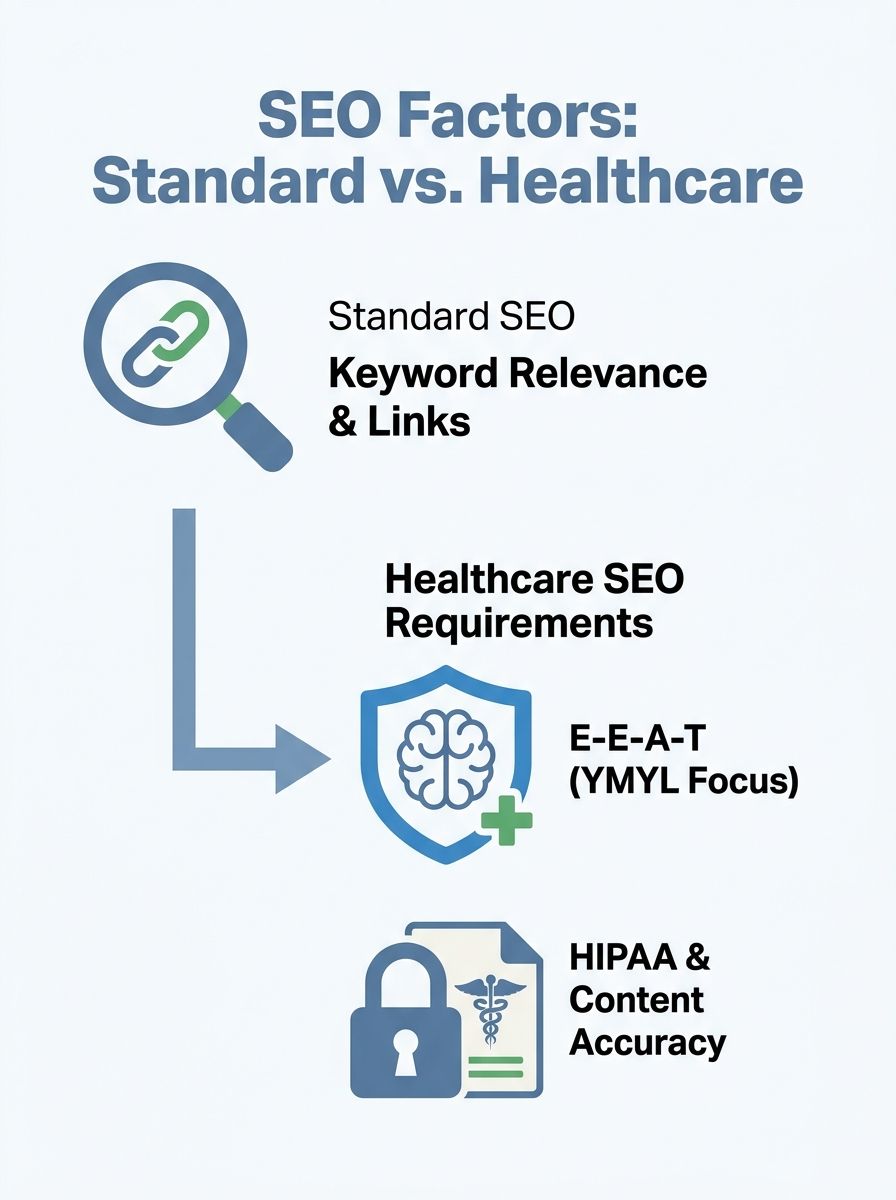
What Healthcare Practices Should Look for in an SEO Partner
A dermatology group in Phoenix hired an agency that promised them page-one rankings in 90 days. The agency built backlinks from gambling sites, stuffed keyword-heavy blog posts with unverified medical claims, and — here's the part that still makes me wince — installed tracking pixels that captured patient form submissions without any HIPAA-compliant data handling. The practice didn't just lose rankings when Google's algorithm caught up. They faced a potential compliance violation that cost them $40,000 in legal fees and an audit that consumed six months of their operations team's bandwidth.
I've evaluated over 200 SEO agencies during my career, and the healthcare vertical is where I see the most damage done by agencies that don't understand the stakes. Healthcare SEO isn't just about driving traffic. It's about patient trust, regulatory compliance, and content that meets the highest quality bar Google applies to any industry. Choosing the wrong partner doesn't just waste your marketing budget. It can put your practice at genuine legal and reputational risk.
Here's exactly what to look for, what to avoid, and how to structure the relationship so it actually works.
Why Healthcare SEO Plays by Different Rules
Every industry has its quirks when it comes to search optimization. Real estate SEO companies deal with hyper-local competition and constantly changing inventory. Home services SEO agencies fight for map-pack visibility in crowded metro areas. But healthcare? Healthcare sits in a category Google treats with extreme scrutiny.
Google classifies medical content under YMYL (Your Money or Your Life), meaning it can directly impact a person's health, financial stability, or safety. As Wheelhouse DMG's industry guide explains, Google evaluates healthcare pages through the lens of E-E-A-T: Experience, Expertise, Authoritativeness, and Trustworthiness. A generic blog post about knee pain written by a freelancer with no medical background will get buried. The same topic authored by a board-certified orthopedic surgeon with proper credentials displayed on the page? That's what Google wants to surface.
Your SEO partner needs to understand this at a fundamental level. If they're pitching you the same keyword strategy they'd use for an e-commerce brand, walk away.
HIPAA Compliance Isn't Optional — It's the First Filter
Before you evaluate an agency's keyword research skills or their content calendar templates, ask one question: How do you handle HIPAA compliance in your SEO and analytics setup?
If they look confused, end the meeting.
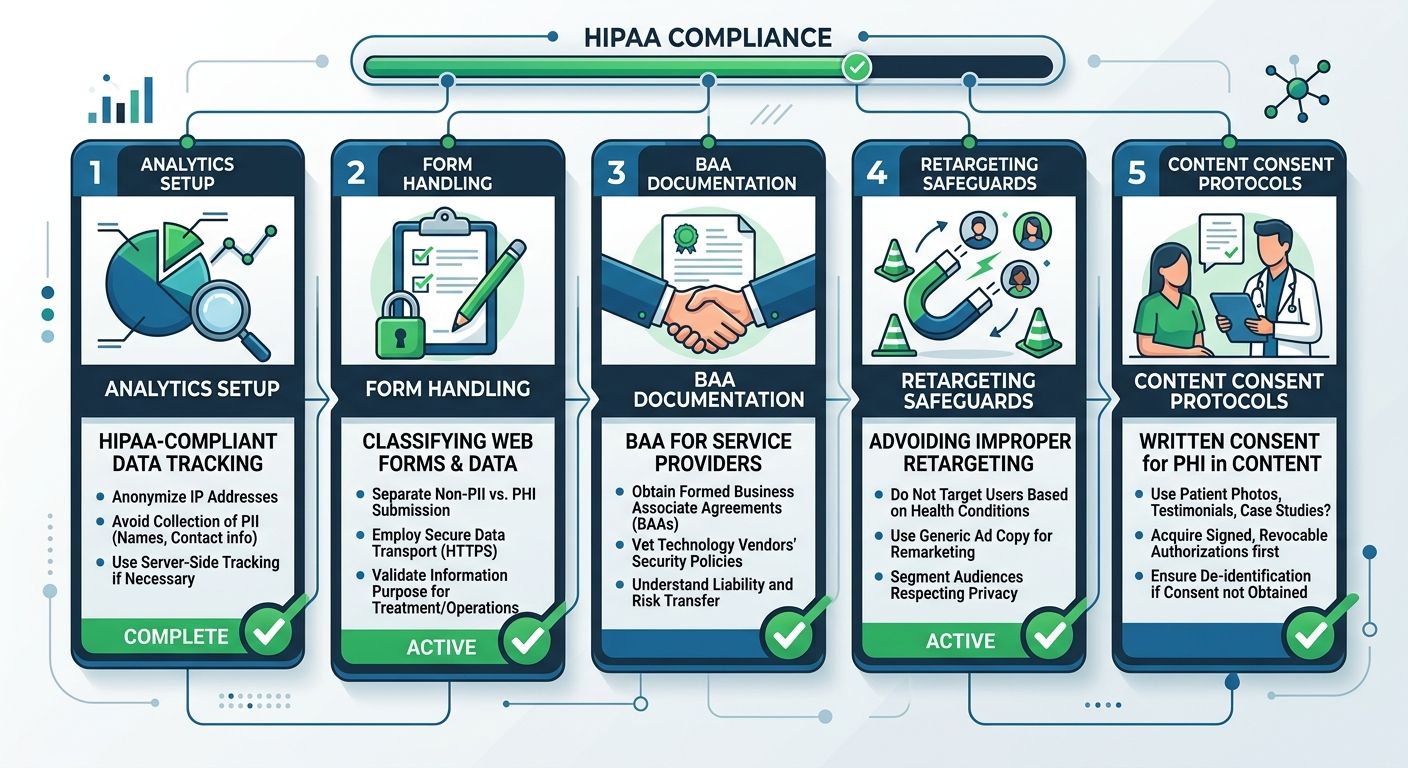
HIPAA compliance in the context of medical practice marketing means more than just being careful with patient names. It extends to:
Analytics tracking: Standard Google Analytics implementations can capture IP addresses and form data that qualifies as protected health information (PHI). Your SEO partner needs to use HIPAA-safe analytics configurations or platforms built specifically for healthcare, as outlined by HIPAA-compliant SEO specialists who use privacy-first tracking strategies.
Form submissions and call tracking: If the agency sets up conversion tracking on appointment request forms, they need Business Associate Agreements (BAAs) with every third-party tool that touches patient data.
Retargeting and ad pixels: Installing Facebook or Google remarketing pixels on pages where patients enter health information is a compliance minefield. Accountable HQ's review of HIPAA-compliant providers highlights that over 10,000 companies now rely on specialized compliance software to manage this.
Content involving patient stories: Testimonials, before-and-after photos, and case studies all require proper consent documentation. Your agency should know this before you have to tell them.
I've seen agencies claim "we handle healthcare clients" while running the exact same tech stack they use for retail brands. Ask for specifics. Ask to see their BAA documentation. Ask which analytics platform they'll deploy. The good agencies welcome these questions. The bad ones deflect.
The E-E-A-T Credentials Your Agency Must Build For You
Google doesn't just want accurate medical content. It wants provable expertise behind that content. This means your SEO partner needs a content strategy that goes far beyond blog post volume.
Here's what a strong healthcare content framework looks like:
Author Credibility Architecture
Every clinical page on your site should display the authoring physician's credentials: board certifications, years of practice, hospital affiliations, and published research. Generic bylines like "Written by the Marketing Team" actively hurt your rankings on YMYL topics.
Your agency should build structured data markup that connects author profiles to published content, making it easy for Google to verify expertise. According to research from LinkGraph, choosing the right SEO partner directly affects patient acquisition, search visibility, and regulatory compliance. That connection starts with how your content is attributed.
Source Citation Standards
Medical claims need backing. Your agency should be citing sources from the CDC, NIH, FDA, and peer-reviewed journals, not pulling statistics from random health blogs. I've audited healthcare sites where the agency's "medical content" linked to Pinterest boards as sources. That's not an exaggeration.
Content Refresh Protocols
Medical guidelines change. Drug interactions get updated. Treatment protocols evolve. Your SEO partner should have a systematic process for reviewing and updating existing content, not just publishing new posts and forgetting old ones.
The agencies that understand healthcare E-E-A-T treat your physicians as the content backbone of the strategy. They'll interview your doctors, build detailed author pages, and create content workflows that keep medical professionals in the review loop. If you want to understand how top agencies vet for this kind of capability, the evaluation criteria overlap significantly with what healthcare practices should demand.
Local SEO: Where Most Patient Acquisition Actually Happens
Here's a number that should shape your entire SEO strategy: 77% of healthcare searches happen on mobile devices, and the vast majority of those searches have local intent. "Dermatologist near me." "Urgent care open now." "Pediatrician accepting new patients."
Your SEO partner's local SEO skills aren't a nice bonus. They're the core of the engagement.
What to demand:
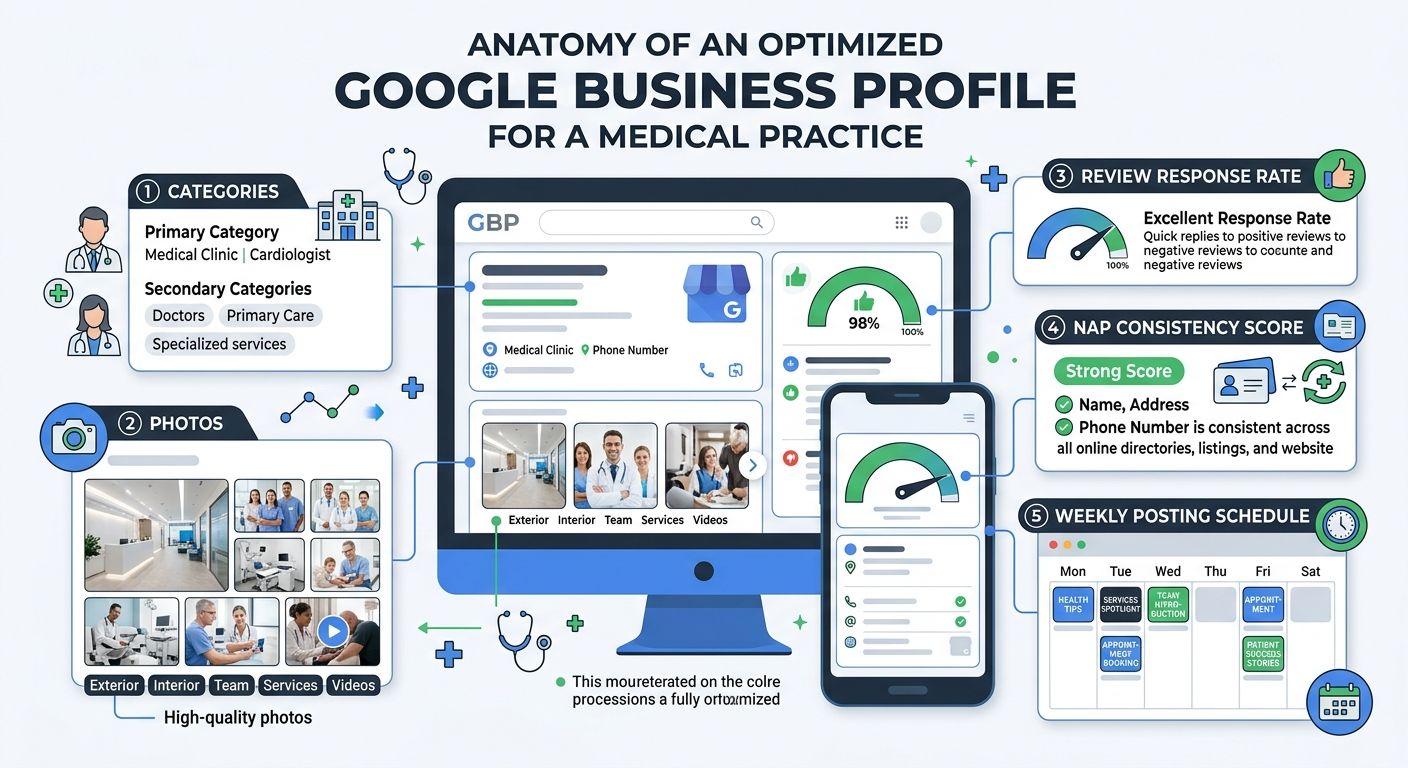
Google Business Profile (GBP) mastery: Your agency should optimize your GBP with precise primary categories ("Dermatologist," not "Medical Clinic"), maintain 100% profile completeness, post weekly updates, and ensure you have 30+ high-quality photos.
Review management strategy: Practices with active review response protocols perform dramatically better. Responding to 100% of reviews within 48 hours signals engagement to both Google and prospective patients.
NAP consistency audits: Your Name, Address, and Phone number must be identical across Google, Healthgrades, Yelp, Zocdoc, and every insurance directory listing. Even minor inconsistencies (suite numbers, abbreviations) erode local search trust.
Geo-targeted content: Service-area pages built around specific neighborhoods, cities, or regions your practice serves. Not thin doorway pages, but genuinely useful content about the communities you work in.
Practices with fully optimized GBP profiles rank two to three positions higher than those with basic listings. That gap often means the difference between a patient calling you or your competitor down the street.
Technical SEO Baseline: Non-Negotiables for Medical Websites
Your healthcare website has technical requirements that go beyond what most small business sites need. Here's the baseline your SEO partner should deliver:
Core Web Vitals Compliance
Largest Contentful Paint (LCP) under 2.5 seconds
Interaction to Next Paint (INP) under 200 milliseconds
Cumulative Layout Shift (CLS) under 0.1
Mobile-First Architecture
With most healthcare searches originating on phones, your site needs one-tap calling, touch-friendly navigation, readable text without zooming, and load times under 3 seconds. This isn't aspirational. It's table stakes.
Accessibility Standards
WCAG 2.2 AA compliance isn't just ethically right. It improves rankings and protects you from ADA-related legal action, which has become increasingly common for healthcare providers. Your agency should audit for proper heading hierarchy, alt text on images, keyboard navigation, and color contrast ratios.
Schema Markup for Healthcare
Medical practice schema, physician schema, FAQ schema on condition pages, and local business schema should all be implemented. If your agency can't explain what structured data they'll add to your site, they're behind the curve. For practices experiencing mysterious ranking drops, understanding how to diagnose invisible technical issues is exactly what separates competent agencies from guesswork operators.
What to Ask During the Vetting Process
I've sat through hundreds of agency pitches over the years. Here are the questions that separate serious healthcare SEO partners from pretenders:
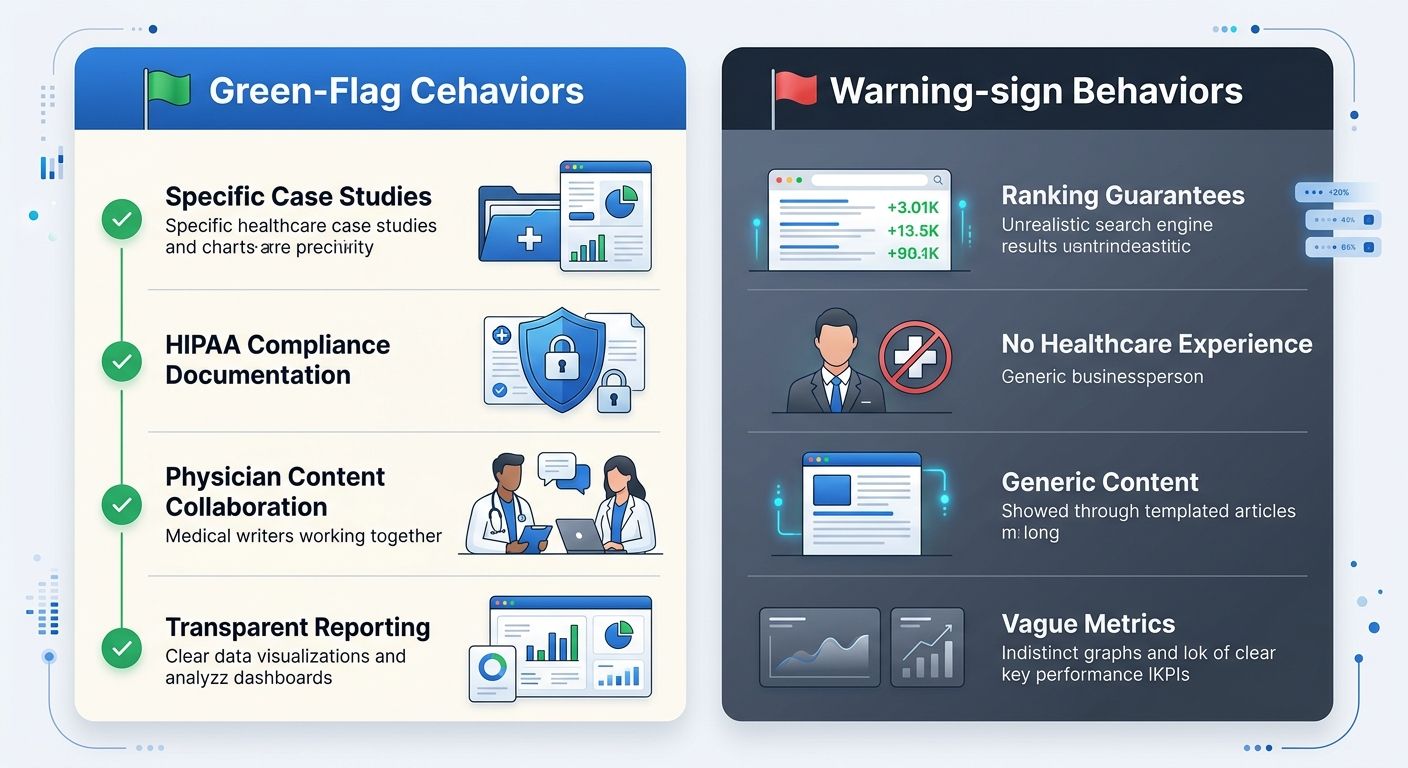
"Can you show me three healthcare clients you've worked with, including measurable outcomes?" Case studies should include specific metrics: organic traffic growth percentages, new patient acquisition numbers, and ranking improvements for target keywords. Vague claims like "we increased their visibility" mean nothing.
"What does your HIPAA compliance process look like?" They should describe specific tools, BAA documentation, and data handling procedures. If they say "we take privacy seriously" without specifics, that's a red flag.
"How do you handle medical content creation and review?" The right answer involves physician collaboration, medical writer networks, fact-checking protocols, and E-E-A-T optimization. The wrong answer is "our content team handles everything."
"What metrics will you report on, and how often?" SEO.com's healthcare guide recommends that partners measure the metrics that matter most to your practice, like patients acquired or talent hired, not vanity metrics like impressions.
"What's your timeline for results?" According to LinkGraph's research, healthcare providers typically see noticeable improvements within 4 to 6 months for local campaigns and 6 to 12 months for broader optimization. Anyone promising faster results is either lying or planning to use tactics that'll get you penalized.
"What happens if we part ways?" You should own your content, your analytics data, your Google Business Profile, and every other asset. Agencies that hold your GBP access hostage or build on proprietary platforms you can't take with you are setting a trap.
Red Flags That Should End the Conversation
After evaluating 200+ agencies, I've developed a pretty reliable gut for warning signs. Here are the ones specific to healthcare:
Guaranteed rankings. No one can guarantee position one. Google's algorithm has thousands of signals, and healthcare is one of the most competitive verticals. Any guarantee is either dishonest or comes with so many caveats it's meaningless.
No healthcare clients in their portfolio. Would you hire a contractor who's never built a house to build yours? Industry experience matters enormously in healthcare SEO.
They don't mention HIPAA unprompted. If compliance doesn't come up in their first presentation, they don't understand your industry.
Unusually low pricing. Most practices invest 5 to 10% of revenue in marketing, and the SEO portion of that should reflect the specialized expertise required. I typically see reputable healthcare SEO engagements ranging from $3,000 to $10,000 per month depending on practice size, number of locations, and competitive landscape. Agencies quoting $500/month for "full-service healthcare SEO" are going to cut corners you can't afford.
Black-hat link building. Ask specifically where they plan to build backlinks. Healthcare sites need links from medical associations, hospital networks, health publications, and local business organizations. Links from link farms or irrelevant directories will trigger penalties.
Pricing, Contracts, and Relationship Structure
Let me be blunt about the business side, because this is where practices get burned most often.
Typical pricing ranges for healthcare SEO:
Single-location practice: $2,500 to $5,000/month
Multi-location practice (2-5 locations): $5,000 to $10,000/month
Hospital systems or large medical groups: $10,000 to $25,000+/month
Contract terms to negotiate:
Push for month-to-month or 6-month initial terms. Avoid 12-month contracts until you've seen results and built trust.
Require a 30-day termination clause after any initial commitment period.
Ensure full asset ownership is documented: content, analytics accounts, GBP access, and all technical implementations belong to you.
Define reporting frequency (monthly minimum) and the specific KPIs included.
The best healthcare SEO relationships I've seen work like partnerships, not vendor transactions. Your agency should understand your patient demographics, your referral patterns, your competitive landscape, and your growth goals. They should be attending quarterly strategy reviews and adjusting based on what's actually driving appointments, not just what's driving traffic.
The Practical Takeaway
Hiring a healthcare SEO partner is a high-stakes decision. The wrong choice wastes budget and can create compliance exposure that follows your practice for years. The right choice turns your website into what PracticeBeat describes as a patient acquisition engine, converting search visibility into real appointments.
Here's your vetting checklist, boiled down:
Verify HIPAA compliance capabilities before anything else. No BAAs, no deal.
Demand healthcare-specific case studies with measurable patient acquisition outcomes.
Confirm E-E-A-T content processes that involve your physicians, not just freelance writers.
Evaluate local SEO expertise with specific GBP optimization strategies.
Check technical competence against Core Web Vitals, accessibility, and schema requirements.
Negotiate fair contract terms that protect your assets and give you an exit path.
Set realistic timeline expectations: 4 to 6 months for local, 6 to 12 months for broader results.
Medical practice marketing is too important and too regulated to hand off to an agency that treats your practice like every other client. Find a partner who understands that your website isn't just a marketing channel. It's an extension of the care you provide.
Marcus Webb
Digital marketing consultant and agency review specialist. With 12 years in the SEO industry, Marcus has worked with agencies of all sizes and brings an insider perspective to agency evaluations and selection strategies.
Explore more topics