
E-commerce SEO Agency Checklist: 10 Things to Verify Before Hiring
A Shopify store owner I consulted for paid $14,000 per month to an ecommerce SEO agency that couldn't explain what they did with the money.
 Marcus Webb··8 min read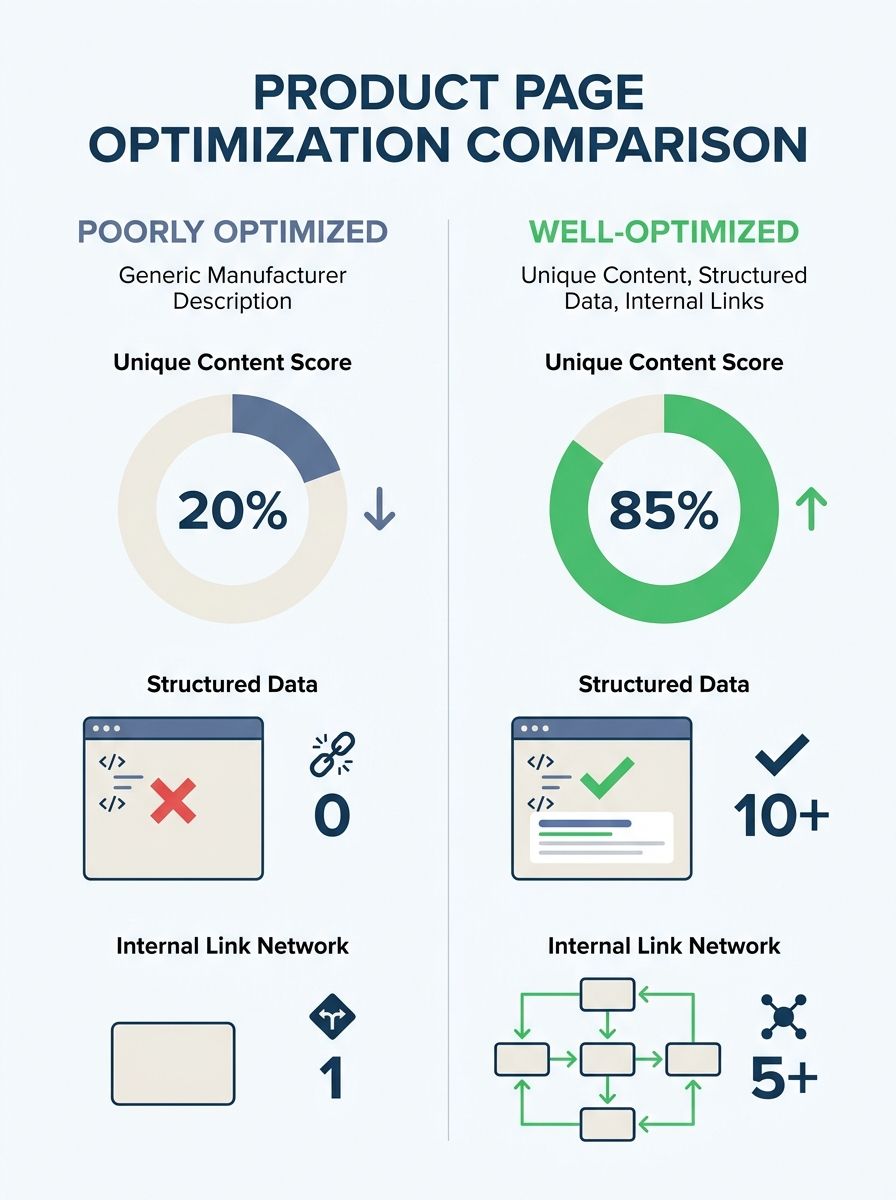
E-commerce SEO Agency Checklist: 10 Things to Verify Before Hiring
A Shopify store owner I consulted for paid $14,000 per month to an ecommerce SEO agency that couldn't explain what they did with the money. Their monthly reports showed keyword rankings for branded terms the store already ranked #1 for, traffic numbers pulled from the wrong Google Analytics property, and "optimized" product pages that were just copy-pasted manufacturer descriptions with a bold keyword shoved into the first sentence. When I audited their account, the agency had actually de-indexed 3,200 filtered collection pages that were driving $47,000 in monthly revenue. It took five months to recover.
I've evaluated over 200 SEO agencies across my career, and the pattern is depressingly consistent: online retail brands sign contracts based on impressive pitch decks, then discover the disconnect between promises and execution only after the damage is done. The gap between a great ecommerce SEO partner and a mediocre one isn't just about rankings. It's about revenue, crawl efficiency, and whether your agency understands product-level search behavior.
This SEO hiring checklist is the exact list I hand to every e-commerce client before they sign anything. Ten items. Each one based on a real failure I've seen or, in a few cases, caused myself back in my agency days.
1. Verify Their SKU-Level Optimization Approach
Category-page optimization is table stakes. Any competent agency does it. The real question is whether they have a documented process for optimizing at the individual product and variant level.
Ask the agency: "How do you handle product pages for items with 15 color variants and 6 sizes?" If the answer is vague, that's your signal. A strong ecommerce SEO agency will explain how they create unique content per variant, manage canonical tags to consolidate authority, and build internal linking structures between product detail pages and buying guides.
Key question to ask: "Show me a product page you optimized and walk me through what changed."
Red flag: They only talk about category pages and blog content.
Good sign: They reference crawl budget management and selective indexing strategies for filtered URLs.
As Search Engine Land explains, indexing everything floods Google with thin, low-value URLs that waste crawl budget, while indexing nothing means missing high-intent long-tail keywords your competitors aren't targeting. The right agency finds the middle ground.
2. Confirm Schema Markup Depth and Accuracy
Structured data isn't optional for e-commerce anymore. Google's own e-commerce SEO documentation explicitly states that using structured data to clarify content meaning, choosing the right method to share product data, and designing an effective URL structure are key actions for online stores.
Your agency should implement Product schema (with price, availability, and brand), Review and AggregateRating markup, and Organization schema that supports E-E-A-T signals. But implementation alone isn't enough. You need to ask about schema drift, which is when the structured data says "InStock" but the page shows "Sold Out." This mismatch erodes Google's trust in your markup over time.
3. Evaluate Their AI Search Visibility Strategy
The SEO work that helps your online store rank in traditional search also increases visibility in AI Overviews and tools like ChatGPT. As Coalition Technologies notes, well-structured, product-focused content that signals trust and authority is exactly what large language models pull from. If your e-commerce site loads quickly, is easy to navigate, and clearly presents products and policies, you're already building the kind of presence AI systems favor.
But a forward-thinking agency goes further. They should track where your brand appears in AI-generated answers, which product queries trigger AI Overviews, and whether your content is being cited. I wrote about how agencies are adapting to this shift when covering how visibility in AI-generated results is changing SEO strategy, and the implications for e-commerce are massive.
What to ask: "Can you show me examples of clients appearing in AI Overviews for product queries?"
Red flag: They dismiss AI search as irrelevant to e-commerce.
Good sign: They mention content structuring for retrieval-augmented generation (RAG) systems and citation tracking.
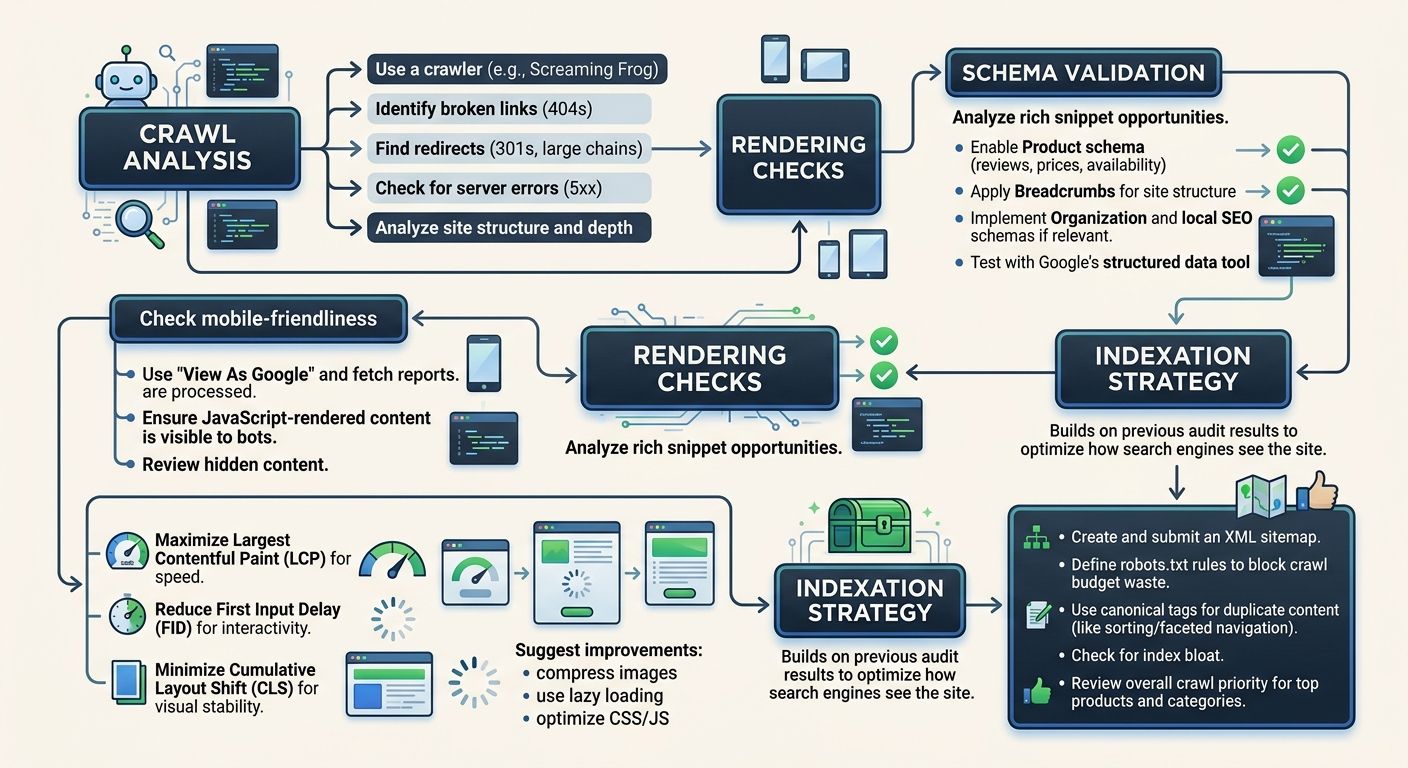
4. Assess Technical SEO and Rendering Capabilities
Shopify SEO has specific technical constraints that generic agencies don't understand. Shopify's liquid templating system, its handling of collection filters, its URL structure quirks, and its limitations around server-side rendering all require platform-specific expertise. As Yoast points out, becoming a real Shopify SEO expert requires knowing both general optimization principles and the specific skills unique to the platform.
Ask the agency to explain how they handle Shopify's duplicate content issues with pagination and filtering. Ask about their approach to JavaScript rendering. If your store runs on a headless setup or a custom platform, the technical bar is even higher. Server-side rendering or incremental static regeneration should be their default recommendation for product detail pages, not client-side rendering that leaves Googlebot guessing.
5. Check Their Core Web Vitals Track Record
Interaction to Next Paint (INP) replaced First Input Delay as a Core Web Vital, and many agencies haven't caught up. A good INP score is under 200 milliseconds. Poor is above 500ms. For e-commerce sites with heavy product image galleries, filtering interfaces, and add-to-cart interactions, INP optimization requires real technical skill.
Ask the agency to share before-and-after Core Web Vitals data from current clients. Not screenshots. Actual CrUX data or PageSpeed Insights reports with URLs you can verify yourself.
If you want to understand how technical SEO debugging works at a deeper level, the methodology an agency uses to diagnose invisible performance issues tells you a lot about their capabilities.
6. Demand Revenue-Focused Reporting
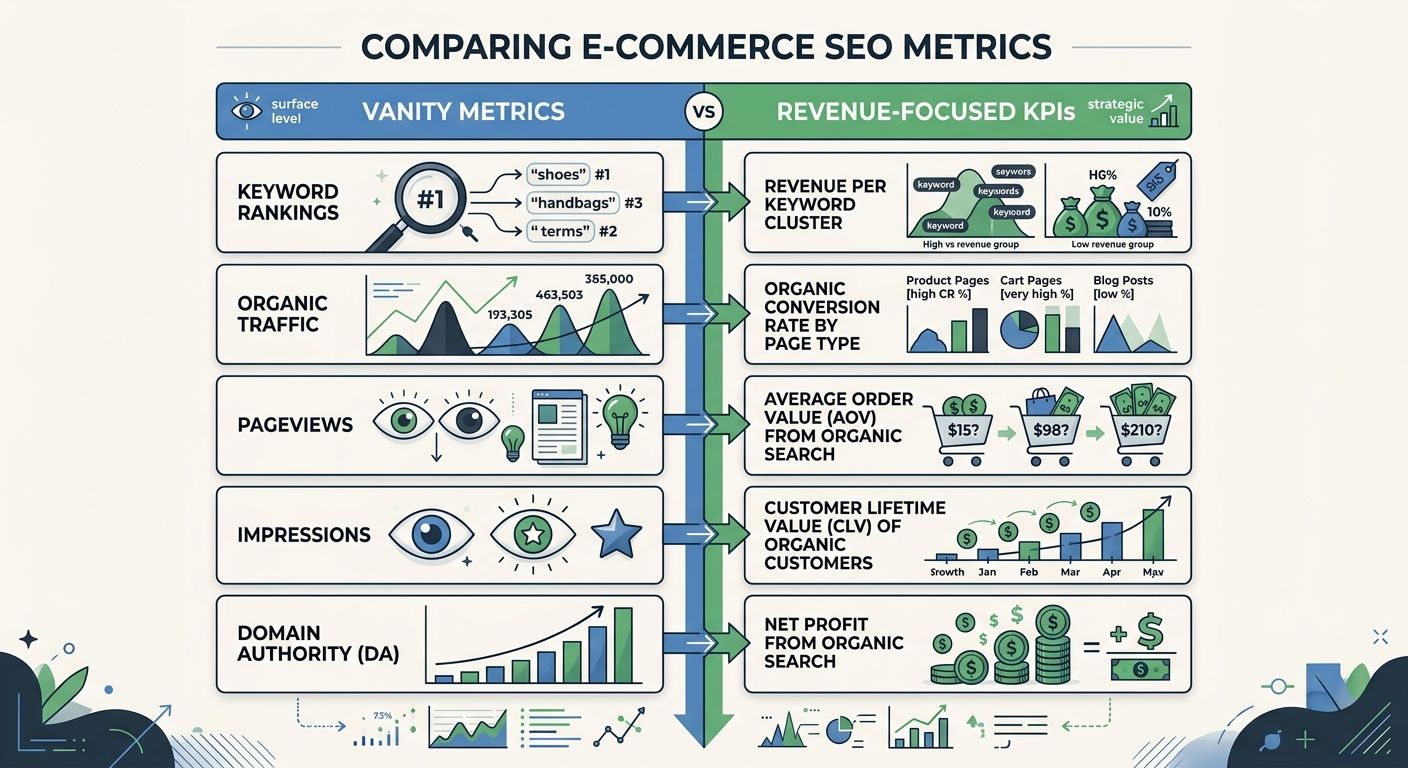
This is where I see the biggest gap between good agencies and bad ones. AgencyAnalytics research confirms what I've long argued: clients don't just want to hear that rankings improved. They want to see how that translates into leads, sales, and business growth. The right SEO metrics help tell that story with clarity.
Here's what your agency's reporting should include at minimum:
Organic revenue broken down by page type (product pages vs. collection pages vs. content)
Conversion rate by landing page
Assisted conversion data showing SEO's role in multi-touch purchase paths
Keyword rankings tied to revenue impact, not just position numbers
There's a real difference between metrics and KPIs. As Carnegie's research explains, a metric is just a data point, while a KPI is an integral marker of success tied to ROI. Your agency should report both, but weight their recommendations toward KPIs.
Pricing benchmark: Agencies that provide this level of reporting typically charge $3,000 to $10,000 per month for mid-market e-commerce brands. Below $2,000/month, you're almost certainly getting template reports with vanity metrics.
7. Verify Their Out-of-Stock Page Strategy
Never hire an agency that 404s out-of-stock products. This sounds basic, but I've seen agencies redirect entire product catalogs to the homepage during inventory gaps, destroying months of accumulated page authority.
The correct approach: keep the page live with a 200 status, update the schema to reflect "OutOfStock," and render a server-side "similar products" widget that passes link equity and keeps users engaged. A strong agency will also have a plan for seasonal products that cycle in and out of availability.
8. Investigate Their Approach to Content Freshness and UGC
Product pages go stale fast. An agency that treats product content as a one-time optimization is leaving money on the table. Verified customer reviews, updated FAQs, and refreshed product descriptions keep pages alive in Google's eyes and improve performance in AI search results.
Shopify's own SEO checklist emphasizes that demonstrating E-E-A-T (Experience, Expertise, Authoritativeness, Trustworthiness) remains essential, and one of the best ways to do that on product pages is through third-party content like customer reviews and expert contributions. Ask your agency how they plan to keep product pages fresh beyond the initial optimization pass.
9. Confirm Their Industry and Platform Experience
An agency that's great at B2B SEO agencies work might struggle with e-commerce product feeds and shopping integrations. Similarly, agencies focused on education SEO agencies won't necessarily understand cart abandonment optimization or product schema requirements.
When evaluating ecommerce SEO specialists, ask for case studies from businesses with similar:
Product catalog sizes (100 SKUs is a different problem than 50,000)
Platforms (Shopify, WooCommerce, Magento, BigCommerce, or headless)
Business models (DTC, marketplace, wholesale)
Average order values (the strategy for $30 products differs from $3,000 products)
Clutch's verification process confirms provider business registration, legal history, credit background, and client feedback, which gives you a baseline level of trust. But platform-specific e-commerce experience is something you'll need to verify through direct conversation and reference calls.
10. Read the Contract Before You Sign It
I'm amazed how many brands skip this. Here's what to look for:
Contract length: Avoid anything longer than 6 months for a first engagement. Three months with a 30-day cancellation clause is ideal. Some agencies lock you into 12-month contracts with 90-day exit windows, which gives you almost no exit options.
Deliverable specifics: "Monthly SEO services" means nothing. The contract should list exact deliverables: number of pages optimized, technical audits per quarter, content pieces produced, and reporting cadence.
Ownership of work: You own all content, optimizations, and data. If the agency builds custom tools or dashboards, clarify whether you retain access after the contract ends.
Performance benchmarks: While I'm skeptical of agencies that guarantee rankings, reasonable performance targets tied to organic revenue or traffic growth should be part of the agreement.
Pricing transparency: Retainer fees should be clearly separated from ad spend, tool costs, and content production fees. Expect to pay $2,500 to $8,000/month for a solid mid-market ecommerce SEO retainer, with enterprise engagements ranging from $10,000 to $25,000+.
If you're considering working with white-label SEO companies that subcontract the actual work, pay extra attention to contract terms around accountability. When things go wrong, you need to know who's responsible for fixing them. Understanding how agencies evaluate and vet their own teams gives you a useful framework for asking the right questions about who will actually be doing the work on your account.
Questions to Ask Before Signing Anything
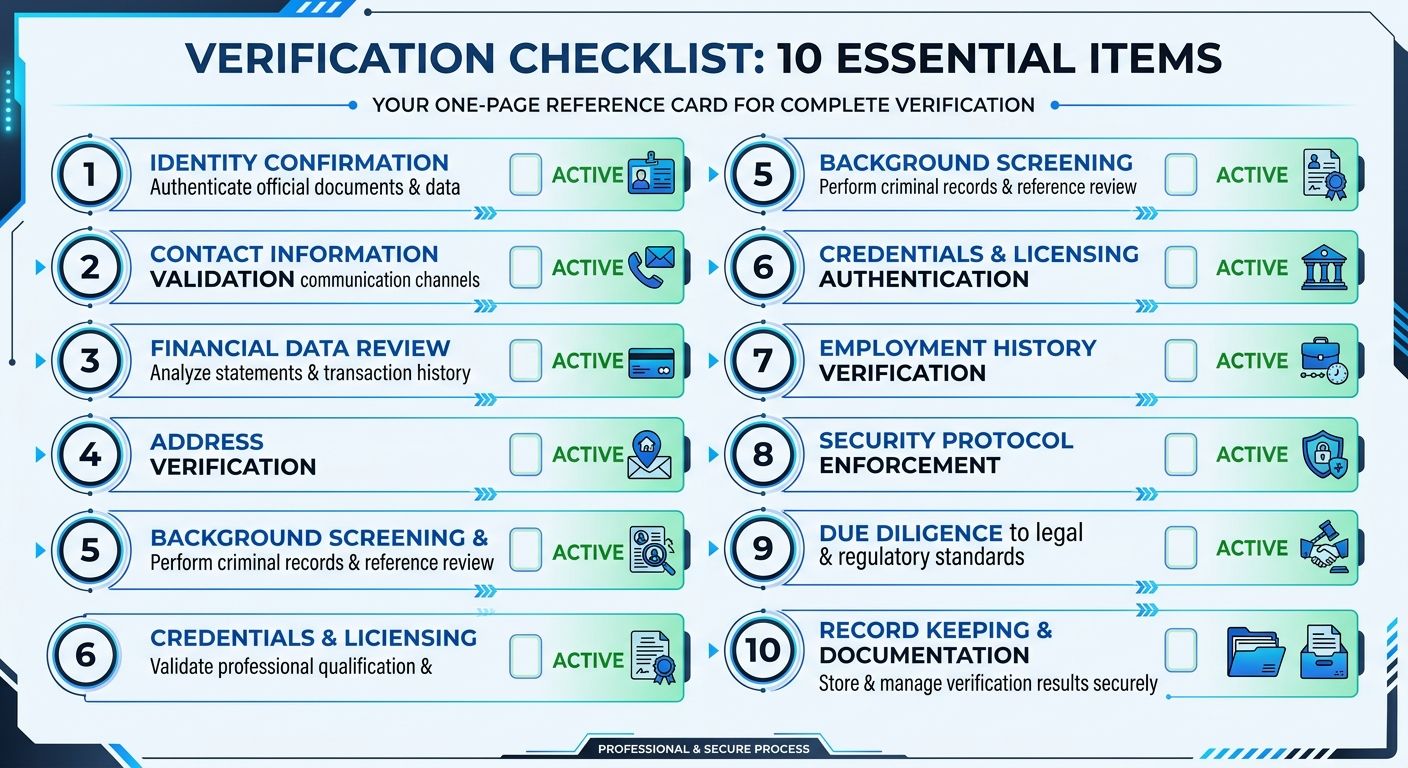
Print this list. Bring it to every agency call. Score each agency on all ten points before you compare proposals. I've watched too many e-commerce brands choose agencies based on personality or pitch quality, then regret it six months later when they're locked into a contract with declining organic revenue.
The best ecommerce SEO agencies won't be offended by tough questions. They'll welcome them. The ones who get defensive when you ask for CrUX data, revenue attribution examples, or contract flexibility are telling you exactly what the engagement will feel like once you've signed.
And if an agency guarantees you first-page rankings for competitive product terms within 90 days, hang up the phone. That's not confidence. That's a red flag wearing a smile.
Marcus Webb
Digital marketing consultant and agency review specialist. With 12 years in the SEO industry, Marcus has worked with agencies of all sizes and brings an insider perspective to agency evaluations and selection strategies.
Explore more topics