
Beyond Search Rankings: Why Enterprise Teams Are Losing Visibility in AI-Generated Results (And How to Adapt Your SEO Strategy)
A Fortune 500 client of mine fired their agency two weeks ago. Not because organic traffic dropped. Traffic was actually up 4% quarter-over-quarter. The problem? Their brand had vanished from every AI-generated answer in their vertical. ChatGPT recommended three competitors by name.
 Marcus Webb··8 min read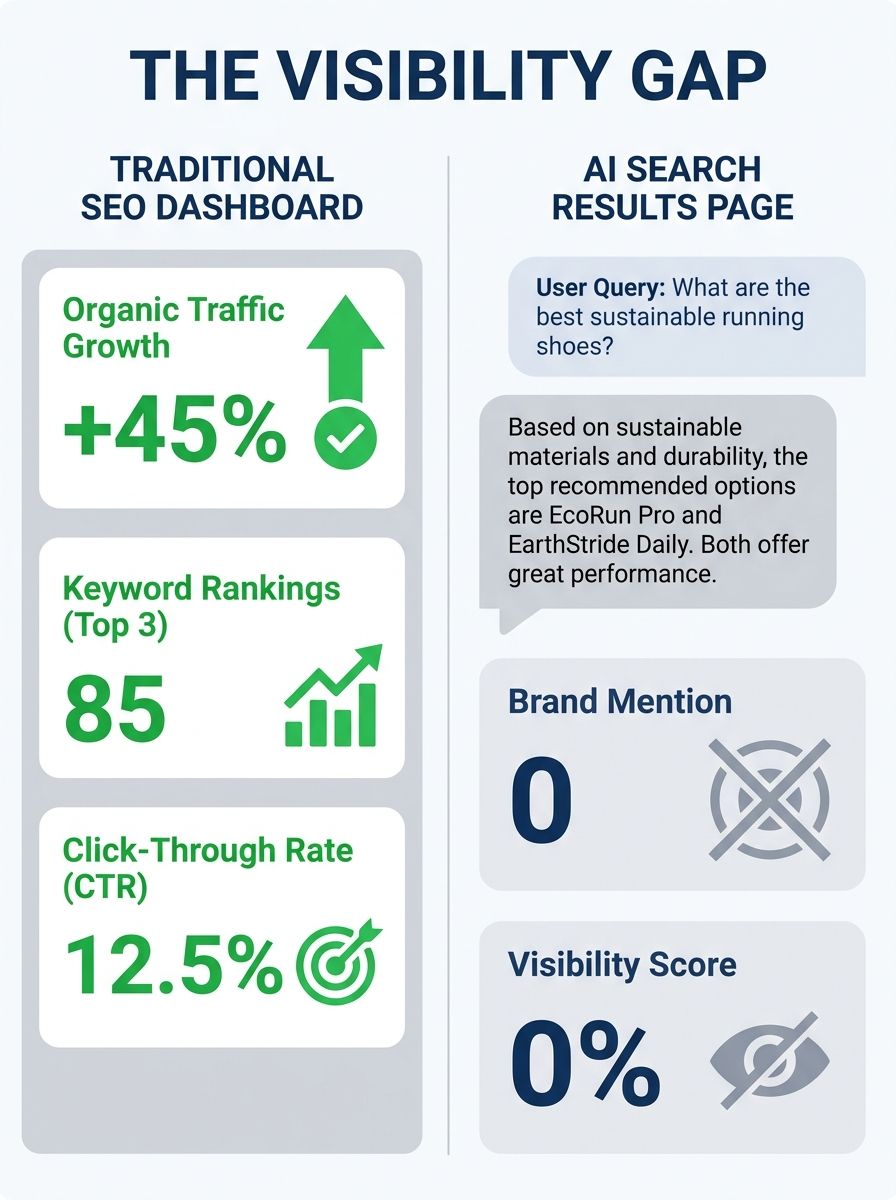
Beyond Search Rankings: Why Enterprise Teams Are Losing Visibility in AI-Generated Results (And How to Adapt Your SEO Strategy)
A Fortune 500 client of mine fired their agency two weeks ago. Not because organic traffic dropped. Traffic was actually up 4% quarter-over-quarter. The problem? Their brand had vanished from every AI-generated answer in their vertical. ChatGPT recommended three competitors by name. Google's AI Overviews cited two industry publications but never mentioned them. Perplexity summarized their market category without a single reference to a company that holds 31% market share. The agency had been reporting green dashboards for nine months while the client's AI search visibility quietly collapsed.
This isn't an isolated case. I've reviewed six enterprise accounts in the past 30 days where the same pattern showed up: strong traditional rankings, deteriorating presence in generative search. And the pace of this shift is accelerating faster than most teams realize.
The Visibility Gap No One's Tracking
Here's the uncomfortable truth about enterprise SEO 2026: the metrics most teams report on every month don't capture the problem. Position tracking, click-through rates, impression counts from Search Console. These all measure your performance in a system that's shrinking in influence.
Adobe published a critical insight on April 9th that frames this perfectly: visibility now depends less on page position and more on whether a brand is cited within AI-generated responses. That's not a prediction. That's a description of what's already happening.
The data backs it up. According to eMarketer's April 2nd analysis of generative engine optimization, 40% to 60% of cited sources in Google AI Mode and ChatGPT change month-to-month. Compare that to traditional organic rankings, where top-10 positions for competitive terms might shift by a few spots per quarter. AI citation volatility is wildly higher than anything SEO teams are used to managing.
And enterprise teams are structurally unprepared for this. Their reporting dashboards don't track AI citations. Their content strategies optimize for crawlers, not language models. Their link-building programs target domain authority, not the entity recognition signals that AI systems use to determine which brands to reference.
Why Enterprise Brands Are Disappearing from AI Answers
I spent a week auditing how five enterprise B2B brands appeared (or didn't) across ChatGPT, Perplexity, Google AI Overviews, and Microsoft Copilot. The patterns were consistent enough to identify three root causes.
1. Content Is Optimized for Crawlers, Not Comprehension
Most enterprise content reads like it was written for a search engine in 2019. Long-form pages stuffed with keyword variations, thin FAQ sections, blog posts built around exact-match queries. Language models don't process content this way. They look for clear, authoritative statements that can be extracted and cited. If your content buries the answer under 800 words of context-setting, the AI will cite someone who gets to the point faster.
As Conductor's enterprise guide to AEO puts it: structured data like schema markup helps AI-powered answer engines understand the context and relevance of your content. But structured data alone won't save you if the content itself is murky.
2. Brand Entity Signals Are Weak
Ahrefs research highlighted by Digiday shows a strong correlation between brand visibility in AI-generated summaries and mentions of a brand on other web pages, including hyperlinked mentions and branded search volume. Enterprise teams that have focused narrowly on their own domains while neglecting third-party mentions, PR coverage, industry citations, and community presence are invisible to the models that power generative search.
This is the entity stacking problem. Language models build internal representations of brands based on how frequently and consistently those brands appear across the training data. If your brand only exists in depth on your own website, you're a single node in a massive graph. Competitors with strong Wikipedia entries, frequent media coverage, active Reddit discussions, and YouTube presence have dozens of nodes reinforcing their entity.
3. Organizational Silos Kill AI Visibility
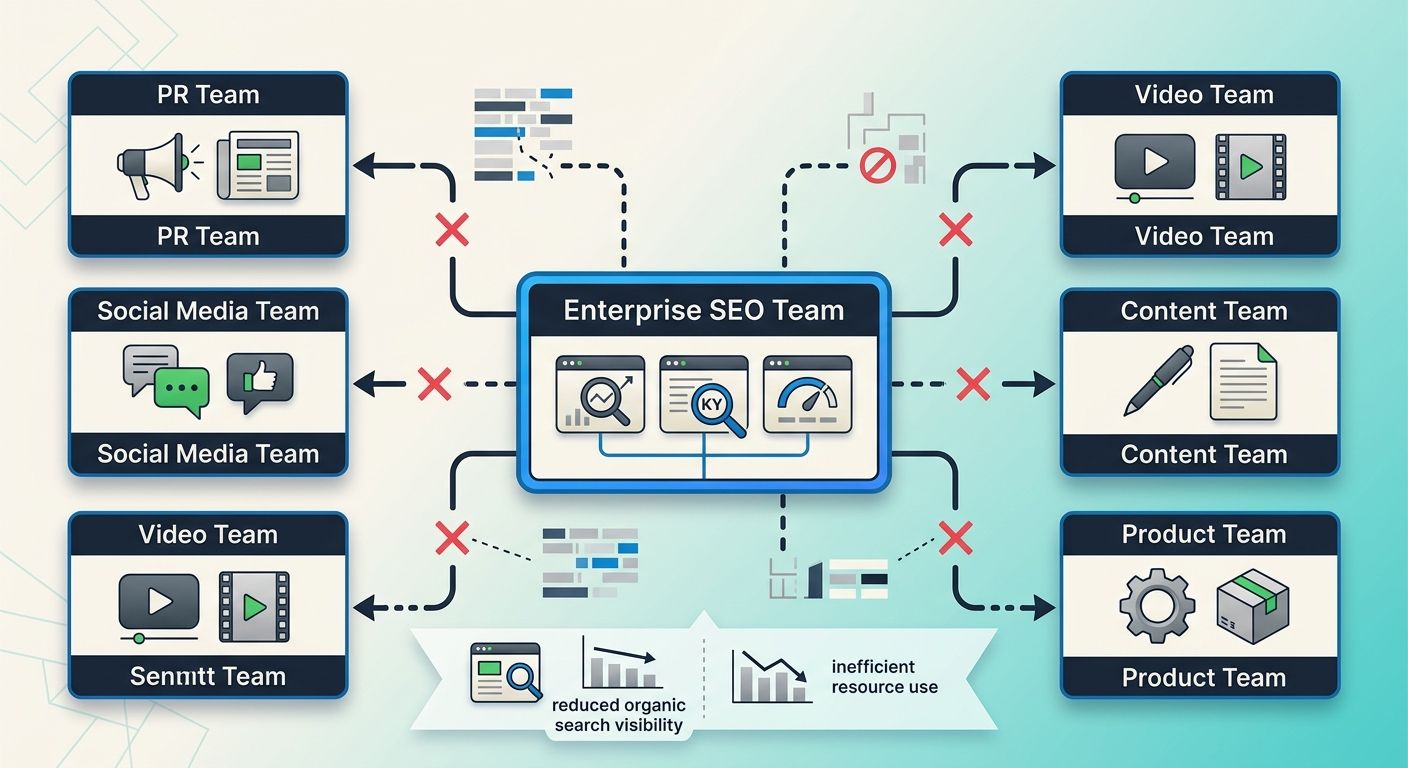
Search Engine Land flagged this on March 24th, and I've seen it play out in every enterprise I've audited: SEO teams are expected to own AI visibility strategy but lack control over the content formats and distribution channels that actually influence AI citations. YouTube is managed by the video team. PR is managed by comms. LinkedIn content is managed by social. Reddit engagement doesn't exist because legal won't approve it.
Brand visibility in generative search is a cross-functional problem, and most enterprise org charts treat it as an SEO-only task.
Answer Engine Optimization: What Actually Works Right Now
Answer engine optimization isn't just a buzzword agencies are using to rebrand their services. It's a fundamentally different approach to content strategy, and the enterprises getting it right share specific patterns. If you're wondering how agencies are navigating this pivot, the breakdown of generative AI SEO versus answer engine optimization is worth reading for context on how the discipline is splitting.
Here's what's working in the accounts I'm reviewing:
Answer-first content formatting. Lead every page with a clear, concise answer to the primary question. Then expand. AI systems extract the clearest statement, not the most detailed one.
Schema markup on everything. FAQ schema, HowTo schema, Organization schema, Author schema. This isn't optional anymore. It's the machine-readable layer that helps AI systems attribute content correctly.
Author verification and expertise signals. Bylined content with linked author profiles, credentials, and external verification. Google's AI Overviews and Perplexity both show preference for content tied to identifiable subject matter experts.
Entity-rich internal linking. Link to your own topic clusters using consistent entity names. This helps language models build stronger associations between your brand and your topic areas.
HubSpot's guide to showing up in AI search through AEO reinforces this point: the shift is from ranking for clicks to becoming the answer that AI pulls from. That's a different optimization target than anything traditional SEO prepared us for.
Building a Multi-Channel Search Strategy That Survives the Shift
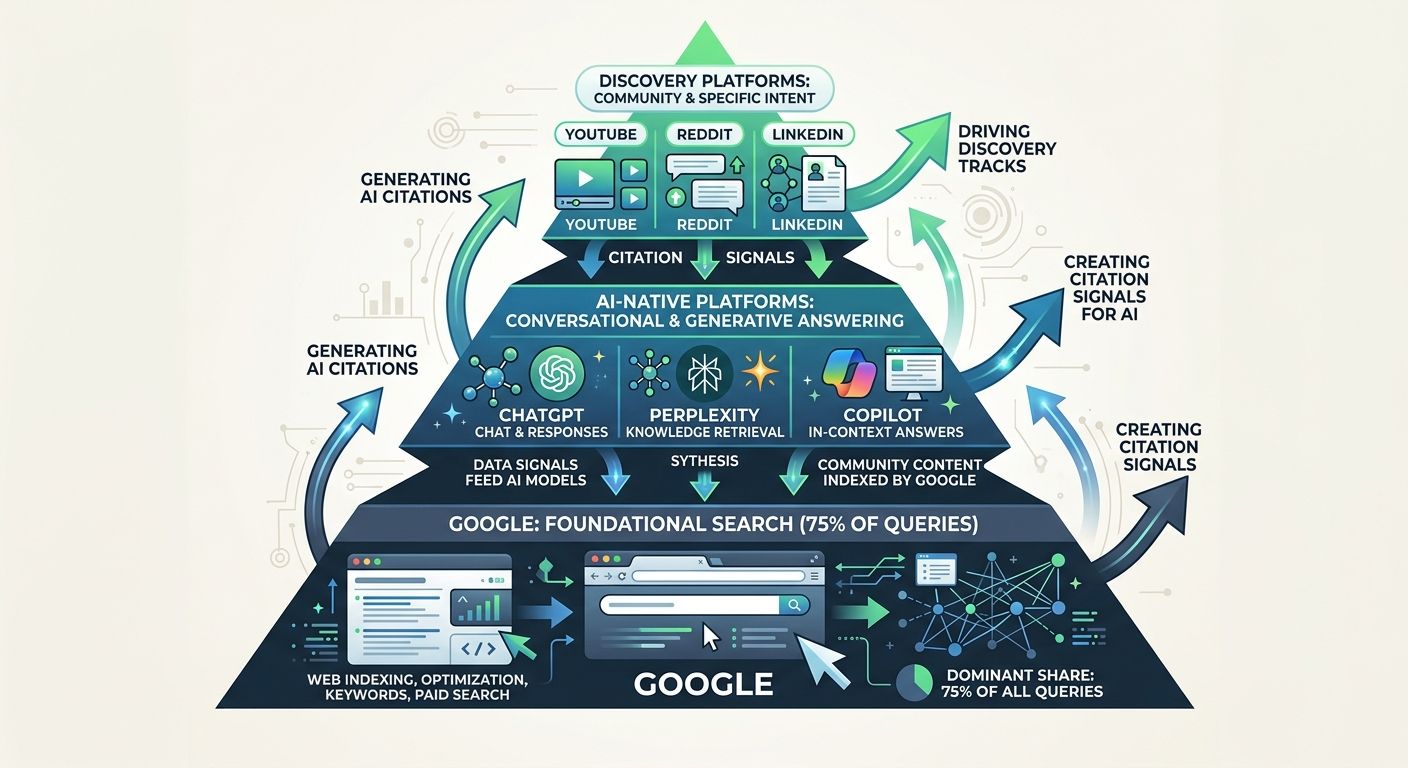
The other critical adaptation is recognizing that Google isn't the only search surface anymore. A real multi-channel search strategy accounts for ChatGPT, Perplexity, Copilot, Google AI Overviews, YouTube search, Reddit search, and even regional engines like Yandex and Baidu for global enterprises.
Search Engine Journal's recent analysis of search engine market share and emerging AI search platforms makes the point bluntly: platforms like Perplexity and ChatGPT don't run on traditional SEO signals, so they require dedicated strategy and budget.
Here's how I'm recommending enterprise teams structure this:
Tier 1: Google (Traditional + AI Overviews)
Still commands roughly 75% of search queries. You can't abandon it. But you need to track both traditional rankings AND AI Overview citations separately. These are different games with different rules.
Tier 2: AI-Native Platforms (ChatGPT, Perplexity, Copilot)
These platforms synthesize answers from web content, but they weight different signals. Perplexity tends to cite recent, well-structured content. ChatGPT leans on entity authority and breadth of web mentions. Copilot pulls heavily from Microsoft's index. Each requires monitoring.
Tier 3: Discovery Platforms (YouTube, Reddit, LinkedIn)
AI systems frequently pull from these platforms when constructing answers. Your presence here directly influences whether AI cites you. An enterprise with zero Reddit presence is leaving a major citation source untapped.
The teams already working on building custom performance dashboards are ahead here because they can add AI citation tracking as a new data layer instead of starting from scratch.
The Tracking Problem (And Emerging Solutions)
You can't fix what you can't measure. And right now, most enterprise teams have zero visibility into their AI visibility. That's not a wordplay joke; it's the actual problem.
The market for tracking tools is splitting fast. As Fingerlakes1.com reported this week, enterprise marketing teams face a clear divide between purpose-built GEO platforms and AI monitoring features bolted onto existing SEO suites. Adobe's LLM Optimizer, for example, is positioning itself as a dedicated solution for tracking and improving how content gets cited in AI-powered search results.
Here's what I'd track if I were building an AI visibility dashboard today:
Citation frequency: How often is your brand mentioned by name in AI-generated answers for your target queries?
Citation sentiment: When AI mentions you, is it a recommendation, a neutral mention, or a comparison where you come up short?
Source attribution: Which of your pages are being cited? This tells you what content format and structure the AI prefers.
Competitor citation share: For your top 50 queries, what percentage of AI citations go to you versus competitors?
Citation stability: How much does your AI visibility fluctuate month to month? Remember, 40-60% source churn is the norm.
Teams that understand how to diagnose invisible ranking losses through systematic frameworks will find it easier to apply similar thinking to AI citation analysis.
What Enterprise Teams Should Do This Month
I'm not going to pretend this is a simple pivot. Enterprise SEO 2026 requires structural changes to how teams operate, what they measure, and how they create content. But there are concrete steps you can take immediately.
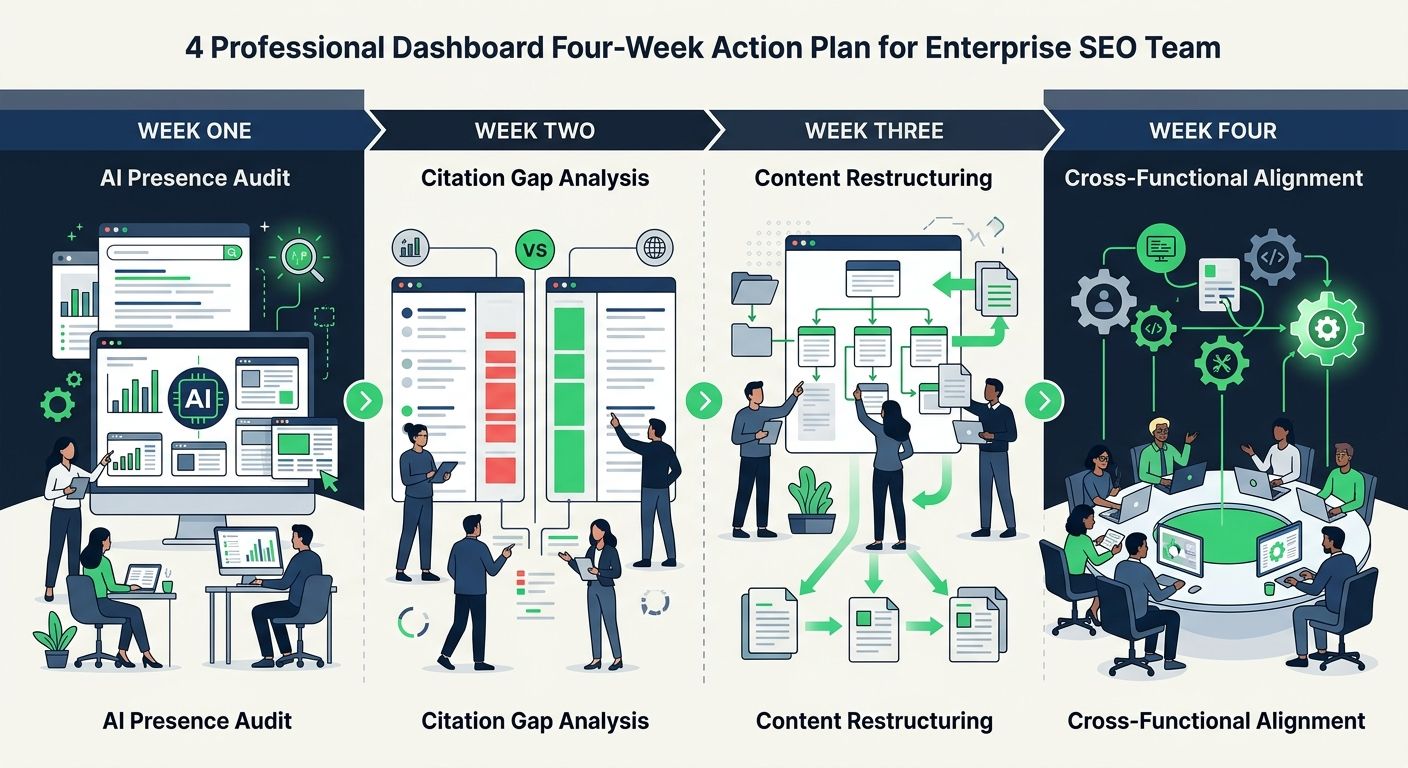
Week 1: Audit your AI presence. Run your top 20 brand-relevant queries through ChatGPT, Perplexity, and Google AI Overviews. Document every citation (yours and competitors'). This gives you a baseline.
Week 2: Identify your citation gaps. Where are competitors getting cited and you're not? Look at what content they have that you don't. Look at where they're mentioned externally that you aren't.
Week 3: Restructure your highest-value content. Take your top 10 traffic pages and reformat them with answer-first structure, updated schema markup, and clear expert attribution. This is the lowest-effort, highest-impact change.
Week 4: Start the cross-functional conversation. Pull in PR, social, video, and content stakeholders. Share the audit data. Make the case that AI visibility is a shared responsibility, not an SEO project.
And if your agency isn't already talking to you about AI citation tracking and answer engine optimization? That's a problem. The agencies that understand why traditional SEO approaches are hitting an inflection point are the ones that will keep their enterprise clients visible through this transition.
The Practical Takeaway
The BrightEdge survey from earlier this month found that enterprises adopting AI search strategies early saw a 35% increase in organic leads within six months, while delayed adopters struggled. The gap between early movers and everyone else is already measurable.
Stop treating AI search visibility as a future concern. It's a current revenue risk. Your traditional rankings might look fine. Your traffic reports might be stable. But if you're not showing up when someone asks ChatGPT, Perplexity, or Google's AI Overview who the best option is in your category, you're losing deals you'll never know about.
Audit your AI presence this week. Restructure your content for citation. Break down the silos between SEO, PR, and content. And start measuring what actually matters: not where you rank, but whether the machines recommend you.
Marcus Webb
Digital marketing consultant and agency review specialist. With 12 years in the SEO industry, Marcus has worked with agencies of all sizes and brings an insider perspective to agency evaluations and selection strategies.
Explore more topics