
The SEO Benchmarking Blind Spot: Why Agencies Miss Competitor Keyword Gaps (And How to Find Them)
A SaaS client walked into my office with a 47-page SEO report from their previous agency. Gorgeous charts. Color-coded dashboards. Rankings tracked for 600 keywords. And every single competitor in the report was wrong.
 Marcus Webb··9 min read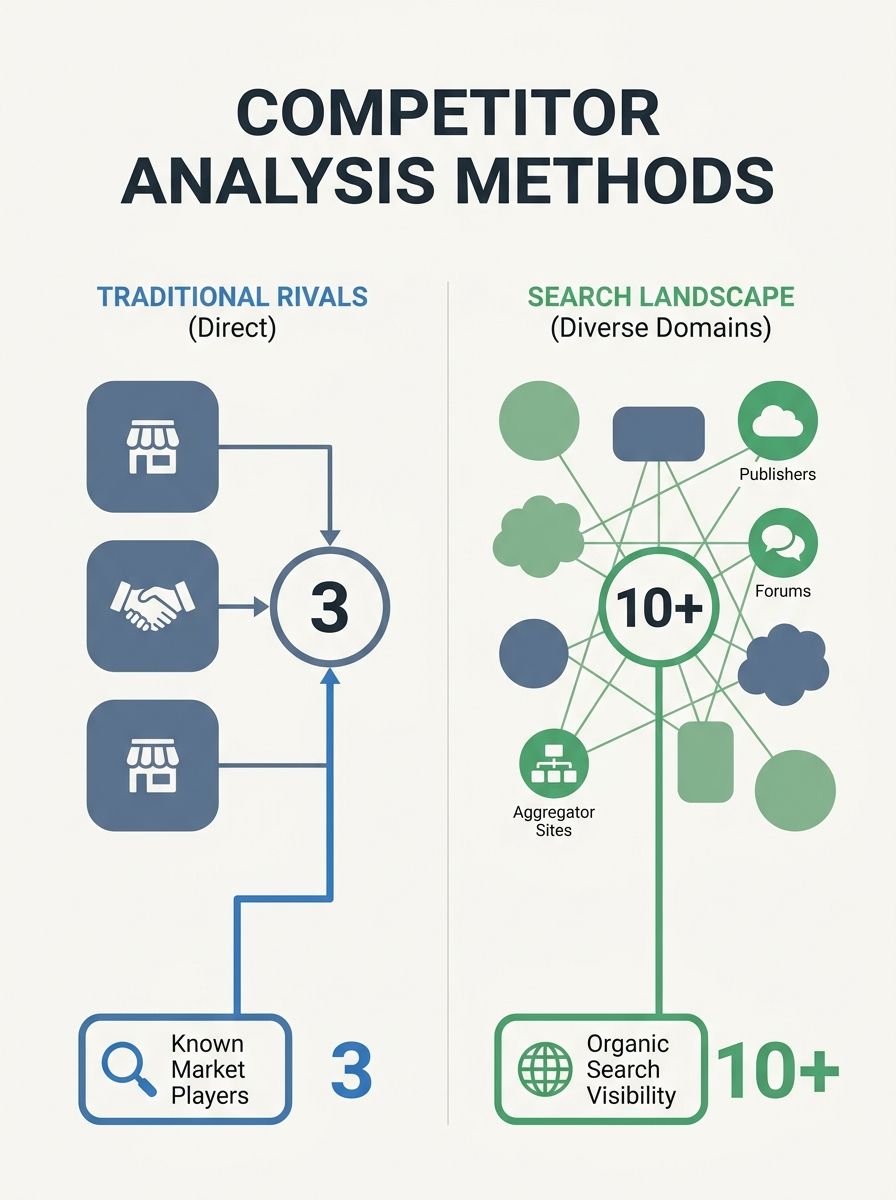
The SEO Benchmarking Blind Spot: Why Agencies Miss Competitor Keyword Gaps (And How to Find Them)
A SaaS client walked into my office with a 47-page SEO report from their previous agency. Gorgeous charts. Color-coded dashboards. Rankings tracked for 600 keywords. And every single competitor in the report was wrong. The agency had benchmarked against three direct business competitors, while the actual domains dominating the SERPs for their most valuable queries were G2, Capterra, two Reddit threads, and a YouTube creator with 14,000 subscribers. The client had been paying $8,500/month for twelve months to track a race they weren't even running in.
That's the blind spot I keep seeing, and it's more common than most marketing teams realize. Agencies perform competitor keyword research against the companies their clients compete with for customers, not the domains they compete with for clicks. The result? Entire keyword clusters go unnoticed, traffic potential sits untapped, and the benchmarking framework that's supposed to guide strategy becomes a decorative artifact.
I've evaluated over 200 SEO agencies at this point, and this specific failure shows up in roughly 70% of the competitive audits I review. So let's break down why it happens, what it actually costs, and how to build a process that catches what others miss.
The Core Problem: Business Competitors ≠ Search Competitors
Here's the mistake in plain terms. Your client sells project management software. They compete with three other vendors for deals. Your agency pulls up those three vendors in Semrush, runs a keyword gap report, and calls it a day.
But when you actually search for "best project management tools for remote teams," the top 10 results include a Forbes listicle, a Zapier comparison page, two Reddit threads, a TechRadar review, and maybe one of those actual competitors. The domains controlling the SERP real estate are publishers, aggregators, and community platforms.
If your benchmarks only track the other three software platforms, you're missing the entities that actually control visibility. And you can't close a gap you don't know exists.
This problem has gotten worse since AI Overviews started appearing in roughly 47% of Google searches, reaching 2 billion users monthly. When an AI Overview appears, organic CTR drops from about 15% to 8%. A site can hold position #2 and still lose half its traffic because the SERP layout changed underneath it.
Why Agencies Keep Making This Mistake
I've managed agency operations. I know the pressures. And I can tell you exactly why this keeps happening:
Time constraints kill thoroughness. Running a proper competitive SEO analysis for a single keyword cluster takes 3-4 hours when done right. Most agency account managers are juggling 8-12 clients. The temptation to plug three competitor domains into a tool and export the CSV is enormous.
Client expectations create tunnel vision. When a CMO says "I want to beat CompanyX," the agency hears a directive, not a starting point. Pushing back with "actually, your real competition is a subreddit" requires confidence and education that junior strategists often lack.
Tools make it too easy to be shallow. As noted in Search Engine Land's guide to analyzing SEO competitors, you need to look into the keywords your competition ranks for and assess what brings them the most traffic. But most teams rush past this step. They export the data, sort by volume, and never ask whether the competitor list itself is flawed.
Reporting cycles reward appearance over insight. Monthly reports need to look good. Showing "we rank for 340 of 600 tracked keywords" is easier to present than "we discovered 200 keywords we weren't tracking at all, and we're invisible for all of them." The second finding is more valuable but harder to spin as a win.
What Keyword Gap Analysis SEO Actually Requires
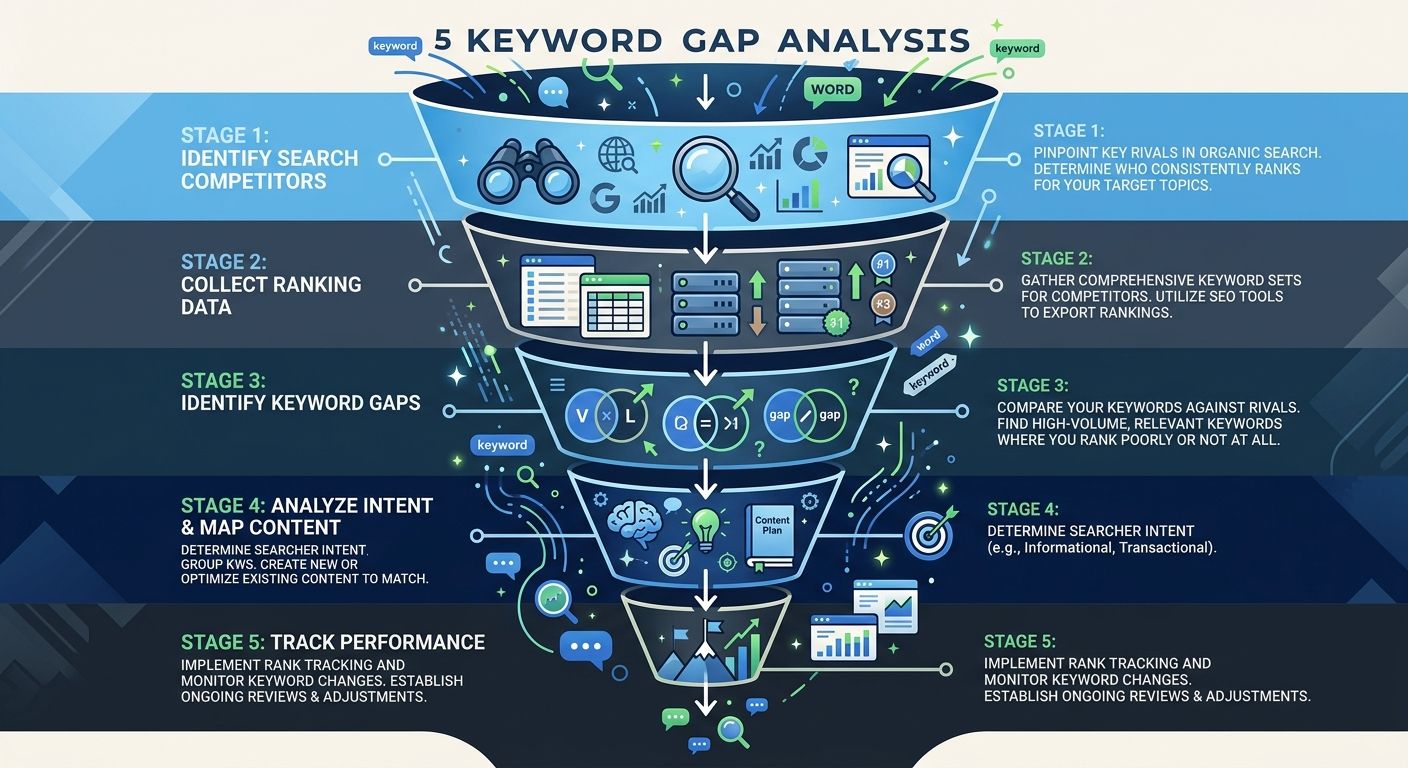
A real keyword gap analysis SEO process has five stages, and most agencies only complete the first two. Here's the full breakdown:
Stage 1: Identify Your True Search Competitors
For every core keyword cluster, manually review the top 20 results (yes, page two matters here) and catalog every unique domain that appears. Do this for at least 15-20 representative queries across your target topics.
You'll typically find 8-15 unique domains that consistently appear. Many of them won't be direct business competitors. That's the point.
Stage 2: Run Cross-Domain Keyword Comparisons
This is where tools earn their subscription fees. Platforms like Semrush's Keyword Gap tool let you compare up to five domains side-by-side, revealing keywords where competitors rank but you don't. Serpstat offers similar functionality for comparing keyword profiles across organic and paid search.
But here's the part most people skip: run this comparison against your search competitors, not just your business competitors. The keyword universe expands dramatically.
Stage 3: Filter by Intent and Business Value
Not all gaps matter equally. A keyword gap for an informational query with 50 monthly searches and zero conversion potential isn't worth chasing. According to the Competitive Intelligence Alliance's guide to SEO competitive analysis, you should filter by search intent and increase the keyword difficulty threshold to remove outliers and surface the most relevant opportunities.
I recommend sorting gaps into four buckets:
High priority: Commercial/transactional intent, volume above your threshold, no existing content
Medium priority: Informational intent with clear funnel connection, moderate volume
Low priority: Tangentially related topics where competitors have thin content
Ignore: Branded competitor terms, irrelevant intent matches, queries dominated by AI Overviews with no click potential
Stage 4: Map Gaps to Content Opportunities
Each keyword gap should map to either a new page, an existing page that needs expansion, or a SERP feature opportunity (featured snippet, People Also Ask, video carousel). This is where SEO opportunity identification becomes actionable strategy.
Stage 5: Track Against Your Search Competitor Set
Build your ongoing tracking around the real SERP landscape, not the boardroom competitor list. Revisit your search competitor map quarterly because domains enter and exit the top results constantly.
The AI Visibility Layer Most Agencies Ignore Completely
Here's where things get really interesting. About 60% of all searches now end without a click. A quarter of queries get resolved entirely within Google's AI Overviews. And platforms like ChatGPT, with 700 million weekly users, have become primary information sources for many audiences.
This means your keyword gap analysis is incomplete if it only looks at traditional organic rankings. You also need to understand where competitors show up (and you don't) in AI-generated answers. If you're thinking about how to adapt your broader strategy around this shift, there's a solid discussion on adapting SEO for AI-generated results that covers the enterprise angle.
The practical approach I recommend for agencies:
Build a panel of 50-100 high-value prompts relevant to your client's business
Test them weekly across Google AI Overviews, ChatGPT, Perplexity, and Microsoft Copilot
Track brand mention frequency, source citation rates, and share of voice versus competitors
Identify gaps where competitors get cited but your client doesn't
Research shows that domains cited in AI-generated answers are 3-4x more likely to have strong presences on Reddit, Quora, and industry review sites. These are signals that traditional SEO tools don't measure, which means they represent a massive blind spot in conventional competitive SEO analysis.
Building a Benchmarking Framework That Actually Works
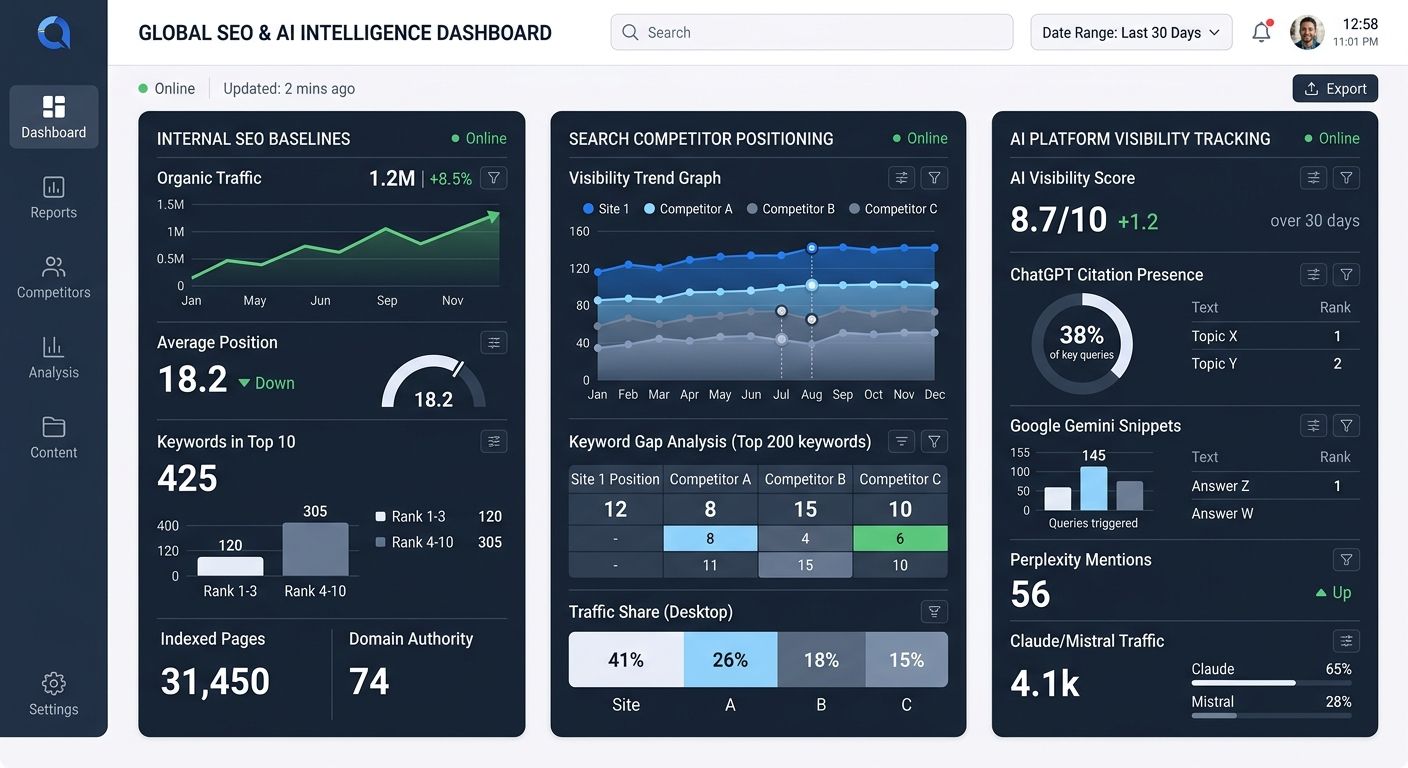
Stop comparing total organic traffic month-over-month. It tells you almost nothing. Instead, build a benchmarking framework with three distinct layers:
Layer 1: Internal Baselines (Segmented)
Track your own performance, but segment it by:
Search intent category (navigational, informational, commercial, transactional)
Device type (mobile versus desktop behavior differs significantly)
SERP feature presence (queries with AI Overviews versus those without)
Content type (blog posts versus product pages versus landing pages)
According to SEO benchmarking best practices for 2026, Core Web Vitals, mobile standards, and ranking optimization all factor into proper performance measurement. And per the SEOmator benchmarks report, 72% of top-3 results were updated within the past year, making content freshness a critical tracking dimension.
Layer 2: Search Competitor Positioning
For each keyword cluster, track:
Your visibility score versus each search competitor
Content depth comparisons (word count, subtopic coverage, media types)
Backlink authority gaps on a per-keyword basis
SERP feature capture rates (who's winning featured snippets, PAA boxes, image packs)
Layer 3: AI Platform Visibility
Track citation frequency and recommendation rates across generative search platforms. This is newer territory for most agencies, but the teams building this muscle now will have a significant advantage. For more on how agencies should think about the generative search shift, the piece on answer engine optimization breaks down the pivot in detail.
The Conversion-Weighted Visibility Metric
Here's something I've started pushing every client toward: stop treating all keywords equally in your gap analysis. A keyword gap for a query that drives $200 average order value matters twenty times more than a gap for a query that drives $10.
Calculate what I call conversion-weighted visibility:
For each keyword, multiply its visibility score (position-weighted impression share) by its business value (conversion rate times average order value or lead quality score). Sum those across your entire keyword set, and you have a single number that tells you whether your visibility is concentrated where it actually generates revenue.
When you apply this lens to your keyword gap analysis, the prioritization changes dramatically. I've seen cases where a client's "biggest" gap by search volume was a 40,000-monthly-search informational query, but their biggest gap by business value was a 900-monthly-search commercial query with a 12% conversion rate.
The agencies that understand this distinction charge premium rates for a reason.
A Practical Process You Can Implement This Week
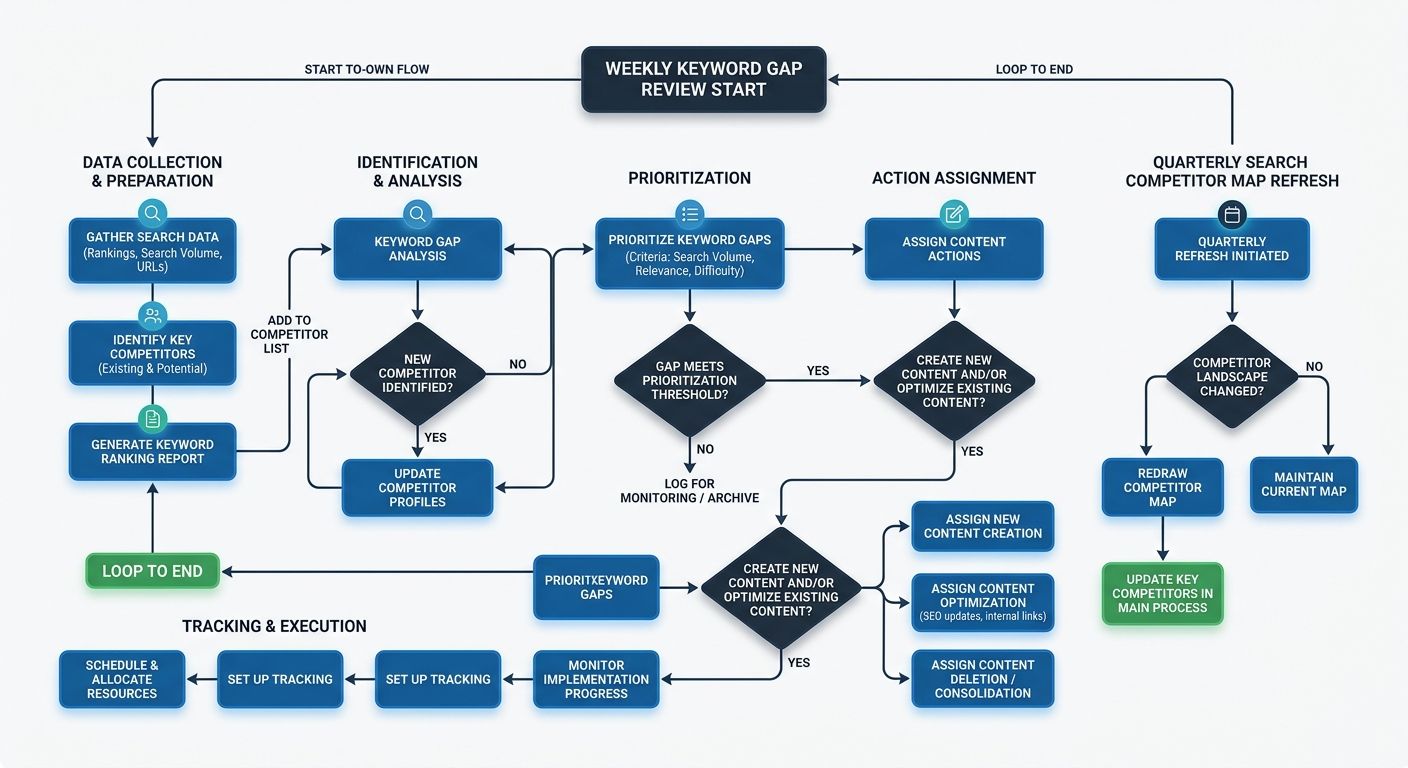
Here's the exact process I walk agency teams through. It takes about 6-8 hours for the initial setup and 2-3 hours monthly to maintain:
Audit your current competitor list. Pull up your top 20 target keywords. Google each one. Write down every domain in the top 10. Compare that list to whoever you're currently tracking. I guarantee there's a gap.
Run keyword comparisons against the real players. Use Mangools' keyword gap tool or a similar platform to compare your domain against the search competitors you just identified. Export everything.
Filter ruthlessly. Remove branded terms, queries with zero business value, and anything dominated by SERP features you can't realistically capture. Your list will shrink by 40-60%. That's a good thing.
Score by business impact. Apply conversion weighting. If you don't have conversion data by keyword, use intent category as a proxy (transactional > commercial > informational > navigational).
Map to action items. Every remaining gap becomes either a new content brief, a content refresh task, a technical fix, or a link building target.
Build your tracking dashboard. If you're setting up performance measurement from scratch, the guide on building custom SEO benchmarking dashboards walks through the technical setup.
Review quarterly. Search competitors change. New domains enter the landscape. AI Overviews reshape which queries even send clicks. Your competitor map should be a living document, not a one-time deliverable.
How This Changes Agency Selection and Evaluation
If you're working with an SEO agency right now, ask them one question: "Which domains are you benchmarking us against, and how did you select them?"
If the answer is "your three main competitors," you've found the blind spot. A good agency will have a search competitor map that includes 8-15 domains per keyword cluster, updated at least quarterly, with clear documentation of why each domain is tracked.
And if you're an agency reading this, here's the uncomfortable truth: the extra hours required to build a proper search competitor map and run real keyword gap analysis SEO is what separates a $3,000/month retainer from a $10,000/month engagement. Clients will pay for insights they can't get from plugging their competitor's URL into a free tool.
The most expensive SEO mistake isn't targeting the wrong keywords — it's building your entire strategy around an incomplete picture of who you're competing against. Every agency I've seen deliver consistently strong results does the same thing: they obsess over the search competitor map before they ever touch a keyword spreadsheet. Get the competitor list right, and the gaps reveal themselves. Get it wrong, and no amount of content production or link building will close the distance. Start by Googling your top 20 target queries, writing down every domain you see, and comparing that list to what your agency is tracking. The delta between those two lists is your blind spot, and it's probably bigger than you think.
Marcus Webb
Digital marketing consultant and agency review specialist. With 12 years in the SEO industry, Marcus has worked with agencies of all sizes and brings an insider perspective to agency evaluations and selection strategies.
Explore more topics