
Generative AI SEO vs. Answer Engine Optimization: How Agencies Should Pivot in 2026
A client of mine fired their SEO agency in February after discovering something alarming: their site ranked #2 for a competitive B2B keyword, but their organic click-through rate on that term had collapsed by over 50% in eight months. The agency kept sending cheerful ranking reports.
 Marcus Webb··8 min read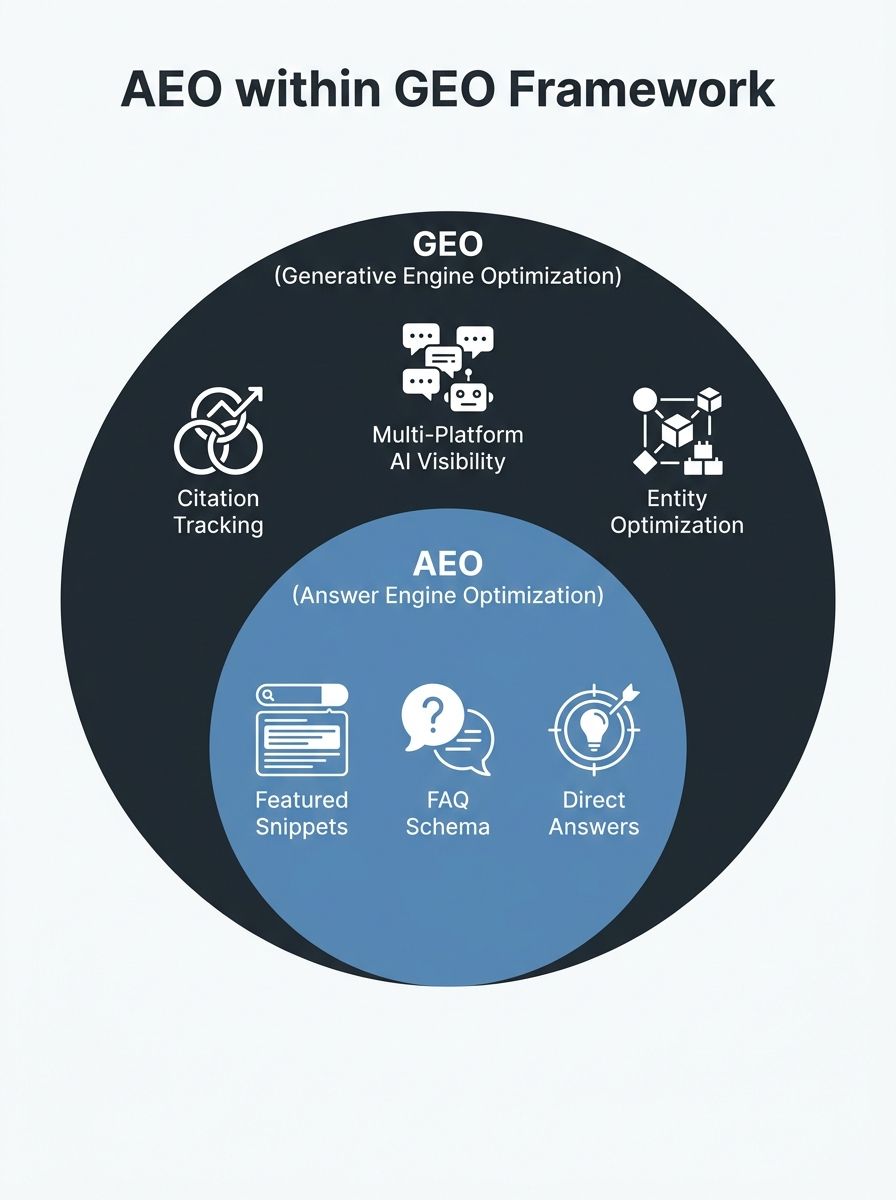
Generative AI SEO vs. Answer Engine Optimization: How Agencies Should Actually Pivot in 2026
A client of mine fired their SEO agency in February after discovering something alarming: their site ranked #2 for a competitive B2B keyword, but their organic click-through rate on that term had collapsed by over 50% in eight months. The agency kept sending cheerful ranking reports. Nobody mentioned that Google's AI Overview had been answering the query directly since mid-2025, citing a competitor's FAQ page that didn't even rank on page one. That's the moment this client understood that rankings and visibility are no longer the same thing.
This disconnect is playing out across thousands of businesses right now. And it's forcing a serious conversation about generative AI SEO vs AEO, what each term actually means, and whether agencies are genuinely adapting or just rebranding their old services with trendy labels.
I've spent the past several months evaluating agencies that claim to offer answer engine optimization, generative search optimization, or some hybrid of both. Here's what I've found, and what you should demand from any agency pitching these services.
The Real Difference Between Generative AI SEO and AEO
Let's kill the confusion first. These terms get thrown around interchangeably, but they describe different things.
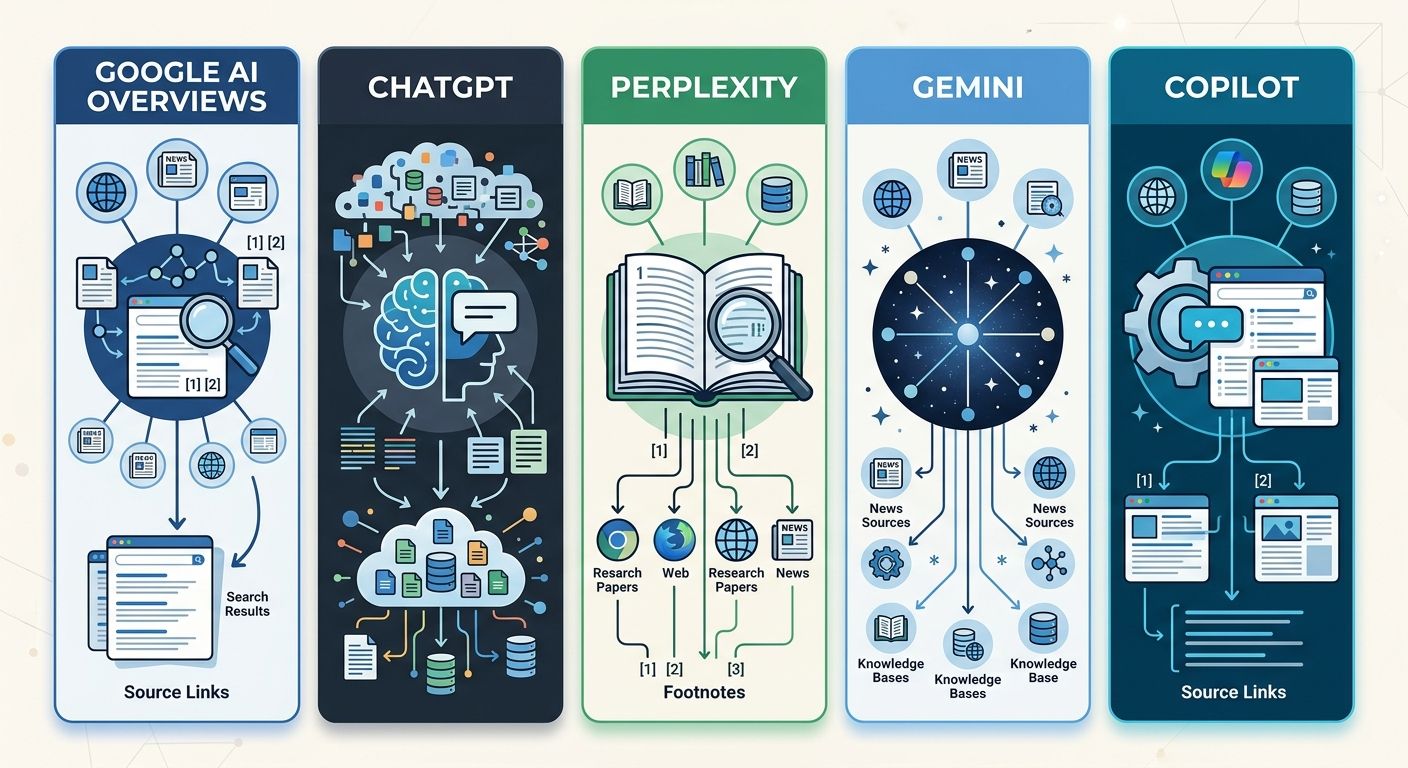
Generative Engine Optimization (GEO) is the broader discipline of optimizing for visibility within AI-generated responses across platforms like Google AI Overviews, Bing Copilot, ChatGPT, Perplexity, and Gemini. It's about showing up when an AI model synthesizes an answer from multiple sources.
Answer Engine Optimization (AEO) is more specific. It targets inclusion in direct answer formats: featured snippets, AI answer boxes, People Also Ask, and the structured responses that platforms like Perplexity.ai deliver as contextually rich answers instead of traditional link lists.
Think of AEO as a subset of GEO. Every AEO strategy contributes to generative search visibility, but GEO extends further into citation tracking, multi-platform presence, and the kind of content engineering that gets your brand mentioned in a Gemini conversation.
The practical difference for agencies? An AEO strategy focuses heavily on structured content, schema markup, and direct answer formatting. A GEO strategy adds layers of authority building, citation monitoring across AI platforms, and content designed for machine extraction rather than human scanning alone.
Why Moving Beyond Traditional SEO Isn't Optional Anymore
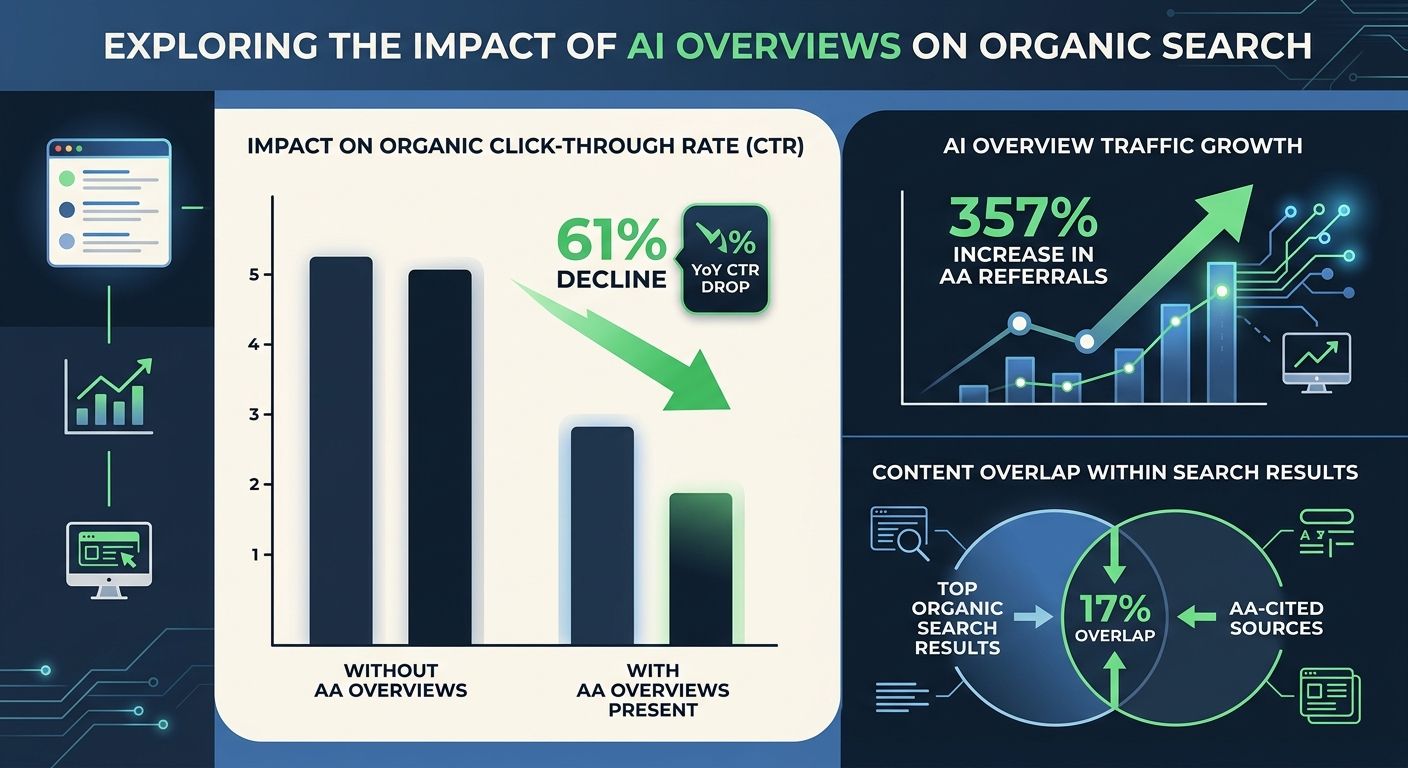
The numbers are stark. According to Position Digital's AI SEO statistics report, organic CTR for queries where an AI Overview is present has dropped 61% year-over-year. That's not a gradual decline. That's a cliff.
And it's not just about Google. Microsoft reported that AI referrals to top websites spiked 357% year-over-year in June 2025, reaching 1.13 billion visits. The traffic is moving. The question is whether it's moving toward your content or your competitor's.
Here's what makes this particularly tricky for agencies: the old playbook of chasing keyword rankings still works for some query types. Transactional searches, local intent, navigational queries. But for informational and research-heavy queries, the kind that often start the buyer's journey, AI systems are increasingly providing the answer directly. Your client's page might technically rank, but nobody clicks through because the AI already extracted what it needed.
Research from Aggarwal et al. found that dedicated generative engine optimization techniques significantly outperform traditional SEO methods in securing visibility within AI-generated responses. This isn't theoretical. It's measurable.
If you're still evaluating agencies purely on ranking positions and organic sessions, you're measuring the wrong things. I wrote about this shift toward better benchmarking approaches earlier this year, and the gap between what agencies report and what actually drives revenue keeps widening.
The Generative Search Ranking Factors That Actually Matter
Traditional SEO trained us to think about backlinks, keyword density, page speed, and domain authority. Those signals still matter for conventional search results. But when it comes to AI search visibility in 2026, a different set of factors determines whether your content gets cited.
Entity Clarity and Knowledge Graph Presence
Google's knowledge graph cleanup removed billions of entities in 2025, focusing on clear, well-typed entities like "writer" or "author" to highlight expertise. If your client's brand, products, or key personnel aren't clearly defined as entities with proper schema markup, AI systems have a harder time citing them.
This means agencies need to invest in entity SEO: ensuring brands are properly represented in knowledge graphs, Wikidata, and structured data across the web.
Extractability Over Readability
AI systems don't read your 3,000-word blog post the way humans do. They extract discrete facts. Content needs to be structured so that key claims, statistics, and answers appear in short, self-contained blocks. The agencies I've seen doing this well format content in 2-3 sentence answer blocks with clear headings that function as implicit questions.
Source Authority and Citation Patterns
BrightEdge's Generative Parser data reveals that only about 17% of sources cited in AI Overviews overlap with the traditional top-ranking results. That's a remarkable finding. It means AI systems have their own citation logic, and it doesn't simply mirror PageRank.
What does get cited? Content with attributable expertise, original data, transparent methodology, and clear E-E-A-T signals. Generic "ultimate guides" that rehash existing information are exactly the kind of content AI models can synthesize without ever citing your page.
Multi-Platform Presence
Your answer engine optimization strategy can't focus on Google alone. ChatGPT, Perplexity, Gemini, Copilot, and Grok all pull from different indexes and have different citation preferences. NoGood's proprietary AEO platform, Goodie, tracks brand visibility across ChatGPT, Gemini, Claude, and Perplexity in real time, including sentiment analysis and prompt-gap analysis. Not every agency needs a proprietary platform, but any agency serious about this space needs multi-platform tracking.
How to Evaluate Agencies Making the GEO/AEO Pivot
This is where my consultant skepticism kicks in hard. I've reviewed dozens of agency websites that added "AI Optimization" or "AEO" to their service pages in the past year. Most of them are doing the same traditional SEO work with new terminology slapped on top.
Here's my checklist for separating real capability from marketing spin:
Do they track AI citations, not just rankings? If an agency can't show you where your brand appears (or doesn't appear) in ChatGPT, Perplexity, or Google AI Overviews, they're not doing AEO. Period.
Do they have a structured data strategy beyond basic schema? FAQ schema is table stakes. You need entity markup, speakable schema, and content structured for machine extraction.
Can they show before/after citation data? Any agency worth hiring should demonstrate how their work increased a client's citation frequency or share of voice in AI answers.
Do they monitor robots.txt for AI crawler access? Many sites inadvertently block AI crawlers. Cloudflare's default settings now block AI bots, requiring manual whitelisting. If your agency hasn't checked this, that's a red flag.
Are they transparent about what they don't know? Generative search is still evolving rapidly. Any agency that guarantees specific AI citation outcomes is either lying or doesn't understand the space. I've always been skeptical of guaranteed results in traditional SEO, and that skepticism doubles for AI search.
The agencies leading this transition treat AEO not as a bolt-on service but as a core methodology integrated across content architecture, structured data, and citation monitoring. That integration is what separates the real players from the pretenders.
Pricing and Contract Structures I'm Seeing
Because I know you'll ask: what does this actually cost?
Agencies offering genuine GEO/AEO services typically price in one of three models:
Monthly retainer with citation tracking: $3,000–$12,000/month depending on scope. This is the most common structure and includes content optimization, structured data work, multi-platform monitoring, and monthly reporting on AI visibility metrics.
Performance-based (Result-as-a-Service): Some agencies like GenOptima tie compensation directly to citation outcomes. You pay based on actual appearances in AI answers. Pricing varies wildly, but expect $5,000–$15,000/month with performance bonuses.
Project-based AEO audits: $2,500–$8,000 for a one-time assessment of your AI search visibility, content extractability, and structured data readiness. Good starting point if you're not ready for a retainer.
If you're weighing whether to bring these capabilities in-house or hire out, the true cost comparison between tool stacks and full-service agencies is worth reviewing carefully. AI visibility tracking tools alone can run $500–$2,000/month before you factor in the human expertise needed to act on the data.
A Practical Pivot Framework for Agency Teams
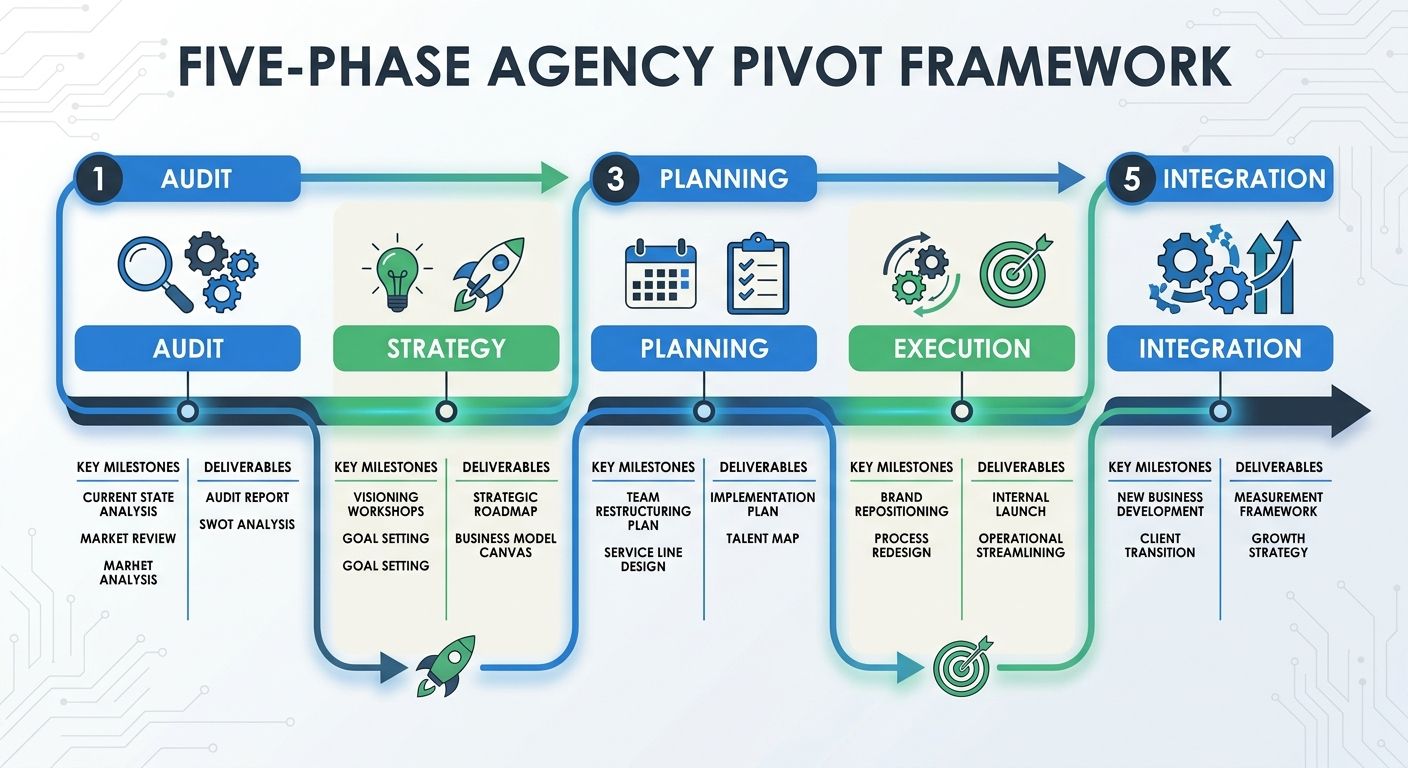
Whether you're an agency adapting your own services or a brand managing an agency relationship, here's the framework I'd recommend:
Phase 1: Audit (Weeks 1-2) Assess your current AI search visibility across Google AI Overviews, ChatGPT, Perplexity, and Copilot. Document where you're cited, where competitors are cited, and where nobody's content is being referenced (that's your opportunity gap).
Phase 2: Foundation (Weeks 3-6) Fix technical blockers. Update robots.txt to allow AI crawlers. Implement entity-level schema markup. Restructure top-performing content into extractable Q&A blocks. This is the kind of work that AI-driven automation can accelerate if your team has the right tooling.
Phase 3: Content Engineering (Ongoing) Create content specifically designed for AI citation. This means original research, expert commentary with attributable credentials, and answers formatted in short, fact-dense blocks. Stop writing 2,000-word articles that bury the answer in paragraph 14.
Phase 4: Multi-Platform Monitoring (Ongoing) Track citation frequency, sentiment, and share of voice across all major AI platforms monthly. Compare against competitors. Adjust content strategy based on what's getting cited and what's being ignored.
Phase 5: Integration with Traditional SEO (Ongoing) Don't abandon traditional SEO. Brands still need visibility across both AI-generated answers and conventional search results, especially for transactional and local queries. The goal is a dual-track strategy, not a complete replacement.
What I'd Do If I Were Hiring an Agency Right Now
I'd ask three questions before anything else:
Show me your AI citation tracking dashboard. If they don't have one, walk away.
What percentage of your clients' content gets cited in AI answers, and how has that changed in the past six months? Real agencies track this.
How do you measure ROI on AEO work specifically? The best answer I've heard: tracking assisted conversions where prospects reference information they found through AI search.
The shift from traditional SEO to generative AI search visibility isn't a future prediction. It's happening now, and the agencies that figured this out twelve months ago have a significant head start.
But here's the honest truth: this space is young enough that even the best agencies are still learning. The ones I trust most are the ones who admit that openly while showing me the data on what's working. If someone tells you they've "cracked the code" on AI search optimization, they haven't. What they should be telling you is that they've built the measurement infrastructure to iterate quickly and the content engineering processes to adapt as these platforms evolve.
Your next step isn't to overhaul everything. It's to run that Phase 1 audit, see where you actually stand in AI search, and make decisions based on data instead of hype. That's always been the right approach to SEO, and it still is.
Marcus Webb
Digital marketing consultant and agency review specialist. With 12 years in the SEO industry, Marcus has worked with agencies of all sizes and brings an insider perspective to agency evaluations and selection strategies.
Explore more topics