
SEO Tool Stack vs. Full-Service Agency: The True Cost Comparison for 2026
The spreadsheet that finally changed my mind had 47 rows. I'd been running a DIY SEO tool stack for a mid-size ecommerce client, tracking every dollar spent on Semrush, Ahrefs, Surfer SEO, and a handful of smaller utilities. The monthly tool spend came to about $1,365.
 Marcus Webb··8 min read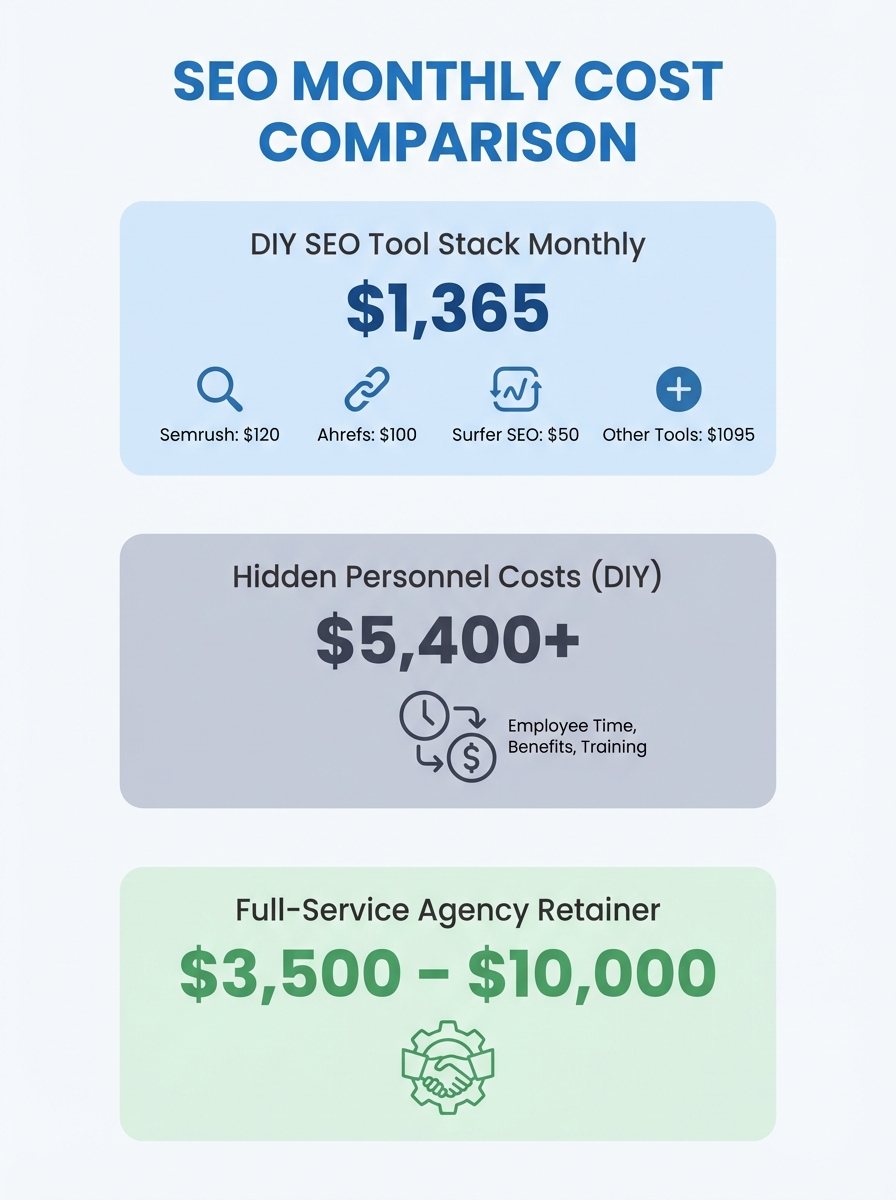
SEO Tool Stack vs. Full-Service Agency: The True Cost Comparison for 2026
The spreadsheet that finally changed my mind had 47 rows. I'd been running a DIY SEO tool stack for a mid-size ecommerce client, tracking every dollar spent on Semrush, Ahrefs, Surfer SEO, and a handful of smaller utilities. The monthly tool spend came to about $1,365. The agency we were comparing against quoted $3,500 per month. Simple math, right? Tools win by a mile. Except when I added the 22 hours per week my team was spending on execution, analysis, and keeping up with AI search changes, the "cheap" option was costing us north of $6,800 per month in real dollars. That spreadsheet broke my loyalty to the DIY-forever camp and forced me to think about this question with a lot more nuance.
So here's what I've learned about when to hire an SEO agency vs tools, and why the sticker price on either option tells you almost nothing about the true cost.
The Real Numbers: What You're Actually Paying
Let's start with the hard costs, because that's where most people begin their comparison and where most people get it wrong.
The DIY Tool Stack
A functional SEO tool stack in 2026 looks something like this: one major all-in-one platform (Semrush at $129.95/month or Ahrefs at $129/month), a content optimization tool like Surfer SEO ($89-$219/month), a rank tracker, a technical audit crawler, and probably Google Analytics plus Search Console, which are free but require real time to configure properly. Add a backlink monitoring tool if your all-in-one doesn't cover it well enough.
According to an SEO software cost breakdown from AEO Engine, a typical DIY stack runs about $1,365 per month. Budget-conscious teams using SE Ranking (starting at $52/month) instead of Semrush can get that number down to around $500-$800, but you're trading capability for savings.
What that number doesn't include: your time. Or the time of whoever on your team is actually logging into these tools, interpreting the data, building the strategies, writing the content briefs, executing technical fixes, and doing outreach. When you factor in personnel costs, benefits, and overhead for even one dedicated SEO specialist, research from Arwenus puts the real in-house cost at $250,000-$500,000+ annually. That's for a proper team. Even a single experienced hire runs $65,000-$100,000 in salary alone, plus 30% for benefits and overhead.
The Full-Service Agency
Agency retainers vary wildly. For small businesses, you might find competent agencies starting at $2,000-$5,000 per month. Mid-market companies typically pay $5,000-$15,000. Enterprise engagements can run $25,000-$250,000 monthly, depending on scope. And watch for the extras: setup fees alone can range from $2,000 to $10,000, with additional tool subscription pass-throughs of $200-$500 monthly that some agencies tack onto their retainers.
The 75% of agencies that use monthly retainer models are pricing in their own tool costs, staff salaries, and overhead. As AgencyAnalytics notes in their pricing guide, agencies using enterprise-level SEO tools have higher operational costs but can deliver superior insights because they're spreading those costs across multiple clients.
That's the key economic insight most people miss. An agency paying $1,000/month for an enterprise Semrush plan splits that cost across 20 clients. You'd pay the same amount to serve one site.
The Hidden Cost Nobody Talks About: Competence Lag
Here's where my opinion gets strong. The biggest cost in the SEO tool costs vs agency fees debate isn't dollars. It's the gap between owning a tool and knowing what to do with it.
Semrush is extraordinary software. I use it daily. But handing someone a Semrush login and expecting them to execute a competitive SEO strategy is like handing someone a piano and expecting a concerto. The tool doesn't create the strategy. The tool doesn't know that your site's traffic drop correlates with a core update penalty rather than seasonal demand shift. The tool doesn't understand that your competitor's backlink profile is full of PBN links that are about to get them crushed.
This is especially true now that AI Overviews dominate informational queries and click-through rates on traditional organic results have dropped 20-30% for certain query types. Navigating Generative Engine Optimization — getting your brand cited in AI-generated responses — requires strategic thinking that no tool automates yet. If you're evaluating how agencies are integrating AI into their workflows, you'll see that the best ones are using tools as inputs into human strategy, not replacements for it.

When the DIY Tool Stack Actually Wins
I'm not here to sell you on agencies. There are clear scenarios where running your own stack delivers better DIY SEO tools ROI.
You already have SEO expertise in-house. If your team includes someone with 3+ years of hands-on SEO experience who understands technical auditing, content strategy, and link acquisition, tools are force multipliers. They don't need an agency to interpret a crawl report or prioritize keyword opportunities.
Your SEO needs are narrow and well-defined. If you're a local business focused on one geographic market, or if your site is technically sound and you mainly need content optimization guidance, a $130/month Semrush subscription might genuinely be all you need. The comparison between enterprise SEO and local SEO approaches makes this distinction clearer — the complexity gap between them is enormous.
You're in a low-competition niche. When your competitors aren't investing heavily in SEO, the bar for "good enough" strategy is much lower. Basic keyword research and on-page optimization from any decent tool can move the needle.
You need to maintain deep institutional knowledge. Some organizations, especially those in regulated industries or with complex product lines, genuinely benefit from keeping SEO expertise internal where it's embedded in the business context every day.
The Semrush vs agency services debate usually tips toward Semrush (or whatever tool stack you prefer) when the human expertise already exists on your team. The tools are the easy part. The thinking is the hard part.
When the Agency Wins — and It's Not Close
For most companies under $50 million in revenue, an agency delivers better ROI. That's not my opinion alone. The data from Arwenus backs it up. Here's why.
Speed to Execution
An in-house hire takes 3-6 months to recruit, onboard, and ramp up. An agency can start executing in week one. If you're recovering from a site migration gone wrong, dealing with a core update hit, or trying to capture a seasonal opportunity, that timeline difference is worth thousands in lost revenue. I've seen teams make critical mistakes during migrations specifically because they didn't have experienced hands available fast enough.
Breadth of Expertise
One person can't be elite at technical SEO, content strategy, link building, conversion rate optimization, and AI search optimization simultaneously. An agency gives you a team. A good one has specialists in each area who've worked across dozens of sites and industries. That pattern recognition is incredibly valuable.
Tool Cost Distribution
Agencies absorb significant recurring software expenses across their client base. They're running enterprise-tier tool subscriptions you'd never justify for a single site. You get access to $3,000-$5,000/month worth of software as part of your retainer.
Turnover Protection
If your one SEO person quits, your program stops. With an agency, turnover is managed internally. Your account gets reassigned, knowledge transfers happen, and execution continues. This risk factor rarely shows up in cost comparisons but it should.
The Hybrid Model: Where Smart Companies Land
The binary framing of this question is actually the problem. The smartest organizations I've worked with run a hybrid approach.
They keep a lean internal team — sometimes just one SEO-savvy marketer — who owns the strategy relationship and maintains brand knowledge. They pair that person with either an agency for execution or a targeted tool stack for specific functions. The internal person becomes the bridge between business context and SEO expertise.
This model works because it addresses the core weakness of each approach:
Tools without strategy are expensive dashboards
Agencies without internal champions lose alignment with business goals
The hybrid gives you both institutional knowledge and specialized execution
For measuring whether any of these models is working, you need clear ROI tracking. As Straight North emphasizes, tools like Google Analytics, CRM systems, and conversion tracking software are essential for accurately measuring SEO's impact. And calculating that ROI means connecting organic traffic to actual revenue — if 4,000 monthly visits convert at 1% with a $100 average order value, that's $4,000 in monthly revenue you can attribute to SEO.
The 2026 Wrinkle: GEO Changes the Calculation
There's a factor in this decision that didn't exist two years ago. Generative Engine Optimization — getting your brand cited in AI-generated search responses — has become a critical capability. AI Overviews, Perplexity, and other AI search platforms now answer a huge percentage of queries directly, and the brands that appear as cited sources in those answers capture disproportionate trust and traffic.
This shifts the equation toward agencies for many businesses. GEO requires understanding how large language models parse content, what entity structures they prefer, how to earn citations in AI responses, and how to track visibility across multiple AI platforms simultaneously. When you're evaluating an agency's capabilities, ask specifically about their GEO strategy and whether they track AI visibility metrics.
The tool ecosystem is catching up — Semrush now offers AI Visibility Analytics, and Ahrefs has Brand Radar for monitoring AI citations — but interpreting this data and building strategy around it still requires human expertise that most in-house teams haven't developed yet.
Making the Decision: A Practical Framework
Stop asking "which is cheaper?" Start asking "which produces more revenue per dollar spent?" Here's how to think through it.
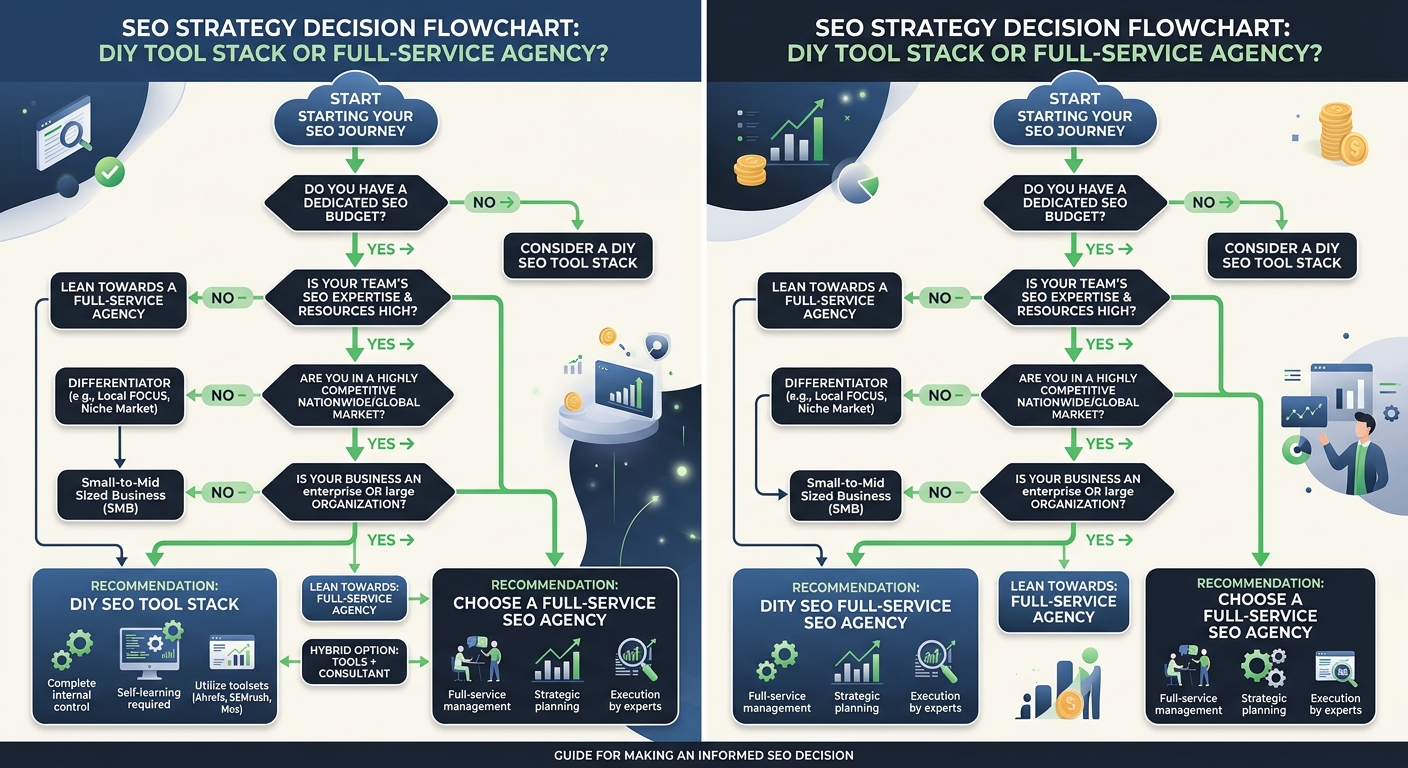
Choose the DIY tool stack if:
You have at least one team member with 3+ years of SEO execution experience
Your annual SEO tool and personnel budget is under $80,000
You're in a low-to-medium competition market
You have the patience for a 6-12 month ramp-up to full capability
Choose a full-service agency if:
You need results faster than you can hire and train
Your competitive landscape includes well-funded players investing heavily in search
You lack in-house technical SEO, content strategy, or link building expertise
You need GEO capabilities and AI search visibility now, not in six months
Choose the hybrid if:
You have budget for both a part-time internal resource and an agency relationship
You're growing fast and need flexibility to scale SEO investment up or down
You want strategic control but don't want to build a full team
The true cost of SEO in 2026 varies enormously based on approach. But the one constant is that the cheapest option on paper is almost never the cheapest option in practice. Factor in time, expertise, opportunity cost, and the revenue you're leaving on the table by moving slowly. That's the number that actually matters.
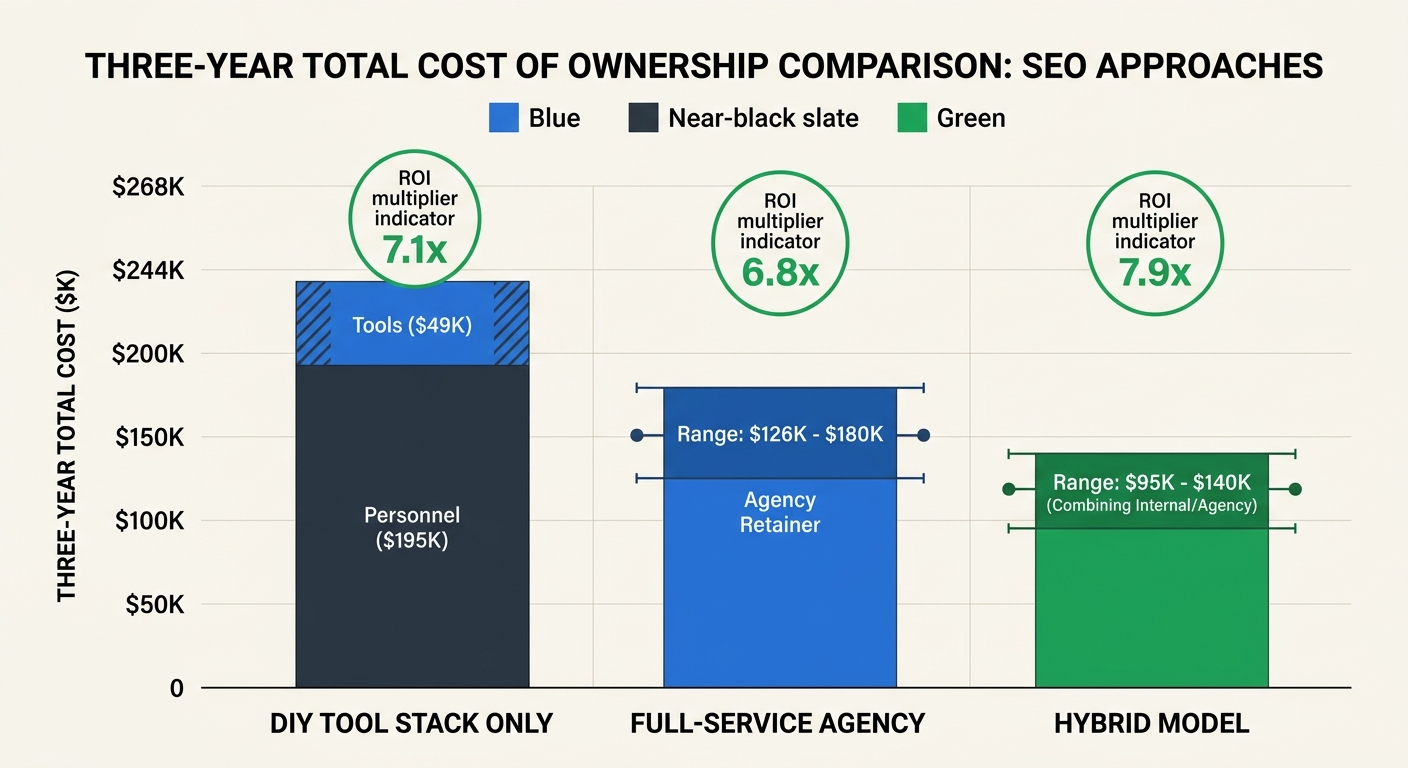
The spreadsheet I mentioned at the start? My client ended up going hybrid. They kept Semrush for day-to-day monitoring and brought on an agency for technical audits, content strategy, and GEO. Their organic revenue grew 34% in the first eight months. The tool-only approach had produced 6% growth over the same period the year before. Same budget, different allocation, dramatically different outcome. That's the comparison that actually counts.
Marcus Webb
Digital marketing consultant and agency review specialist. With 12 years in the SEO industry, Marcus has worked with agencies of all sizes and brings an insider perspective to agency evaluations and selection strategies.
Frequently Asked Questions
- How much does a typical DIY SEO tool stack cost per month in 2026?
- A functional DIY SEO tool stack typically costs around $1,365 per month and includes an all-in-one platform like Semrush ($129.95/month) or Ahrefs ($129/month), a content optimization tool like Surfer SEO ($89-$219/month), a rank tracker, technical audit crawler, and backlink monitoring tool. Budget-conscious teams can reduce this to $500-$800 monthly using SE Ranking instead of premium platforms, though with reduced capabilities.
- What is the real cost of DIY SEO when factoring in labor and overhead?
- When including personnel costs, benefits, and overhead for even one dedicated SEO specialist, the real in-house cost reaches $250,000-$500,000 annually. A single experienced SEO hire costs $65,000-$100,000 in salary alone, plus 30% for benefits and overhead, making the true DIY cost far higher than just tool subscriptions.
- How much do full-service SEO agencies charge per month?
- SEO agency retainers vary by company size: small businesses pay $2,000-$5,000 per month, mid-market companies typically pay $5,000-$15,000, and enterprise engagements can range from $25,000-$250,000 monthly. Additional setup fees can range from $2,000-$10,000, with tool subscription pass-throughs of $200-$500 monthly sometimes added to retainers.
- When is a DIY SEO tool stack the better choice than an agency?
- A DIY tool stack works best when you have at least one team member with 3+ years of SEO execution experience, your annual SEO budget is under $80,000, you're in a low-to-medium competition market, and you can afford a 6-12 month ramp-up period. It's also suitable for local businesses with narrow geographic focus or technically sound sites needing primarily content optimization.
- What is Generative Engine Optimization (GEO) and why does it matter for SEO in 2026?
- Generative Engine Optimization is the practice of getting your brand cited in AI-generated search responses from platforms like AI Overviews and Perplexity. It requires understanding how large language models parse content and has become critical because AI now answers a huge percentage of queries directly, making brands that appear as cited sources capture disproportionate trust and traffic.
- What are the advantages of a hybrid SEO approach?
- A hybrid model uses a lean internal team (often one SEO-savvy marketer) who owns strategy and maintains brand knowledge, paired with either an agency for execution or targeted tools for specific functions. This approach combines institutional knowledge with specialized execution and addresses the weakness of tools without strategy (expensive dashboards) and agencies without internal champions (lost business alignment).
- How long does it take to hire and onboard an in-house SEO specialist versus using an agency?
- An in-house SEO hire takes 3-6 months to recruit, onboard, and fully ramp up, whereas an agency can start executing in week one. This timeline difference is particularly valuable if you're recovering from a site migration, dealing with a core update hit, or trying to capture seasonal opportunities.
- How can I measure whether my SEO investment is actually producing revenue?
- Connect Google Analytics 4 to your CRM, define conversion events, and track organic revenue monthly. For example, if 4,000 monthly visits convert at 1% with a $100 average order value, that's $4,000 in monthly revenue attributable to SEO. Proper attribution from the start is essential to determine if your tool stack or agency retainer is actually paying for itself.
Explore more topics