
AI in SEO Agencies: Automation That Enhances (Not Replaces) Human Expertise
Seventy-four percent of all new web content published today includes AI-generated elements, yet purely AI-written content lands in top search positions only 13.5% of the time. That gap tells you everything about where this industry actually stands.
 Marcus Webb··8 min read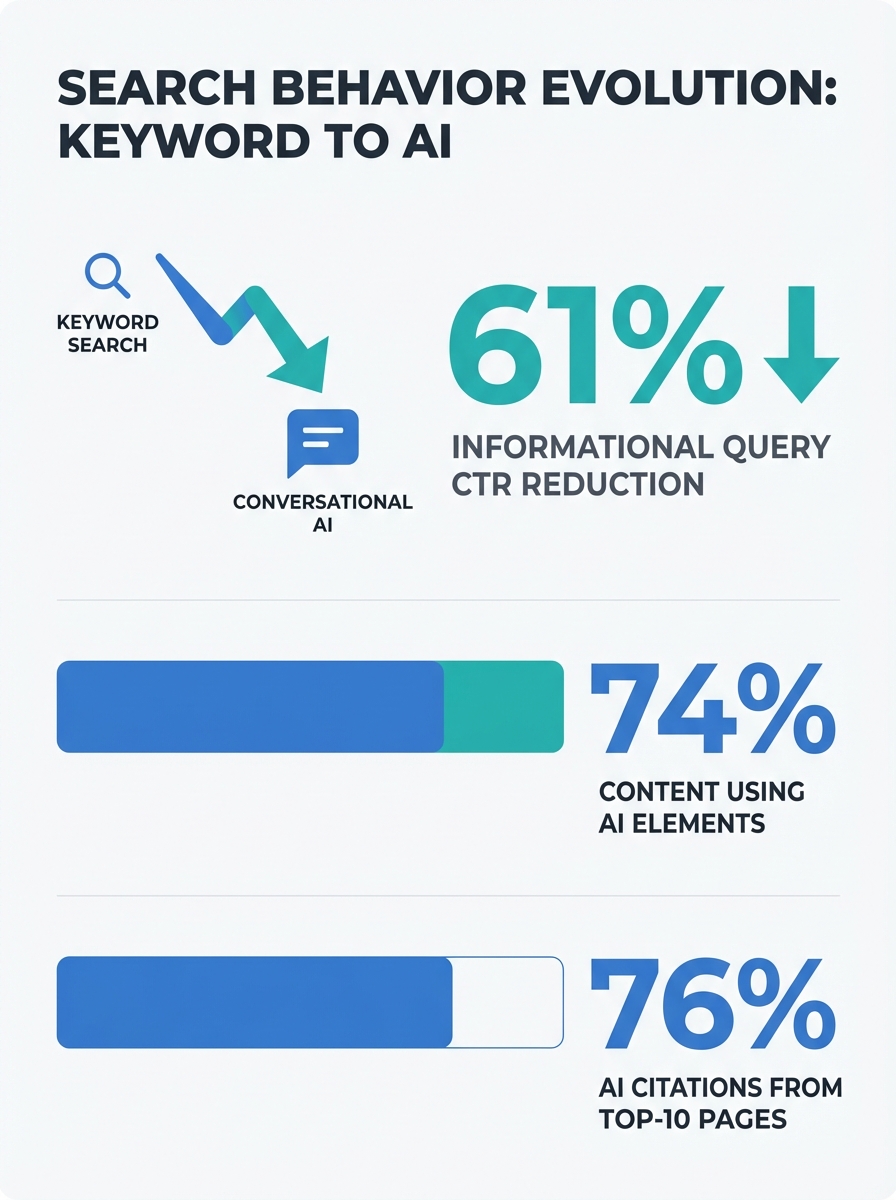
AI in SEO Agencies: Automation That Enhances (Not Replaces) Human Expertise
Seventy-four percent of all new web content published today includes AI-generated elements, yet purely AI-written content lands in top search positions only 13.5% of the time. That gap tells you everything about where this industry actually stands. The agencies winning right now aren't the ones who handed their content pipelines over to ChatGPT and called it a day. They're the ones who figured out exactly where machines should do the work and where a human brain is still irreplaceable.
I run the SEO practice for a mid-size agency, and over the past eighteen months I've watched our team go from skeptical to strategic about AI tooling. We tried the "automate everything" approach. It was a disaster. Then we tried ignoring AI entirely. That was worse. What finally worked was a deliberate, task-by-task audit of our workflows to determine which ones benefited from machine speed and which ones still demanded human judgment. This post is the playbook that came out of that process.
The Shift You Can't Ignore: From Rankings to Recommendations
Google's AI Overviews now appear in a significant share of U.S. searches, and they've reduced organic click-through rates by up to 61% for informational queries. That number should make every agency leader sit up straight. The old model of "get you to position one and watch the traffic roll in" is fracturing.
Search behavior itself has changed. Users aren't just typing keywords anymore. They're asking multi-part questions, getting synthesized answers, and sometimes never clicking a single blue link. According to Search Engine Land's analysis of the traditional agency model, AI tools can now adapt to algorithm updates more quickly than human teams and assess competitor code changes to see their impact across sites. That's a real threat to agencies that sell manual audits as their primary value prop.
But here's where the nuance matters. Seventy-six percent of AI Overview citations come from pages already ranking in Google's top 10. Traditional SEO fundamentals haven't evaporated. Crawlability, relevance, authority, structured content: these still form the foundation. What's changed is that there's a new layer on top, and agencies need to operate on both levels simultaneously.
Where AI Actually Excels in Agency Work
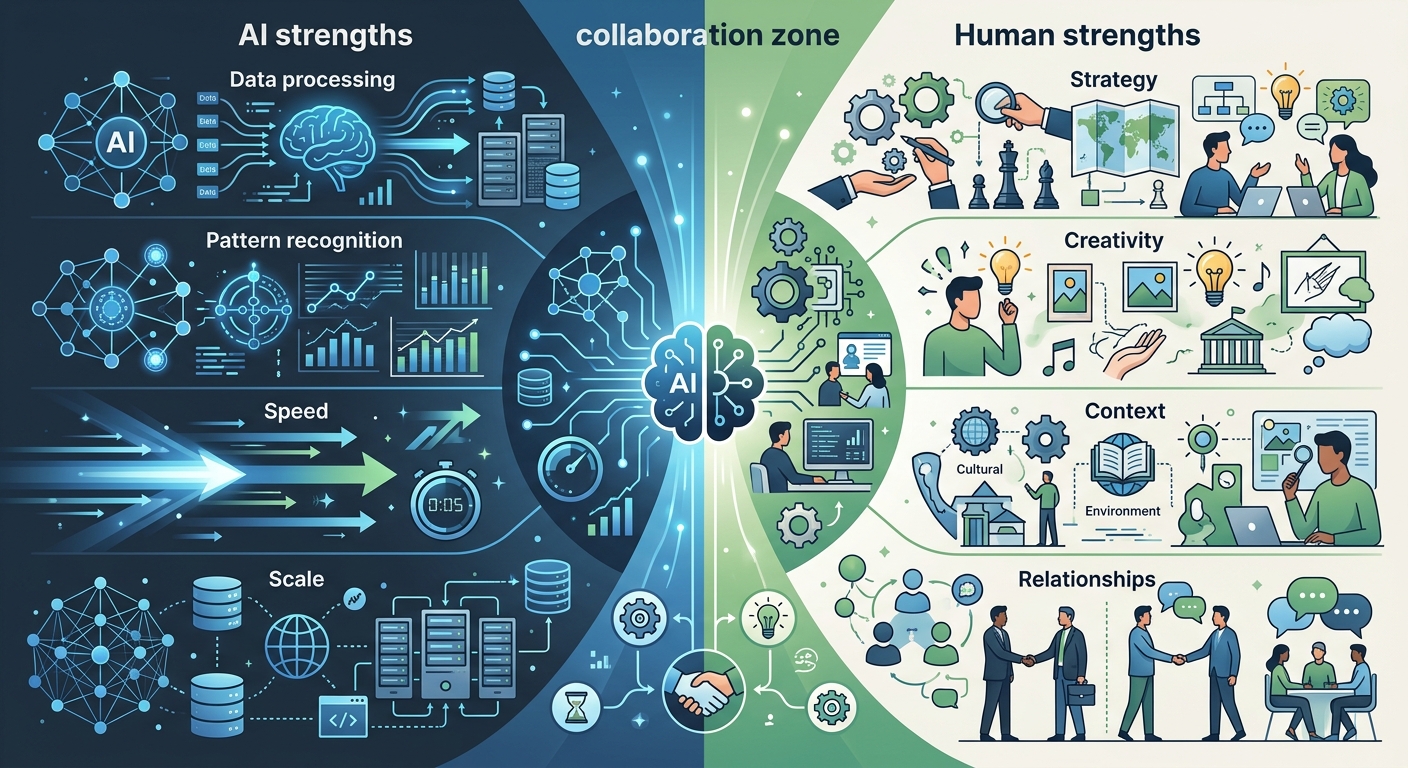
Not every task benefits equally from automation. After months of trial and error, I've found that AI works best when the task involves a lot of text, a lot of rows, pattern recognition, classification, or structured transformation. If your work checks one or more of those boxes, there's probably an AI workflow that'll cut your time in half.
Here are the areas where agency automation delivers the most value without sacrificing quality.
Content Drafting at Scale
AI is excellent at producing first drafts, outlines, and structural frameworks for content. It can synthesize competitor content, identify gaps in topical coverage, and generate briefs that would take a human researcher hours to assemble. Our team uses AI to produce initial drafts for about 80% of our blog content.
The catch? Ninety-three percent of marketers edit AI-generated content before publishing, and 97% of companies mandate human review. Those numbers aren't a failure of the technology. They're evidence that the hybrid model works. AI handles the scaffolding; humans add the expertise, the voice, and the angle that makes content actually rank.
Technical Audits and Pattern Detection
This is where machine learning search optimization really shines. AI tools can crawl thousands of pages, flag duplicate content, identify cannibalization issues, and surface technical problems that would take a human analyst days to find manually. When Google rolls out a core update, our team can now run a full diagnostic across every client site within hours instead of weeks.
If you're still using spreadsheets to cross-reference Search Console data with crawl reports, you're leaving money on the table. AI excels at the kind of large-scale pattern recognition that human eyes simply can't match at speed. And if you've been hit by a recent algorithm shift, understanding how to audit your site's performance after a core update becomes a lot faster when AI handles the initial data crunching.
Keyword Research and Intent Mapping
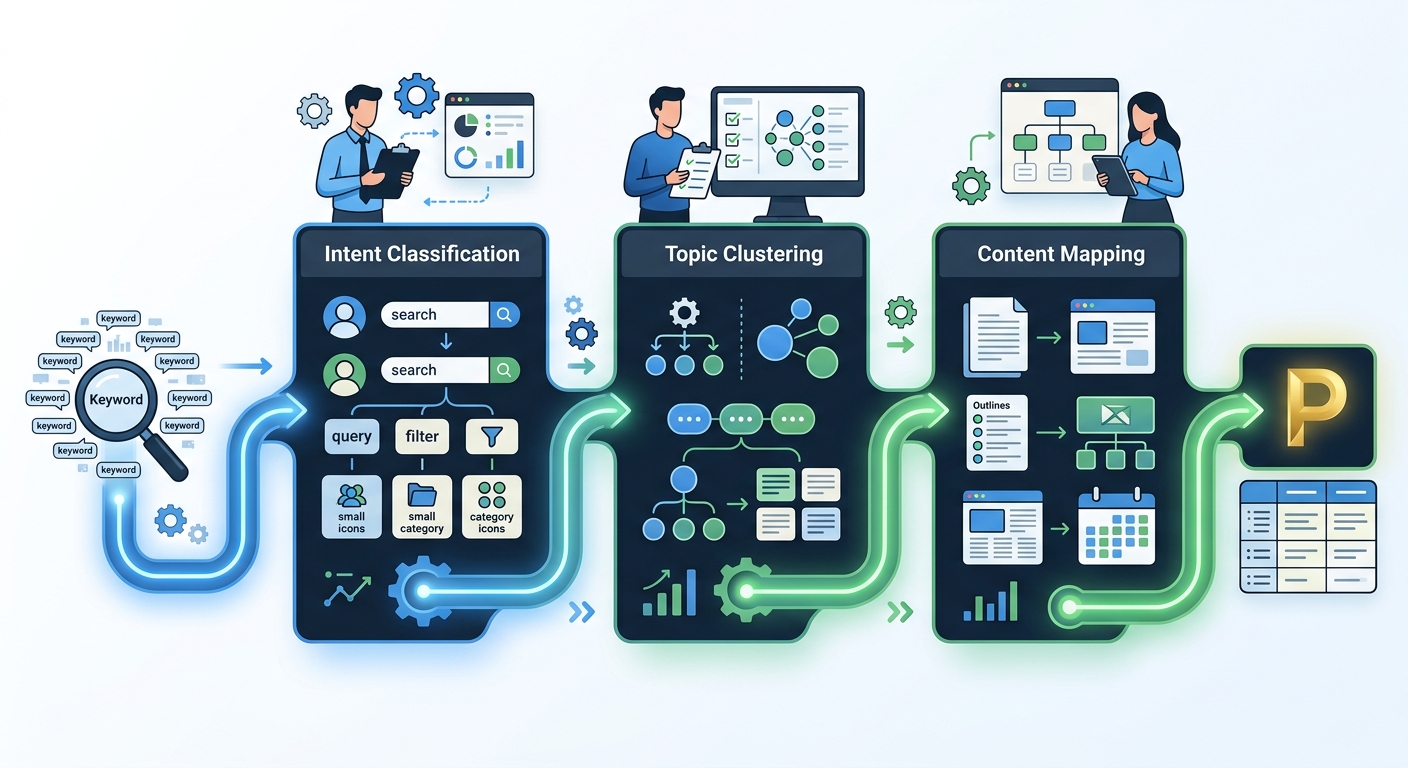
Traditional keyword research was always tedious. Pull a list from a tool, sort by volume, check difficulty, map to pages. AI transforms this from a mechanical process into an analytical one. Instead of chasing long-tail keywords one by one, you can create intent-driven content that naturally includes related variations, covering entire topic clusters in a single workflow.
The real power here is in intent classification. AI can analyze thousands of queries and group them by informational, navigational, transactional, or commercial intent far more accurately than manual sorting. This means your content strategy maps to the actual user need, not just the keyword with the highest search volume.
Reporting and Client Communication
Every agency person knows the pain of monthly reporting. Pull data from five platforms, build slides, write analysis, schedule the call. AI can automate the data aggregation and even draft initial commentary on trends. Our team saves roughly 12-13 hours per week on reporting tasks alone, which is remarkably close to the industry average.
But the analysis itself? The part where you tell a client why their organic revenue dropped 15% and what you're going to do about it? That's still a human conversation. AI can tell you what happened. It can't tell a nervous CMO why it doesn't mean the sky is falling.
Where Humans Are Still Essential
The temptation with any powerful tool is to let it do too much. I've seen agencies overcorrect, handing strategic decisions to AI outputs without applying critical thinking. The results are predictable: generic strategies, tone-deaf content, and missed opportunities that a senior strategist would have caught immediately.
Strategy and Business Context
As Vendasta's guide on SEO automation puts it plainly, an SEO specialist interprets AI insights, adapts them to business goals, and ensures campaigns stay aligned with evolving search algorithms. AI doesn't know that your client is about to launch a new product line. It doesn't understand that their CEO just gave a keynote that shifted the brand narrative. It can't factor in the competitive dynamics of a niche B2B market where three companies control 90% of the relevant content.
Strategy requires context that no model has access to. The best agencies use AI to inform strategy, not to generate it.
Original Thought Leadership
Google's own guidance on this is worth paying attention to. Their Search Central blog on AI search experiences emphasizes that unique and valuable content remains critical for both AI-powered experiences and traditional blue link results. Users are asking longer, more specific questions and following up to dig deeper.
This means surface-level content generated purely by AI is becoming less valuable, not more. The brands earning citations in AI Overviews are the ones publishing genuine expertise: original research, proprietary data, experience-based insights that can't be synthesized from existing web content. As Semrush's analysis notes, these elements differentiate your content and provide value that competitors using the same AI tools can't easily match.
Relationship Management
SEO is a long game. Clients need to trust that their agency understands their business, not just their backlink profile. The human relationships, the ability to push back on a bad idea, the judgment call about whether to chase a trending topic or stay the course: these are the things that keep clients for years instead of months.
The New Optimization Frameworks Worth Knowing
The future of SEO services isn't just about traditional rankings anymore. Two emerging frameworks are reshaping how agencies think about visibility.
Generative Engine Optimization (GEO)
GEO focuses on influencing how AI systems explain, compare, and recommend topics. Research using the GEO-BENCH benchmark shows that including citations, quotes, and statistics in your content boosts source visibility by over 40% across queries. This isn't about gaming the system. It's about structuring your content so that AI can accurately represent your expertise when it synthesizes answers.
Practically, this means front-loading clear answers, using structured data like FAQ and HowTo schema, and mirroring natural language queries in your headings. If your content starts with three paragraphs of preamble before getting to the point, AI systems will skip you in favor of a competitor who answers the question in the first sentence.
Answer Engine Optimization (AEO)
AEO takes a more structural approach, focusing on how content gets extracted into direct AI responses. The tactics overlap with GEO but lean more heavily on schema markup, concise definitions, and content organized around specific questions. Both frameworks complement traditional SEO rather than replacing it.
And here's the thing most agencies miss: you can't optimize for AI search without first being strong in organic search. The data is clear that AI systems overwhelmingly cite pages that already have strong traditional signals. So AI in SEO isn't a separate discipline. It's an extension of everything you're already doing, done more deliberately.
Building the Hybrid Workflow: A Practical Framework
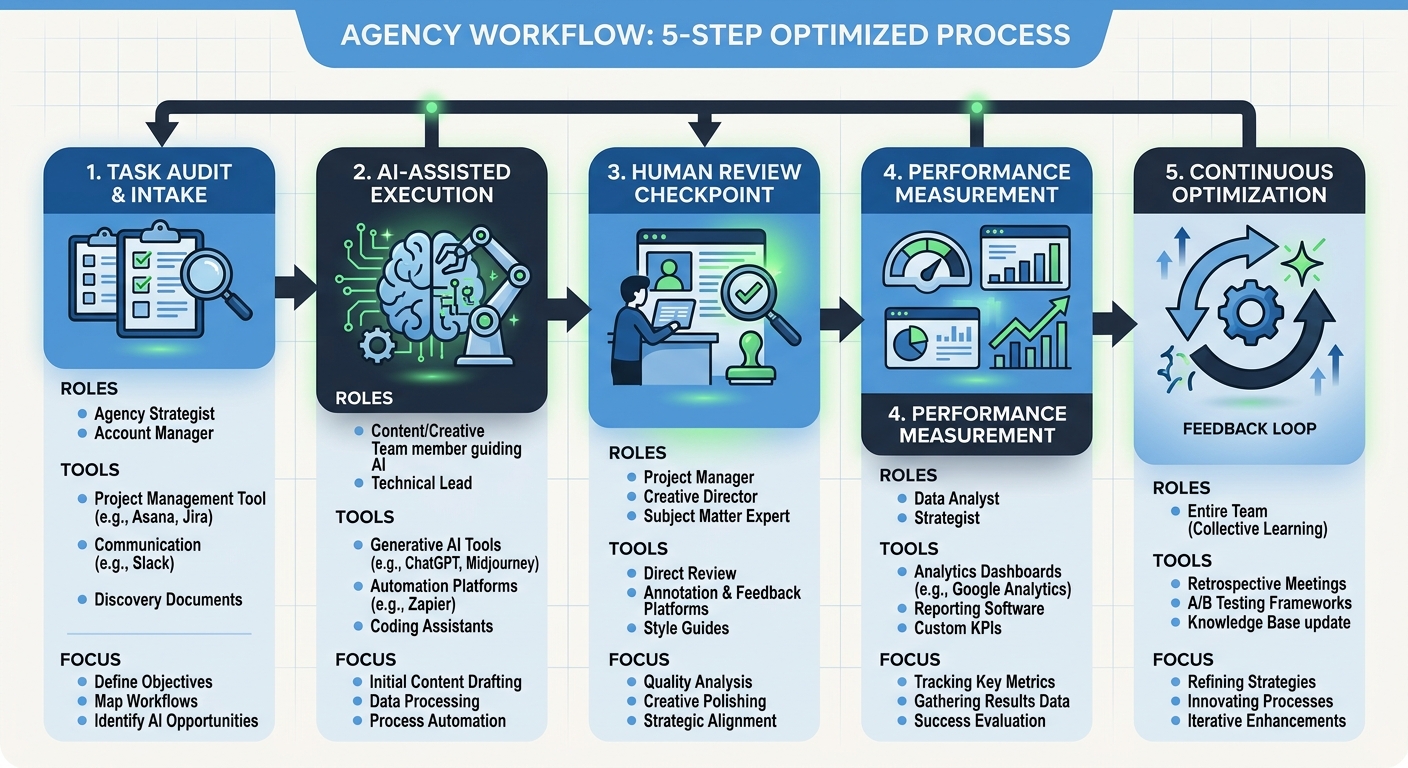
If you're running an agency or leading an SEO team, here's the framework that's worked for us. It's not theoretical. We've been running this for over a year across 30+ client accounts.
Audit every recurring task for AI suitability. Ask: does this involve large data sets, pattern matching, or repetitive transformation? If yes, test an AI workflow.
Establish human checkpoints at every decision point. AI drafts, humans edit. AI surfaces data, humans interpret. AI flags issues, humans prioritize.
Track new visibility metrics beyond organic traffic. AI citations, brand mentions in AI responses, and entity recognition across platforms like ChatGPT and Perplexity are becoming just as important as traditional rankings.
Invest in third-party authority. The most-cited domains in AI responses include Reddit, Wikipedia, Forbes, and major industry publications. Build your clients' presence on these platforms through expert contributions and original data.
Update content continuously. AI Overviews favor fresh, relevant content. Quarterly content refreshes are no longer optional for competitive queries.
Machine learning is also transforming the predictive side of SEO. As Zero Gravity Marketing's analysis explains, by analyzing seasonal patterns and behavioral signals, marketers can anticipate when certain products or services will trend before the rankings shift. Agencies that build predictive workflows gain a meaningful edge over competitors still optimizing reactively.
How This Changes Agency Pricing and Client Relationships
If your agency's pricing model is based on hours spent doing repetitive work, AI is going to compress your margins. Tasks that used to justify 10 billable hours now take two. You can try to hide that efficiency from clients, but smart ones will figure it out.
The better play is to shift your positioning. Sell outcomes and strategic value, not labor hours. The 13 hours per week your team saves with AI should be reinvested into deeper analysis, better strategy, and proactive recommendations that clients can't get from a tool subscription.
Agencies that treat AI as a way to do the same work cheaper will race to the bottom. Agencies that treat AI as a way to do fundamentally better work will thrive. The technology handles the mechanical so your team can focus on the meaningful.
The Practical Takeaway
Don't build an AI-first agency. Don't build an AI-free agency. Build an agency where every team member knows exactly which parts of their workflow should be automated and which parts demand their expertise. Audit your processes task by task. Test AI workflows in low-risk areas first. Measure the output quality relentlessly. And never, ever publish content or deliver a strategy that hasn't been reviewed by someone who understands the client's business.
The agencies that get this balance right won't just survive the shift to AI-powered search. They'll be the ones their clients can't afford to leave.
Marcus Webb
Digital marketing consultant and agency review specialist. With 12 years in the SEO industry, Marcus has worked with agencies of all sizes and brings an insider perspective to agency evaluations and selection strategies.
Frequently Asked Questions
- How much has Google AI Overviews reduced organic click-through rates?
- Google AI Overviews have reduced organic click-through rates by up to 61% for informational queries. This represents a significant shift in search behavior where users get synthesized answers directly without clicking traditional search results.
- What percentage of AI-generated content ranks in top search positions?
- Purely AI-written content lands in top search positions only 13.5% of the time, even though 74% of all new web content published includes AI-generated elements. This gap shows the importance of human expertise in creating ranking content.
- Which tasks should SEO agencies automate with AI?
- AI works best for tasks involving large data sets, pattern recognition, classification, or structured transformation—such as content drafting, technical audits, keyword research, and reporting. Starting with reporting and technical audits provides the lowest-risk, highest-reward automation opportunities.
- What percentage of marketers edit AI-generated content before publishing?
- Ninety-three percent of marketers edit AI-generated content before publishing, and 97% of companies mandate human review. This demonstrates that the hybrid model of AI drafting combined with human expertise is the standard practice.
- How much time do SEO agencies save on reporting with AI automation?
- Teams can save roughly 12-13 hours per week on reporting tasks using AI automation, which is close to the industry average. However, strategic analysis and client communication still require human judgment.
- What percentage of AI Overview citations come from top-ranking pages?
- Seventy-six percent of AI Overview citations come from pages already ranking in Google's top 10. This means traditional SEO fundamentals remain essential for achieving visibility in AI-powered search results.
- How much does including citations and statistics boost source visibility in AI responses?
- Including citations, quotes, and statistics in content boosts source visibility by over 40% across queries in AI-generated responses. This is a key tactic for Generative Engine Optimization (GEO).
- What should agencies do instead of hiding AI efficiency gains from clients?
- Agencies should shift positioning from selling labor hours to selling outcomes and strategic value. The time saved through AI should be reinvested into deeper analysis, better strategy, and proactive recommendations that clients can't get from tool subscriptions alone.
Explore more topics