
Enterprise SEO vs. Local SEO: A Head-to-Head Comparison for 2026
Enterprise SEO and local SEO are often mistaken for the same discipline at different scales. After spending years building search strategies for both a 12,000-page SaaS platform and a chain of 45 dental offices, I can tell you the mental models are fundamentally different. The tools overlap.
 Marcus Webb··8 min read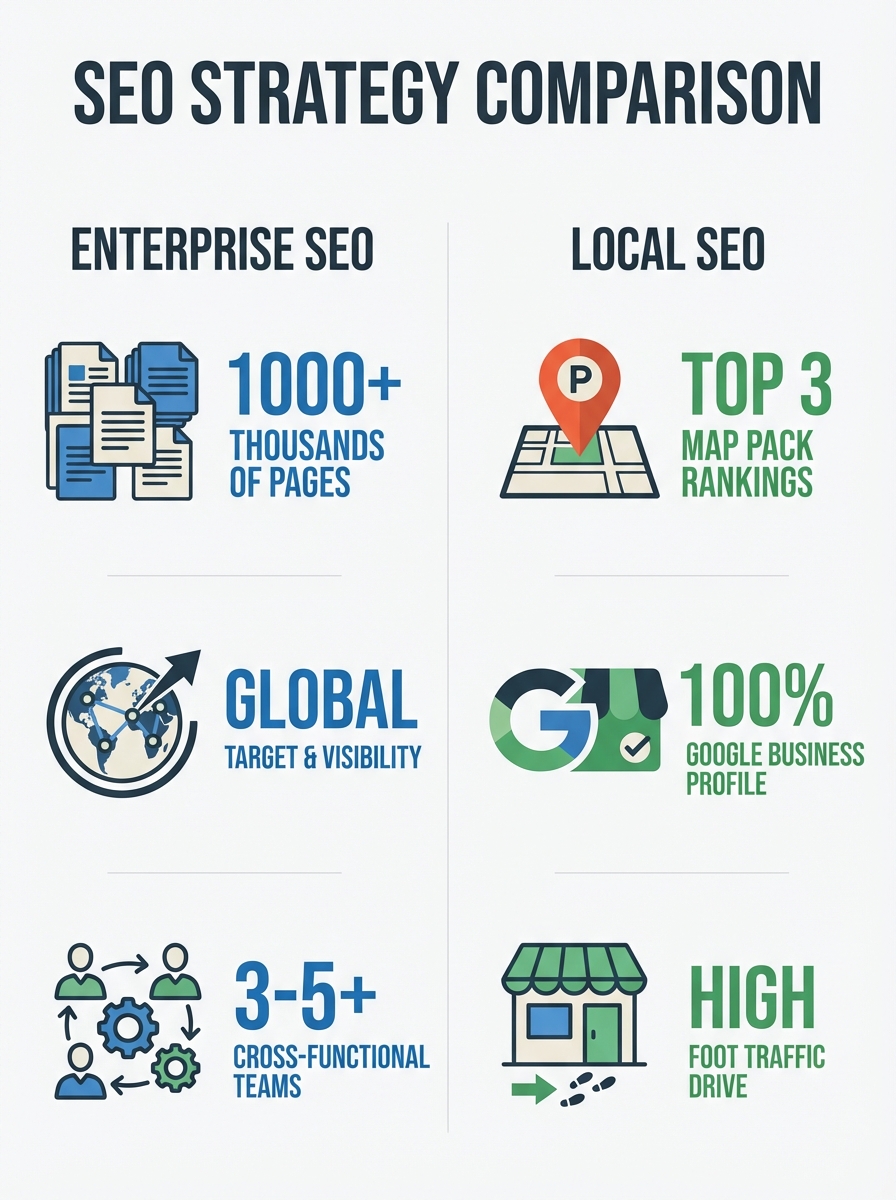
Enterprise SEO vs. Local SEO: A Head-to-Head Comparison That Actually Matters
Enterprise SEO and local SEO are often mistaken for the same discipline at different scales. After spending years building search strategies for both a 12,000-page SaaS platform and a chain of 45 dental offices, I can tell you the mental models are fundamentally different. The tools overlap. The metrics overlap. But the way you think about problems, allocate resources, and measure success couldn't be more distinct. Conflating the two is how companies burn through budgets while their organic visibility flatlines.
This comparison isn't academic. It's built from watching real teams struggle when they apply an enterprise SEO strategy to a local business, or worse, try to run local SEO tactics on a site with tens of thousands of pages. Both fail spectacularly. So let me break down what actually matters in each discipline, where they converge, and how to pick the right approach for your situation.
What We're Actually Talking About
Before getting into the weeds, let's clarify scope. Enterprise SEO is the practice of scaling organic search across massive websites, typically those with thousands or millions of pages, multiple product lines, and often international reach. According to enterprise SEO pricing research from SEOProfy, 55% of enterprise-level companies invest over $20,000 per month in SEO alone. That number tells you something about the operational weight involved.
Local SEO, by contrast, is about showing up when someone nearby searches for what you offer. As Backlinko's local SEO guide puts it, when someone searches "barber Boston," the goal is to appear in those results with your Google Business Profile, local pack listing, and location-specific pages. The budget is smaller. The surface area is smaller. But the precision required is surgical.
Where things get interesting is the space between these two: multi-location optimization. A restaurant chain with 200 locations. A healthcare system with clinics in 30 cities. These organizations need both disciplines simultaneously, and that's where most strategies fall apart.
The Strategic Differences That Actually Matter
Content: Depth Clusters vs. Service Pages
Enterprise content strategy in 2026 revolves around topical authority. You're not just publishing pages. You're building interconnected clusters of content that signal deep expertise in a subject area. If you're an enterprise software company, you don't write one blog post about data governance. You build a cluster of 15-20 pieces covering every angle, from compliance frameworks to implementation guides to case studies. As HawkSEM's enterprise SEO breakdown explains, if the intent behind a keyword is informational, you target it with top-of-funnel content. If it's transactional, you point it at product pages. Matching intent at scale is the game.
Local SEO content looks nothing like this. You need fewer pages, but each one has to be hyper-relevant to a specific geography and service. Think "emergency plumber in Greenville SC" rather than "plumbing best practices." The shift toward quality over quantity is especially pronounced here. Frequent edits to your core business information can actually trigger re-verification loops in Google Business Profile, which tanks your visibility during the review period.
Technical Foundation: Crawl Budget vs. NAP Consistency
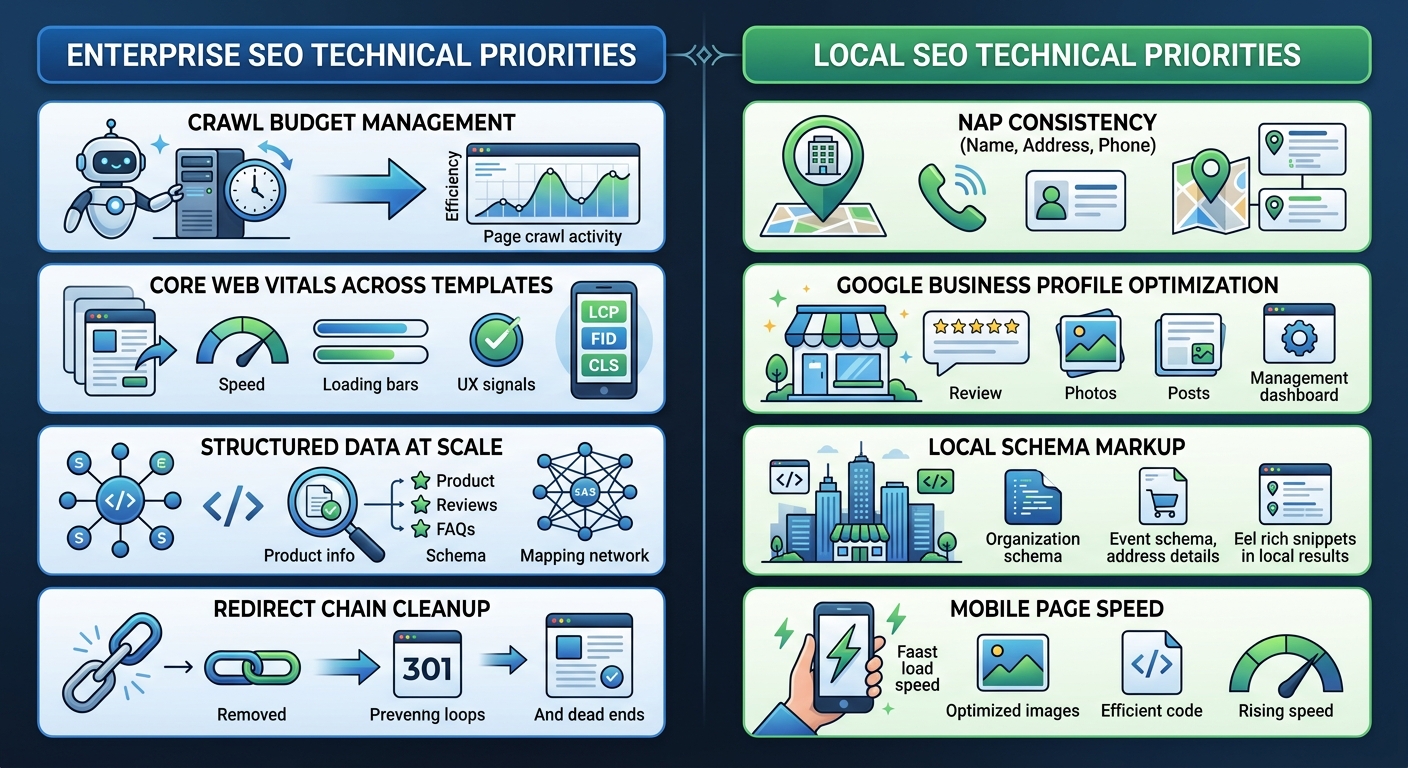
The technical problems at enterprise scale are fundamentally different from local. On a site with 50,000 pages, crawl budget is a real constraint. If you've got misconfigured redirects, orphaned pages, or thousands of thin templated URLs, Googlebot wastes its time on junk instead of indexing your high-value content. Core Web Vitals performance across every template type matters. Structured data needs to be deployed systematically, not page by page. This is where enterprise-focused crawl tools like DeepCrawl earn their keep over lighter-weight alternatives.
For local SEO, the technical foundation is simpler but unforgiving in its own way. NAP consistency (name, address, phone number) across every directory, citation source, and your own website is table stakes. One wrong phone number on Yelp can create a trust gap that AI systems pick up on. Mobile optimization matters even more here than in enterprise, because the vast majority of "near me" searches happen on phones. You also need proper local schema markup on your location pages so search engines can parse your business details accurately.
Team Structure: Cross-Functional vs. Focused
Here's something that caught me off guard when I transitioned from local to enterprise work. Enterprise SEO isn't really a marketing function. It's an organizational coordination problem. Search Engine Journal's piece on enterprise SEO operating models nails it: visibility depends on development, content, product, UX, legal, and localization teams working together, similar to a professional sports team. Your SEO recommendations are worthless if you can't get engineering to prioritize a crawl fix over their product roadmap. The SEO lead at an enterprise company spends more time in cross-functional meetings than they do in keyword research tools.
Local SEO teams are typically lean. One or two people can manage the SEO for a single-location business or even a small multi-location chain. The bottleneck isn't organizational politics. It's execution consistency: keeping reviews flowing, updating seasonal hours, posting to GBP regularly, and monitoring local rankings across target zip codes.
Where AI Changed the Equation
Both enterprise and local SEO have been reshaped by AI-driven search features, but in very different ways.
On the enterprise side, Google's AI Overviews now appear in roughly a quarter of U.S. searches, and the percentage climbs significantly for long-tail informational queries. That means even if you rank number one organically, an AI-generated summary might answer the user's question before they ever click through to your site. Enterprise teams now have to optimize for citation within those AI overviews. That means clear entity definitions, direct answers positioned early in content, and structured FAQ sections that AI can extract from.
If you're thinking about how recent algorithm changes affect your approach, understanding how to audit your site after a core update is critical for enterprise sites where a single ranking shift can move millions of dollars in revenue.
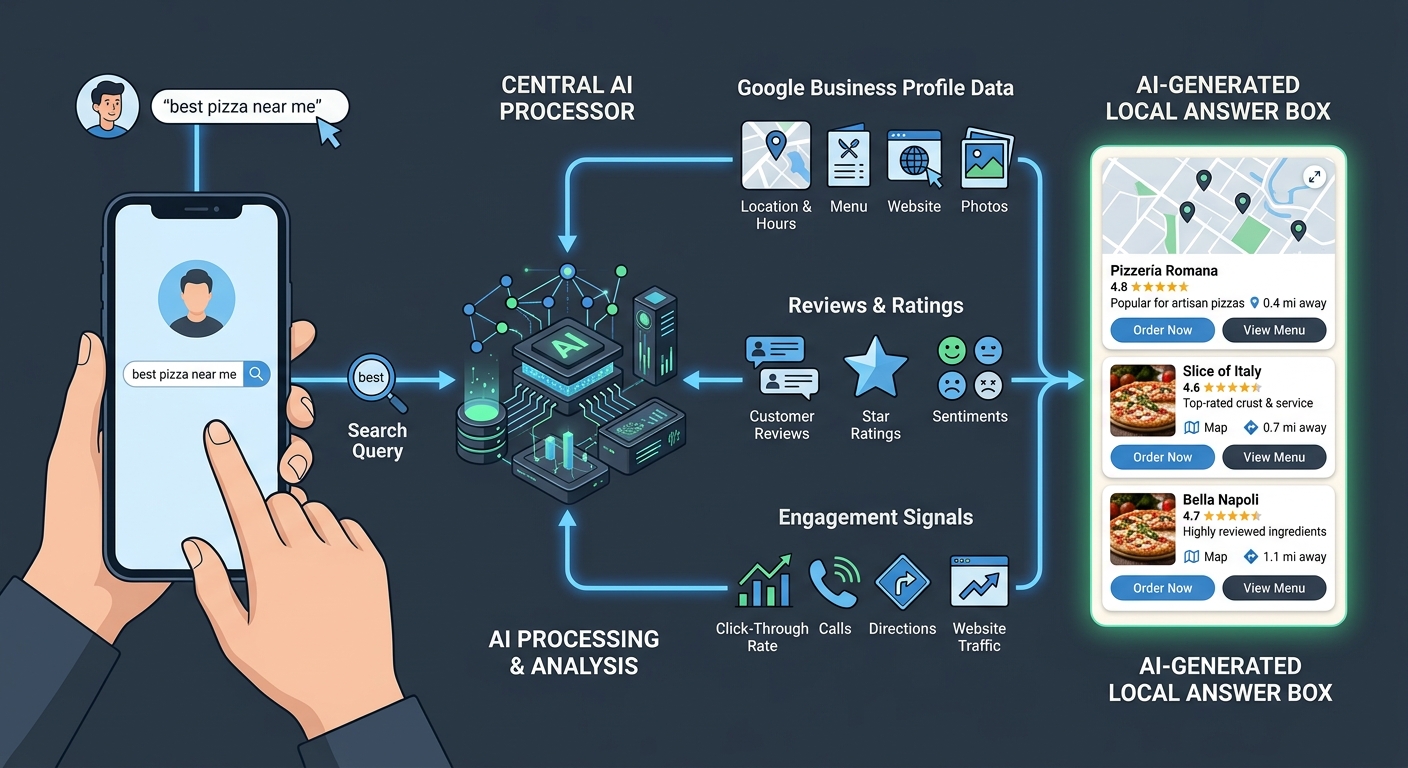
For local businesses, AI shows up differently. AI-generated local answer boxes are becoming the front door to discovery for service-based queries. Your Google Business Profile data needs to be impeccable because that's what feeds these answers. Real customer signals like calls, direction requests, and photo uploads carry enormous weight here. They're the hardest signals to fake, which is exactly why AI systems trust them.
The role of AI in SEO workflows has expanded dramatically for both camps. Enterprise teams use AI for content drafts, anomaly detection in crawl data, and schema generation. Local teams use it for review response drafting and GBP post creation. But in both cases, original insights, real data, and authentic customer experiences are what sustain rankings. AI-generated content without a human perspective gets filtered out faster than ever.
The Multi-Location Problem
This is where things get genuinely hard, and it's where I see the most wasted money. Multi-location optimization sits in the uncomfortable middle ground between enterprise and local SEO. You need the operational rigor and SEO scalability of enterprise thinking, but the geographic precision of local tactics.
Managing thousands of location pages, Google Business Profiles, local citations, and regional landing pages across cities or countries creates significant operational and technical complexity. Manual processes simply break down at this scale. You need automated workflows for bulk GBP updates, citation management, and local ranking monitoring across every target market.
But automation introduces its own risks. Bulk-update a category across 500 GBP listings and you might trigger mass re-verification. Push templated content to hundreds of location pages and you create a thin content problem that hurts crawl efficiency. The organizations that do this well treat each location page as a legitimate piece of content with unique elements: local staff bios, neighborhood-specific details, genuine customer testimonials from that area.
Here's a practical framework for deciding your approach:
Single location: Pure local SEO. Invest in GBP optimization, review generation, and a small set of high-quality service pages targeting local keywords.
2-20 locations: Local SEO with light systematization. Use a single tool for GBP management, create unique location pages, and build local backlinks for each area.
20-100 locations: Hybrid approach. You need some enterprise tooling for crawl management and content operations, but your local SEO tactics stay hands-on per market.
100+ locations: Full enterprise SEO infrastructure with local SEO execution embedded. Automated workflows, centralized content governance, and dedicated local SEO specialists for key markets.
Measurement: Different Dashboards, Different Decisions
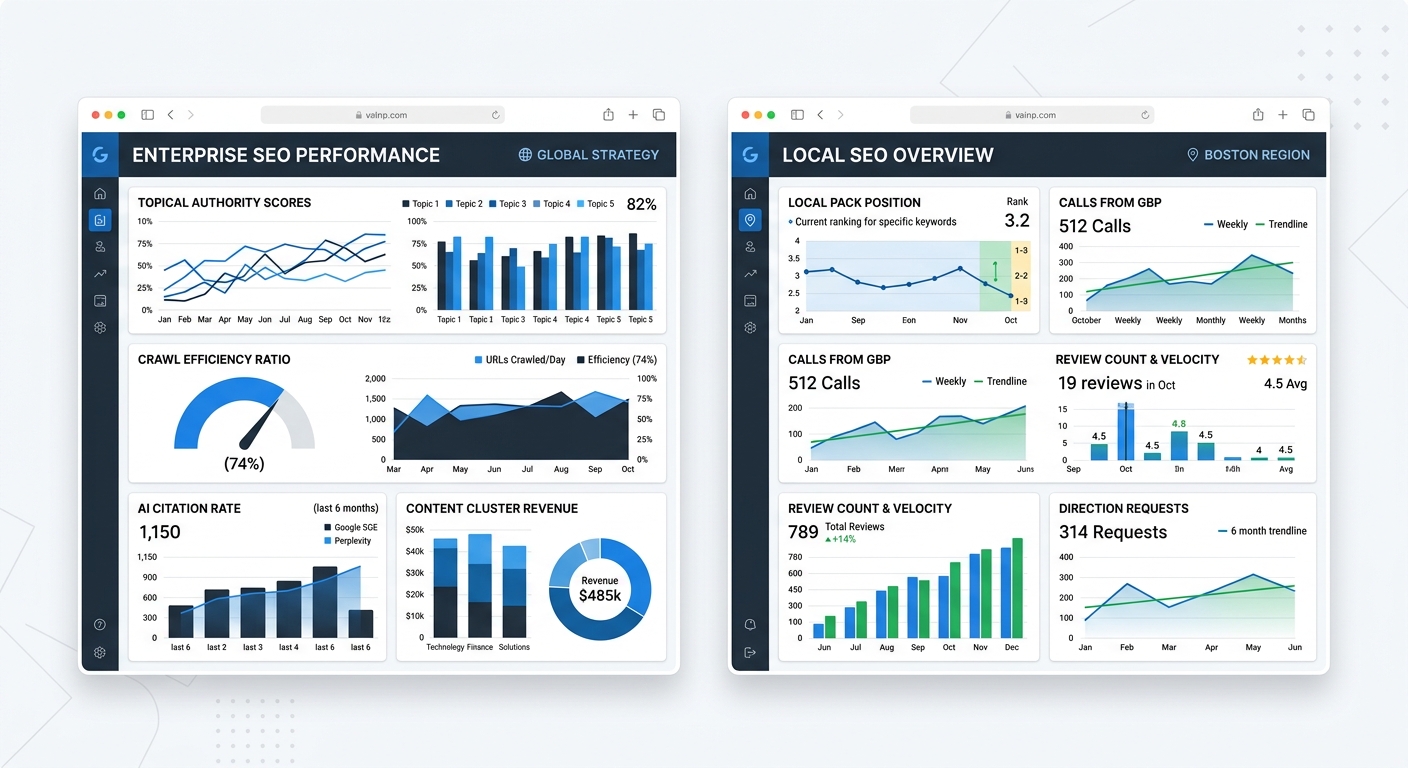
Enterprise SEO teams have moved well beyond tracking keyword rankings and organic traffic as primary metrics. The sophisticated ones track qualified demand, conversion depth across content types, crawl efficiency ratios, and increasingly, AI citation rates. When your site has 50,000 pages, knowing that "organic traffic went up 8%" tells you almost nothing. You need to know which content clusters are driving revenue, which templates are wasting crawl budget, and whether your structured data is getting picked up by AI overviews.
According to Indeed's enterprise SEO strategy guide, maintaining page authority on older content is just as important as creating new content. Regular audits to ensure existing pages still comply with the latest best practices and contain accurate information are a core enterprise activity. Content decay is a real problem when you have thousands of pages aging simultaneously.
Local SEO measurement is more tangible. You're tracking customer actions: calls, direction requests, form submissions, and bookings. Review velocity matters. Local pack position across your target keywords matters. Setmore's guide to local SEO tactics emphasizes optimizing for hyper-specific local keywords like "Thai massage Belmont St" because that's how customers actually search.
As Search Engine Land's enterprise SEO guide recommends, getting your team into the habit of documenting processes every time they do something new is essential for maintaining consistency at scale. Enterprise sites produce more content more regularly, and without documented workflows, quality inevitably degrades.
Which Approach Fits Your Business Model
The decision between enterprise and local SEO isn't really a choice. It's determined by your business model. But here's where I see teams go wrong: they pick the wrong execution model for their actual scale.
A 15-location regional business doesn't need an enterprise SEO platform that costs $5,000 a month. They need solid local SEO fundamentals applied consistently. Conversely, a SaaS company with 30,000 pages doesn't need someone optimizing their Google Business Profile. They need a technical SEO team embedded with engineering and a content operation that builds topical authority systematically.
The organizations winning at search right now share one trait regardless of which discipline they practice: they treat SEO as a trust-building exercise, not a traffic-acquisition hack. For enterprise, trust means demonstrating genuine expertise through deep, well-structured content that AI systems want to reference. For local, trust means consistent business information, authentic customer engagement, and stable signals that both humans and algorithms can rely on.
Stop thinking about enterprise and local SEO as two sizes of the same thing. Start thinking about them as two different sports that happen to be played on the same field. Your playbook should match the game you're actually in.
Marcus Webb
Digital marketing consultant and agency review specialist. With 12 years in the SEO industry, Marcus has worked with agencies of all sizes and brings an insider perspective to agency evaluations and selection strategies.
Frequently Asked Questions
- What is the difference between enterprise SEO and local SEO?
- Enterprise SEO involves scaling organic search across massive websites with thousands or millions of pages and often international reach, while local SEO focuses on appearing in search results for nearby customers searching for specific services, like "barber Boston." The mental models, resource allocation, and measurement approaches are fundamentally different between the two disciplines.
- How much do enterprise companies spend on SEO?
- According to enterprise SEO pricing research, 55% of enterprise-level companies invest over $20,000 per month in SEO alone, reflecting the significant operational complexity involved in scaling search visibility across large websites.
- What is the best content strategy for enterprise SEO in 2026?
- Enterprise SEO in 2026 focuses on building topical authority through interconnected clusters of 15-20+ related content pieces that signal deep expertise, rather than individual pages. The strategy matches search intent—informational keywords target top-of-funnel content while transactional keywords point to product pages—and aims to become a source that AI systems want to cite.
- Why is NAP consistency important for local SEO?
- NAP (name, address, phone number) consistency across directories, citations, and your website is critical for local SEO because even one wrong phone number can create a trust gap that AI systems detect. This directly impacts your visibility in local search results and business listings.
- How many locations should I have before switching to enterprise SEO infrastructure?
- You should consider full enterprise SEO infrastructure with local SEO execution embedded once you reach 100+ locations, using automated workflows and centralized content governance. Below 100 locations, a hybrid approach works better, with local SEO tactics remaining hands-on per market.
- What metrics should enterprise SEO teams track?
- Enterprise SEO teams should track qualified demand, conversion depth across content types, crawl efficiency ratios, and AI citation rates rather than just keyword rankings and traffic volume. Content decay management and page authority maintenance on older content are equally important as creating new content.
- How has AI changed local SEO strategy?
- AI-generated local answer boxes are becoming the primary discovery method for service-based queries, making Google Business Profile data quality critical since it feeds these answers. Real customer signals like calls, direction requests, and photo uploads carry enormous weight because they're hard to fake and trusted by AI systems.
- What is multi-location optimization and why is it challenging?
- Multi-location optimization manages location pages, Google Business Profiles, citations, and regional landing pages across multiple cities or countries, requiring both enterprise-level operational rigor and local geographic precision. It's challenging because manual processes break down at scale, yet automation can trigger mass re-verification issues or create thin content problems.
Explore more topics