
The SEO Agency Selection Checklist: 7 Critical Evaluation Criteria Beyond Case Studies
I once hired an SEO agency with a portfolio so impressive it could make you weep. Gorgeous traffic graphs, hockey-stick revenue charts, glowing client logos from brands you'd recognize.
 Marcus Webb··8 min read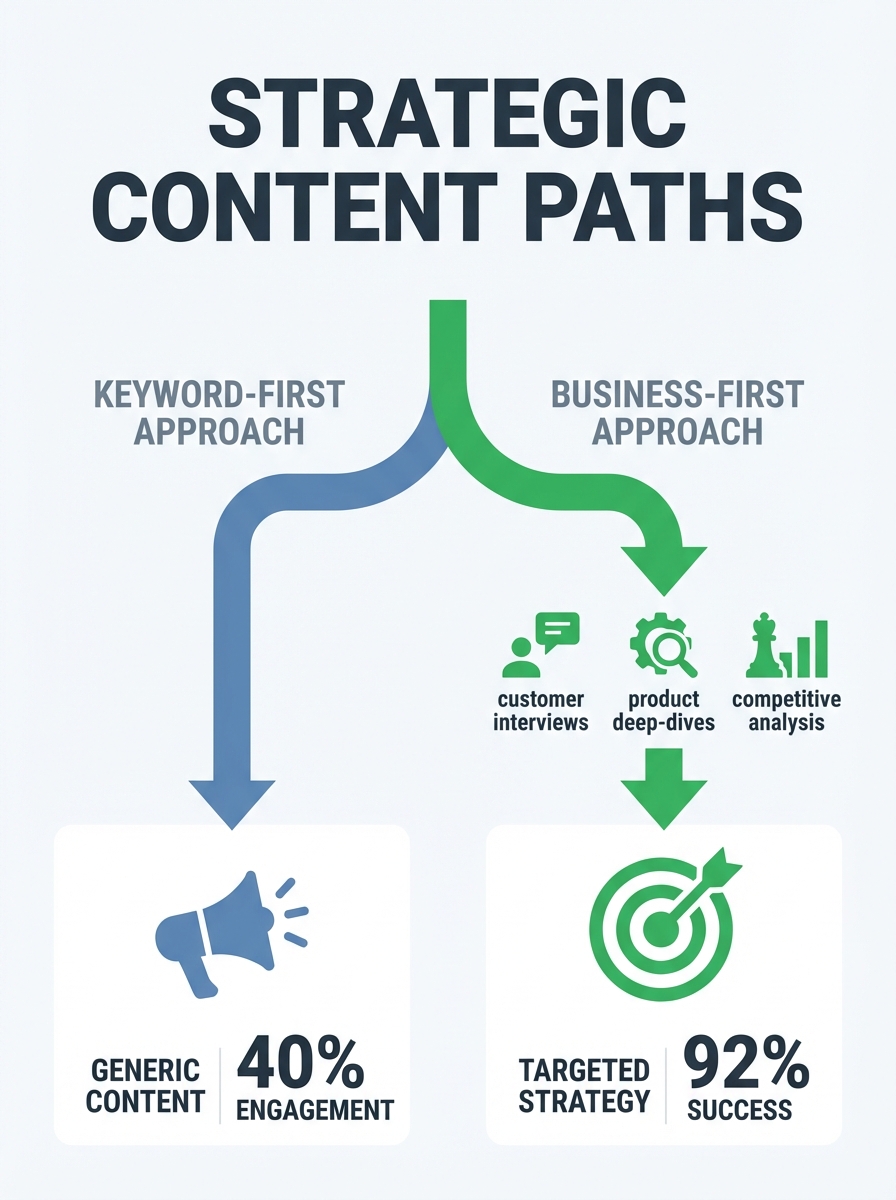
The SEO Agency Selection Checklist: 7 Critical Evaluation Criteria Beyond Case Studies
I once hired an SEO agency with a portfolio so impressive it could make you weep. Gorgeous traffic graphs, hockey-stick revenue charts, glowing client logos from brands you'd recognize. Three months in, I realized their "strategy" for our account was recycled blog posts and a shared backlink vendor they used for every client. The case studies were real. The work behind them just wasn't repeatable, and it definitely wasn't tailored to us.
That expensive mistake taught me something: case studies are marketing materials, not proof of future performance. Every agency has its highlight reel. What separates the genuinely capable from the well-packaged is a set of criteria most buyers never think to evaluate. After years of hiring, firing, and occasionally being pleasantly surprised by agencies, I've built a checklist that goes deeper than portfolio reviews. Here are the seven criteria I'd bet money on.
1. How They Learn Your Business (Not Just Your Keywords)
The first question I ask any prospective SEO partner has nothing to do with SEO: "Walk me through how you'd learn our product well enough to write about it." The answer tells you everything.
Mediocre agencies start with keyword research tools. They'll pull a list of high-volume terms, map them to pages, and call it a strategy. Better agencies start with your business. As Grow and Convert points out in their agency selection guide, you want a team that has a documented process for understanding your product's differentiators through customer interviews, sales call reviews, and conversations with your subject matter experts.
Ask these specific questions during the pitch:
Do you interview our customers or sales team before creating content briefs?
How do you ensure technical accuracy when writing about topics outside your expertise?
Can you show me a content brief from a client in a complex industry?
An agency that skips the learning phase will produce content that reads like it was written by someone who Googled the topic for twenty minutes. Because it was. And with AI tools now capable of generating that same surface-level content instantly, the bar for human-created SEO content has moved significantly higher. We've explored how AI is reshaping agency workflows in detail before, and the takeaway is clear: AI should accelerate research, not replace it.
2. Transparency in Reporting (and What They Choose to Measure)
Reporting frequency is easy to evaluate. Reporting quality is harder. Most agencies will promise monthly reports, and most of those reports will be dense PDFs full of keyword position tables and traffic charts that look busy but say very little about business impact.
Here's my rule: if an agency's sample report doesn't connect SEO activity to revenue-adjacent metrics, they're reporting on effort, not outcomes. The Forbes Business Council recommends evaluating whether an agency's KPIs are specific to your goals, not just generic SEO benchmarks. That means asking what a report actually covers. Organic traffic is table stakes. You want to see:
Conversion rates segmented by organic landing page
Revenue or pipeline influence attributed to organic search
Content performance tied to specific business objectives
Technical health trends over time, not just one-time audits
The Arkansas Small Business and Technology Development Center makes the point well: transparency and understanding are central to any successful agency partnership. You should receive detailed insights into traffic sources and growth opportunities, not just a dashboard link with no context.
A good agency will also proactively tell you when something isn't working. If every monthly check-in is sunshine and progress, someone's hiding bad news.
3. Their Technical SEO Depth (Beyond the Basics)
Every agency claims technical SEO expertise. Few can demonstrate it under pressure. I've found that asking one pointed question separates the pretenders from the practitioners: "What's your approach to structured data, and how do you decide which schema types to implement?"
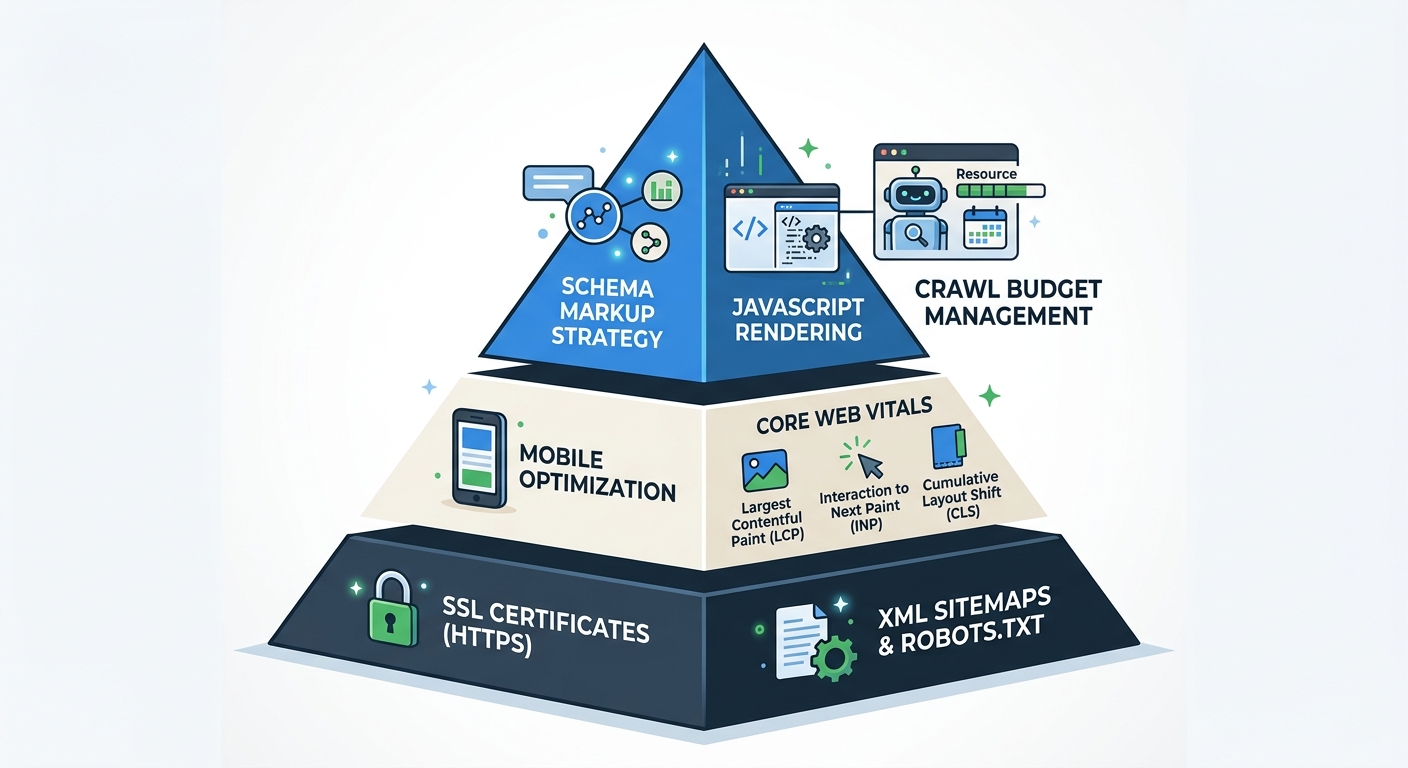
Technical SEO in 2026 goes well beyond SSL certificates and XML sitemaps. Those are prerequisites, not differentiators. With AI-powered search results pulling structured information directly from pages, the correct implementation of schema markup for FAQs, how-to content, product data, and article metadata has become a genuine competitive advantage. According to Common Ground's assessment framework, the correct deployment of structured markup and technical fundamentals remains a critical measure of agency competence.
What you should probe for:
Can they explain their crawl budget optimization approach for large sites?
Do they have experience with JavaScript rendering issues and how search engines process client-side content?
How do they handle international SEO architecture, if relevant to your business?
What's their process for diagnosing and fixing Core Web Vitals regressions?
The difference between enterprise-scale SEO and local SEO is massive when it comes to technical complexity. An agency that's only worked with small WordPress sites will drown when faced with a headless CMS, multiple CDN layers, or a site with 500,000 indexed pages. Match their technical ceiling to your technical reality.
4. Content Quality Standards and Production Process
Content is where most agency relationships quietly fail. Not because the agency can't write, but because they can't write well enough about your specific subject to earn trust from your audience. And if your audience doesn't trust the content, neither will search engines evaluating E-E-A-T signals.
When you're figuring out how to choose an SEO agency, spend serious time evaluating their content operation. As one professional SEO services checklist highlights, relevant, high-quality, and engaging content plays a critical role in SEO success. That sounds obvious. Putting it into practice is where agencies diverge.
Ask to see three pieces of content they've produced for clients in technical or specialized industries. Then ask yourself:
Would an expert in this field find this accurate and useful?
Does it say something a competitor's blog doesn't?
Is there evidence of original insight, data, or expert input?
If the content reads like a well-organized Wikipedia summary, it's not going to perform. Google's emphasis on experience and expertise means content needs a genuine point of view. The best agencies I've worked with build editorial workflows that include subject matter expert interviews, fact-checking steps, and revision cycles that go beyond surface-level grammar checks.
Content velocity matters too. An agency producing two blog posts per month when your competitive landscape demands ten is going to leave you behind. But speed without quality is just expensive noise. Push them to explain how they maintain standards at scale.
5. Their Approach to Algorithm Volatility
Google shipped multiple core updates throughout the past year, and each one reshuffled rankings for millions of sites. Your agency's reaction to these events tells you whether they're strategic thinkers or firefighters.
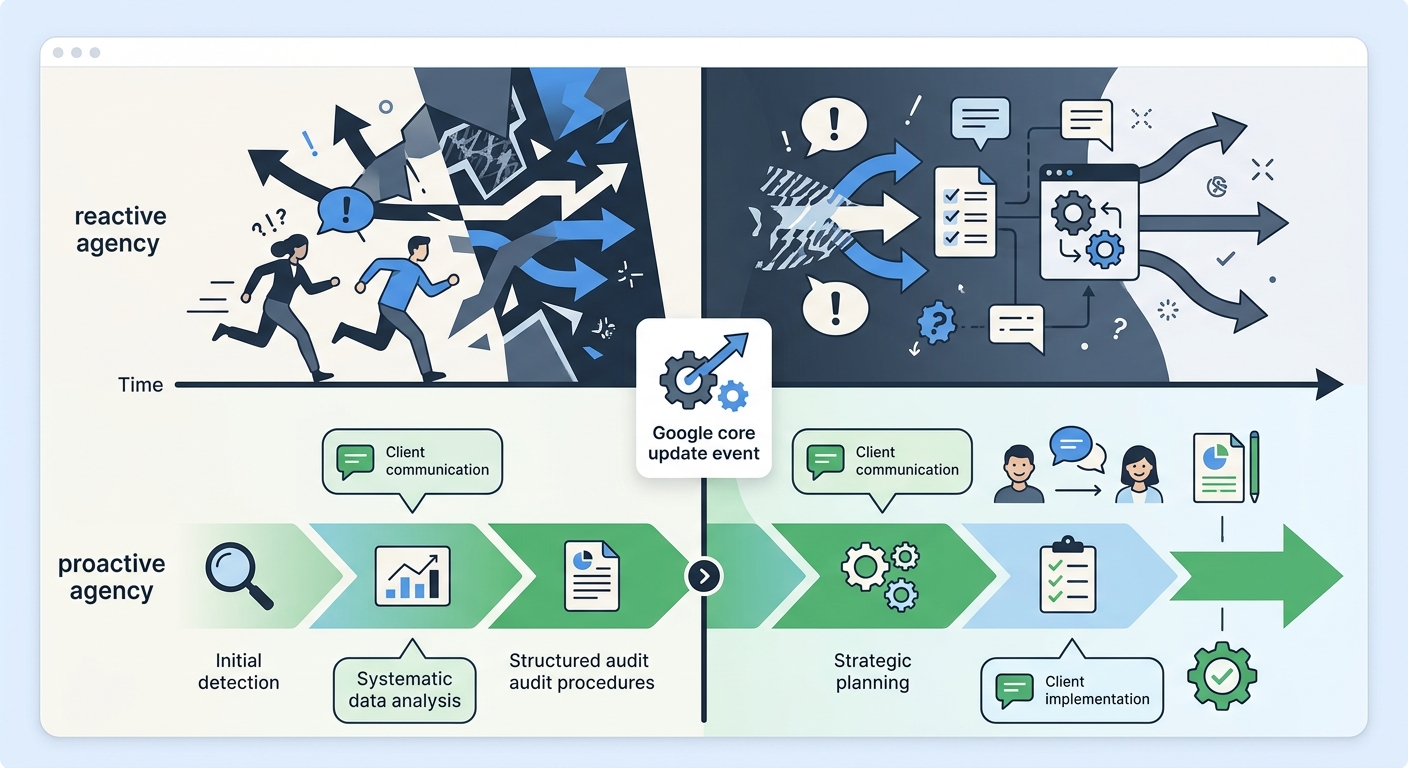
When I evaluate agencies, I ask: "Walk me through how you handled the most recent core update for your clients." The answer should include a structured audit process, not just "we monitored rankings." If you want to understand how a proper core update audit works, the process involves analyzing content quality signals, backlink profile shifts, and SERP feature changes in a systematic way.
Strong agencies will have a documented playbook for algorithm changes. It should cover:
An initial impact assessment within the first 48-72 hours
A prioritized action plan based on which pages or sections were affected
Communication to clients within a defined timeframe, even if the news is "we're still analyzing"
A historical record of past update responses and outcomes
Weak agencies will tell you "the algorithm always fluctuates" and advise you to wait it out. Sometimes waiting is correct. But an agency that can't articulate why waiting is the right call in a specific situation doesn't understand the update well enough to make that judgment.
6. Pricing Structure and What It Actually Includes
SEO pricing is famously opaque, and agencies like it that way. Some charge flat monthly retainers. Others bill hourly. Some separate strategy from execution. A few bury link building costs in vague "off-page optimization" line items. Your agency selection framework needs to cut through this.
Here's what I've learned the hard way: the cheapest agency is almost never the cheapest option. A $2,000/month retainer that produces thin content and low-quality backlinks will cost you far more in lost time and potential penalties than a $6,000/month partner who moves the needle.
When evaluating pricing, demand a scope breakdown:
How many hours per month are allocated to your account?
Who specifically will work on your account, and what's their experience level?
Are content production costs included, or billed separately?
What's the link acquisition strategy, and is it ethical?
Are there setup fees, tool costs, or other charges beyond the retainer?
SeeResponse's agency selection tips emphasize the importance of customized strategies and measurable results over generic promises. Pricing should reflect the complexity of your situation. An agency offering the same package to a local dentist and a national SaaS company either isn't doing real strategy work, or is dramatically overcharging one of those clients.
Also pay attention to contract terms. Month-to-month arrangements with a 30-day notice period signal confidence. A 12-month lock-in with steep early termination fees signals an agency that knows clients would leave if they could.
7. Cultural Fit and Communication Cadence
This one feels soft, but it's quietly the most important factor in long-term success. SEO is a slow discipline. Results take months. During those months, your agency relationship will be tested by ambiguity, setbacks, and the inevitable "why isn't this working yet?" conversation.
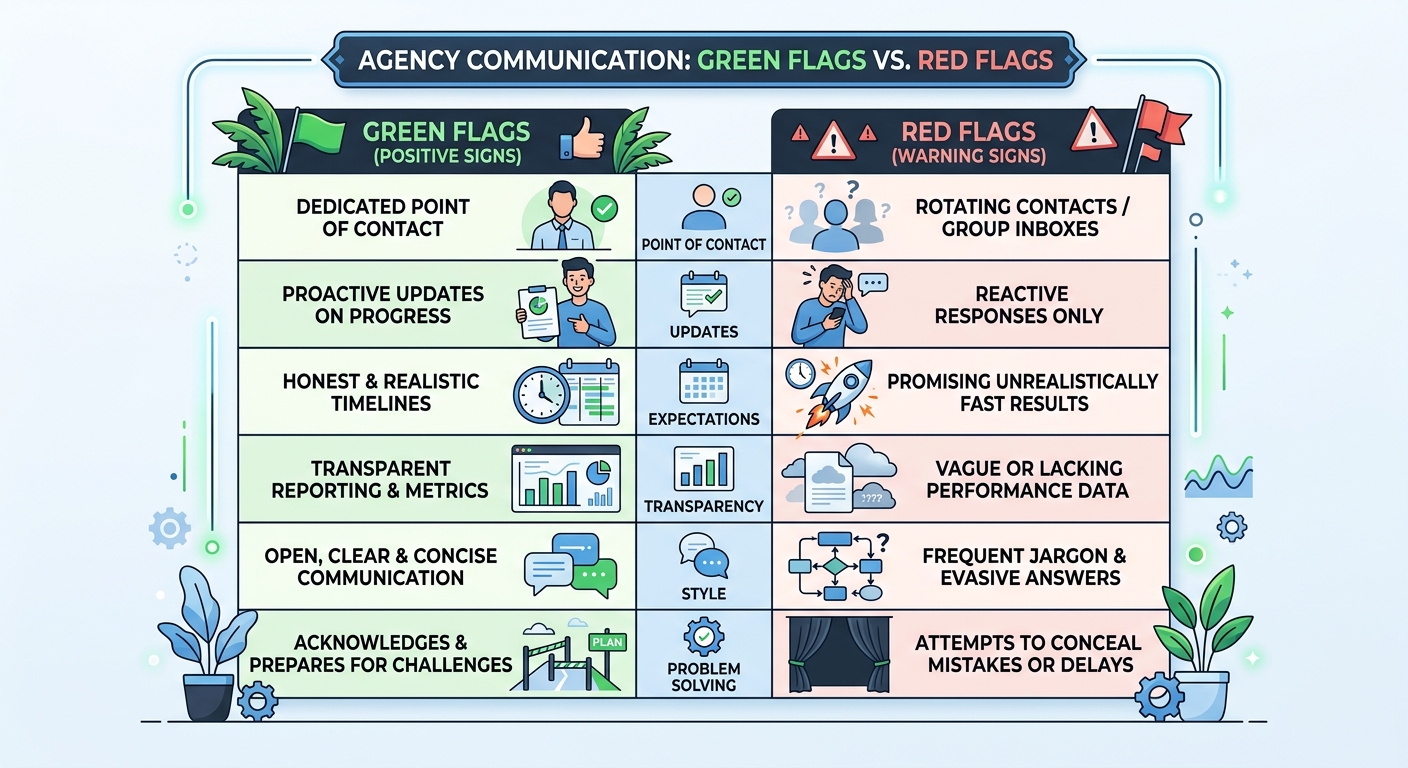
The agency's communication style during the sales process is a preview of how they'll communicate during the engagement. Are they responsive to emails within a reasonable timeframe? Do they ask thoughtful follow-up questions? Do they push back on unrealistic expectations, or do they agree to everything to close the deal?
I specifically look for agencies that:
Assign a dedicated account manager, not a rotating cast of junior staff
Schedule regular check-ins with a set agenda, not ad-hoc calls when problems arise
Proactively share industry updates or competitive intelligence
Disagree with me when I'm wrong, and can explain why
An evaluation framework from XAgency identifies cultural fit alongside proven results, strategic approach, and fair pricing as key selection criteria. I'd go further: cultural misalignment kills more agency relationships than poor performance does. If your team moves fast and expects direct communication, a buttoned-up agency that takes three days to return emails will drive you mad regardless of their SEO chops.
Putting the Checklist to Work
When you're vetting digital marketing partners, the temptation is to default to whoever has the most impressive case studies or the smoothest pitch. Resist that. Case studies tell you what happened for someone else, in a different market, at a different time, with different resources. Your evaluation needs to focus on the agency's current capabilities, their process rigor, and their ability to adapt to your specific context.
Print this checklist. Bring it to your next agency call. Score each candidate on these seven criteria with a simple 1-5 rating. The agency that scores highest across all seven will almost certainly outperform the one that aced the case study presentation but fumbled the hard questions about process, pricing, and communication.
The best SEO agency for your business isn't the one with the prettiest results deck. It's the one that can explain exactly how they'll earn those results for you, prove they have the systems to do it, and communicate honestly when things don't go according to plan. That combination is rarer than you'd think, and it's worth every dollar when you find it.
Marcus Webb
Digital marketing consultant and agency review specialist. With 12 years in the SEO industry, Marcus has worked with agencies of all sizes and brings an insider perspective to agency evaluations and selection strategies.
Frequently Asked Questions
- What questions should I ask an SEO agency about their content creation process?
- Ask whether they interview customers or sales teams before creating content briefs, how they ensure technical accuracy when writing about unfamiliar topics, and request to see a content brief from a client in a complex industry. The best agencies have a documented process for understanding your product's differentiators through customer interviews, sales call reviews, and conversations with subject matter experts.
- What should a good SEO agency report include?
- Beyond organic traffic, a quality report should show conversion rates segmented by organic landing page, revenue or pipeline influence attributed to organic search, content performance tied to specific business objectives, and technical health trends over time. You should receive detailed insights into traffic sources and growth opportunities, not just a dashboard link or Google Analytics screenshot with no context.
- How should I evaluate an SEO agency's technical SEO expertise?
- Ask pointed questions about their structured data implementation approach, crawl budget optimization for large sites, experience with JavaScript rendering issues, international SEO architecture experience, and their process for diagnosing Core Web Vitals regressions. Match the agency's technical ceiling to your technical reality—an agency experienced only with small WordPress sites may struggle with headless CMS, multiple CDN layers, or sites with hundreds of thousands of indexed pages.
- What red flags should I watch for when choosing an SEO agency?
- Be cautious of agencies that guarantee specific rankings, offer identical packages to businesses of vastly different sizes, have dense reports that don't connect to business impact, can't provide sample reports from existing clients, and take several days to respond to emails. Additionally, avoid agencies that agree to everything without pushing back on unrealistic expectations.
- How should an SEO agency handle Google algorithm updates?
- A strong agency should have a documented playbook that includes an initial impact assessment within 48-72 hours, a prioritized action plan based on affected pages, timely client communication even if still analyzing, and a historical record of past update responses. Weak agencies simply advise waiting without explaining why waiting is the correct strategy for your specific situation.
- What should I look for in SEO agency pricing?
- Demand a scope breakdown that includes hours allocated to your account per month, the experience level of staff assigned, whether content production costs are included, the link acquisition strategy, and any additional fees beyond the retainer. Month-to-month arrangements with 30-day notice signal confidence, while 12-month lock-ins with steep early termination fees suggest an agency knows clients would leave if they could.
- How important is cultural fit when selecting an SEO agency?
- Cultural fit is critical to long-term success because SEO results take months and your agency relationship will be tested by ambiguity and setbacks. Look for agencies that assign a dedicated account manager, schedule regular check-ins with set agendas, proactively share industry updates, and disagree with you when necessary—cultural misalignment kills more agency relationships than poor performance does.
- Why shouldn't I rely only on case studies when evaluating SEO agencies?
- Case studies are marketing materials, not proof of future performance, and tell you what happened for someone else in a different market, at a different time, with different resources. The agency's current capabilities, process rigor, and ability to adapt to your specific context matter far more than their highlight reel results.
Explore more topics