
How to Leverage ChatGPT for SEO Review Analysis: Mining Your Google Reviews for Hidden Keywords and Sentiment Patterns
A plumbing company was spending $2,400 a month on keyword research tools and still missing the phrases their actual customers used. We dumped 600 Google Reviews into ChatGPT, ran five prompts, and found 23 long-tail keyword opportunities that none of their paid tools had surfaced.
 Marcus Webb··8 min read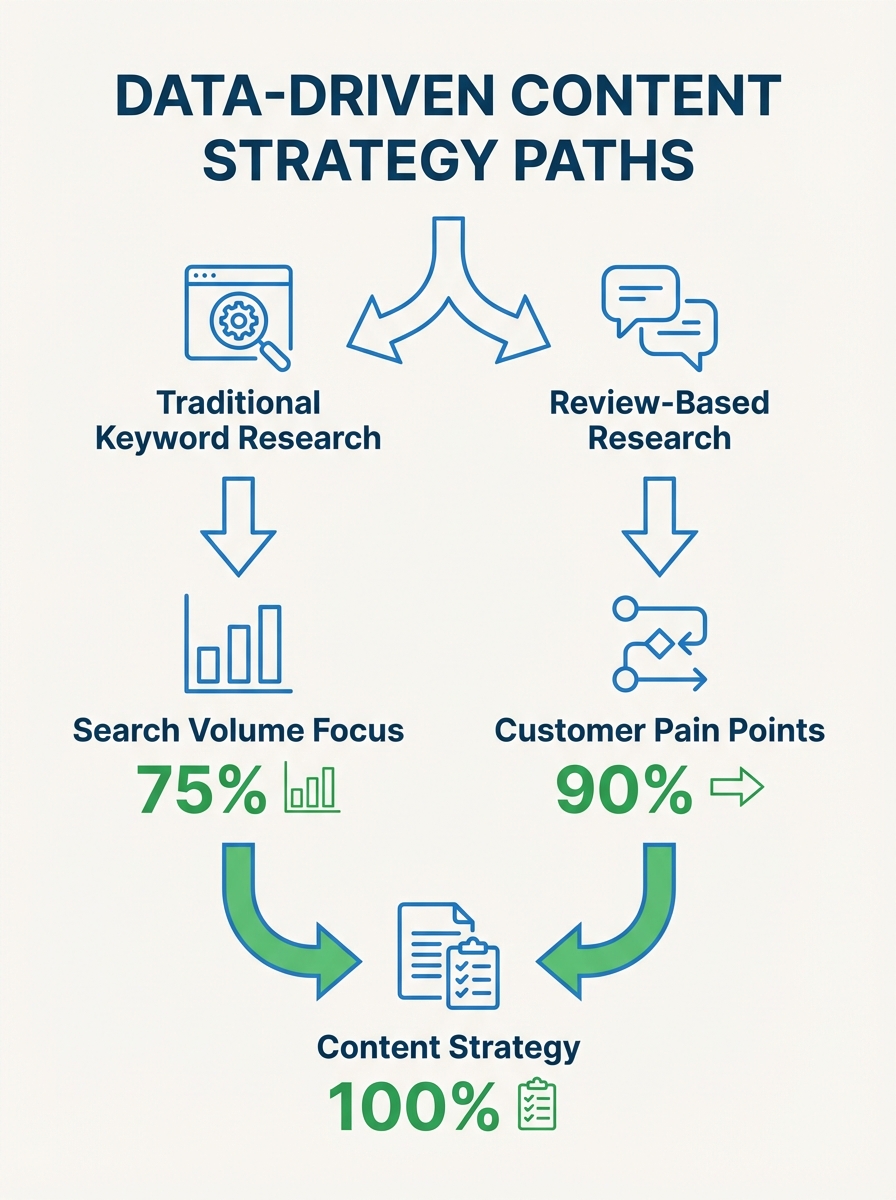
How to Use ChatGPT for SEO Review Analysis: Mining Google Reviews for Hidden Keywords and Sentiment Patterns
A plumbing company was spending $2,400 a month on keyword research tools and still missing the phrases their actual customers used. We dumped 600 Google Reviews into ChatGPT, ran five prompts, and found 23 long-tail keyword opportunities that none of their paid tools had surfaced. One of those phrases, "emergency pipe burst fix same day," now drives 14% of their organic leads. The keywords were hiding in plain sight, written by real people describing real problems in their own words.
That experience changed how I think about review-based keyword research. Your customers are already telling you exactly what they searched for before they found you. You just need a system to extract it.
Why Google Reviews Are an Untapped SEO Goldmine
Reviews contain something far more valuable than a rating: they contain the exact language your target audience uses to describe their problems, expectations, and experiences.
Traditional keyword research starts with seed terms and expands outward using search volume data. That's fine, but it's inherently limited to what tools already know about. Review-based keyword research works in the opposite direction. It starts with unfiltered customer language and works backward to identify search opportunities your competitors haven't mapped.
Think about it. When someone writes "I needed someone who could fix my AC unit on a Sunday without charging me double," they've just handed you a long-tail keyword cluster on a platter. "AC repair Sunday," "weekend AC service no extra charge," "emergency HVAC weekend rates." These are real search queries that real people type into Google, and they're buried in your review data.
The challenge is scale. Reading 500 reviews and manually tagging themes takes hours. That's where ChatGPT comes in, not as a magic solution, but as a very fast text analysis engine that can process patterns humans would miss or take forever to find.
Setting Up Your Review Data for Analysis
Before you touch ChatGPT, you need clean data. Garbage in, garbage out applies here more than anywhere.
Step 1: Export Your Reviews
Google doesn't make this easy natively. You have a few options:
Use the Google Business Profile API to pull review data programmatically
Export through a third-party tool like Grade.us, Birdeye, or even a simple scraping script
Copy and paste manually into a spreadsheet if you have fewer than 200 reviews
For each review, capture the text, star rating, date, and any response you've given. The star rating matters because it lets you segment sentiment analysis later. The date matters because customer language shifts over time, and seasonal patterns show up in reviews more than you'd expect.
Step 2: Clean and Segment
Remove duplicates, spam reviews, and anything that's just a star rating with no text. Then segment into three buckets: positive (4-5 stars), neutral (3 stars), and negative (1-2 stars). Each bucket tells you different things about your SEO opportunity.
If your business is in a competitive local market, export competitor reviews too. Platforms like Yelp and Google show competitor reviews publicly. When you understand how local SEO differs from enterprise SEO, you realize that local SEO reputation data is essentially a free competitive intelligence tool sitting right on the search results page.
The ChatGPT Prompt Framework That Actually Works
I've tested dozens of prompt structures for review analysis. The key is specificity: tell ChatGPT exactly what you want, in what format, and give it enough context to work with.
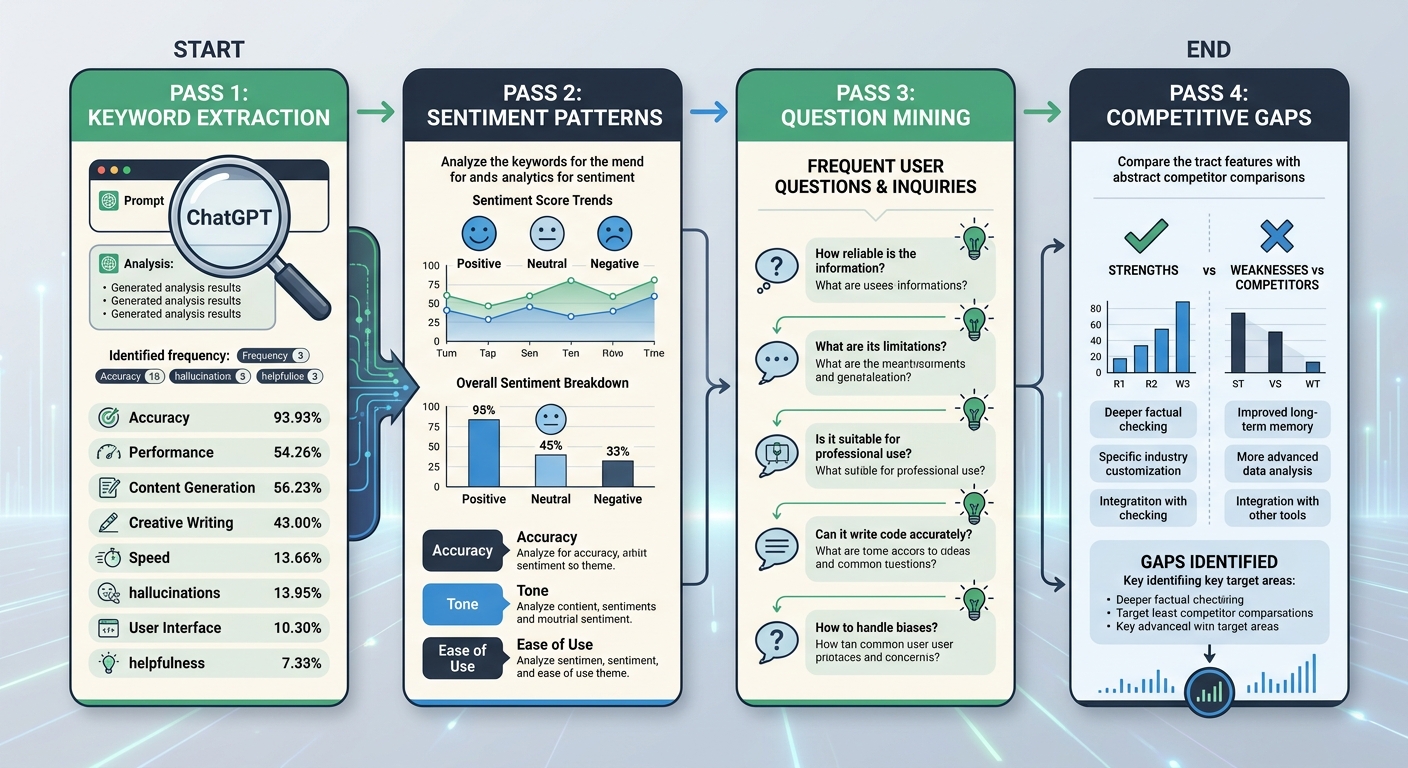
Here's the framework I use, broken into four distinct passes over the same data.
Pass 1: Customer Keyword Extraction
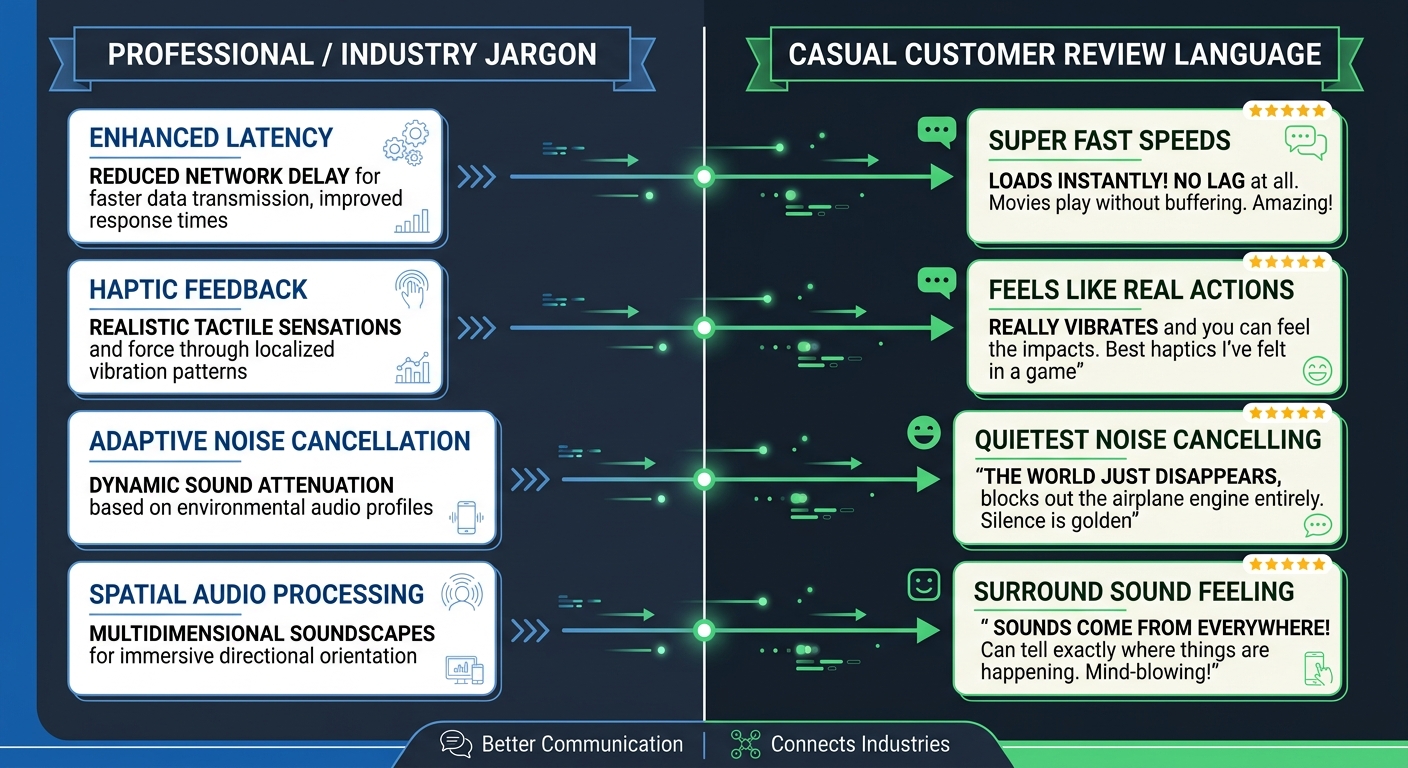
Feed ChatGPT a batch of 50-100 reviews at a time (it handles this volume well within the context window) and ask it to extract noun phrases and problem descriptions. You want it to identify the specific services, products, features, and pain points customers mention using their own words, not industry jargon.
The goal of customer keyword extraction is to build a vocabulary list that reflects how real people talk about your business category. A dentist might call it "endodontic therapy." Patients call it "root canal." Your content needs both, but the patient language is what drives discovery-phase search traffic.
According to keyword research best practices from Exaltus, planning content around the actual questions your ideal customers ask on their path to purchase beats optimizing around generic high-volume terms. Reviews are literally those questions and concerns, written down voluntarily.
Pass 2: Sentiment Pattern Recognition
This is where review sentiment analysis gets interesting. Ask ChatGPT to categorize each review not just as positive or negative, but by the specific attribute being evaluated. A single review often contains multiple sentiments about different aspects of the experience.
As Thematic's guide on review sentiment analysis points out, a phrase like "I love the product, but the service was terrible" contains both positive and negative sentiment. Simpler analysis tools miss this entirely. ChatGPT handles mixed sentiment reasonably well when you explicitly instruct it to break reviews into attribute-level assessments.
Ask it to output a structured table: attribute, sentiment, frequency, and representative quotes. You'll start seeing patterns. Maybe 40% of your positive reviews mention speed of service. Maybe 60% of negative reviews mention communication during the process. These patterns tell you what to emphasize in your content and what operational issues to address.
Pass 3: Question and Intent Mining
Reviews are full of implied questions. "I wish I'd known they don't do weekend appointments" implies someone searched for "weekend appointments near me" before leaving that review. Ask ChatGPT to identify implied search queries from the review text.
This pass is gold for FAQ content, which remains one of the most effective structures for capturing featured snippets and People Also Ask boxes. Writesonic's tested SEO prompts recommend analyzing competitor reviews specifically to uncover FAQ gaps your content can fill. Tell ChatGPT to compare the questions implied in your reviews against the FAQ content already on your website, and it will identify the mismatches.
Pass 4: Competitive Language Gaps
If you've collected competitor reviews, this is where the real differentiation happens. Feed ChatGPT both your reviews and a competitor's, then ask it to identify themes that appear in their negative reviews but your positive ones. Those are your competitive advantages, expressed in customer language.
A restaurant client discovered that competitors consistently received complaints about "wait times for a table on weekends" while their own reviews praised "the reservation system that actually works." That insight shaped an entire local content strategy targeting "restaurant reservations [city name]" and "no-wait dining [neighborhood]."
Turning Analysis Into an Actual SEO Strategy
Extracting data is satisfying. But it's useless without execution. Here's how to convert your ChatGPT review analysis into a ChatGPT SEO strategy that produces measurable results.
Build Content Around Customer Language
Take the keyword clusters from Pass 1 and map them to content types. Problem-awareness keywords become blog posts and guides. Service-specific phrases become landing page copy. Comparison language becomes versus-style content.
The critical insight: don't translate customer language back into industry jargon for your content. If customers say "fix my credit score fast," don't write a page titled "Expedited Credit Remediation Services." Match their vocabulary. Search Engine Land's guide to using ChatGPT for SEO confirms that targeting semantically related terms your customers actually use beats stuffing pages with formal keyword variations.
Restructure Your Site's Information Architecture
When review analysis reveals that customers consistently ask about topics you haven't covered, that's a site architecture problem, not just a content gap. If you're building your site architecture with SEO in mind, the themes emerging from review analysis should map directly to your navigation structure and internal linking.
A home services company discovered through review analysis that "emergency" was the second most common word in their positive reviews, yet they had zero dedicated emergency service pages. Adding those pages, written in the language their reviewers used, increased organic traffic by 31% in four months.
Feed Sentiment Data Back Into Your Operations
This goes beyond SEO, but it matters for SEO indirectly. The SentiSum team's research on review sentiment analysis shows that advanced AI sentiment tools can pinpoint recurring issues and customer pain points with detailed, unbiased tagging. When you fix operational problems that generate negative reviews, your average rating improves. Higher ratings improve click-through rates from local pack results. Better CTR improves rankings. It's a virtuous cycle.
Don't just mine reviews for keywords. Share the sentiment analysis with your operations team so they can fix the things customers complain about.
What ChatGPT Gets Wrong (And How to Compensate)
I'd be irresponsible if I didn't flag the limitations. ChatGPT is a text analysis tool, not an SEO oracle.
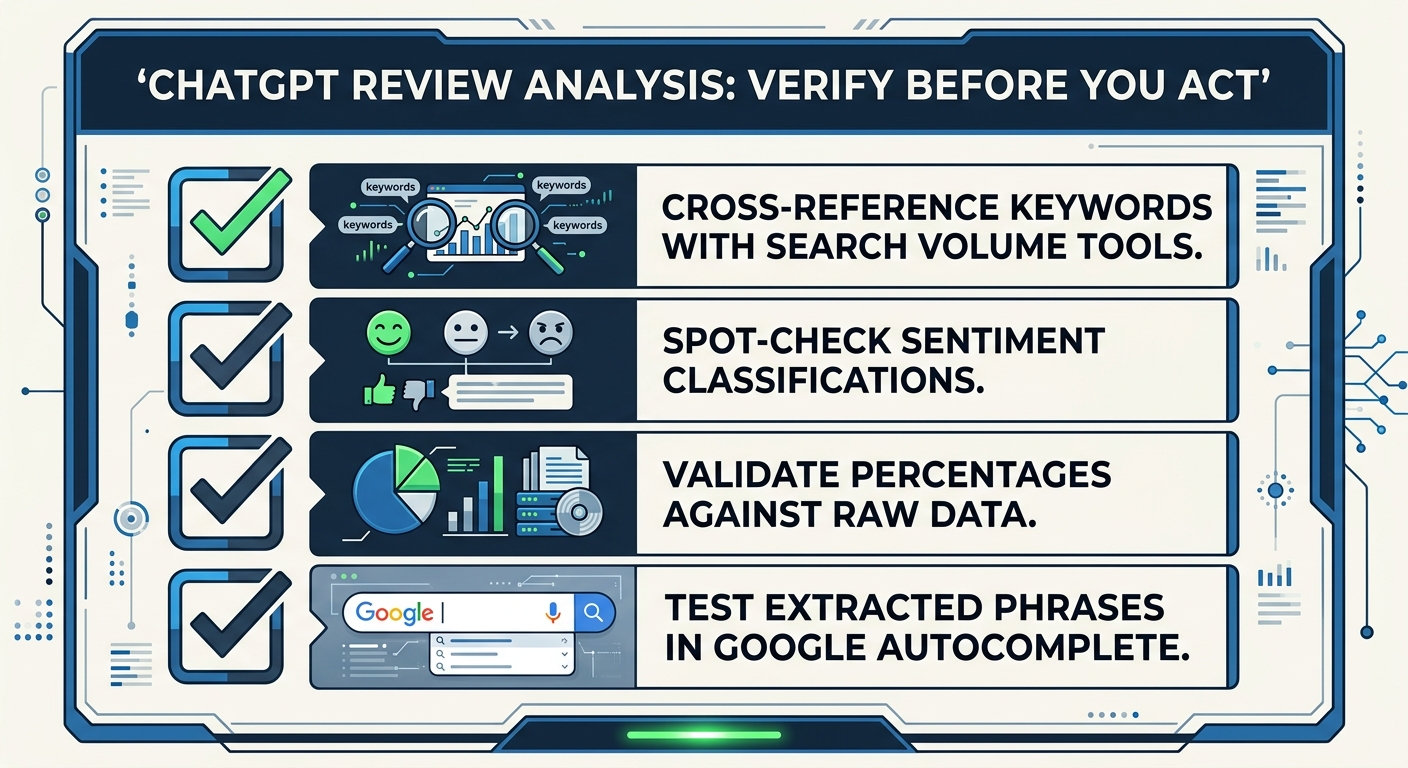
It has no access to real search volume data. A phrase that appears in 50 reviews might get zero monthly searches, or it might get 10,000. You still need to validate extracted keywords against actual search data from Google Search Console, Ahrefs, or similar tools. If you're evaluating which tools belong in your SEO stack, make sure keyword validation tools are part of the mix.
ChatGPT also hallucinates patterns. I've seen it claim that "73% of reviews mention delivery speed" when the actual number was closer to 30%. Always spot-check its quantitative claims against the raw data. Use it for qualitative pattern recognition and theme extraction, then verify any numbers it generates.
The academic literature on sentiment analysis catalogues dozens of known challenges, from sarcasm detection to context-dependent polarity. When a customer writes "Oh great, another week without my order," ChatGPT sometimes reads "great" as positive. Human review of the output isn't optional.
Starting Your Review Analysis Process
If this all sounds like a lot of work, here's the minimum viable version:
Export your 100 most recent Google Reviews into a spreadsheet
Paste them into ChatGPT in batches of 50
Run the keyword extraction prompt (Pass 1) and save the output
Run the sentiment pattern prompt (Pass 2) and save the output
Cross-reference extracted keywords against Google Search Console data to find terms you're already ranking for on page 2 or 3
Create or optimize one piece of content targeting the highest-opportunity keyword cluster
Repeat monthly as new reviews come in
The entire process takes about two hours the first time and 30 minutes for each monthly refresh. For businesses with hundreds of reviews, this approach to mining local SEO reputation data will surface opportunities that no generic keyword tool can replicate, because it's grounded in what your actual customers say about your actual business.
The businesses that understand how AI fits into their SEO workflow without replacing human judgment are the ones pulling ahead right now. Your reviews are a dataset. Treat them like one, and the keywords will follow.
Marcus Webb
Digital marketing consultant and agency review specialist. With 12 years in the SEO industry, Marcus has worked with agencies of all sizes and brings an insider perspective to agency evaluations and selection strategies.
Frequently Asked Questions
- How can I find long-tail keywords from Google reviews?
- Export your Google reviews into ChatGPT in batches of 50-100 and use a keyword extraction prompt to identify noun phrases and problem descriptions customers use. This reveals real search terms your customers typed before finding you, often surfacing long-tail opportunities that paid keyword research tools miss.
- What data should I extract from Google reviews before analyzing them in ChatGPT?
- Capture the review text, star rating, date, and any responses you've given. Then segment reviews into positive (4-5 stars), neutral (3 stars), and negative (1-2 stars) buckets, as each reveals different SEO opportunities and negative reviews often contain the most specific keyword-rich language.
- How can I identify what my competitors' reviews reveal about my advantages?
- Feed ChatGPT both your reviews and competitor reviews, then ask it to identify themes appearing in their negative reviews but your positive ones. These competitive advantages, expressed in customer language, can shape your content strategy and local SEO approach.
- What are the limitations of using ChatGPT for review keyword analysis?
- ChatGPT has no access to real search volume data, so extracted keywords must be validated against Google Search Console or Ahrefs. It can also hallucinate patterns and misread sentiment (like interpreting sarcasm as positive), so human verification of output is essential before publishing any data.
- How should I structure content based on keywords found in customer reviews?
- Map keyword clusters to content types: problem-awareness keywords become blog posts and guides, service-specific phrases become landing page copy, and comparison language becomes versus-style content. Match the vocabulary customers actually use rather than translating it back into industry jargon.
- How often should I analyze my Google reviews for SEO opportunities?
- Run the minimum viable process monthly as new reviews come in. The initial analysis takes about two hours, while monthly refreshes take approximately 30 minutes, making it a sustainable workflow for ongoing keyword discovery.
- Can negative reviews help with SEO keyword research?
- Yes, negative reviews are often the most keyword-rich because unhappy customers tend to be specific about what went wrong, providing detailed language about pain points that can inform content planning and targeting.
Explore more topics