
Post-March 2026 Core Update: How Enterprise Sites Should Prioritize Technical SEO vs. Content Quality in Recovery Strategy
The biggest mistake enterprise SEO teams are making right now is splitting into two camps. One side is scrambling to fix Core Web Vitals. The other is rewriting every piece of content on the site. Both are wasting time because they're treating an integrated problem like two separate ones.
 Marcus Webb··9 min read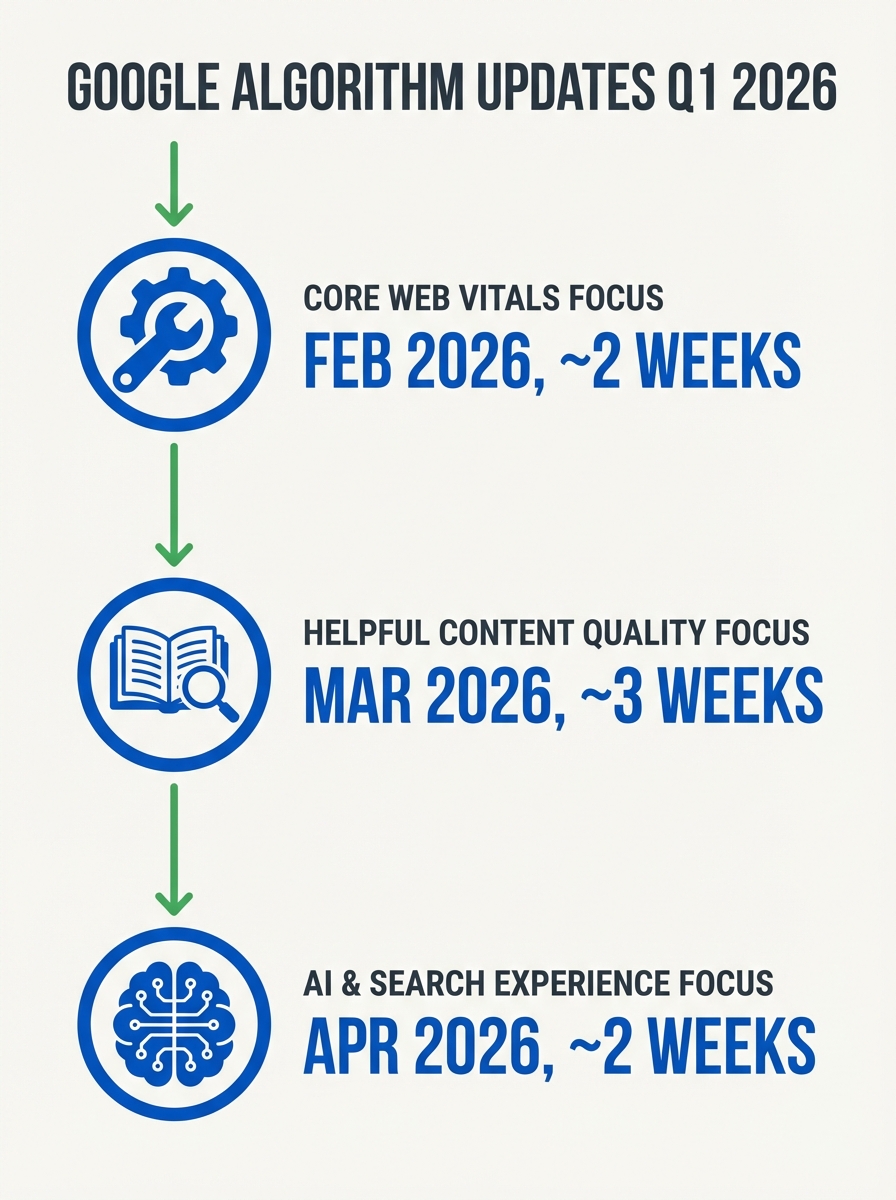
Post-March 2026 Core Update: How Enterprise Sites Should Balance Technical SEO and Content Quality in Recovery
The biggest mistake enterprise SEO teams are making right now is splitting into two camps. One side is scrambling to fix Core Web Vitals. The other is rewriting every piece of content on the site. Both are wasting time because they're treating an integrated problem like two separate ones.
Google's March 2026 core update finished rolling out on April 8, wrapping up a 12-day rollout that started on March 27. SEMrush Sensor recorded peak volatility at 9.5 out of 10, and over 55% of monitored websites saw significant ranking shifts. For enterprise sites managing thousands or tens of thousands of pages, the impact has been brutal, confusing, and weirdly uneven. Some sections of a domain tanked while others held steady or even climbed.
I've spent the past 48 hours analyzing data from three enterprise clients across eCommerce, SaaS, and financial services. The pattern I keep seeing isn't a clean "technical problem" or "content problem." It's both, tangled together in ways that demand a unified recovery approach.
What Actually Happened: Three Updates in Six Weeks
Before you start fixing anything, you need to understand what hit you. The March 2026 core update didn't arrive in isolation. It was the third algorithmic change in rapid succession:
February 2026 Discover Core Update ran from February 5 through 27, Google's first standalone update targeting the Discover feed specifically
March 2026 Spam Update landed on March 24 and completed in under 20 hours, the fastest confirmed spam update ever
Google March 2026 core update began March 27 and completed April 8
This stacking effect means your traffic graph might show compounded losses from multiple causes. A page that lost visibility in Discover during February, then got dinged by the spam update for questionable backlinks, and then took another hit from the core update's content quality signals looks like a catastrophic failure. But it's actually three separate problems that need three separate fixes.
The critical first step in any enterprise SEO recovery strategy is dating your losses accurately. Pull your Google Search Console data and map traffic drops to these specific windows. If your pages cratered between March 24 and 25, you're likely dealing with a spam-related penalty. If the decline started on or after March 27, the core update is your primary concern. If you haven't done a thorough audit of your site's performance against these timelines, stop reading and do that first.
The False Choice Between Technical SEO and Content Quality
Here's my strong opinion on this, and I know some people will disagree: framing recovery as "technical SEO priorities OR content quality" is the seventh deadly sin of algorithm update impact analysis.
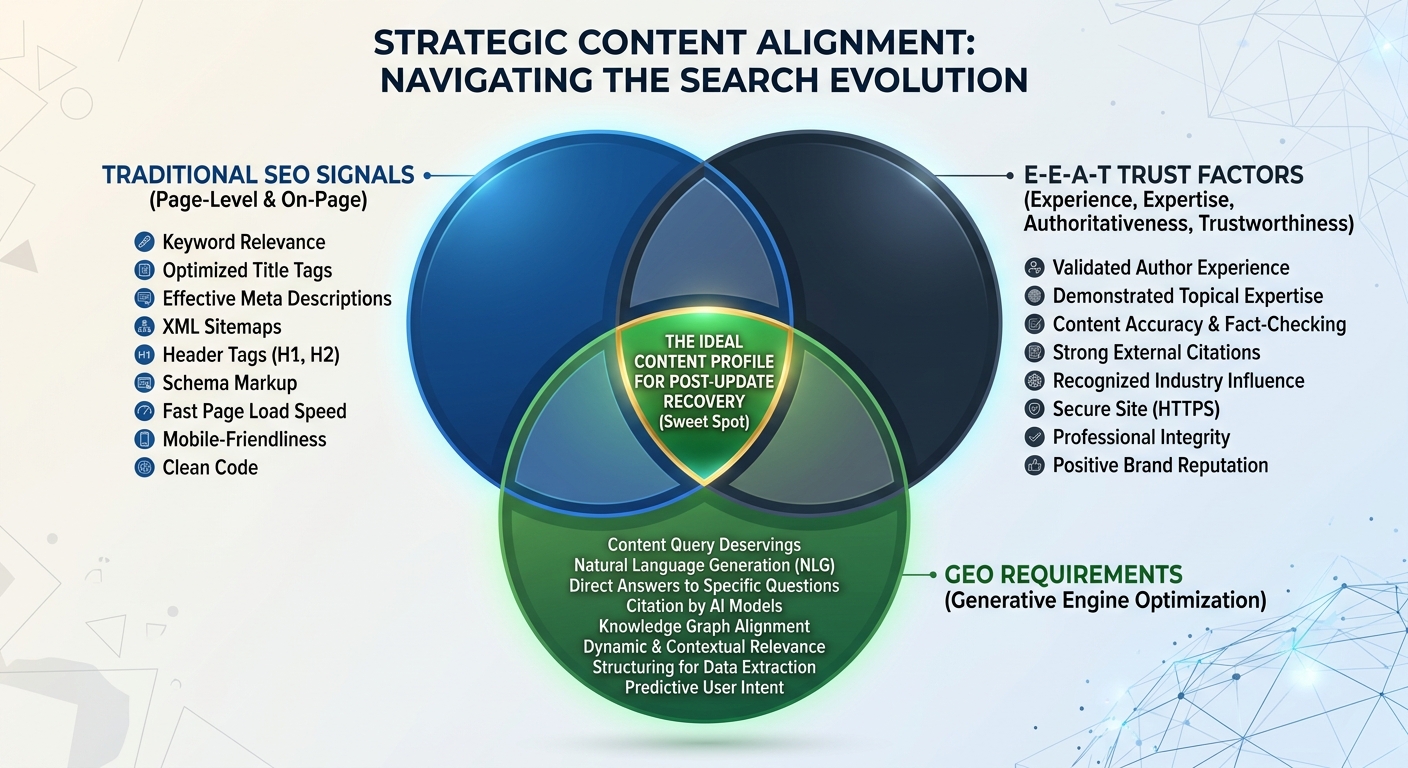
ALM Corp's analysis put it plainly: treating content and technical SEO as separate worlds is one of the most common mistakes site owners make after a core update. Google's systems don't evaluate your pages in two separate passes. They assess the complete experience a user gets when they land on your page. A brilliantly written article that takes 6 seconds to load fails the user. A lightning-fast page full of recycled AI content also fails the user.
But that doesn't mean you should try to fix everything at once. Enterprise sites need a triage framework, and triage means sequence, not separation.
Identify Your Revenue-Critical Pages
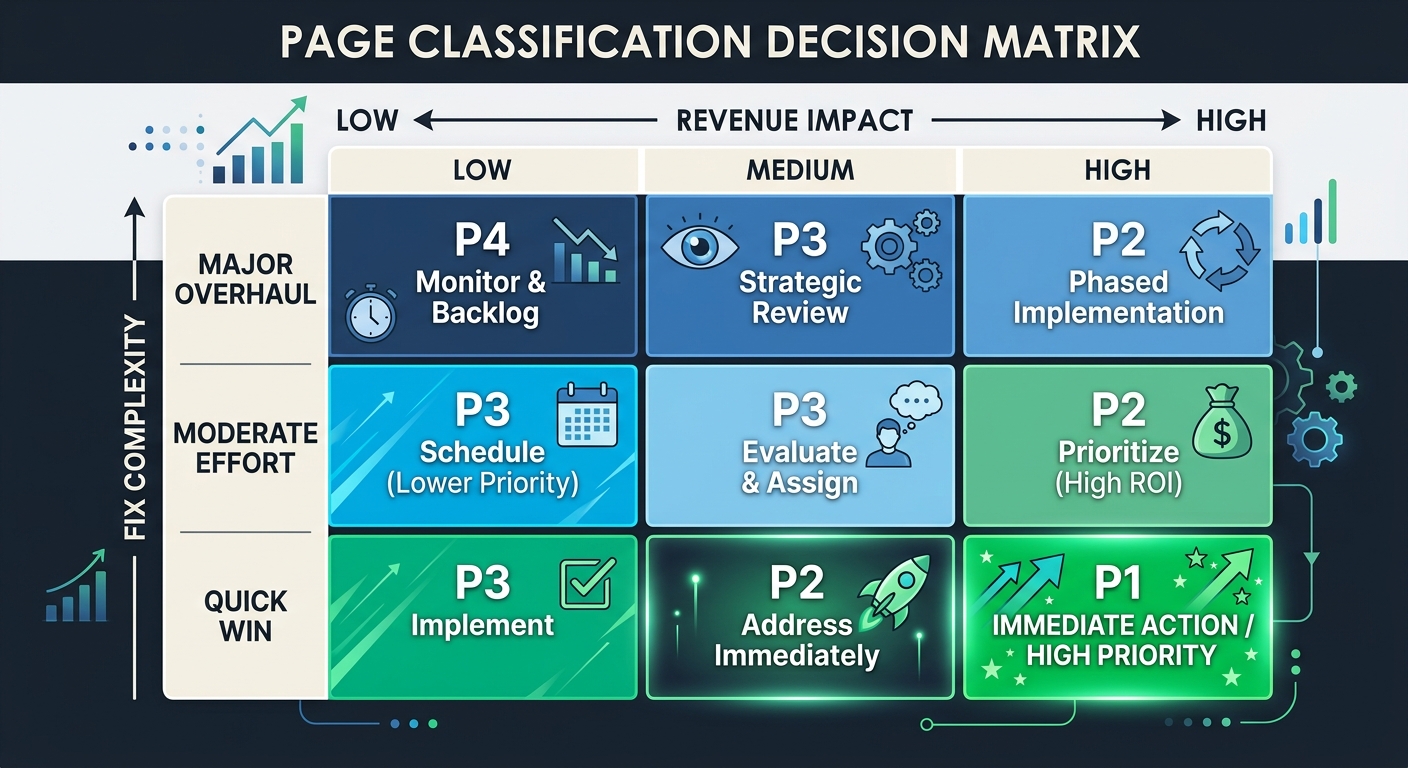
Not every ranking loss deserves equal effort. ALM Corp's recovery guide is right that you should focus first on pages tied to revenue, trust, and strategic visibility. For enterprise sites, this usually means:
Product and service pages that directly drive conversions
Category pages with high commercial intent keywords
Thought leadership content that supports your brand's authority
Landing pages tied to active paid campaigns (because organic drops here inflate your acquisition costs)
Pages with drops greater than 30% are your recovery priorities, according to Digital Applied's analysis. Everything else goes into a secondary queue.
At this stage, you should be building a spreadsheet with three columns for every affected page: the revenue impact (estimated lost conversions multiplied by average order value), the likely cause category (technical, content, or both), and the estimated effort to fix. Sort by revenue impact descending. That's your roadmap.
Run a Diagnostic on Each Priority Page
For each page in your top priority list, answer these questions honestly:
Technical Health Check
Pull your CrUX data. Google tightened Core Web Vitals thresholds in this update, with stricter benchmarks for Largest Contentful Paint, Interaction to Next Paint, and Cumulative Layout Shift. Time to First Byte is now a monitored metric as well. If your enterprise site runs on a legacy CMS with heavy server-side processing, TTFB alone could be dragging you down.
Check whether the page is actually getting crawled efficiently. Enterprise sites with tens of thousands of URLs frequently waste crawl budget on parameter-heavy URLs, outdated paginated archives, and orphaned pages. When you're thinking about your site's architecture from an SEO perspective, crawl efficiency matters more than ever for large domains.
Content Quality Assessment
This is where things get uncomfortable. The March 2026 core update hit sites hard when their content was, as Google's Danny Sullivan framed it, "published primarily to generate SEO traffic, especially at scale." According to BuildMVPFast's recovery guide, Sullivan personally reviewed 13,000 submissions from site owners claiming negative impacts from updates. The pattern was clear: brands investing in original research thrived, while those mass-producing generic AI content without human oversight cratered.
Ask yourself honestly about each priority page:
Does this page contain information a user can't find anywhere else?
Is there a real human author with verifiable credentials attached to it?
Would you be comfortable showing this page to your CEO as an example of your brand's expertise?
If the answer to any of those is no, you've found a content problem. And content problems won't be fixed by faster load times.
The E-E-A-T Reality Check
Google's systems now check whether your authors are real, whether their credentials are verifiable, whether your domain covers its topic consistently, and whether users trust your content enough to stay and engage. This isn't theoretical. It's measurable in engagement metrics, and 73% of top-ranking YMYL pages now include author qualifications.
For enterprise sites, this has a specific operational implication: your subject matter experts need to be involved in content creation, not just content approval. Having a VP's name on a blog post written entirely by an intern with no domain knowledge is exactly the kind of signal Google's systems are getting better at detecting.
Execute in the Right Order
Here's the sequence I'm recommending to enterprise clients right now, based on what the data is showing.
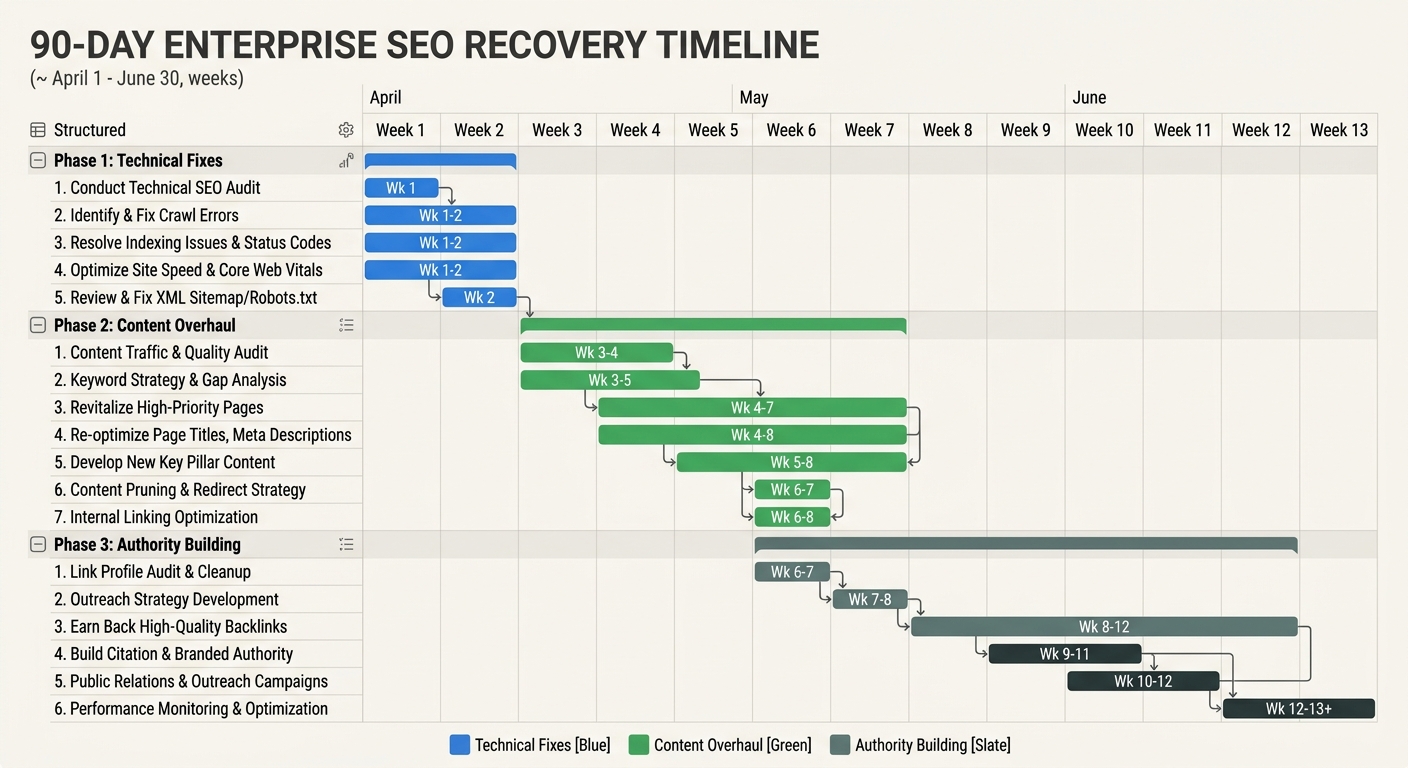
Week One (Now Through April 17)
Fix technical issues on revenue pages first. Why technical before content? Because technical fixes have predictable timelines and measurable outcomes. You can deploy a CDN improvement, optimize images, or fix render-blocking resources and see CrUX data reflect those changes within 28 days. Content improvements take longer to be re-evaluated by Google's systems.
Specifically:
Audit and fix LCP issues on your top 50 revenue pages
Implement lazy loading for below-fold images and third-party scripts
Fix any crawl errors or redirect chains on high-priority URLs
Submit updated sitemaps for any pages you've recently modified
This is also the time to clean up any spam update fallout. Disavow toxic backlinks. Remove or noindex any thin affiliate or partner content that lives on your domain but adds no real value. The page-level evaluation of what some analysts call "parasitic SEO" means individual weak pages can now be penalized without dragging down your whole domain, but why take the risk?
Weeks Two Through Eight
Now shift to content. This is the heavy lift, and it's where most enterprise sites will spend the majority of their recovery effort.
Start with the pages you identified as having content quality problems. For each one, you need to determine if the page should be rewritten, consolidated, or removed entirely. Pages that are just keyword variations of other pages on your site should be consolidated. Pages that exist solely because someone on the SEO team thought "we should rank for this term" should probably be removed or noindexed.
For pages worth keeping, the playbook is straightforward but labor-intensive:
Add original data, proprietary insights, or first-hand case studies
Attach real author bylines with credentials that match the topic
Cut filler content and focus on answering user intent directly
Structure headings and subheadings for clarity (this helps with AI Overview visibility too)
The data shows that sites adding proprietary research saw up to 22% gains in visibility through this update. That's not a small number. If you have internal data that can make a page genuinely more useful than competing results, use it.
Indeed's enterprise SEO guidance reinforces this: ensure old content on your site still complies with the latest best practices and contains relevant, accurate information. For enterprise sites with thousands of pages created over a decade, this is a massive undertaking. Prioritize ruthlessly.
Weeks Six Through Twelve
Layer in your authority-building and Generative Engine Optimization (GEO) work. AI Overviews now appear in 41% of UK search queries and a growing percentage of US queries. As Evertune's content guide explains, GEO is the practice of improving your brand's visibility in AI-generated responses across LLMs like ChatGPT, Gemini, and Claude. The content these models trust and recommend shares a consistent profile: original, expert-attributed, and topically authoritative.
For enterprise sites, this means:
Implement FAQ, Article, and Organization schema markup on key pages
Structure content with clear question-and-answer patterns
Monitor which of your high-value keywords are triggering AI Overviews
Build topical clusters that demonstrate depth rather than breadth
The Enterprise-Specific Trap of Organizational Silos
I want to call out something specific to enterprise SEO recovery strategy that doesn't get enough attention. At most large organizations, the people who own technical infrastructure are not the same people who own content. The DevOps team controls page speed. The marketing team controls editorial. The product team controls page templates. And the SEO team gets to influence but not decide.
This means your recovery plan needs executive buy-in and cross-functional coordination. I've seen too many enterprise recovery efforts stall because the SEO team identified the problems but couldn't get engineering resources allocated for technical fixes, or couldn't convince the content team to sunset underperforming pages.
If you're evaluating whether you need external help navigating this, consider carefully what separates effective agencies from ones that overpromise. The right partner should be able to bridge these organizational gaps and speak the language of both engineering and content teams.
What About the Next Update?
Industry watchers expect another broad core update in June or July 2026, with mandatory mobile-first indexing coming on July 1. That gives you roughly 80 days to show meaningful progress. Google's systems do re-evaluate sites during subsequent updates, so improvements you make now can be rewarded in the next cycle.
But don't wait for the next update to validate your changes. Track your enterprise site rankings weekly against the specific keyword clusters you've identified as priorities. If your pages are genuinely more useful, more technically sound, and more trustworthy than they were before the March 2026 core update, the rankings will follow. Maybe not in the next 28 days. But Google's direction is clear, and it's not reversing course.
Your Immediate Recovery Checklist
Map your traffic losses to specific update windows using Search Console date ranges, build a priority list of affected pages sorted by revenue impact, and run a technical audit on your top 20 pages to fix what you can within the first sprint. Begin content assessments on priority pages, flagging each for rewrite, consolidation, or removal, then get executive buy-in for a 90-day cross-functional recovery program.
The cost comparison between tooling and agency support is worth revisiting now, especially if your internal team is stretched thin. This recovery isn't a side project. It's a business-critical initiative with direct revenue implications, and it needs to be resourced accordingly.
The sites that recover fastest from this update won't be the ones that picked the right side of a false dichotomy. They'll be the ones that diagnosed accurately, prioritized by impact, and executed a coordinated plan across both technical and content dimensions. The clock started on April 8. Don't waste it.
Marcus Webb
Digital marketing consultant and agency review specialist. With 12 years in the SEO industry, Marcus has worked with agencies of all sizes and brings an insider perspective to agency evaluations and selection strategies.
Frequently Asked Questions
- How do I know if my site was hit by the spam update or the core update?
- Check your Google Search Console data to date your traffic losses accurately. If your pages dropped between March 24-25, you were likely hit by the spam update. If the decline started on or after March 27, the core update is your primary concern. The March 2026 spam update was the fastest confirmed spam update ever, completing in under 20 hours.
- What are the new Core Web Vitals thresholds Google is using?
- Google tightened Core Web Vitals thresholds in the March 2026 update with stricter benchmarks for Largest Contentful Paint, Interaction to Next Paint, and Cumulative Layout Shift. Time to First Byte is now a monitored metric as well, which is especially important for enterprise sites running on legacy CMS platforms with heavy server-side processing.
- Should I fix technical SEO or content first after a core update?
- Fix technical issues first on your revenue-critical pages because technical fixes have predictable timelines and measurable outcomes within 28 days. Content improvements take longer to be re-evaluated by Google's systems, so they should be tackled in weeks two through eight of your recovery strategy.
- Which pages should I prioritize in my recovery strategy?
- Prioritize pages tied to revenue, trust, and strategic visibility: product and service pages that drive conversions, category pages with high commercial intent, thought leadership content supporting brand authority, and landing pages tied to active paid campaigns. Pages with ranking drops greater than 30% are your recovery priorities.
- What content changes did Google's March 2026 core update target?
- Google's systems targeted content published primarily to generate SEO traffic at scale, especially generic AI content without human oversight. The update favored brands investing in original research, pages with real human authors with verifiable credentials, and content that users cannot find anywhere else. Pages with proprietary research saw up to 22% visibility gains.
- How important is E-E-A-T for ranking after the March 2026 update?
- E-E-A-T is now measurable in engagement metrics, with 73% of top-ranking YMYL pages including author qualifications. Google's systems verify whether authors are real, their credentials are verifiable, the domain covers its topic consistently, and whether users trust and engage with the content. Subject matter experts need to be involved in content creation, not just approval.
- What is Generative Engine Optimization and why does it matter now?
- Generative Engine Optimization (GEO) is the practice of improving your brand's visibility in AI-generated responses across LLMs like ChatGPT, Gemini, and Claude. AI Overviews now appear in 41% of UK search queries and a growing percentage of US queries, and these models trust content that is original, expert-attributed, and topically authoritative.
- How often will Google release core updates after March 2026?
- Industry watchers expect another broad core update in June or July 2026, with mandatory mobile-first indexing coming on July 1. Google's systems re-evaluate sites during subsequent updates, so improvements made now can be rewarded in the next update cycle.
Explore more topics