
Zero-Click SEO Expertise: What Agencies Need to Hire for in 2026
A mid-size ecommerce agency I consulted for fired their entire content team in January. Not because the writers were bad. The team was producing 40 blog posts a month, hitting every keyword target, earning decent rankings.
 Marcus Webb··9 min read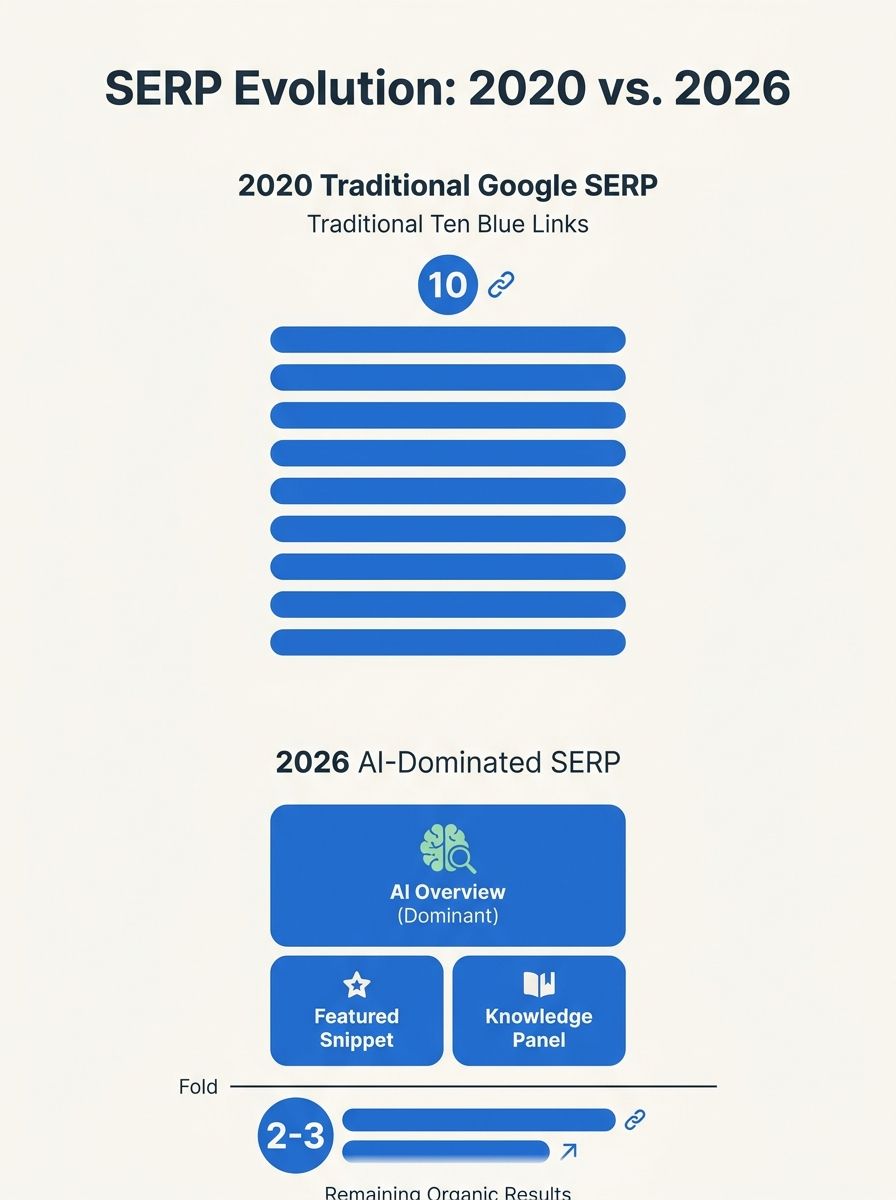
Zero-Click SEO Expertise: What Agencies Need to Hire for in 2026
A mid-size ecommerce agency I consulted for fired their entire content team in January. Not because the writers were bad. The team was producing 40 blog posts a month, hitting every keyword target, earning decent rankings. But organic traffic had dropped 34% over 18 months while rankings stayed flat. The agency owner called me, genuinely confused. "Marcus, we're ranking. Why aren't we getting clicks?" The answer was brutal: 60% of the searches they were ranking for never produced a click. Google answered the query right on the SERP. The team had been optimizing for a world that no longer exists.
That agency isn't an outlier. It's the norm. And the hiring decisions agencies make right now will determine whether they survive the zero-click era or become another cautionary tale.
The Numbers That Should Scare Every Agency Owner
I'm not being dramatic here. According to verified zero-click search statistics, nearly 60% of Google searches now end without a single click to any website. On mobile, that number jumps to 77.2%. When AI Overviews appear on a SERP, the zero-click rate hits 83%.
Read that again. Eighty-three percent.
If your agency is still measuring success by organic sessions and keyword rankings alone, you're reporting metrics that increasingly don't reflect reality. Your clients' content can rank #1 and still deliver nothing.
But here's the twist that makes this interesting rather than just depressing: visitors who do click through from AI search results convert at 14.2%, roughly 5x higher than traditional organic traffic. The pool is smaller, but the fish are bigger. Agencies that figure out zero-click search optimization will serve clients who get fewer visits but dramatically better business outcomes.
The question is: do you have the right people to execute this strategy?
Why Your Current Team Probably Isn't Built for This
I've evaluated over 200 SEO agencies. The typical organic search team structure looks something like this: a strategist, a few content writers, a link builder, maybe a technical SEO person, and an analytics lead. That team was perfect for 2019. It's dangerously incomplete for 2026.
The core problem? Most SEO professionals were trained to chase clicks. Every playbook, every course, every certification program taught us to get people from Google to a website. Answer engine optimization skills require the opposite instinct: making your brand visible and authoritative even when nobody clicks.
As Search Engine Journal reported, AEO requires SEO and content teams to break down silos and work together on entity targeting, semantic associations, and content structure. Without that coordination, brands lose AI citation opportunities to competitors who've figured it out.
This isn't a minor skill upgrade. It's a fundamentally different way of thinking about search.
The Three Skill Gaps I Keep Finding
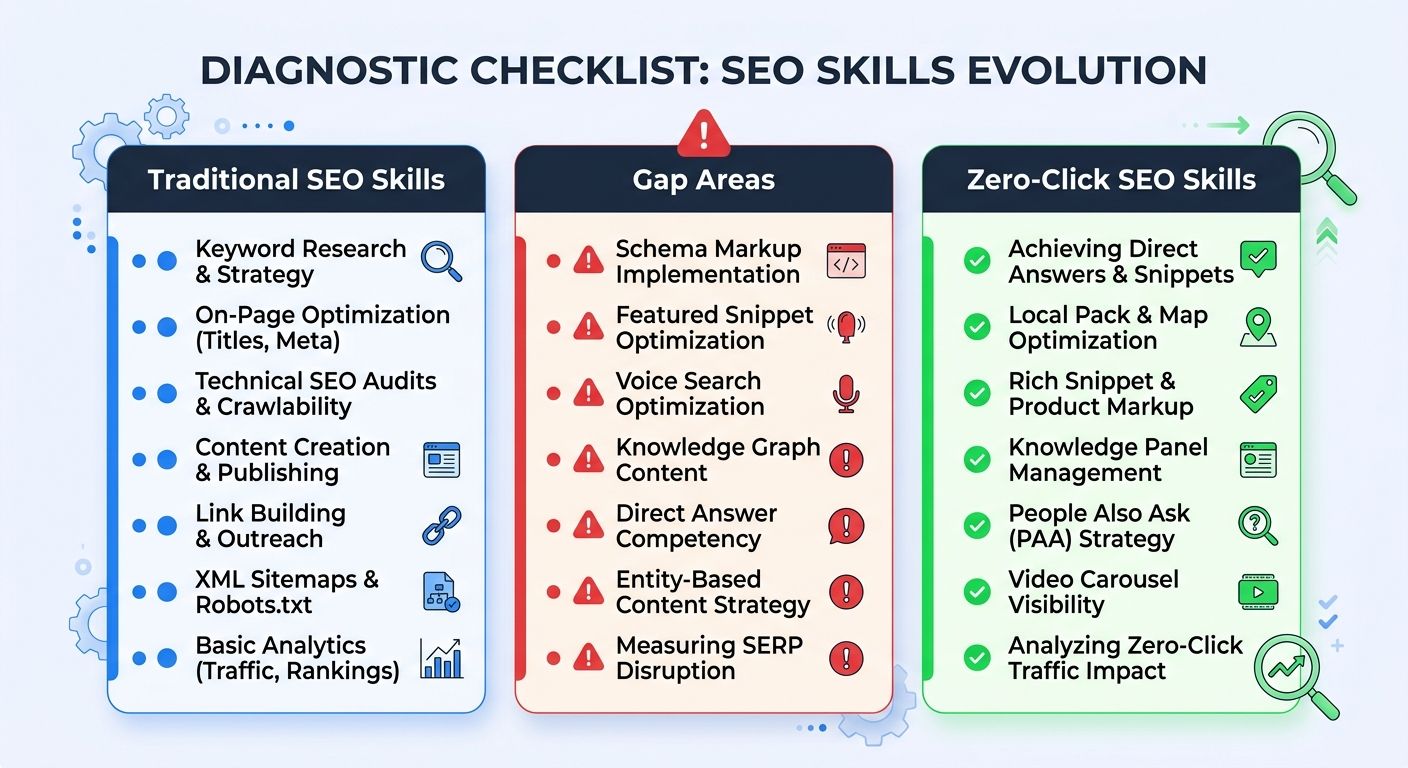
When I audit agency teams, the same gaps appear over and over:
No one owns AI visibility. Someone might casually monitor AI Overviews, but nobody's dedicated job is tracking where the brand gets cited, mentioned, or referenced across AI search surfaces.
Measurement is stuck in the past. Teams track rankings, traffic, and maybe conversions. Nobody's tracking Share of Search, brand mention frequency in AI results, or SERP real estate metrics.
Content strategy hasn't evolved. Writers still produce "What is X?" articles that get immediately absorbed into AI Overviews, delivering zero value to the client.
If any of this sounds familiar, you're not alone. But you need to fix it.
The Five Roles Agencies Need to Fill
Based on my work with agencies adapting to zero-click search, here's the organic search team structure that actually works in 2026. You don't necessarily need five new hires. Some of these can be upskilled from existing staff, combined into hybrid roles, or brought in as fractional specialists. But someone on your team needs to own each of these functions.
1. AI Visibility Strategist
This is the most critical hire. An AI Visibility Strategist understands how content gets selected for AI Overviews, how LLMs choose which sources to cite, and how to position a brand across Google's AI Mode, ChatGPT, and Perplexity.
What to look for in candidates:
Experience with schema markup beyond basics (FAQ, HowTo, Speakable)
Understanding of entity SEO and knowledge graph optimization
Hands-on work tracking AI citations, not just traditional rankings
Familiarity with multiple AI search platforms, not Google alone
Backlinko's team-building guide emphasizes that AI-ready team leaders need to understand how AI search works and adapt when platforms change. The rest of the team needs execution capability, but this person sets the direction.
Salary range I'm seeing: $85,000–$130,000 for full-time, $150–$250/hr for freelance specialists. Yes, it's premium. The role barely existed two years ago, and demand far outstrips supply.
2. Brand Authority Manager
E-E-A-T has gone from a nice-to-have to the primary filter AI systems use when selecting sources. A Brand Authority Manager builds the trust signals that make AI systems choose your client's content over a competitor's.
This person handles:
Thought leadership placement (executive bylines, expert commentary, podcast appearances)
Cross-platform entity consistency (making sure a brand's identity is uniform across every touchable surface)
Unlinked brand mention acquisition
Author authority development for key content creators
If your agency is already thinking about how AI visibility optimization differs from traditional SEO, this role is where the rubber meets the road.
3. Non-Click Attribution Analyst
Traditional analytics people know Google Analytics inside and out. That's necessary but insufficient. You need someone who can measure success when there are no clicks to measure.
Key metrics this person tracks:
AI Overview citation frequency for target queries
Share of Search (branded search volume relative to category)
SERP real estate (percentage of visible screen occupied by client content)
Assisted conversions where AI visibility influenced the customer path
Brand lift surveys connecting search presence to awareness
Building a custom performance dashboard that captures these non-click signals is table stakes for this role. If your reporting still leads with "organic sessions increased by X%," you're telling an incomplete story.
4. Resilient Content Architect
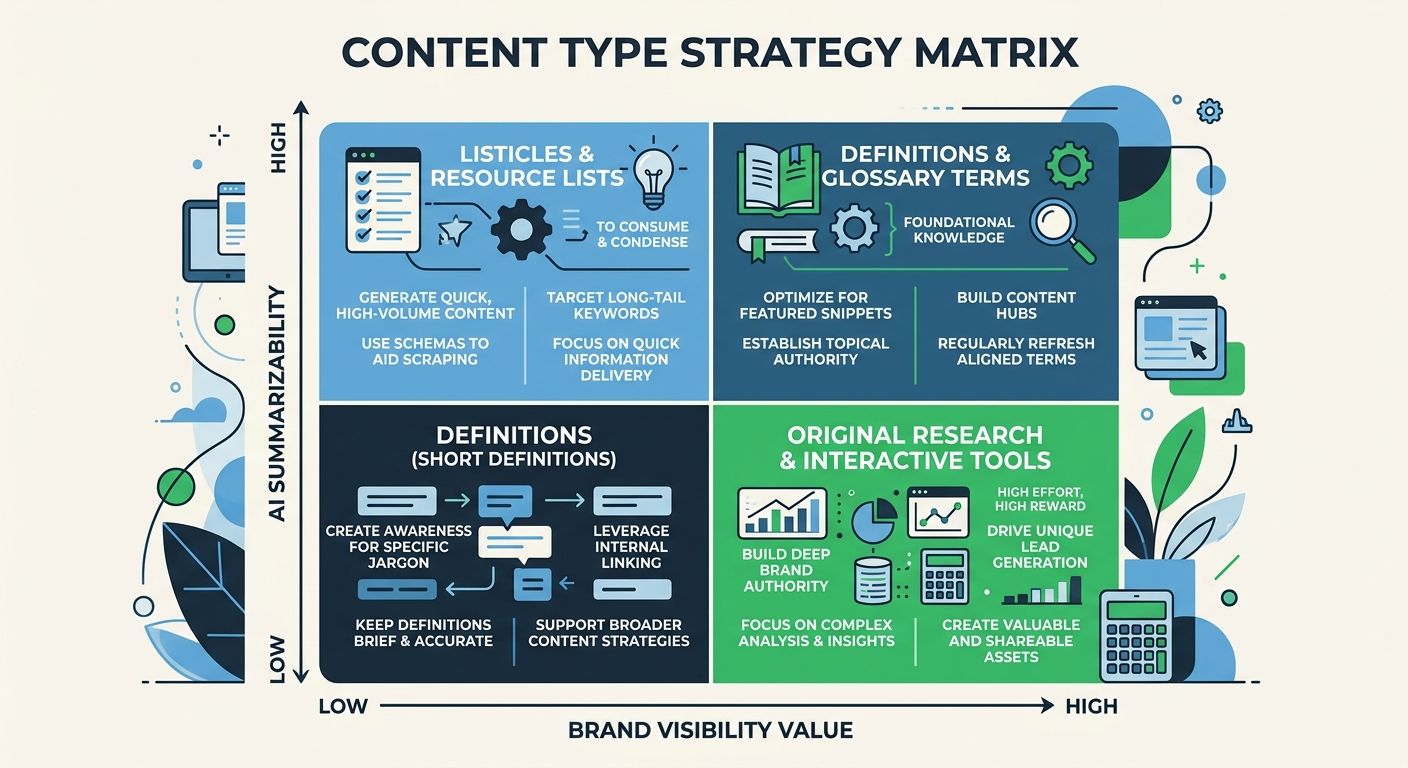
This isn't your traditional content strategist. A Resilient Content Architect designs content specifically to resist AI summarization. Their job is to create assets that AI can't fully replicate in a search result, forcing users to visit the site.
According to Digital Applied's survival guide, vulnerable content formats like how-to guides, listicles, and definitions are easily absorbed by AI. The formats that survive are interactive tools, original research with methodology, personalized assessments, and real-time data.
What to look for:
Experience creating interactive content (calculators, configurators, assessments)
Background in original research and data journalism
Understanding of which content formats trigger AI Overviews (to avoid or target them strategically)
Ability to structure content in 40-60 word answer blocks for citation purposes while keeping the full piece valuable enough to visit
This role requires a strange duality. You want your content both cited by AI (for visibility) and impossible to fully summarize (for traffic). That's a genuinely difficult design challenge.
5. Multi-Platform Search Specialist
Google isn't the only game anymore. ChatGPT processes 800 million weekly users. Perplexity handles 780 million queries per month. YouTube is a search engine. Reddit content surfaces in AI results. Your team needs someone who optimizes across all of these.
LLMrefs' guide to AI SEO points out something most agencies overlook: pages that rank well in both Google and Bing get the broadest AI search visibility, since many AI platforms pull from Bing's index. Most SEOs ignore Bing entirely. That's a mistake.
This specialist should:
Maintain Bing Webmaster Tools alongside Google Search Console
Optimize for YouTube discovery (video SEO is booming in AI search)
Monitor how brand content surfaces in ChatGPT and Perplexity responses
Track Reddit and LinkedIn content performance as search referral sources
How to Actually Evaluate Candidates for These Roles
Here's where I see agencies fumble. They write job descriptions full of buzzwords, interview candidates with generic SEO questions, and end up hiring someone who's great at traditional search but lost in the zero-click world.
When I help agencies with SEO talent acquisition, I recommend this evaluation framework:
For any zero-click focused role, ask these five questions:
"Show me a campaign where traditional organic traffic dropped but business outcomes improved. How did you measure success?" This separates people who understand the new reality from those still clinging to traffic metrics.
"Walk me through how you'd get a brand cited in an AI Overview for a competitive commercial query." You want specifics: schema implementation, content structure, entity building. Vague answers about "great content" are a red flag.
"What tools do you use to track AI search visibility?" There's no single dominant tool yet, so you're looking for resourcefulness. People who've cobbled together monitoring solutions from multiple sources are showing real initiative.
"How do you decide which queries to target for clicks versus which to target for visibility only?" This tests strategic thinking. Not every query deserves the same approach.
"Describe a time you had to convince a client that fewer clicks was actually a good thing." Communication skills matter enormously in this space because clients are conditioned to want more traffic.
The Hire Overseas AEO guide nails it: hiring someone who optimizes for quantity, publishing velocity, or page count usually slows AEO progress. Answer engines reward clarity, not activity. If a candidate leads with output volume, they're probably not the right fit.
Structuring the Team: What Works at Different Agency Sizes
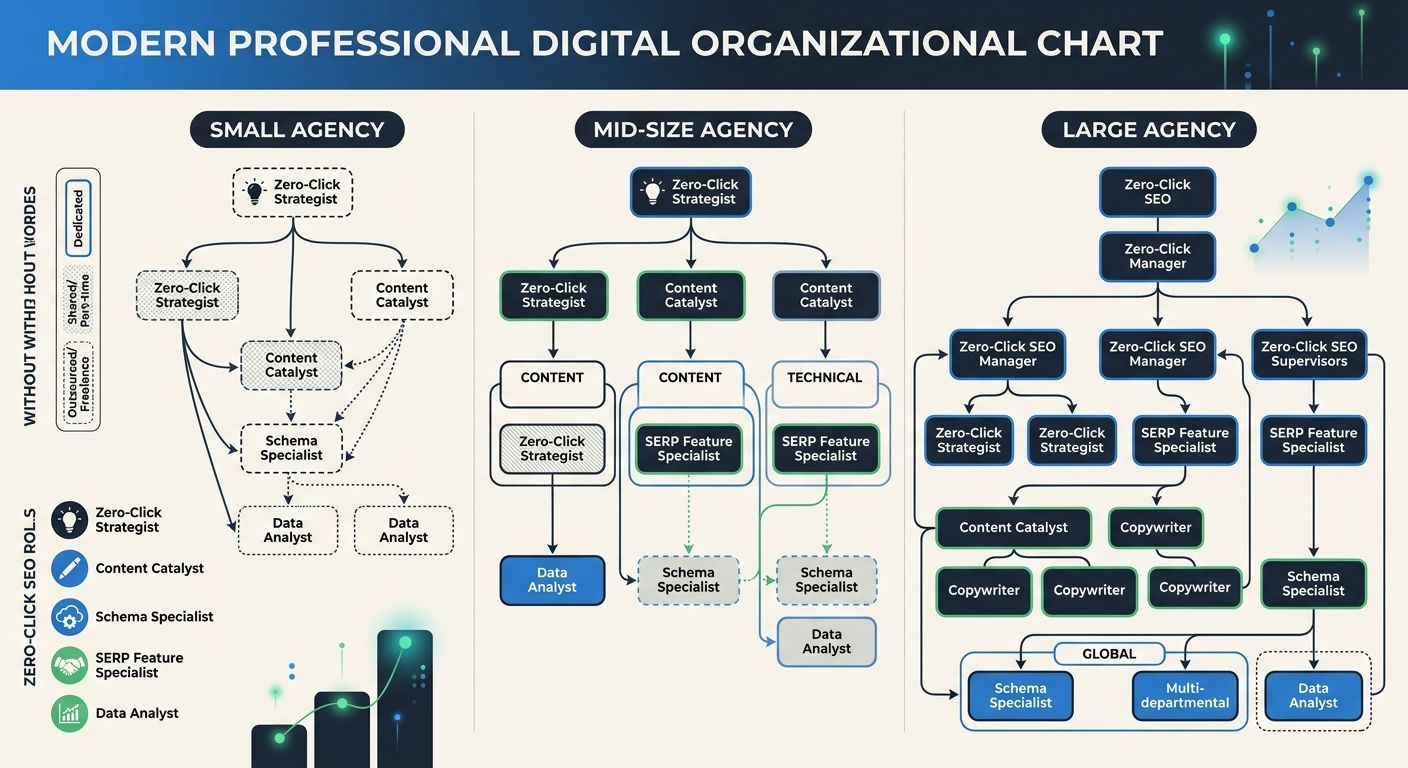
Not every agency can hire five new specialists. Here's how I'd approach AI search expertise hiring at different scales:
Small agencies (under 10 people): Hire one hybrid AI Visibility Strategist / Content Architect. This person sets strategy and trains existing staff. Outsource attribution analysis to a fractional specialist. Budget: $90K-$120K fully loaded.
Mid-size agencies (10-30 people): Hire a dedicated AI Visibility Strategist and a Non-Click Attribution Analyst. Upskill your existing content lead into the Resilient Content Architect role. Send your technical SEO person to get trained on multi-platform optimization. Budget: $180K-$280K for the two new hires.
Large agencies (30+ people): Build a dedicated zero-click unit with all five roles. This team works across client accounts as an internal center of excellence. Budget: $400K-$600K annually, but the competitive advantage is massive.
If you're navigating a broader agency transition or team restructuring, folding these new roles into the plan makes the change less disruptive than piecemeal hiring.
For agencies exploring whether automation can supplement some of these functions, the honest answer is: AI tools handle monitoring and data collection well, but strategic interpretation and client communication still require human expertise.
Where to Find These People
The talent pool for dedicated zero-click specialists is small. Here's where I've had success sourcing candidates:
Toptal and similar platforms for freelance AEO experts who've already built portfolios. Toptal's AEO directory is worth reviewing for benchmarking what experienced candidates look like.
Former in-house SEO leads at brands that lost significant traffic to AI Overviews and had to adapt. These people learned zero-click optimization under pressure, which is the best training ground.
Data analysts from paid media who already think in terms of visibility metrics, impressions, and brand lift rather than just clicks.
Technical SEO specialists who've been working with structured data and schema at an advanced level. They're often one training program away from becoming effective AI Visibility Strategists.
The Bottom-Line Advice
The agencies that thrive through 2026 and beyond won't be the ones with the biggest teams. They'll be the ones with the right skills in the right seats.
If you take one thing from this piece, let it be this: stop hiring people who only know how to drive clicks. Start hiring people who know how to make a brand impossible for AI to ignore. The clicks that do come through will be worth more than the flood of low-intent traffic you're losing.
Audit your current team against the five roles above. Identify your biggest gaps. And start filling them before your competitors do. The window for building a first-mover advantage in zero-click search optimization is closing fast.
Marcus Webb
Digital marketing consultant and agency review specialist. With 12 years in the SEO industry, Marcus has worked with agencies of all sizes and brings an insider perspective to agency evaluations and selection strategies.
Explore more topics