
MeasureBoard's AI Automation Layer: Why Agency Teams Are Ditching Manual SEO Workflows
A client of mine fired their previous agency after discovering that the team billed 14 hours per month for "reporting and data analysis" that amounted to copying numbers from Google Search Console into a spreadsheet, adding conditional formatting, and emailing a PDF. Fourteen hours. Every month.
 Marcus Webb··8 min read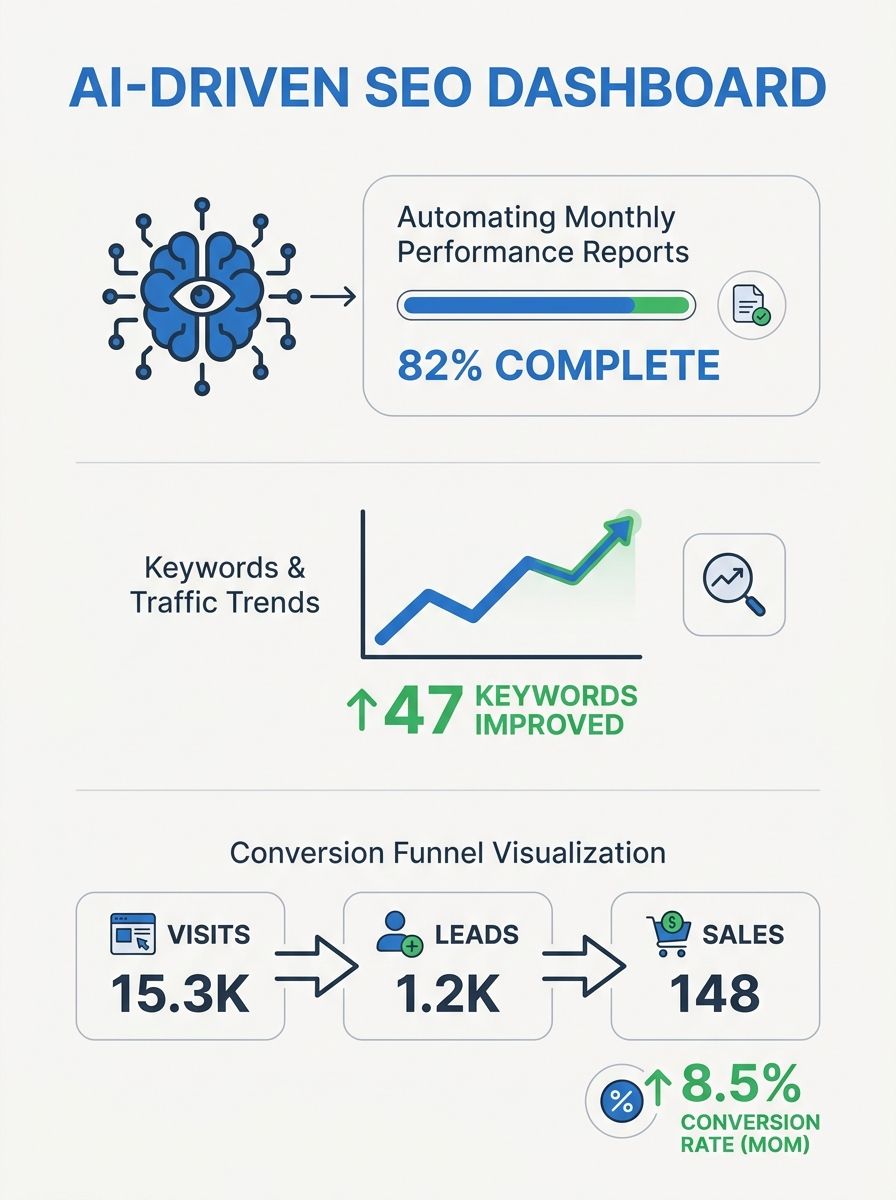
MeasureBoard's AI Automation Layer: Why Agency Teams Are Ditching Manual SEO Workflows
A client of mine fired their previous agency after discovering that the team billed 14 hours per month for "reporting and data analysis" that amounted to copying numbers from Google Search Console into a spreadsheet, adding conditional formatting, and emailing a PDF. Fourteen hours. Every month. For copy-paste work. That agency isn't unusual. I've audited over 200 SEO agencies, and the dirty secret is that somewhere between 30% and 50% of billable hours at most shops go toward tasks that a well-configured automation could handle in minutes. So when MeasureBoard announced its AI-powered marketing intelligence and automation platform on April 15, the timing couldn't have been better for agencies bleeding money on manual workflows.
Here's my breakdown of what MeasureBoard just shipped, where it fits in the current agency tech stack, and whether it actually delivers enough to justify the switch.
What MeasureBoard Actually Launched
MeasureBoard's platform went live yesterday as an all-in-one AI-powered SEO platform for agencies and businesses that want analytics, SEO tracking, and marketing automation under a single roof. The headline feature is what the company calls its agentic AI analyst, an autonomous AI agent that pulls data from Google Analytics, Google Search Console, and ad platforms, then interprets it without you having to build custom reports or write queries.
That last part matters. Most "AI-powered" SEO tools I've tested are really just dashboards with a chatbot bolted on. You still have to ask the right questions. MeasureBoard's pitch is different: the AI agent proactively surfaces trends, flags ranking drops, and generates plain-language reports on its own. Think of it less like a tool and more like a junior analyst who never sleeps and never forgets to check the data.
The core feature set includes:
AI traffic intelligence reporting with automated interpretation
True conversion funnels that calculate effective CPA across all channels and campaigns
AI rank tracking for real-time keyword movement monitoring
SEO page analysis at the individual URL level
Uptime monitoring to catch availability issues before they tank rankings
Integrations with CMS platforms and ad networks for unified performance views
MeasureBoard is positioning itself as a replacement for the $500+/month stack of tools that most agencies cobble together. There's a free tier that includes AI-driven reporting and basic site audits, with paid plans unlocking higher data limits and advanced features.
Why This Matters Right Now
The timing of this launch isn't accidental. Agencies are under more pressure than ever to cut costs while delivering better results. I've been writing about why the vast majority of agencies face existential pressure and how the survivors are the ones who figure out operational efficiency first, strategy second. MeasureBoard is explicitly targeting that pain point.
Consider the math. Running manual SEO audits across 500 pages takes weeks, according to Siteimprove's analysis of AI SEO tool efficiency. Adding user behavior data analysis on top of that adds another month. For a mid-sized agency managing 20 clients, that's a terrifying amount of labor spent on tasks that don't require creative thinking or strategic insight.
The broader industry is moving in the same direction. Salesforce just redesigned its entire platform for agent-driven automation, exposing data and workflows as APIs so AI agents can automate tasks without traditional user interfaces. When the biggest players in martech are rebuilding around autonomous AI agents, smaller platforms like MeasureBoard are smart to ride the same wave.
The Agency Tech Stack Consolidation Problem
I talk to agency owners every week, and the number one operational headache I hear isn't client churn or algorithm updates. It's tool sprawl. A typical agency in my consulting practice runs Ahrefs or Semrush for research, Screaming Frog for crawls, Google Looker Studio for reporting, a separate rank tracker, uptime monitoring through Pingdom or UptimeRobot, and maybe Surfer SEO or Clearscope for content optimization. That's six to eight subscriptions before you factor in project management and communication tools.
The cost adds up fast. But the real damage isn't financial. It's operational. Every tool switch requires a context shift. Data lives in silos. Your team exports CSVs from one platform, imports them into another, and manually reconciles numbers that should match but somehow never do.
As research from Dotdigital on martech stack consolidation confirms, consolidating eliminates redundant subscriptions and leads to better resource allocation and higher marketing ROI. MeasureBoard is betting that agencies want fewer tools doing more work, and based on what I'm seeing in the market, they're right.
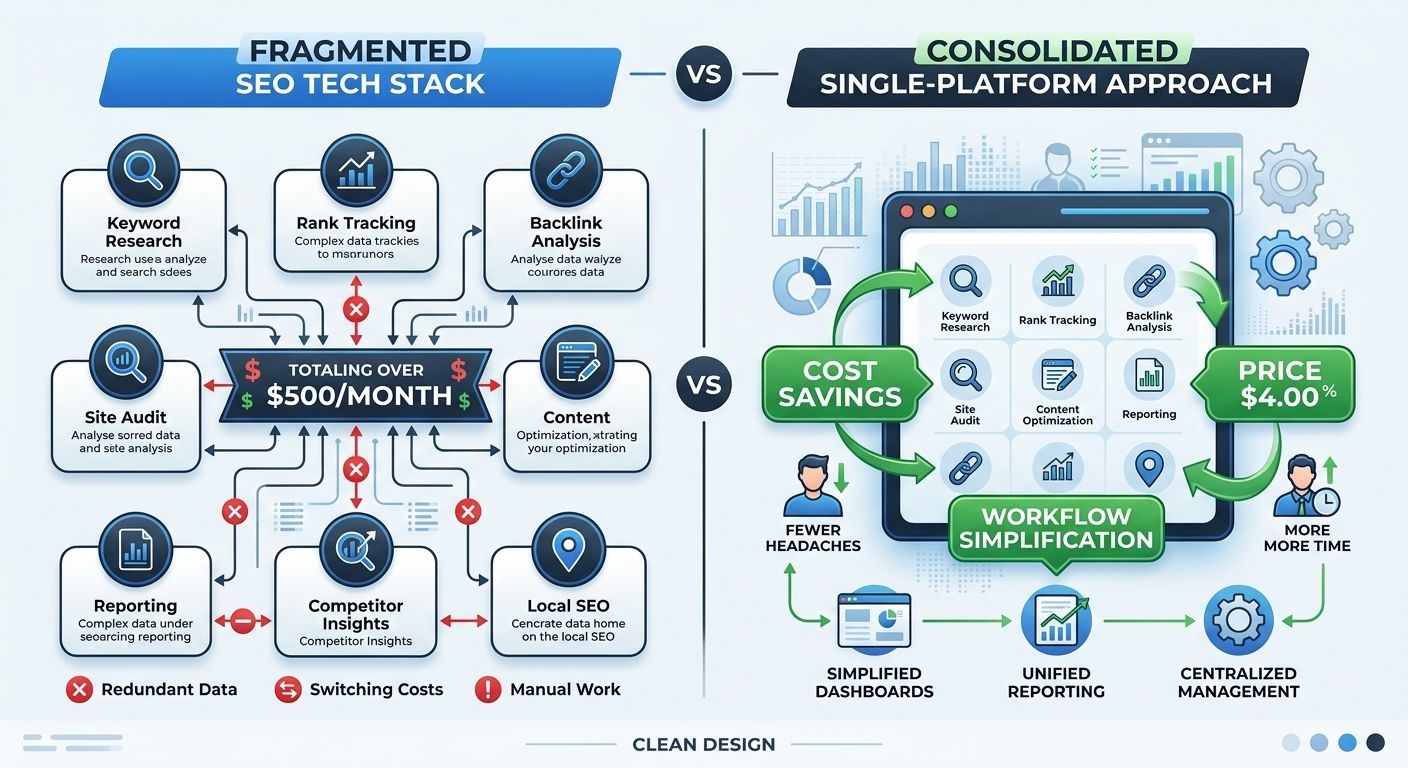
This push toward agency tech stack consolidation isn't just a MeasureBoard narrative. The entire API-first SEO movement is driven by the same logic: agencies want unified data, fewer logins, and automated handoffs between tasks that used to require manual intervention.
How MeasureBoard's Automation Compares to the Competition
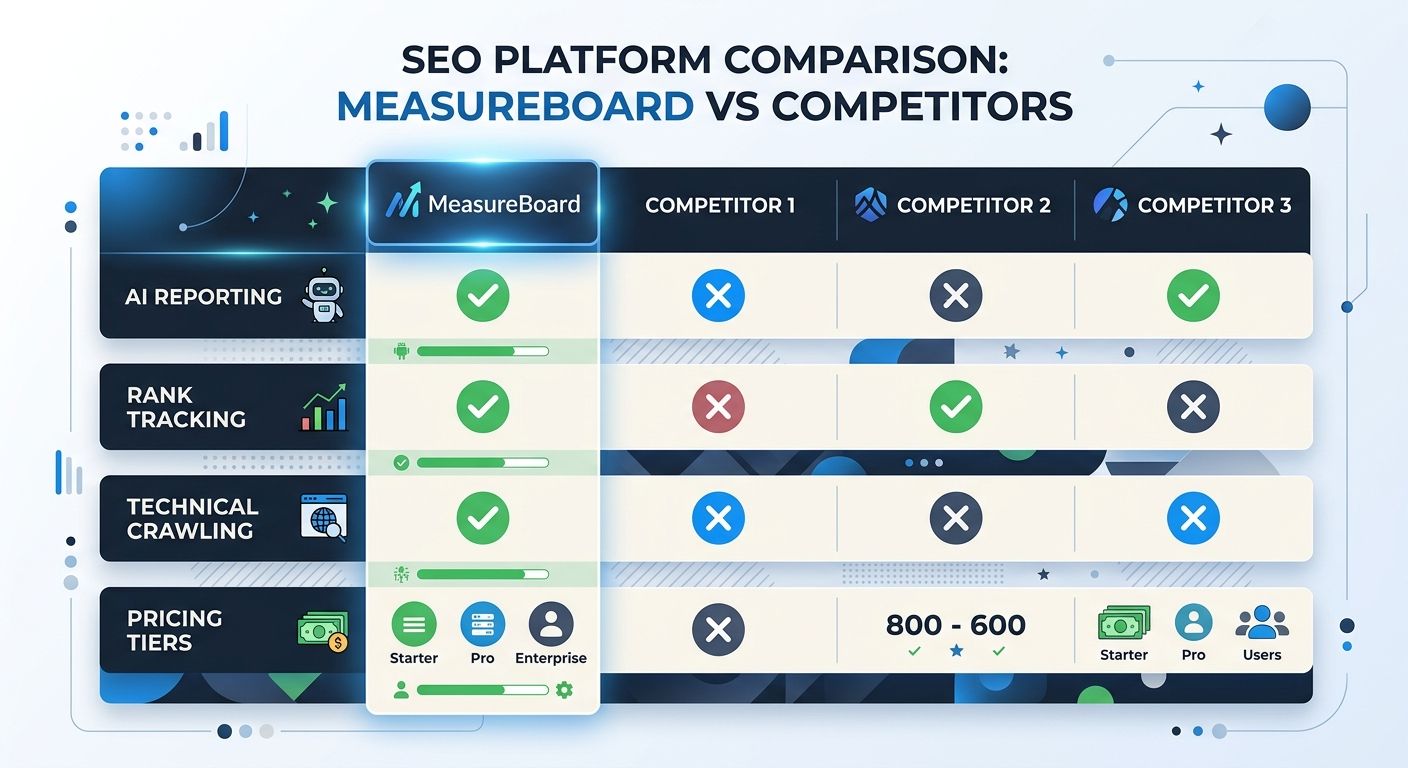
I want to be fair here. MeasureBoard isn't the only player in the AI-powered SEO platform space. A recent comparison of top AI SEO platforms for agencies identified multiple contenders, including BrightEdge for enterprise users and tools like Surfer SEO and Scalenut for content optimization. The market is crowded.
But MeasureBoard's differentiator is the bundling approach combined with an agentic AI layer. Most competitors focus on one slice of the workflow: BrightEdge does enterprise recommendations and opportunity detection (but carries enterprise pricing). Screaming Frog is brilliant for technical crawls at £199/year for unlimited crawling, but it doesn't touch reporting or rank tracking. SE Ranking and Mangools handle keyword tracking and AI visibility well, according to their latest feature comparisons, but they don't include uptime monitoring or unified conversion funnels.
Here's my honest assessment of where MeasureBoard fits:
Where MeasureBoard Looks Strong
Reporting automation: If the agentic AI works as advertised, this alone saves agencies 10-15 hours per month per client. That's not hyperbole. I've timed manual reporting processes at agencies I've consulted for.
Price point: A free tier with AI reporting is aggressive. Paid plans that undercut a $500+/month tool stack give agencies a reason to test the platform with minimal risk.
Unified data: CPA calculations that pull from both organic and paid channels in one view solve a real attribution headache.
Where I Have Questions
Crawl depth and technical SEO: The announcement doesn't specify how MeasureBoard's page analysis compares to dedicated crawlers like Screaming Frog or Sitebulb. If you're running deep technical SEO debugging, you probably still need a specialized tool.
Data accuracy at scale: New platforms often struggle with rank tracking accuracy in the first six months. I'd want to see third-party validation before trusting it for enterprise accounts.
Integration maturity: Supporting Google Analytics and Search Console is table stakes. The real test is how cleanly it handles CMS-specific integrations, custom API connections, and white-label reporting for agency clients.
The Real Impact of SEO Workflow Automation on Agency Economics
Let me put some actual numbers on this, because vague promises about "saving time" don't pay invoices.
A mid-tier SEO agency with 15 active clients typically allocates staff time roughly like this:
30-40% on reporting, data analysis, and client communication prep
20-25% on technical audits and implementation recommendations
20-25% on content strategy and production
15-20% on link building, outreach, and relationship management
The first category is where automation tools like MeasureBoard (and workflow automation platforms generally) create the most immediate ROI. If you can cut reporting time by even 60%, you're freeing up 18-24% of your total agency capacity. For a team of five people billing at $125/hour, that's roughly $15,000-$20,000 per month in recovered capacity that can go toward higher-value strategic work or new client acquisition.
The implementation benefits of marketing automation go beyond raw time savings. Consistent execution through standardized processes and pre-built automation templates mean your junior team members produce client-ready work faster, with fewer review cycles from senior staff.
This is why I keep saying that the agencies winning right now aren't necessarily the smartest strategists. They're the most operationally efficient. SEO workflow automation isn't about replacing your team. It's about stopping your team from doing work that machines do better.
What Agency Teams Should Do This Week
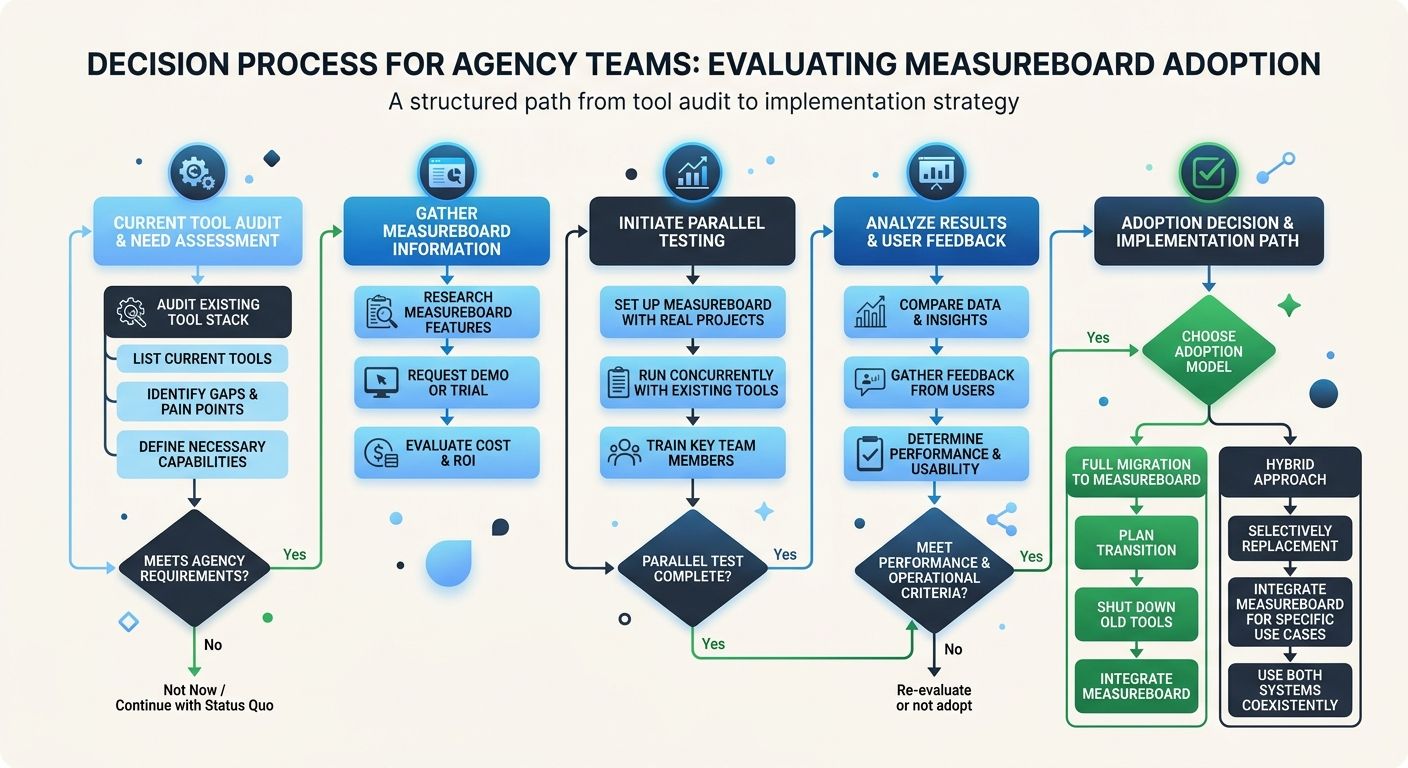
If you're running an agency or managing an in-house SEO team, here's what I'd recommend based on MeasureBoard's launch and the broader shift toward AI-driven marketing automation tools for agencies:
Audit your current tool spend. Open a spreadsheet right now and list every SEO tool subscription your team pays for. Include the monthly cost, what it's actually used for, and how many hours per week your team spends inside it. Most agencies I audit discover at least two tools with significant feature overlap. This is the essential first step in evaluating any MeasureBoard SEO alternative claim.
Test MeasureBoard's free tier. There's zero financial risk. Connect it to one client's Google Analytics and Search Console data and run it alongside your existing tools for 30 days. Compare the AI-generated reports against what your team produces manually. If the quality is comparable, you've found your first automation win.
Identify your highest-cost manual workflows. Rank tracking, monthly reporting, technical audit preparation, and competitor monitoring are the usual suspects. Map out exactly how many touches each workflow requires from a human. Any process with more than three manual handoffs is a candidate for automation.
Don't abandon specialized tools yet. MeasureBoard's pitch is about consolidation, and that's appealing. But if you rely heavily on specific technical crawling features or advanced link analysis, keep those tools until you've verified MeasureBoard handles your edge cases. The comparison between standalone tools and full-service platforms is worth revisiting as you evaluate.
Recalculate your service pricing. If automation cuts your delivery costs by 20-30%, you have two options: increase your margins or reduce your prices to win more clients. Both are valid, but you need to decide intentionally. I've seen agencies accidentally deflate their pricing by passing all savings to clients instead of reinvesting in growth.
My Bottom-Line Take
MeasureBoard is entering a market that's hungry for exactly what it's selling. Agencies are tired of paying for six different tools, tired of manual reporting, and tired of losing margin to operational inefficiency. The agentic AI approach, where the tool proactively analyzes and reports instead of waiting for you to ask, is the right design philosophy for agency teams that are already stretched thin.
But I've been in this industry for 12 years, and I've watched plenty of promising platforms launch strong and then stall on feature development or struggle with data accuracy at scale. MeasureBoard's free tier makes it low-risk to test. The question is whether the platform matures fast enough to earn permanent spots in agency tech stacks before established players like Ahrefs, Semrush, and BrightEdge bolt on similar AI automation layers of their own.
My advice: test it now, before your competitors do. The agencies that figure out AI-powered workflow automation first will have a structural cost advantage that's very hard to claw back. And if MeasureBoard doesn't deliver? You'll have learned exactly which parts of your workflow are ripe for automation, which makes evaluating the next platform that much easier.
That's not a bad outcome either way.
Marcus Webb
Digital marketing consultant and agency review specialist. With 12 years in the SEO industry, Marcus has worked with agencies of all sizes and brings an insider perspective to agency evaluations and selection strategies.
Explore more topics