
The SEO Agency Transition Playbook: Parallel Running, Data Migration, and Risk Mitigation in 2026
A $4.2 million e-commerce brand I consulted for fired their SEO agency on a Friday, onboarded a new one the following Monday, and watched organic traffic drop 38% over six weeks. Nobody had mapped redirect chains. The old agency's custom schema markup disappeared during a theme update.
 Marcus Webb··9 min read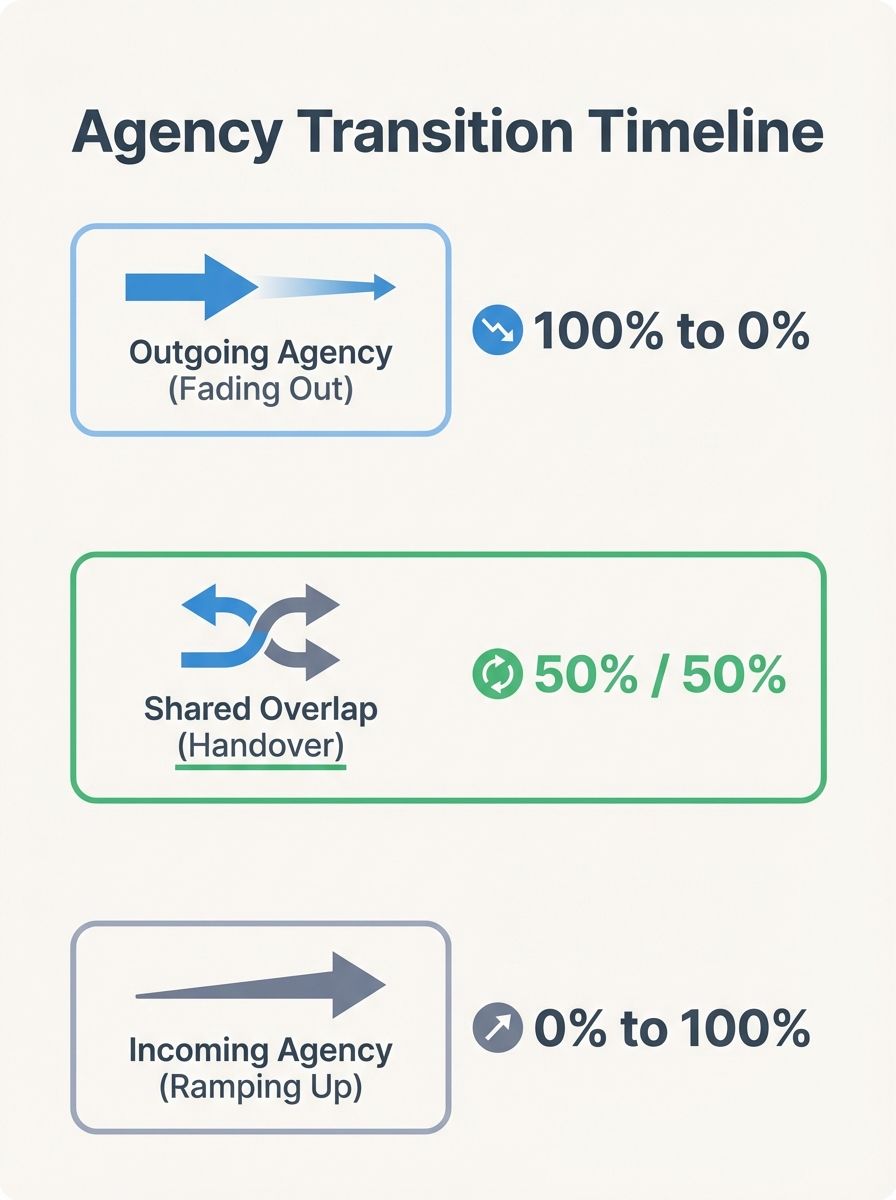
The SEO Agency Transition Playbook: Parallel Running, Data Migration, and Risk Mitigation
A $4.2 million e-commerce brand I consulted for fired their SEO agency on a Friday, onboarded a new one the following Monday, and watched organic traffic drop 38% over six weeks. Nobody had mapped redirect chains. The old agency's custom schema markup disappeared during a theme update. And three months of link-building outreach contacts vanished because they lived in the former agency's proprietary CRM. The client blamed the new agency. The new agency blamed the old one. The real problem? There was no transition plan. Just a switch flip.
I've evaluated over 200 SEO agencies in my career, and I can tell you that the moment of greatest risk isn't when an agency does bad work. It's when you swap one agency for another without a structured handoff. The SEO agency transition is where rankings go to die, and most businesses treat it like canceling one subscription and starting another.
This playbook exists because I'm tired of watching companies lose months of progress during what should be a routine operational change.
Why Most Agency Transitions Fail Before They Start
The core problem is that SEO work isn't a product you receive in a box. It's an ongoing collection of strategies, relationships, technical configurations, and institutional knowledge. When you cut ties with an agency, you're not just ending a contract. You're potentially severing access to:
Historical performance data and reporting dashboards
Backlink outreach relationships and contact databases
Custom tracking configurations in Google Analytics and Search Console
Content calendars and keyword targeting roadmaps
Technical SEO fixes that were implemented but never documented
As Coast Digital points out in their agency handover guide, strategies and tactics are intellectual property. Your old agency won't hand over their SEO playbook. They'll give you access credentials and maybe a summary report, but the thinking behind decisions? That walks out the door with them.
This is why the "clean break" approach to switching agencies almost always results in a performance dip. You need overlap. You need parallel running.
The Case for Parallel Running SEO
Parallel running SEO means keeping your outgoing agency active for a defined overlap period while your incoming agency ramps up. Think of it like a relay race handoff. You don't stop running before the next person grabs the baton.
I recommend a minimum 30-day overlap for small businesses and 60-90 days for enterprise operations. Yes, you'll pay two agencies simultaneously. That cost is trivial compared to the revenue impact of a 30-40% organic traffic drop.
Here's what the overlap period should look like in practice:
Weeks 1-2: Audit and Documentation
The incoming agency conducts a full technical and strategic audit while the outgoing agency continues executing. The incoming team should run a complete crawl using tools like Screaming Frog or Sitebulb, as recommended in BFoundOnline's migration checklist, to benchmark the current state of internal links, redirects, and crawl efficiency.
During this phase, you need to extract and document everything from the outgoing agency:
Google Analytics property access and custom event configurations
Google Search Console ownership (not just user access)
All third-party tool logins and API keys
Active link-building campaigns and pending outreach
Content publication schedules and draft assets
Any custom scripts, schema markup, or server-side configurations they implemented
Weeks 3-4: Shadow Operations
The incoming agency begins developing their strategy while observing the outgoing agency's active campaigns. They're not making changes yet. They're watching, learning, and building their own baseline understanding. If you're working with an enterprise site, this is when the new team should be auditing technical SEO configurations to identify what's working and what needs to change.
Weeks 5-8 (Enterprise): Gradual Handoff
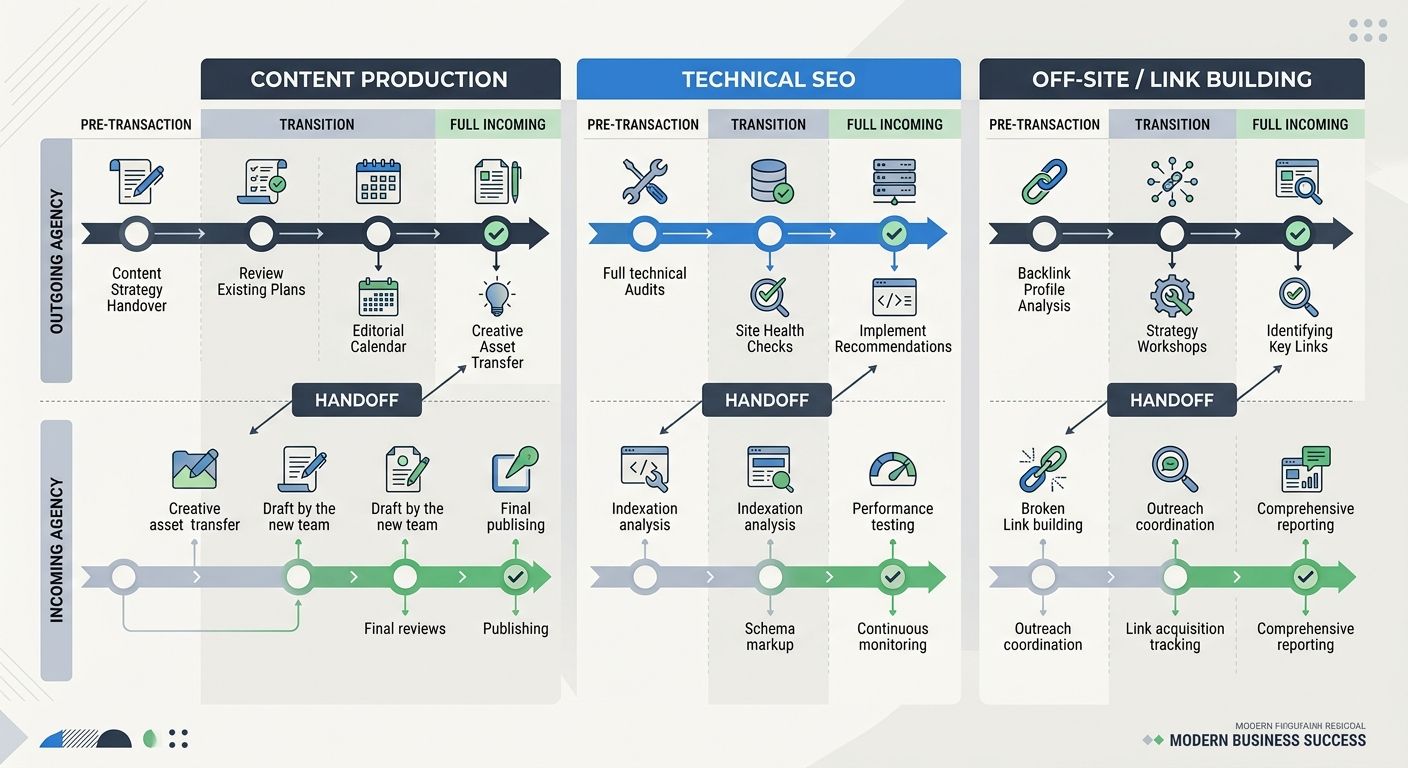
Responsibilities shift one by one. Content production moves first. Then technical SEO management. Link building transfers last because relationship continuity matters most there.
Agency Data Migration: What to Move and What You'll Lose
Agency data migration is the most technically demanding part of any transition, and it's where I see the most costly mistakes. The challenge isn't just moving data. It's knowing which data matters and ensuring continuity of measurement.
The Non-Negotiable Data Assets
Google Search Console and Analytics ownership. If your agency set up these properties, you might only have viewer access. Before any transition begins, ensure your company email is the verified owner of all Google properties. Not a user. The owner. I've seen agencies hold Search Console access hostage during contentious departures.
Historical ranking data. Most agencies track rankings through third-party tools tied to their own accounts. Once the contract ends, that historical data disappears. Request full data exports, including keyword positions, search volume trends, and SERP feature tracking, in CSV or spreadsheet format before the relationship ends.
Backlink profiles and disavow files. If the outgoing agency submitted a disavow file to Google, you need that file. A new agency starting fresh won't know which toxic links were previously flagged, and they might accidentally undo years of cleanup work.
Reporting baselines. As AgencyDashboard's tracking guide emphasizes, you need baseline benchmarks so the incoming agency can show measurable improvement from the start of their contract. Without them, you're flying blind for the first quarter.
The Measurement Gap Problem
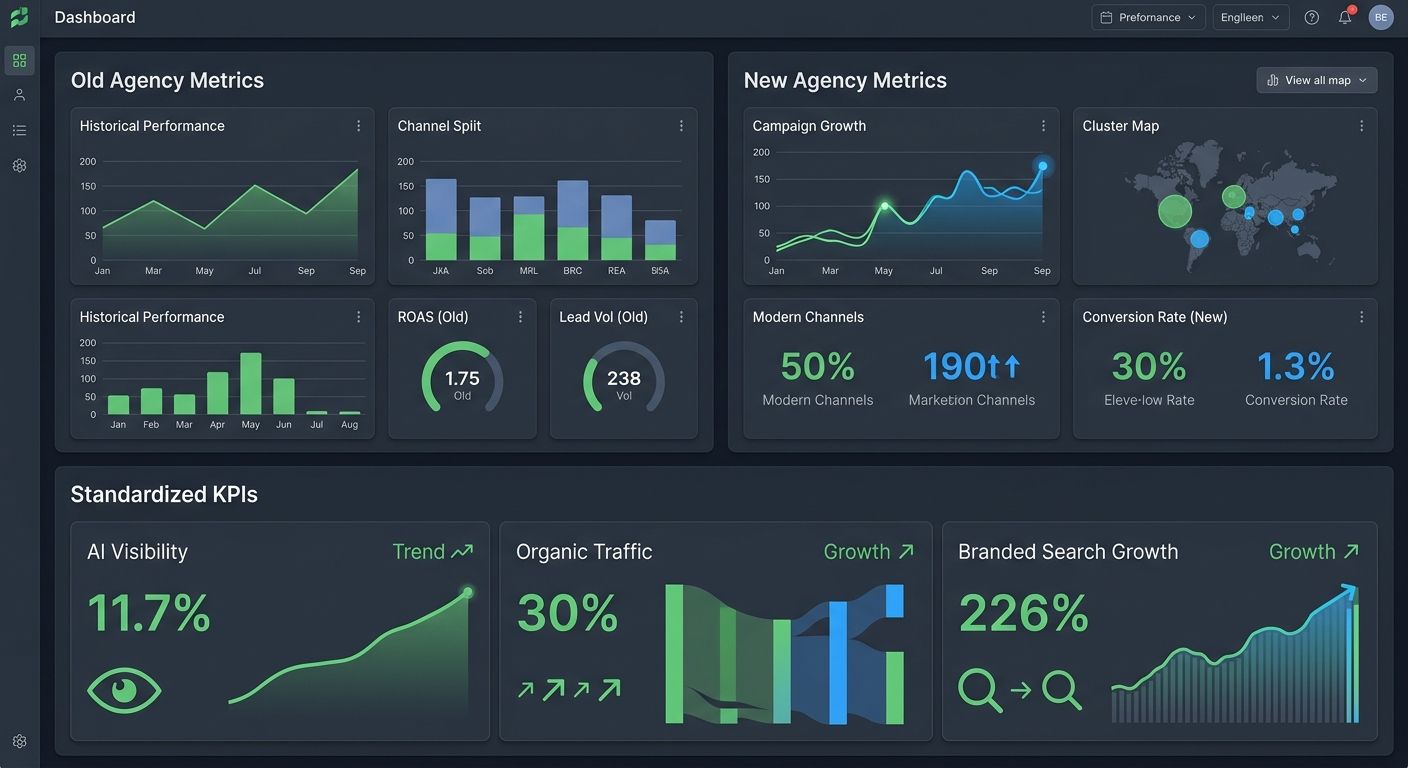
Here's a problem most people don't anticipate: your old and new agencies will almost certainly measure success differently. One might track 500 keywords across three tools. The other might focus on 200 keywords in a single platform. Their definitions of "organic traffic" might differ based on filtering and attribution settings.
Before the outgoing agency exits, align on a shared measurement framework. Use a centralized reporting platform like Swydo, AgencyAnalytics, or Looker Studio to combine data from multiple properties with standardized naming conventions and conversion goals. This gives you a source of truth that survives the transition.
And don't forget about AI visibility metrics. With zero-click searches now accounting for roughly 69% of queries and AI Overviews reaching 2 billion monthly users, your measurement framework needs to track impression share in AI-generated results, not just traditional rankings. Some agencies are already incorporating GEO measurement into proprietary software to give clients an accurate picture of how they're being cited in AI summaries.
SEO Handoff Risks: The Threats Nobody Warns You About
Every SEO handoff carries risk. But some risks are predictable and preventable if you know where to look. Here are the five most dangerous ones I've seen across dozens of agency transitions.
1. The "Strategy Vacuum" Period
Between the old strategy ending and the new one beginning, there's a gap where nobody is actively optimizing. Content stops publishing. Technical fixes stall. Link-building outreach goes silent. Google notices. Your competitors don't take a break because you're reorganizing.
Mitigation: The incoming agency should have a 90-day tactical plan ready before the outgoing agency departs. Not a grand strategy document. A week-by-week action plan covering content production, technical monitoring, and outreach continuity.
2. Redirect Chain Corruption
If your outgoing agency implemented redirects and the incoming agency adds their own layer without auditing what exists, you end up with redirect chains that slow crawling and dilute link equity. Even design changes can hurt SEO if they bury important text or remove internal links, as noted in BFoundOnline's migration best practices.
Mitigation: Run a full redirect audit during the overlap period. Map every 301, 302, and meta refresh. Consolidate chains into single-hop redirects.
3. Lost Schema and Structured Data
Agencies often implement custom schema markup as part of their technical SEO work. When they leave, nobody maintains it. Worse, a new agency might strip it out and start over, causing rich results to disappear from SERPs overnight. You shouldn't just migrate URLs; you need to migrate your structured data authority as well, including schema for local business info, product data, and FAQ content, as WebifyTech's migration guide makes clear.
Mitigation: Document all structured data implementations. Test with Google's Rich Results Test before and after the transition. If you're dealing with site migration issues during an agency switch, understanding the common SEO mistakes that sink websites during migrations becomes doubly important.
4. Penalty Inheritance Without Context
If the outgoing agency engaged in aggressive link building or other borderline tactics, the new agency inherits those risks without context. A manual action or algorithmic penalty might hit weeks after the transition, and the new agency won't know why.
Mitigation: Request a full disclosure of all link-building tactics, PBN usage, and any Google manual actions from the outgoing agency. Get it in writing.
5. Contractual Lock-In on Tools and Assets
Some agencies build your SEO infrastructure on their own accounts. Their Ahrefs subscription tracks your backlinks. Their Semrush project houses your keyword research. Their WordPress login manages your blog. When they leave, so does all of that.
Mitigation: Every tool, login, and digital asset should be owned by your company from day one. If your current setup doesn't reflect this, fix it before you start transition conversations. This is one of the critical evaluation criteria I recommend checking before you even sign with a new agency.
Building a Quarterly SEO Strategy That Survives Agency Changes
The best protection against transition disruption is building a quarterly SEO strategy framework that's agency-agnostic. This means your strategic direction, measurement benchmarks, and core processes live with your organization, not with whoever happens to be executing.
Here's the framework I recommend:
Quarter 1: Baseline and Alignment. Define your core keyword targets, content pillars, and technical requirements. Build a shared measurement dashboard that both your internal team and external agency can access. As WhitePress notes, defining roles, responsibilities, task order, and timelines up front is what makes strategy execution trackable and adaptable.
Quarter 2: Execute and Measure. Full-speed execution against the plan, with weekly performance check-ins. Document everything the agency does, not just the results.
Quarter 3: Evaluate and Adjust. Compare performance against Q1 baselines. Is the strategy working? Are the KPIs moving in the right direction? This is where you decide if the partnership is healthy or if transition planning needs to begin.
Quarter 4: Retain or Transition. If you're staying, plan Q1 of the next cycle. If you're leaving, begin parallel running with the new agency, targeting a handoff that completes before the next quarter starts.
This quarterly rhythm means you're never more than 90 days away from a natural transition point. Your data is organized. Your baselines are fresh. Your documentation is current.
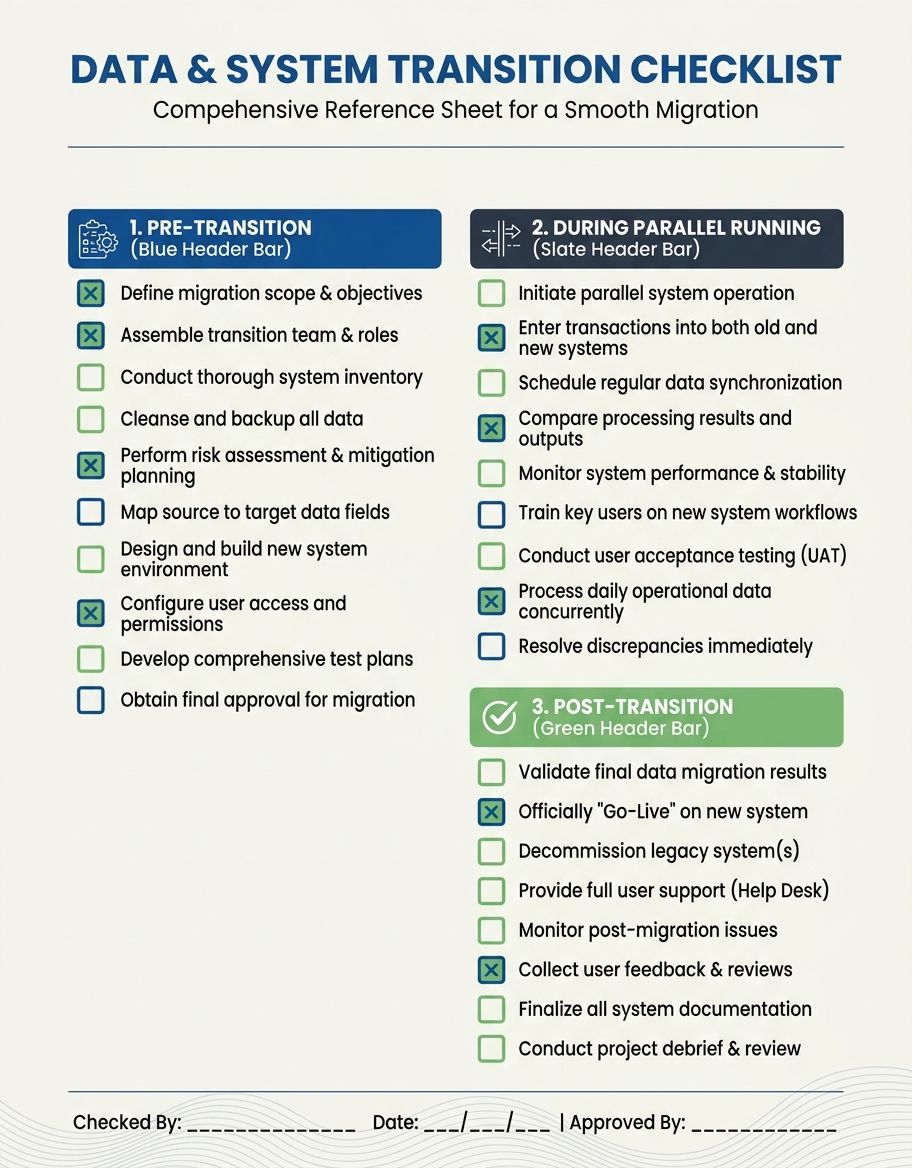
The 30-Point Transition Checklist
I've distilled everything above into a checklist I give to every client considering an agency switch. Print this. Share it with your team.
Pre-Transition (Before Signing with New Agency):
Verify company ownership of Google Search Console, Analytics, and Tag Manager
Export historical ranking data from outgoing agency's tools
Request all disavow files, redirect maps, and technical documentation
Audit current schema markup and structured data implementations
Confirm contractual obligations with outgoing agency (notice periods, data rights)
Define your quarterly strategy framework independent of any agency
During Parallel Running:
Establish shared measurement dashboard accessible to both agencies
Incoming agency conducts full technical crawl and content audit
Map all active campaigns, outreach contacts, and pending deliverables
Stagger responsibility transfer: content first, technical second, off-site last
Monitor key rankings daily during the overlap period
Document every configuration change with date stamps and rationale
Post-Transition (First 90 Days with New Agency):
Compare performance metrics against pre-transition baselines weekly
Validate all redirects resolve in a single hop
Confirm robots.txt and XML sitemaps reflect current site structure
Test all structured data with Rich Results Test
Verify Google Search Console settings match post-migration best practices
Run a full backlink audit to establish a clean starting point
The Real Cost of Getting This Wrong
I opened with a story about a $4.2 million brand that lost 38% of organic traffic during a botched transition. That traffic loss translated to roughly $127,000 in lost revenue over three months. The parallel running overlap they skipped would have cost about $8,000 in duplicate agency fees.
The math isn't complicated. Spend a little on a structured transition, or spend a lot recovering from a chaotic one.
Every SEO agency transition is a risk. But it's a manageable risk when you control the data, own the infrastructure, run agencies in parallel during the handoff, and build quarterly strategy rhythms that don't depend on any single vendor. Your SEO should belong to your business. Not to whoever's managing it this quarter.
Marcus Webb
Digital marketing consultant and agency review specialist. With 12 years in the SEO industry, Marcus has worked with agencies of all sizes and brings an insider perspective to agency evaluations and selection strategies.
Explore more topics