
Enterprise-Grade Technical SEO Audits vs. DIY Tools: When to Build vs. Buy in 2026
A mid-market SaaS client walked into my office with a 147-page "SEO audit" from their previous agency. Gorgeous formatting. Color-coded charts. Executive summary that read like a TED talk.
 Marcus Webb··9 min read
Enterprise-Grade Technical SEO Audits vs. DIY Tools: When to Build vs. Buy
A mid-market SaaS client walked into my office with a 147-page "SEO audit" from their previous agency. Gorgeous formatting. Color-coded charts. Executive summary that read like a TED talk. One problem: the audit was generated almost entirely by a $139/month Semrush subscription with default settings, then dressed up with the agency's logo. The client had paid $18,000 for it. When I dug into their actual crawl data, I found 34,000 orphaned pages the tool never flagged because nobody configured the crawl depth beyond the default. Those orphaned pages were cannibalizing their highest-revenue product categories. Eighteen grand, and the most damaging issue on the site went completely undetected.
This is the tension at the heart of every enterprise technical SEO audit conversation: the tools are better than ever, but the gap between "running a tool" and "conducting an audit" has never been wider. And the build-vs-buy decision isn't as simple as comparing subscription costs. It's about understanding where automated crawlers stop and where human expertise needs to take over.
I've evaluated over 200 SEO agencies and their audit methodologies over the past 12 years. Here's what I've learned about making this decision in a way that doesn't waste your budget.
The Real State of SEO Audit Tools in 2026
The tool landscape has matured significantly. According to testing by SEOmator across 40+ client projects, the top audit tools for agencies include SEOmator, SE Ranking, Screaming Frog, Surfer SEO, Serpstat, JetOctopus, and several others. Each handles different audit dimensions well, but none of them do everything.
Here's where the pricing shakes out at the enterprise tier, based on current market data from SEOLEVELUP:
Semrush Business: $499.95/month
Ahrefs Advanced: $449/month
Lumar (formerly DeepCrawl): Custom pricing, typically ~$500+/month
OnCrawl: Custom pricing, typically ~$600+/month
Screaming Frog: $259/year (desktop license, unlimited crawls)
That's a massive price spread. And the cheapest option on that list, Screaming Frog, is arguably the most powerful for hands-on technical auditors who know what they're doing. The expensive options justify their price through cloud-based crawling at scale, CI/CD integration, and collaborative dashboards.
But here's what nobody selling you a tool will admit: the tool is maybe 30% of a real enterprise audit. The other 70% is the methodology, the prioritization framework, and the human who interprets the data.
What Actually Makes an Enterprise Audit "Enterprise-Grade"
I cringe when I see agencies slap "enterprise" on their audit deliverables just because they ran a crawl on a big site. An actual enterprise technical SEO audit differs from a standard audit in several specific, measurable ways.
Scale and Crawl Architecture
Enterprise sites routinely have 100,000+ URLs. Many have millions. A desktop crawler running on your laptop will choke on this. But the bigger issue isn't raw crawl volume. It's JavaScript rendering at scale. After Google's December 2025 rendering update clarified that pages returning non-200 status codes may be excluded from the rendering pipeline entirely, the stakes for proper crawl configuration are higher than ever.
Cloud-based crawlers like Lumar and JetOctopus handle this by distributing rendering across server clusters. If you're doing technical SEO at scale, you need infrastructure that can render JavaScript the way Googlebot does, not just fetch raw HTML.
Blended Data Integration
The Screaming Frog team recommends using their SEO Spider's API connectors to pull data from Ahrefs, Google Search Console, and other platforms directly into the crawl. This is the right approach, but it requires someone who knows which data sources matter for your specific business model.
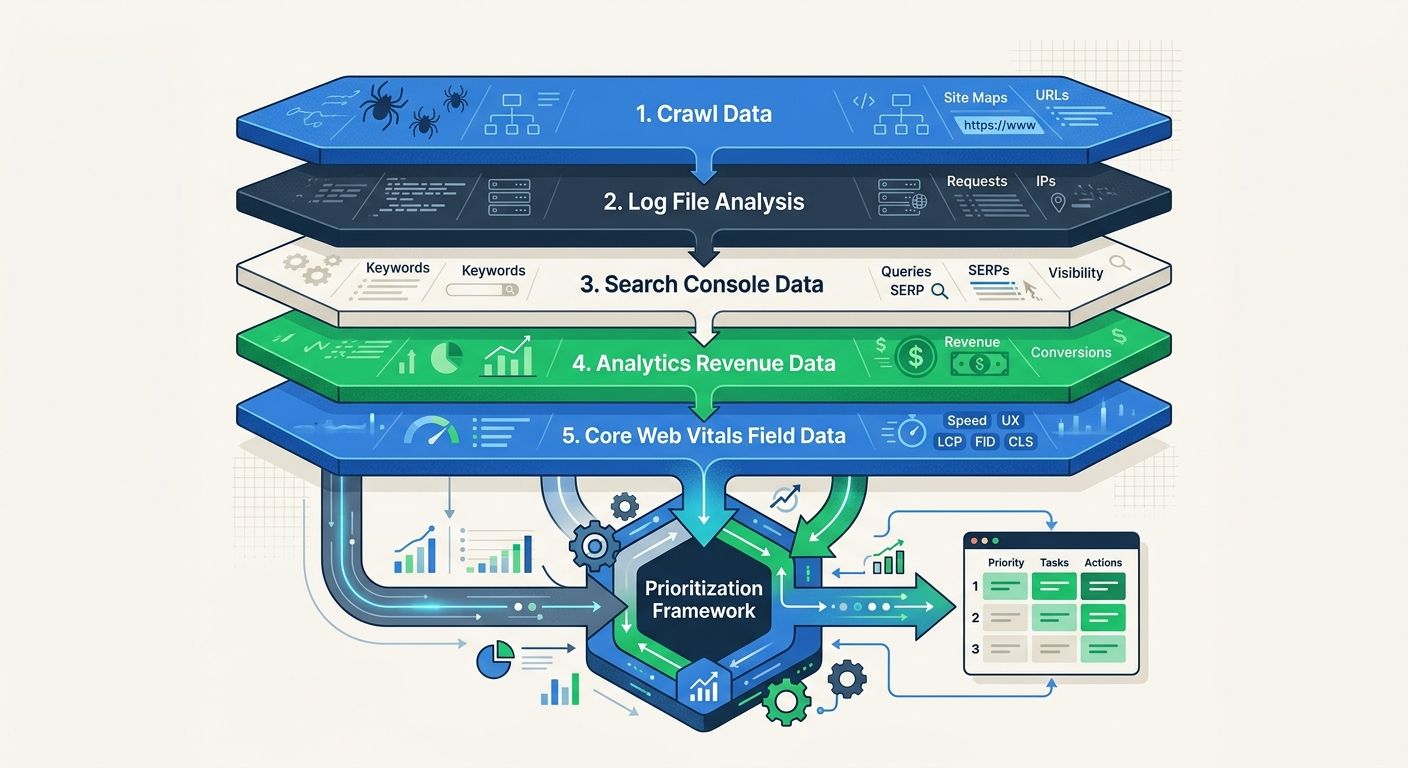
A proper enterprise audit blends:
Crawl data (indexability, rendering, internal linking)
Log file analysis (actual Googlebot behavior vs. assumed behavior)
Search Console performance data (impressions, clicks, CTR by template)
Analytics data tied to revenue outcomes
Core Web Vitals field data (not just lab scores)
The shift to Interaction to Next Paint (INP) replacing First Input Delay has made this even more critical. Sites with INP scores above 200 milliseconds face measurable ranking headwinds, and the only way to diagnose INP issues properly is by combining field data with JavaScript execution analysis. If you're auditing mobile-specific ranking blockers, INP is now the metric that trips up the most enterprise sites.
KPIs That Actually Matter
According to Sugar Pixels' enterprise audit framework, the KPIs that separate real enterprise audits from glorified crawl reports include intended page indexation rates, crawl efficiency ratios, non-brand organic conversions by site section, render success rates for key templates, and time-to-index for newly published priority pages.
If your audit report doesn't include at least three of those, you're getting a standard audit with an enterprise price tag.
When Building Your Own Audit Process Makes Sense
Building an in-house proprietary SEO framework isn't crazy. For some organizations, it's the smartest move. But you need to be honest about what it requires.
The Real Cost of DIY
The tool cost is the easy part. Screaming Frog at $259/year plus a Search Console API integration gets you surprisingly far. The expensive part is the human capital.
A competent in-house technical SEO analyst who can build and maintain an enterprise audit process will cost you $85,000-$130,000/year in salary, depending on market. You'll also need them to spend 2-3 months building the methodology before producing anything useful. And they'll need ongoing training as Google's systems evolve. The agency landscape is shifting rapidly toward API-first approaches that replace sprawling tool subscriptions, and your in-house team needs to keep pace.
Here's when DIY genuinely makes sense:
Your site has fewer than 50,000 indexable URLs
You have existing engineering resources who can help with log file analysis and crawl infrastructure
Your technical SEO needs are specific to your tech stack (e.g., you run a headless CMS with custom rendering)
You audit frequently enough (monthly or more) to justify the fixed cost
You're willing to invest in training, not just tools
The DIY Stack I'd Recommend
If you're going down this road, here's the stack I've seen work best for teams doing it themselves:
Screaming Frog ($259/year) as your primary crawler with API integrations configured
Google Search Console (free) for indexing and performance data
Lighthouse CI (free) for automated Core Web Vitals monitoring in your deployment pipeline
A log file analysis tool like Screaming Frog's Log File Analyzer or a custom ELK stack setup
BigQuery or a similar data warehouse for blending crawl data with analytics and business metrics
Total tool cost: under $1,000/year. Total human cost: that's where it gets real.
When Hiring an Agency or Buying Enterprise Tools Is Worth It
When Enterprise Tools Justify Their Price
Cloud-based enterprise crawlers earn their $500-$600/month price tags when you need:
Pre-deployment SEO testing integrated into CI/CD pipelines
Crawling more than 500,000 pages with JavaScript rendering
Multi-user collaboration with role-based access
Automated monitoring with alert thresholds for regressions
Historical crawl comparison to track changes over time
Semrush's testing data shows that their audit tool checks 140+ on-page and technical issues, and fixing meta tag issues alone can raise site health scores by six points. That's useful. But the real value of enterprise platforms is the crawl comparison feature, which lets you verify that fixes actually moved the needle.
The enterprise SEO tool market in 2026 has shifted the playbook significantly, with platforms increasingly integrating CRM and sales data to connect SEO performance to revenue.
When Hiring an Agency Makes Sense
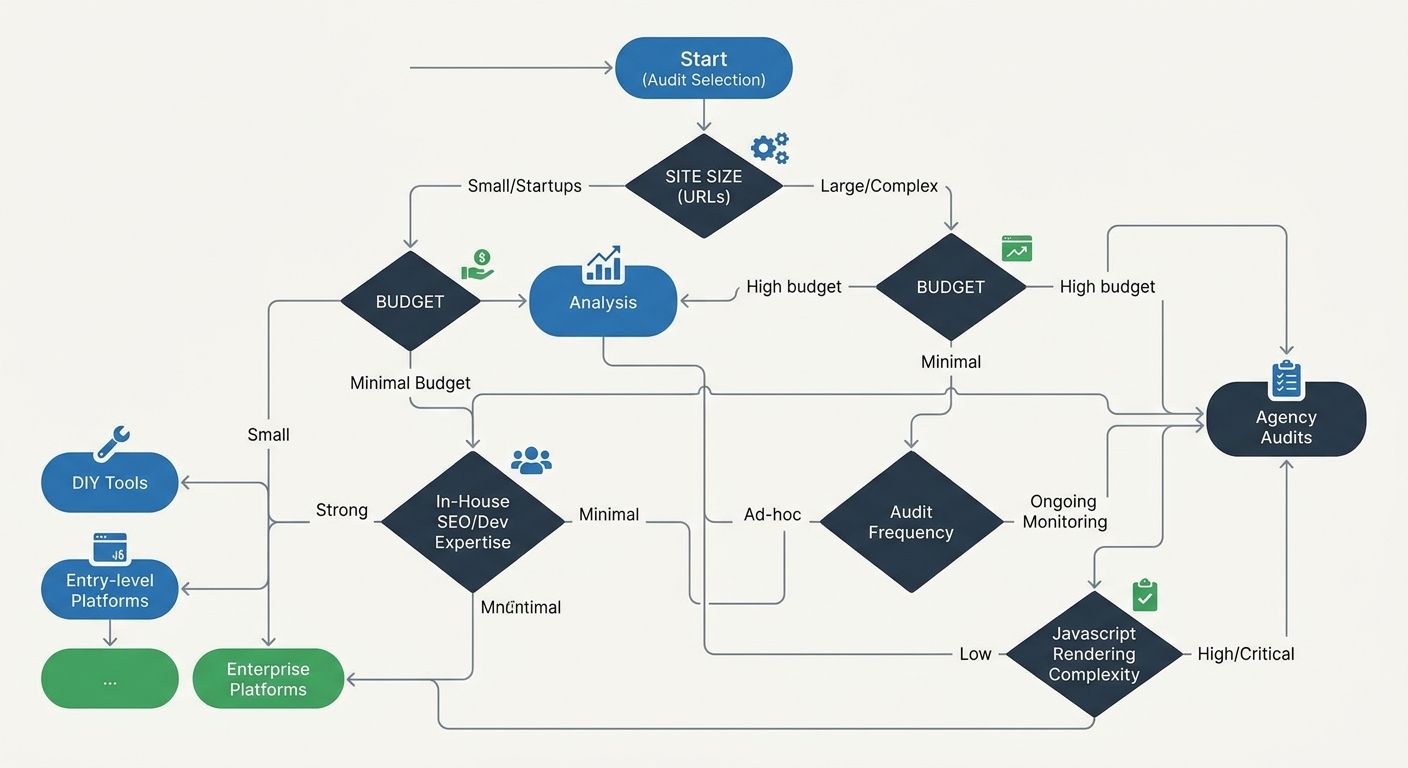
This is where my 12 years of evaluating agencies pays off. An agency audit makes sense when:
You need an outside perspective to cut through internal politics ("Our dev team says the site is fine")
You're dealing with a site migration, redesign, or platform change
Your team lacks log file analysis or JavaScript rendering expertise
You need the audit to serve as a business case for executive buy-in
You want accountability baked into the engagement
A credible agency audit for an enterprise site typically costs $8,000-$25,000 as a one-time engagement, or $3,000-$7,000/month for ongoing monitoring with quarterly deep-dives. If you're comparing those numbers against your full tool and staffing costs, the math often favors the agency for the first 12-18 months while you build internal capability.
But — and this is critical — you need to vet the agency audit methodology before signing. I've written extensively about evaluation criteria beyond case studies, and the audit methodology question is one of the most revealing. Ask specifically:
Do they perform log file analysis, or just tool-based crawling?
How do they handle JavaScript rendering in their audit process?
What data sources do they blend beyond the crawl output?
How do they prioritize findings (effort vs. impact vs. risk)?
Can they show you a redacted sample audit from a similar-sized site?
If the answer to the log file question is "we don't do that," walk away. Log file analysis is the single most underrated component of enterprise auditing, and it's the one thing DIY tool users almost never do.
The Hybrid Model: What Smart Enterprise Teams Actually Do
Here's what I see working best across the organizations I advise: they don't pick one path exclusively. They build a hybrid.
The typical setup looks like this:
In-house team owns ongoing monitoring using Screaming Frog and Search Console, running weekly crawls and watching for regressions
Enterprise platform (Lumar or JetOctopus) handles pre-deployment testing in the CI/CD pipeline and provides the crawl infrastructure for the full site
Agency partner conducts quarterly deep-dive audits that go beyond what tools surface, with log file analysis, competitive gap analysis, and executive-ready prioritization
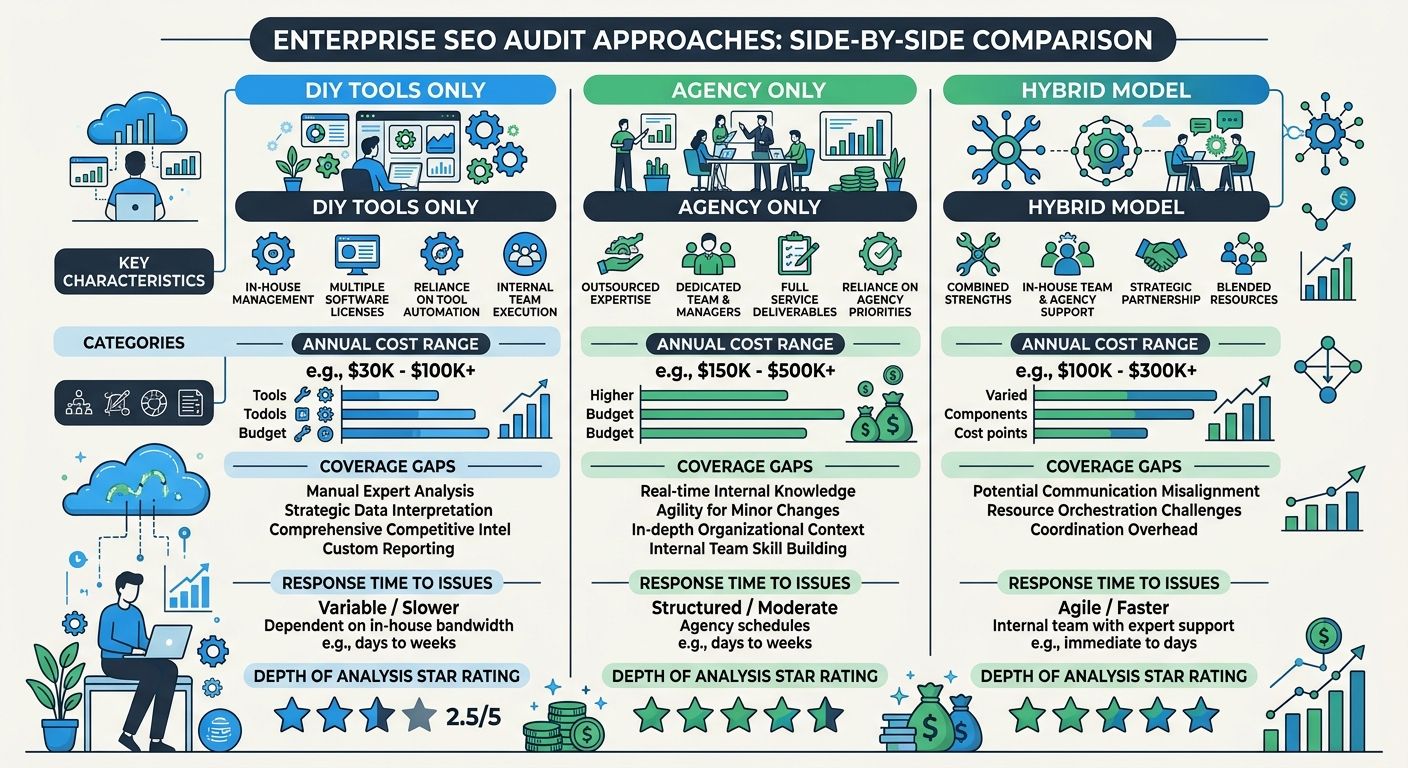
This hybrid approach costs more than any single path in isolation, but it catches more. The in-house team handles velocity. The platform handles automation. The agency handles depth. Each fills a gap the others can't.
When the March 2026 Core Update hit, the clients I work with who had this hybrid setup identified the impact within 48 hours and had a recovery prioritization plan in place within a week. Clients relying solely on monthly agency reports? They didn't even know they'd been hit until traffic reports came in two weeks later.
Budget Breakdown for the Hybrid Model
For a mid-enterprise site (200,000-1,000,000 indexable pages):
In-house SEO analyst: $95,000-$120,000/year
Enterprise crawl platform: $6,000-$7,200/year
Quarterly agency audits: $20,000-$40,000/year
Total: $121,000-$167,200/year
Compare that to a full-service agency retainer that includes auditing: $60,000-$120,000/year. The hybrid costs more, but you own the capability. When your agency relationship ends, you don't start from zero.
If you're trying to compare those numbers against a pure tool-stack approach, I've seen a thorough breakdown of SEO tool costs versus full agency pricing that helps frame the decision.
What This Changes About How You Approach Enterprise Audits
Don't confuse tool output with an audit. A Semrush scan is a starting point, not a deliverable. Real SEO audit tools comparison should evaluate what the tool can't do, not just what it can.
Log file analysis is non-negotiable at enterprise scale. If your current process doesn't include it, you're flying blind on crawl budget and bot behavior.
INP has replaced FID. Your audit process needs to include field data analysis for this metric, not just Lighthouse lab scores.
The hybrid model wins for most enterprise organizations. In-house monitoring + enterprise platform + quarterly agency deep-dives covers all the gaps.
Budget $120K-$170K/year for a proper hybrid setup on a mid-enterprise site. If that number makes you flinch, a full-service agency retainer at $60K-$120K/year is a reasonable alternative while you build internal capability.
Always audit the auditor. Ask about log files, JavaScript rendering, data blending, and prioritization methodology before you sign anything.
The $18,000 audit I mentioned at the top? My client eventually got the orphaned page issue fixed, recovered about $340,000 in annual revenue from those cannibalized product pages, and built an in-house monitoring process so they'd never miss something like that again. The tool wasn't the problem. The absence of a real methodology was. Make sure you're buying the methodology, not just the dashboard.
Marcus Webb
Digital marketing consultant and agency review specialist. With 12 years in the SEO industry, Marcus has worked with agencies of all sizes and brings an insider perspective to agency evaluations and selection strategies.
Explore more topics