
How Philippine SEO Agencies Are Disrupting the Global Market with Lower Costs and Higher ROI
A client I worked with in 2024 was paying $8,500/month to a mid-tier agency in Chicago. Their organic traffic had flatlined for eleven months. The agency kept sending glossy decks full of keyword rankings that didn't move the revenue needle.
 Marcus Webb··8 min read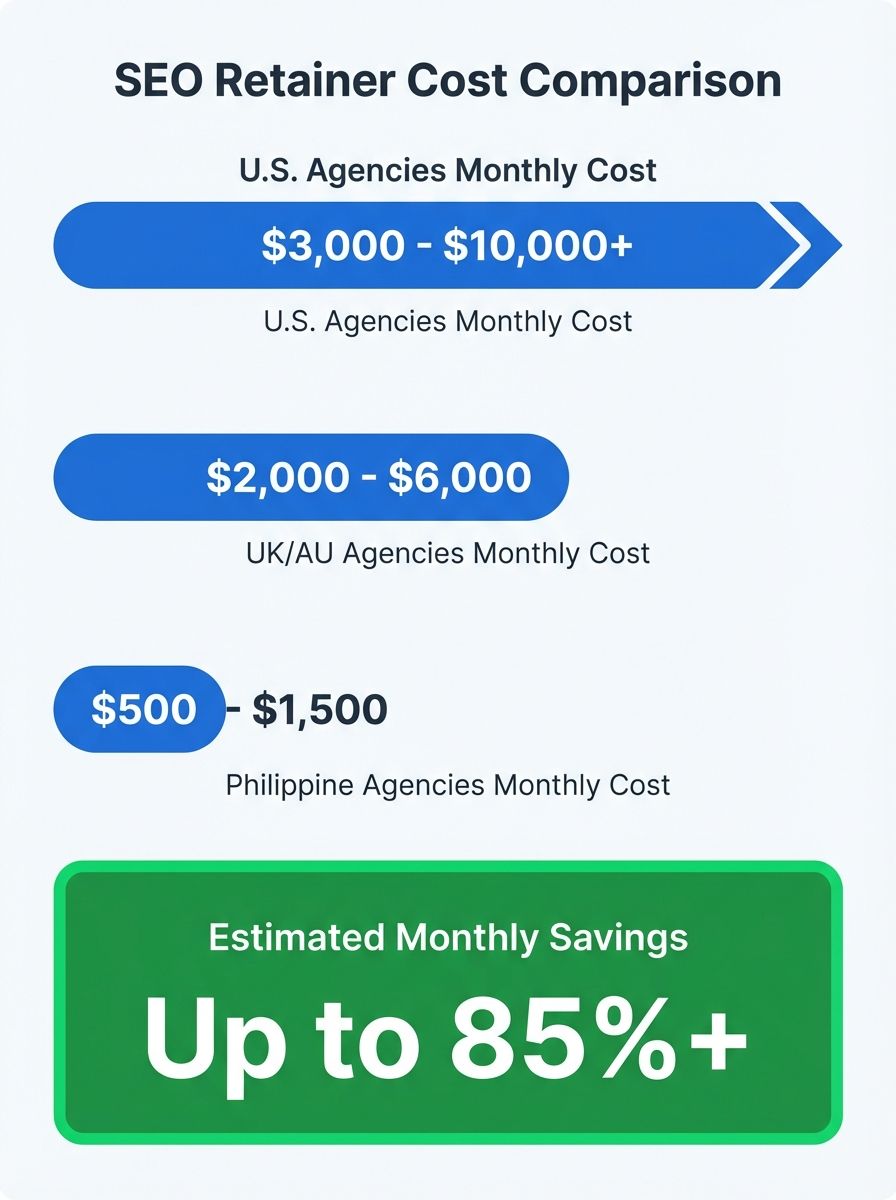
How Philippine SEO Agencies Are Disrupting the Global Market with Lower Costs and Higher ROI
A client I worked with in 2024 was paying $8,500/month to a mid-tier agency in Chicago. Their organic traffic had flatlined for eleven months. The agency kept sending glossy decks full of keyword rankings that didn't move the revenue needle. When we finally audited their account, we found duplicate meta descriptions on 340 product pages, orphaned blog content no one had touched in six months, and a link building strategy that consisted of... three guest posts. Total. For the entire year.
That client now works with a Philippine SEO agency. They pay $3,200/month. Their organic revenue is up 47% in eight months.
I'm not telling you this to trash domestic agencies. I've run operations inside one. But when I look at the math behind SEO outsourcing Philippines and compare it against what most Western agencies actually deliver for their price tags, the disruption happening right now isn't subtle. It's a full-scale restructuring of how smart businesses allocate their SEO budgets.
The Cost Gap Is Wider Than You Think
Let's talk real numbers, because that's where the conversation gets uncomfortable for a lot of agencies in the U.S., UK, and Australia.
The average annual cost of an in-house SEO specialist in the U.S. hovers around $65,000. That's salary alone. Add benefits, tools, management overhead, and you're looking at $85,000–$100,000 fully loaded. An agency in a major U.S. metro? You're paying $5,000–$15,000/month for a mid-range retainer, and a good chunk of that covers the agency's own office rent, account management layers, and profit margins.
Philippine SEO agencies operate in a fundamentally different cost environment. As GlenDemands notes, the competitive job market and lower cost of living mean Filipino SEO professionals earn a fraction of their Western counterparts. This isn't about paying people unfairly. The cost of living in Manila or Cebu simply makes $1,500–$4,000/month retainers sustainable for agencies that employ skilled, full-time teams.
Here's what that looks like in practice:
U.S. agency retainer (mid-tier): $5,000–$12,000/month
UK agency retainer (mid-tier): £3,000–£8,000/month
Philippine agency retainer (mid-tier): $1,500–$4,000/month
Cost savings: 50–70% depending on scope
And before you say "you get what you pay for," hold that thought. I've got case studies to show you.
The ROI Numbers Don't Lie
One case study that keeps coming up in my agency evaluations: a digital agency in Australia outsourced technical SEO tasks to the Philippines and cut costs by 50% while actually improving client results. Not maintaining. Improving.
I've seen similar patterns across multiple clients I've advised. A U.S.-based e-commerce brand reported a 60% increase in organic traffic within six months of switching to a Philippine team. Industry benchmarks suggest businesses partnering with Filipino SEO teams achieve an average ROI around 250%.
So why does this happen? Why would a cheaper service produce equal or better outcomes?
Three reasons:
Specialization over generalization. Many Philippine SEO agencies don't try to be full-service digital marketing shops. They focus specifically on SEO, which means their teams develop deep expertise rather than spreading thin across social media, PPC, and email marketing.
Tool access without markup. When you work with a Western agency, you're indirectly paying for their Ahrefs, SEMrush, and Screaming Frog licenses. Philippine agencies provide access to these same enterprise tools but at a lower overall service cost. The tools are identical. The analysis is identical. The overhead isn't.
Hunger and accountability. This is the one nobody talks about. The Philippine SEO market is fiercely competitive. Agencies there know that if they don't deliver measurable results, their international clients will move on fast. That competitive pressure produces a results-driven culture I don't always see in agencies that coast on long contracts and brand reputation.
If you're curious about how to properly compare the true cost of agencies against tool stacks, that analysis applies directly here. The gap becomes even more dramatic when you factor in offshore pricing.

The Talent Pipeline Is Real
The Philippines ranks 22nd globally in the EF English Proficiency Index. That matters enormously for SEO, where content quality, keyword nuance, and communication with English-speaking clients are non-negotiable.
I'll be honest: I was skeptical about this when I first started evaluating Philippine SEO agencies around 2019. My concern was the same one every Western marketer has. "Can they really write content that resonates with American or British audiences?"
After reviewing work from dozens of Filipino SEO teams, my skepticism evaporated. The best Philippine agencies produce content that's indistinguishable from what a skilled U.S.-based writer would create. And for technical SEO? The work is often more thorough, because the teams tend to be methodical and process-driven in ways that remind me of engineering cultures.
The talent pipeline is fed by several factors:
BPO industry infrastructure. The Philippines has been the world's call center capital for over a decade. That infrastructure created a workforce comfortable with Western communication styles, time zone flexibility, and remote collaboration.
Growing digital marketing education. Universities and certification programs have expanded dramatically. Filipino SEO professionals commonly hold Google Analytics, Google Ads, HubSpot, and SEMrush certifications.
Conference culture. Events like MORCon and PeepCon have built a legitimate SEO knowledge community. As SharpRocket points out, legitimate Philippine agencies demonstrate visibility through guest posts, podcast appearances, and conference talks.
What Services Actually Look Like on the Ground
When people hear "offshore SEO services," they sometimes imagine a content farm churning out 500-word blog posts stuffed with keywords. That's a 2012 stereotype, and it's dangerously outdated.
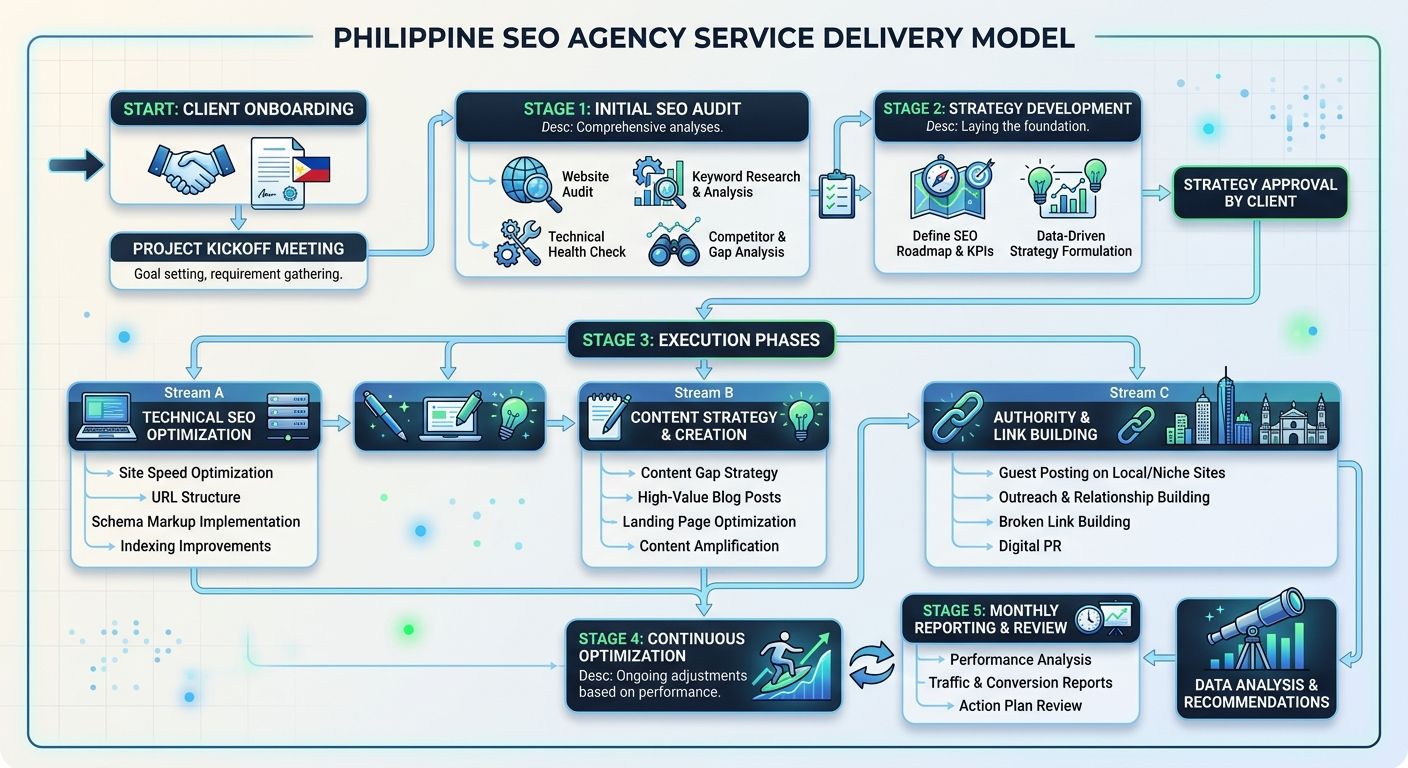
Here's what a modern Philippine SEO engagement typically includes:
Technical SEO
Mobile-first optimization is practically a default. With 87.64% of web traffic in the Philippines coming from mobile devices, Filipino SEO teams have been forced to think mobile-first longer and harder than many Western agencies. They're experienced with Core Web Vitals audits, site architecture optimization, and crawl budget management. If you've been working through technical SEO audit decisions, a Philippine team can execute those audits at a fraction of the cost.
Content Strategy and Production
The best agencies build content clusters, not just blog posts. They map search intent, build topical authority plans, and produce content that targets featured snippets and AI Overviews. English fluency is a prerequisite, not a bonus.
Link Building
This is where you need to be careful. Quality varies wildly. The top agencies build links through genuine outreach, guest posting, and digital PR. The bottom-tier ones still sell PBN links and directory submissions. Your vetting process here needs to be ruthless.
Reporting and Analytics
Monthly performance reports with organic sessions, conversion rates, keyword movement, and revenue attribution are standard from serious Philippine agencies. Many now include "Answer Share" metrics for AI search visibility.
How to Vet Philippine SEO Agencies (Without Getting Burned)
Here's where my agency evaluation experience becomes directly relevant. I've reviewed over 200 agencies across multiple countries, and the vetting principles are universal. But there are specific red flags and green flags unique to SEO outsourcing Philippines.
Green Flags
They rank for their own keywords. A Philippine SEO agency that can't rank for "SEO services Philippines" or related terms in their own market is a red flag. Check their organic visibility before you check their pitch deck.
Published case studies with real metrics. Not "we increased traffic 300%." Actual numbers. Revenue impact. Time frames. Client names or at least industries.
White hat practices documented. Sortlist's reviews of Philippine agencies emphasize looking for companies with a strong track record and adherence to search engine guidelines. Sustainable results require sustainable practices.
Ongoing training investment. The agencies worth hiring invest in continuous learning because algorithms change constantly. Ask what certifications their team holds and when they last updated their processes.
Red Flags
Guaranteed rankings. Any agency, Philippine or otherwise, that guarantees you'll rank #1 for a specific keyword is either lying or planning to use tactics that will get you penalized. I've written about what separates agencies that survive from those that don't, and this is always the dividing line.
No clear point of contact. You should have a named project manager who communicates in fluent English and is available during overlapping business hours.
Suspiciously cheap pricing. Yes, Philippine agencies are more affordable. But $200/month for "full SEO services" isn't a deal. It's a scam. Realistic pricing for quality work starts around $1,000–$1,500/month for small business engagements.
Vague deliverables. If the proposal says "SEO optimization" without specifying exactly what they'll do each month, walk away.
Contract Structures and What to Negotiate
Based on my evaluations, here's how most Philippine SEO agencies structure their engagements:
Month-to-month retainers: $1,500–$4,000/month for small to mid-size businesses. This is the most common structure and the one I recommend starting with. Never sign a 12-month lock-in with an agency you haven't tested.
Project-based pricing: $2,000–$8,000 for specific deliverables like technical audits, site migrations, or content overhauls. Good for defined scope work.
Dedicated team models: $2,500–$6,000/month for a dedicated SEO specialist or small team working exclusively on your account. Common for agencies using white-label SEO providers to fulfill client work.
Negotiate these terms upfront:
30-day termination clause. Non-negotiable. If they insist on 90 days, find someone else.
Ownership of all deliverables. Content, audit reports, strategy documents. Everything they produce should be yours.
Monthly reporting cadence. Define exactly which KPIs they'll track and report on.
Communication SLA. Response time expectations during overlapping business hours.
For businesses exploring seo services from the Philippines, these contract terms should be your baseline before any engagement begins.
The Competitive Landscape Is Maturing Fast
The Philippine SEO industry has gone through a significant natural selection process. As Outsourced.ph describes it, the current crop of agencies in the market are mostly survivors. The fly-by-night operations that sold cheap link packages and spun content have largely been weeded out by Google's algorithm updates and client attrition.
What's left is a maturing ecosystem of agencies that understand E-E-A-T, adapt to algorithm changes like Google's March 2026 Core Update, and build strategies around long-term organic growth rather than quick wins. The best Philippine agencies now compete not just on price, but on strategic thinking, technical capability, and measurable business outcomes.
This maturation is exactly why the disruption is accelerating. Price was the initial hook that got Western businesses to try offshore SEO services. Results are what's keeping them there.

Practical Takeaway: Your Decision Framework
If you're considering SEO outsourcing to the Philippines, here's my evaluation framework based on everything I've seen across 200+ agency reviews:
Define your scope before you shop. Know whether you need technical SEO, content, link building, or all three. Philippine agencies specialize differently.
Request three proposals minimum. Compare deliverables line by line, not just total price.
Check their own SEO performance. Pull their domain into Ahrefs or SEMrush. If they can't grow their own organic traffic, they won't grow yours.
Start with a 90-day pilot. Give them a defined project with measurable outcomes. Don't commit your entire SEO operation until you've seen results.
Evaluate communication quality in the sales process. How fast do they respond? How clearly do they explain their approach? The sales experience is the best version of the relationship. If it's already rough, run.
The math is clear. The talent exists. The quality, for the right agencies, is there. Your job isn't to decide whether Philippine SEO agencies are worth considering. That debate is over. Your job is to pick the right one.
Marcus Webb
Digital marketing consultant and agency review specialist. With 12 years in the SEO industry, Marcus has worked with agencies of all sizes and brings an insider perspective to agency evaluations and selection strategies.
Frequently Asked Questions
- How much do Philippine SEO agencies cost compared to US agencies?
- Philippine SEO agencies typically charge $1,500–$4,000/month for mid-tier retainers, compared to $5,000–$12,000/month for US agencies and £3,000–£8,000/month for UK agencies. This represents 50–70% cost savings depending on scope.
- What ROI can you expect from a Philippine SEO agency?
- Businesses partnering with Filipino SEO teams achieve an average ROI around 250%, with some case studies showing 60% increases in organic traffic within six months and 47% organic revenue increases in eight months.
- Why do Philippine SEO agencies deliver better results despite lower costs?
- Philippine agencies typically specialize specifically in SEO rather than offering full-service digital marketing, provide access to enterprise tools without markup, and operate in a highly competitive market that drives results-focused practices and accountability.
- What red flags should I watch for when hiring a Philippine SEO agency?
- Avoid agencies that guarantee rankings, lack a clear English-speaking point of contact, offer suspiciously cheap pricing (under $1,000/month), or provide vague deliverables. Always request a sample technical audit before signing a contract.
- What contract terms should I negotiate with a Philippine SEO agency?
- Secure a 30-day termination clause, ensure you own all deliverables (content, reports, strategy documents), define a monthly reporting cadence with specific KPIs, and establish clear communication response time expectations during overlapping business hours.
- How can I verify that a Philippine SEO agency is legitimate?
- Check if they rank for their own keywords in search results, review published case studies with real metrics and time frames, verify they use white hat practices documented through certifications, and confirm they invest in ongoing training.
- What types of SEO services do Philippine agencies typically offer?
- Modern Philippine SEO agencies provide technical SEO (including mobile optimization and Core Web Vitals audits), content strategy with topical authority mapping, quality link building through genuine outreach, and monthly analytics reporting with revenue attribution.
- Why are English skills not a barrier for Philippine SEO agencies?
- The Philippines ranks 22nd globally in the EF English Proficiency Index, and the BPO industry infrastructure, growing digital marketing education, and SEO conference culture have created a workforce of skilled professionals who produce content indistinguishable from US-based writers.
Explore more topics