
The Content Production Standardization Framework: How SEO Agencies Can 2X Output Without Burning Out Teams
The gap between a 10-article-per-month agency and a 40-article-per-month agency has almost nothing to do with headcount. I've evaluated over 200 SEO agencies in my consulting career, and the ones doubling or tripling their output are choosing between three distinct scaling models.
 Marcus Webb··8 min read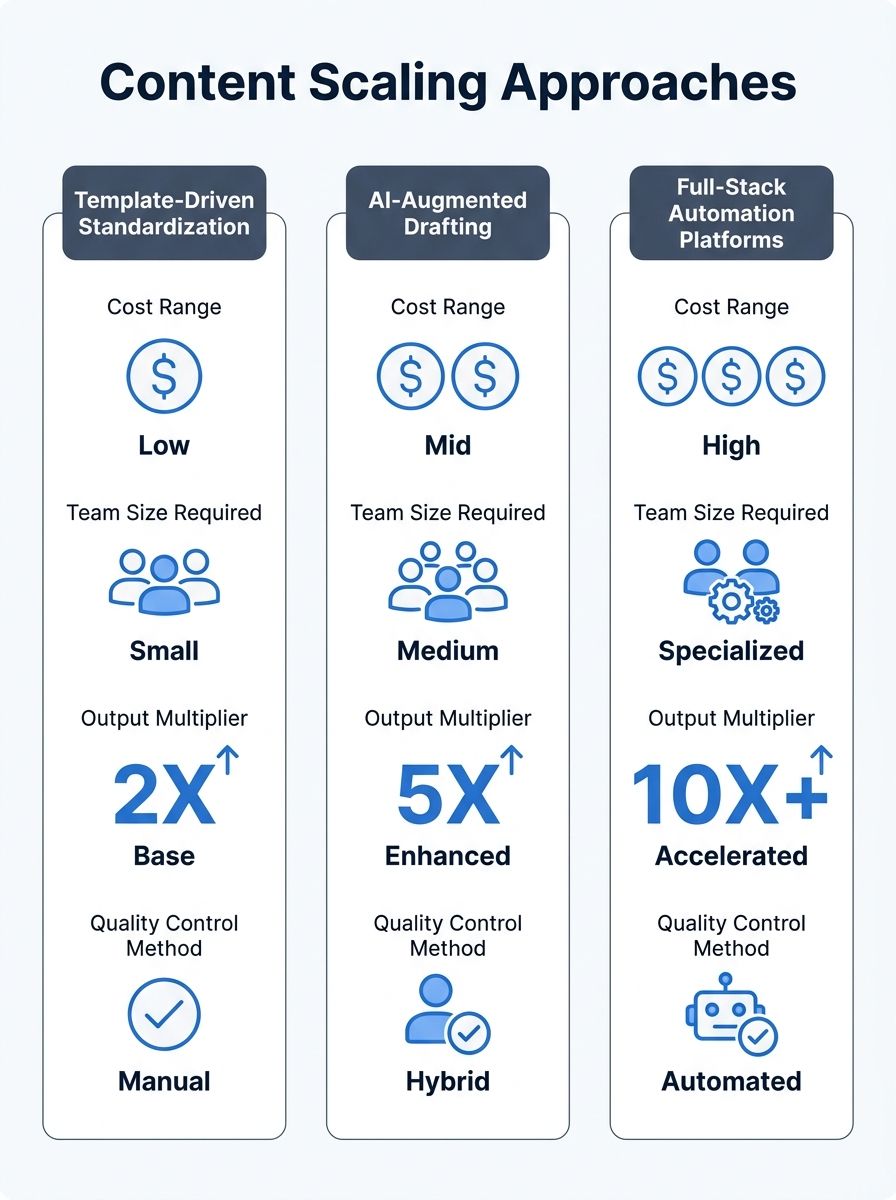
The Content Production Standardization Framework: How SEO Agencies Can 2X Output Without Burning Out Teams
The gap between a 10-article-per-month agency and a 40-article-per-month agency has almost nothing to do with headcount. I've evaluated over 200 SEO agencies in my consulting career, and the ones doubling or tripling their output are choosing between three distinct scaling models. Each one carries real tradeoffs in cost, quality control, and team sustainability. The wrong pick burns people out. The right one changes the economics of your entire operation.
This piece breaks down the three dominant approaches to content production scaling SEO agencies are actually using right now, with specific pricing, real workflow structures, and honest assessments of where each one falls apart. If you're running a content team that's stuck at its current ceiling, one of these models is your way through.
Template-Driven Standardization and Process Documentation
This is the analog approach, and it's the one I recommend agencies try first. The core idea: you can't scale what isn't documented. Before you add AI tools or hire more writers, you build the infrastructure of content brief templates, style guides, editorial checklists, and repeatable workflows that make every piece of content predictable.
The analogy I keep hearing from agencies that have done this well is the restaurant kitchen. TrySight.ai's content scaling guide puts it well: the difference between cooking for 20 people and 200 people isn't speed. It's prep stations, standardized recipes, and a brigade system that turns individual talent into collective output.
What a Standardized Brief Actually Contains
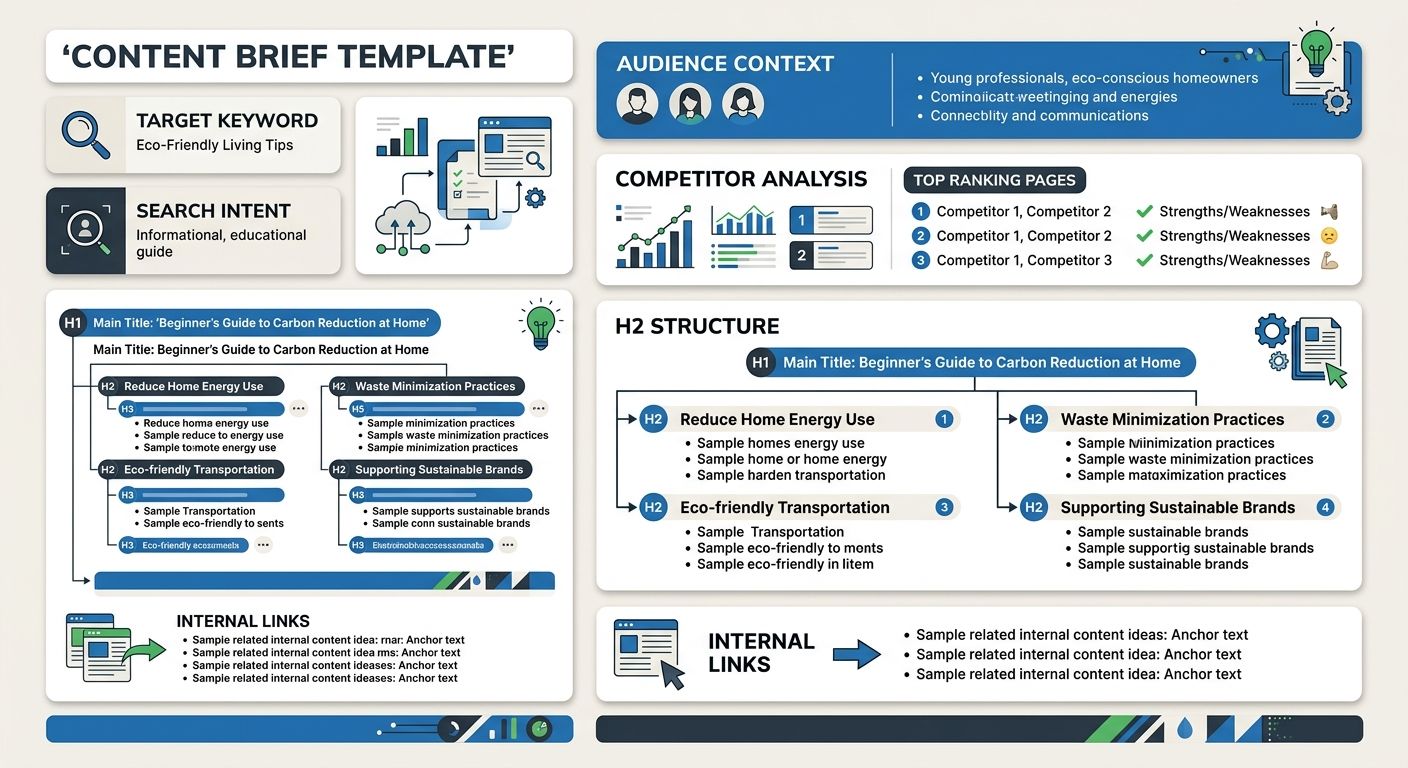
A good content brief template isn't a half-page prompt. It's a decision document that removes ambiguity for the writer. Based on what I've seen work at agencies producing 25+ pieces monthly, the brief should include:
Primary and secondary keywords with search intent classification
Competitor content analysis showing what's already ranking and what angles are underserved
Required H2/H3 structure with keyword placement guidance
Internal linking targets (specific URLs, not vague instructions like "add internal links")
Meta description and URL slug pre-written
Word count range and content type designation
Audience context explaining who reads this and what they're trying to accomplish
SEOmonitor offers a free content brief template worth stealing as a starting point, and Semrush's content template tool can auto-populate competitive data into your briefs.
The Tradeoffs
Cost: Low. You're investing 40 to 80 hours upfront building templates and documenting processes. No software fees beyond what you already pay.
Output gain: Moderate. Agencies I've worked with typically see a 40 to 60 percent increase in articles per month after standardization, mostly because writers spend less time asking questions and editors spend less time sending work back.
Quality control: High. Humans touch every step. If you're in a vertical where E-E-A-T matters (healthcare, finance, legal), this approach gives you the tightest quality floor. If you're working in specialized niches like architecture or design firms, templates ensure your writers hit domain-specific expectations even if they're generalists.
Where it breaks: Somewhere around 30 to 40 articles per month, pure template standardization hits a wall. Your bottleneck shifts from "writers don't know what to do" to "there aren't enough hours in the day for editing, fact-checking, and publishing." The process works, but it doesn't compress time. One agency I consulted for had bulletproof briefs and a gorgeous content workflow. They were still capped at 32 articles monthly because their two senior editors simply couldn't review more.
AI-Augmented Drafting Paired With Human Editors
This is where the majority of agencies are landing right now, and for good reason. The model pairs AI tools (ChatGPT, Claude, or Jasper) with skilled human editors who refine, fact-check, and inject expertise into machine-generated first drafts. It's the fastest path to 2X output without 2X payroll.
The math is straightforward. According to research from Adobe, AI-assisted workflows boost weekly content output by 75 percent while reducing creative burnout. And a Reddit thread surveying what agencies actually use daily confirms the stack most teams have converged on: ChatGPT or Claude for outlines and drafts, Grammarly for editing, and Canva AI or Midjourney for visuals.
How the Workflow Actually Runs
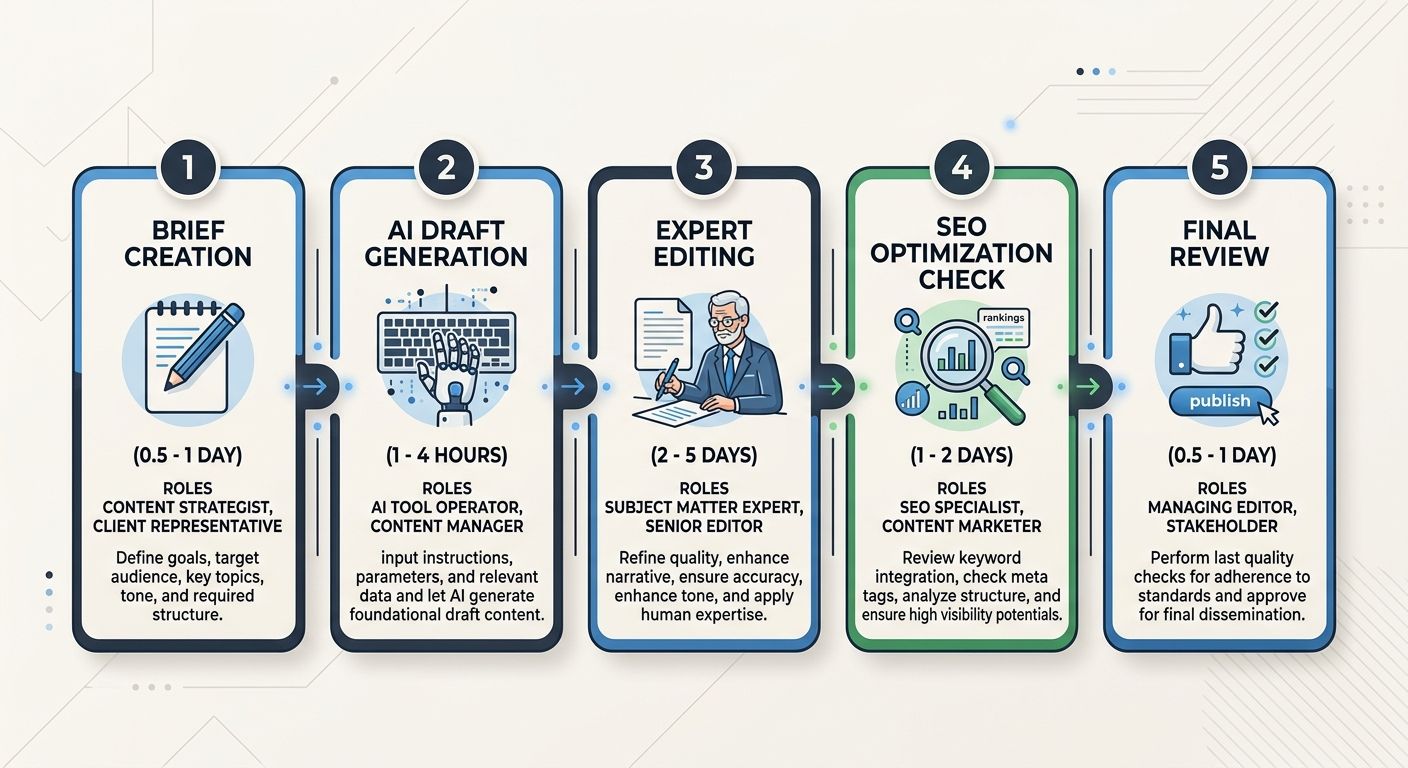
The AI-assisted content creation for agencies model I see working best follows this sequence:
Brief creation (human, 15 to 20 minutes per piece using standardized templates)
First draft generation (AI tool, 5 to 10 minutes including prompt refinement)
Expert editing pass (human editor, 30 to 45 minutes adding original insights, fixing factual errors, adjusting voice)
SEO optimization check (semi-automated, 10 minutes verifying keyword placement, internal links, meta data)
Final review and publish (human, 10 to 15 minutes)
Total time per article: roughly 70 to 90 minutes of human effort. Compare that to 3 to 5 hours for a fully human-written piece, and you see why the output multiplier is real.
One case study from SingleGrain documents an agency that achieved a 167 percent increase in organic traffic while scaling to 30 articles per quarter after standardizing their SEO workflow with content clustering. That 10x improvement in production volume came without proportional headcount growth.
The Tradeoffs
Cost: Moderate. AI tool subscriptions run $15 to $115 per month per seat depending on the platform and tier. You still need senior editors ($55,000 to $85,000 annually for a full-time hire, or $40 to $75 per hour for freelancers). But your writer-to-editor ratio shifts dramatically. Instead of four writers and two editors, you might run one editor managing AI-generated drafts across 8 to 12 pieces weekly.
Output gain: High. Agencies consistently report 2X to 3X content velocity with this model. The constraint moves from production to strategy and distribution.
Quality control: Variable, and this is where agencies get into trouble. AI drafts are structurally competent but factually unreliable. If your editors aren't subject-matter experts, garbage gets published. I've seen agencies push out AI-drafted content with outdated statistics, fabricated citations, and generic advice that ranks briefly before getting overtaken by genuinely useful competitor content. If you're already thinking about how AI search is changing what content needs to look like, this is the exact point where quality becomes existential.
Where it breaks: The model depends entirely on your editors. Burn out one senior editor who's reviewing 40+ AI drafts per month, and quality collapses fast. You've also got a voice consistency problem. AI drafts tend to homogenize, and unless your editors are actively injecting differentiation, your content starts sounding like everyone else's AI content. Agencies targeting long-tail comparison keywords find this particularly frustrating because the specific, nuanced angles that make comparison content rank well are exactly what AI tends to flatten.
Full-Stack Automation Platforms
The third option is the most ambitious and the most expensive. Full-stack platforms like Jasper, MarketMuse, or Surfer SEO's content suite attempt to automate the entire pipeline from keyword research through brief generation, draft creation, optimization scoring, and even scheduling.
Jasper's pitch is representative: with tools like Studio and Grid, anyone can design and run automations that scale content creation without technical setup or prompt engineering. The promise is that you don't need a content operations specialist. You need a platform subscription.
What You're Actually Buying
These platforms bundle multiple functions into a single interface:
Automated brief generation pulling from SERP data, competitor analysis, and semantic keyword databases
AI drafting with brand voice training and content type templates
Real-time optimization scoring that grades your content against top-ranking competitors
Workflow management with approval stages, role assignments, and publishing integrations
Performance tracking connecting Google Search Console data back to content planning
Pricing varies substantially. Entry-level plans start around $45 to $99 per month for small teams. Enterprise tiers run $500 to $2,000+ monthly depending on seat count and feature access. TrySight.ai reviewed nine automated content tools for agencies and found that the sweet spot for mid-size agencies (5 to 15 people) sits in the $115 to $300 per month range.
The Tradeoffs
Cost: High upfront, potentially lower per-article. Once you factor in platform fees, onboarding time (most agencies report 2 to 4 weeks before the team is fluent), and the inevitable customization needed to make outputs match your standards, you're looking at $3,000 to $8,000 in first-quarter costs before the efficiency gains kick in.
Output gain: Potentially the highest of the three. Agencies using mature automation setups report that brief creation drops from 60 minutes to under 10 minutes per article. At scale, this compounds. A 15-person agency running a well-configured platform can realistically produce 60 to 80 pieces monthly.
Quality control: This is the weak point. Platforms optimize for volume and SEO signals, not for depth or originality. The optimization scores these tools assign can create a perverse incentive to write for the algorithm rather than the reader. I've reviewed content from agencies running full-stack automation that scored 95 out of 100 on their platform's metrics but read like a keyword-stuffed Wikipedia summary.
Where it breaks: Vendor dependency. If you build your entire content operation around one platform and that vendor raises prices 40 percent (it happens), you're scrambling. I wrote about this exact scenario in the context of building a custom agency stack that avoids vendor lock-in, and the principle applies doubly when your content workflow lives inside someone else's software. You're also at the mercy of the platform's AI model choices. When they update their underlying language model, your outputs change overnight, sometimes in ways that break your brand voice.
How To Choose Between These Three
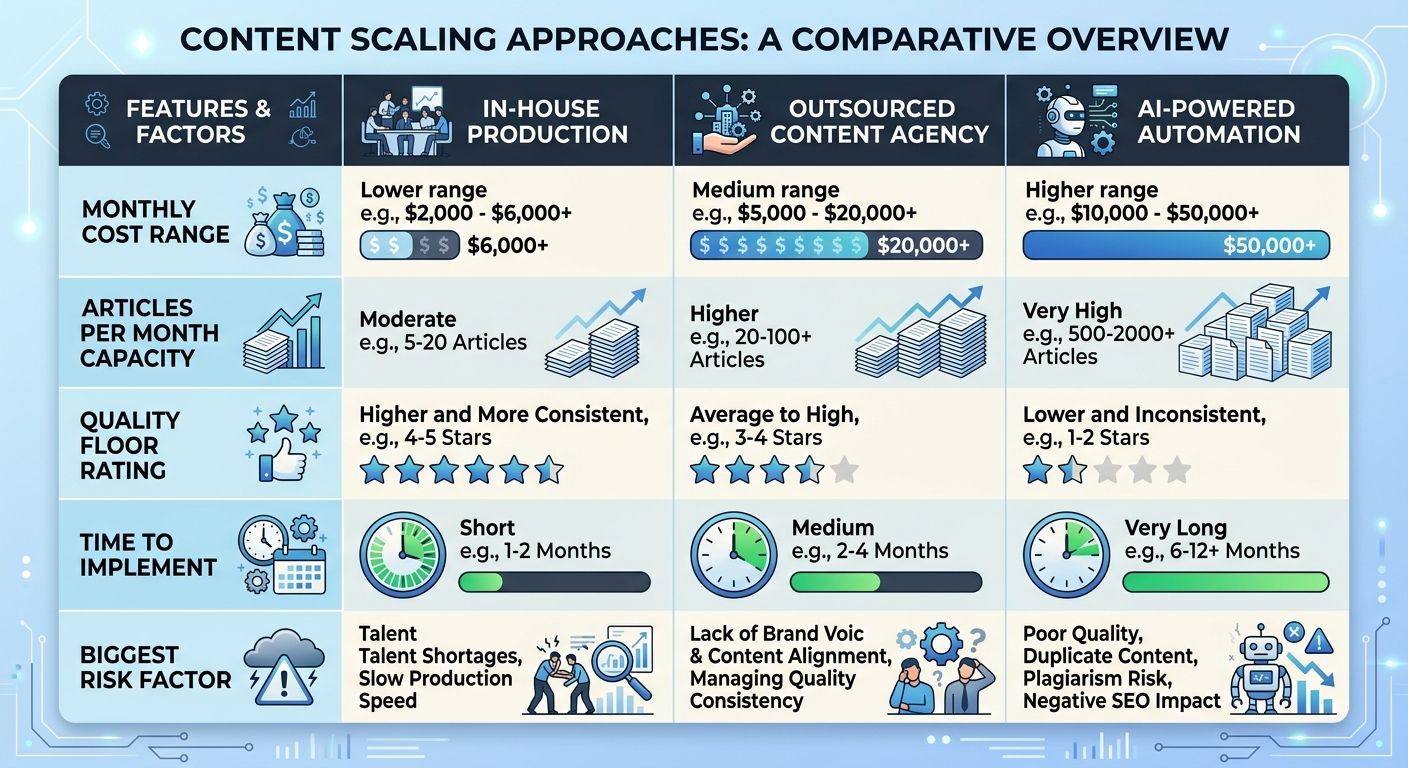
After evaluating dozens of agencies running each of these models, my honest assessment comes down to three variables: your team's current size, your quality threshold, and how much operational risk you're willing to absorb.
Choose template-driven standardization if you have fewer than 5 content team members, operate in YMYL verticals, or haven't yet documented your existing processes. This is the foundation. Agencies that skip straight to AI tools without first standardizing their briefs and editorial workflows end up automating chaos. You'll double your output of bad content, which is worse than producing less good content. SEO agency workflow standardization sounds boring because it is boring, and it works precisely because of that.
Choose AI-augmented drafting if you have at least one senior editor with genuine subject-matter expertise, you've already standardized your briefs, and you need to move from 15 to 30+ articles monthly without proportional hiring. This is where most agencies should land. The one-editor-to-multiple-AI-drafts model delivers the best ratio of output gain to quality maintenance. But invest in your editors. Pay them well. Give them authority to reject AI drafts entirely when the topic demands original research or lived experience.
Choose full-stack automation if you're producing at enterprise scale (50+ articles monthly), have dedicated content operations staff who can manage the platform, and your content is primarily informational rather than expert-driven. B2B SaaS companies publishing how-to guides and feature comparisons get the most value here. Agencies producing thought leadership, medical content, or anything requiring genuine expertise will find the platform's output ceiling frustrating.
The agencies I respect most tend to run a hybrid. They standardize their processes first (always first), layer in AI-augmented drafting for their volume content, and reserve fully human production for pillar pieces and content that carries their brand's authority. Team productivity in SEO doesn't come from picking one tool or one method. It comes from matching the right production model to each content type in your calendar, then being disciplined enough to keep the system running when deadlines get tight and the temptation to cut corners feels rational.
The framework that doubles your output is the one you'll actually maintain in month six. Pick accordingly.
Marcus Webb
Digital marketing consultant and agency review specialist. With 12 years in the SEO industry, Marcus has worked with agencies of all sizes and brings an insider perspective to agency evaluations and selection strategies.
Frequently Asked Questions
- How can SEO agencies increase content output without hiring more writers?
- SEO agencies can 2X output through three scaling models: template-driven standardization, AI-augmented drafting with human editors, or full-stack automation platforms. The most effective approach depends on team size and quality requirements, with AI-augmented drafting being the most popular choice for agencies with at least one senior editor.
- What should a content brief template include?
- A comprehensive content brief should include primary and secondary keywords with search intent classification, competitor analysis, required H2/H3 structure with keyword placement, internal linking targets, pre-written meta description and URL slug, word count range, content type, and audience context explaining who reads the content and what they're trying to accomplish.
- How much time does AI-assisted content creation save per article?
- AI-assisted workflows reduce time per article to roughly 70 to 90 minutes of human effort, compared to 3 to 5 hours for fully human-written content. This includes brief creation, AI drafting, expert editing, SEO optimization, and final review.
- What is the one-editor-to-multiple-drafts model in content agencies?
- This model pairs AI tools like ChatGPT or Claude to generate first drafts with skilled human editors who refine, fact-check, and inject expertise into the content. One senior editor can oversee AI-generated drafts for 8 to 12 pieces weekly, effectively matching the output of three traditional writers.
- When does template standardization alone stop working for content scaling?
- Pure template standardization hits a ceiling around 30 to 40 articles per month, when the bottleneck shifts from writer confusion to insufficient editing and publishing capacity. At this point, senior editors can no longer handle the volume of content reviews needed.
- What are the risks of using full-stack automation platforms for content?
- Full-stack automation platforms create vendor dependency risks, optimize for SEO signals over reader value, and can produce generic content that reads like keyword-stuffed summaries. These platforms are also vulnerable to price increases and model updates that can unexpectedly change content output quality and brand voice.
- Which content production model should I choose based on team size?
- Choose template-driven standardization for teams under 5 people or in YMYL verticals, AI-augmented drafting for 15-30+ articles monthly with one senior editor, and full-stack automation only for enterprise-scale operations (50+ articles monthly) with dedicated content operations staff.
Explore more topics