
Customer Reviews as Ranking Signals: How to Build an SEO-Optimized Review Strategy That Drives Organic Traffic
A client of mine—a regional HVAC company with 14 locations—fired their previous agency after six months of zero movement in the local pack. When I audited their strategy, I found something absurd: the agency had built 47 new backlinks, optimized every title tag, and rewrote all their service pages.
 Marcus Webb··9 min read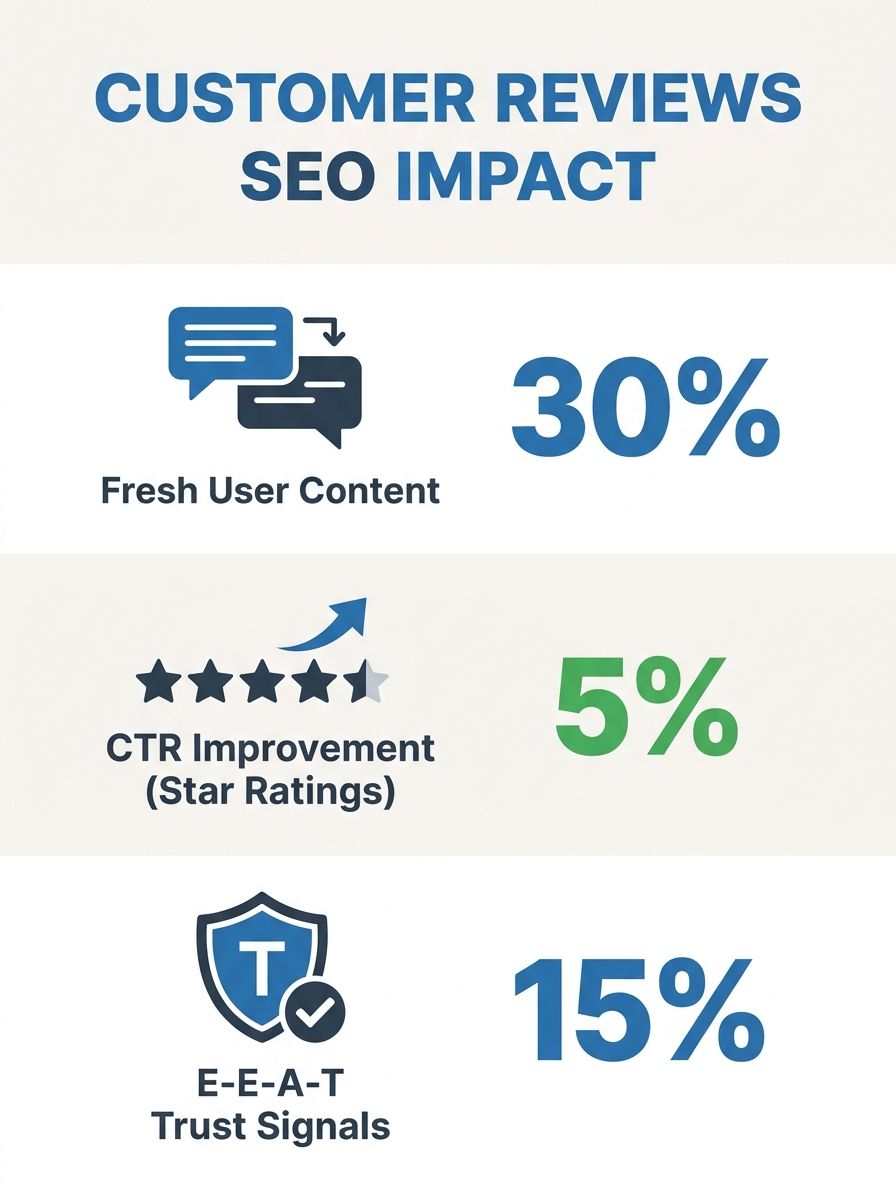
Customer Reviews as Ranking Signals: How to Build an SEO-Optimized Review Strategy That Drives Organic Traffic
A client of mine—a regional HVAC company with 14 locations—fired their previous agency after six months of zero movement in the local pack. When I audited their strategy, I found something absurd: the agency had built 47 new backlinks, optimized every title tag, and rewrote all their service pages. Not once did they touch the company's review profile. The business had 23 Google reviews total, most of them over two years old, and a 3.2 average rating. Their top competitor? 312 reviews, a 4.7 rating, and consistent new reviews every week. The agency had ignored the single most visible trust signal in local search, and it cost their client roughly $180,000 in wasted retainer fees.
I've seen this pattern repeat across dozens of agencies I've evaluated. Reviews get treated as a "nice-to-have" or shoved into a customer service bucket, completely disconnected from the SEO program. That's a strategic mistake. Review signals for SEO ranking aren't a secondary consideration—they're a primary driver of visibility, click-through rates, and conversion. And building an effective review strategy requires specific tools, workflows, and technical implementation.
Here's how I approach it, and what you'll need in your toolkit to do the same.
Why Reviews Directly Impact Your Rankings
Let's get the fundamentals straight. Google considers ratings and reviews when suggesting a business location to a user, and this isn't speculation. Review quantity, diversity, and velocity account for roughly 15% of Google's local pack ranking factors, making them the third most influential signal behind link signals and proximity.
But the impact goes beyond the local pack. Customer reviews drive organic traffic through three distinct mechanisms:
Fresh user-generated content (UGC): Every new review adds unique, keyword-rich text to your pages or profile. Search engines see this as a signal that your site is active and engaging with real users.
Click-through rate improvement: Star ratings in search results increase CTR by 20-35%, which feeds back into ranking performance.
E-E-A-T reinforcement: Reviews are arguably the strongest signal of "Experience" and "Trustworthiness" in Google's quality framework. Real customers describing real product usage is exactly what Google wants to surface.
The research backs this up. A Yotpo study tracking organic traffic over nine months found that sites with active review programs saw consistent month-over-month organic traffic increases. The reviews provided fresh, relevant content that showed search engines the business wasn't just talking at customers, but engaging in genuine conversation with them.
The Recency Factor Most Teams Overlook
Here's something I wish more agencies understood: it's not just about accumulating reviews. Sterling Sky ran a focused case study on whether review recency affects ranking, and their findings confirmed what I've observed anecdotally for years. Google doesn't just count your total reviews—it evaluates how recently you've received them.
Think about it from Google's perspective. A business with 500 reviews but nothing new in the past six months looks different from a business with 200 reviews but a steady stream of 8-10 per week. The second business appears more active, more relevant, and more likely to provide a current customer experience worth recommending.
This means your local SEO review strategy can't be a one-time campaign. It needs to be an ongoing operational process, baked into your post-purchase or post-service workflows.
Tools for Automated Review Collection
I've tested most of the major review management platforms over the years, and your choice depends heavily on business size and budget. Here's what I recommend based on what I've seen work:
For Small to Mid-Size Local Businesses ($50-$200/month)
Podium: Specializes in SMS-based review requests, which consistently outperform email. Their data shows SMS requests drive significantly higher conversion rates than email outreach. Podium's engagement tools also make it easy to respond to reviews quickly, which Google treats as a positive trust signal.
BirdEye: Strong multi-platform distribution. If you need reviews flowing to Google, Yelp, and industry-specific sites simultaneously, BirdEye handles the routing well. Plans start around $299/month but include reputation monitoring.
Grade.us: Budget-friendly option at $110-180/month per location. Good for agencies managing multiple clients because of its white-label capabilities.
For Mid-Market and Enterprise ($200-$1,000+/month)
Yotpo: Best for e-commerce brands that need on-site review widgets with proper SEO indexability. Their platform handles visual UGC, review syndication, and has decent schema markup integration out of the box.
Bazaarvoice: Enterprise-grade review syndication across retail networks. Expensive ($1,000+/month typically), but if you're selling through Target, Walmart, or other major retailers, the syndication network is hard to replicate.
Trustpilot: Strong for businesses that need third-party credibility. Trustpilot's high domain authority means your Trustpilot profile often ranks independently for branded searches.
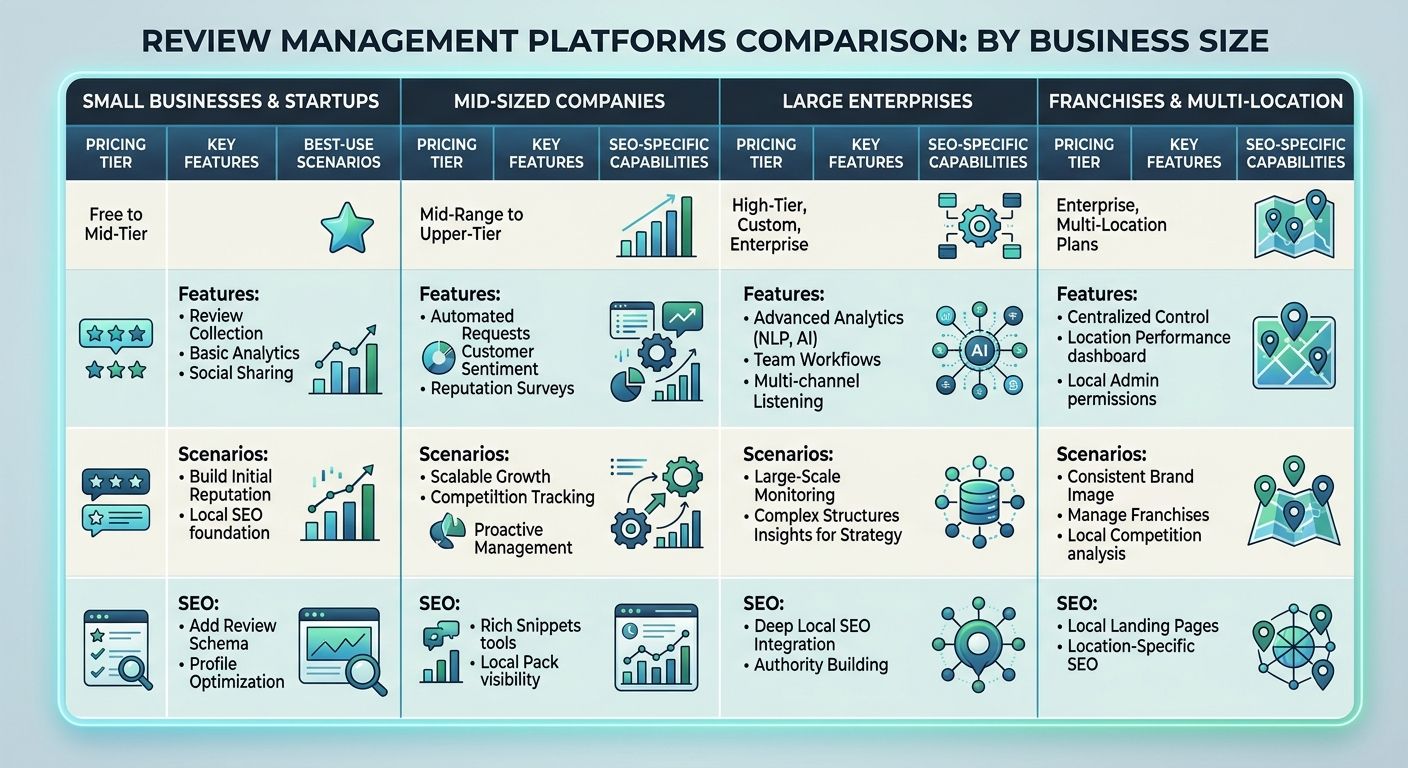
The platform matters less than the process. I've seen businesses generate excellent review velocity using nothing more than a well-timed email sequence and a direct Google review link. Tools just make it easier to scale.
Review Schema Markup and Rich Snippets
Collecting reviews is step one. Making sure Google can parse and display them properly is step two, and this is where review schema markup becomes essential.
Schema markup is structured data you add to your pages that gives search engines explicit context about your content. As Backlinko's schema guide explains, search engines need to parse and interpret a webpage before deciding whether to index it, and schema acts as a translator between your content and Google's understanding of it.
For reviews specifically, you'll want to implement three types of schema:
Review schema: Applied to individual review content on a page. Requires properties like author, reviewRating, and datePublished.
AggregateRating schema: Summarizes your overall rating (e.g., 4.7 out of 5 based on 312 reviews). This is what triggers star ratings in search results.
Product or LocalBusiness schema: The parent entity that your reviews attach to. Without proper entity markup, Google can't associate your reviews with your business or product.
The implementation method that I recommend for most teams is JSON-LD, injected into the page header. It's cleaner than inline microdata, easier to maintain, and it's what Google officially prefers. If you're working with a developer, point them to Google's structured data documentation for the specific required and recommended properties.
The payoff is real. Rich snippets with star ratings can increase CTR by 20-35%, and that increased click rate compounds over time as Google recognizes your listing as the preferred result for a query.
Google Business Profile Reviews and Local Ranking
For any business with a physical location or service area, Google Business Profile reviews ranking is where the highest-impact work happens. Google's own support documentation states that businesses with complete and accurate info are more likely to show up in local search results, and reviews are a major component of that completeness signal.
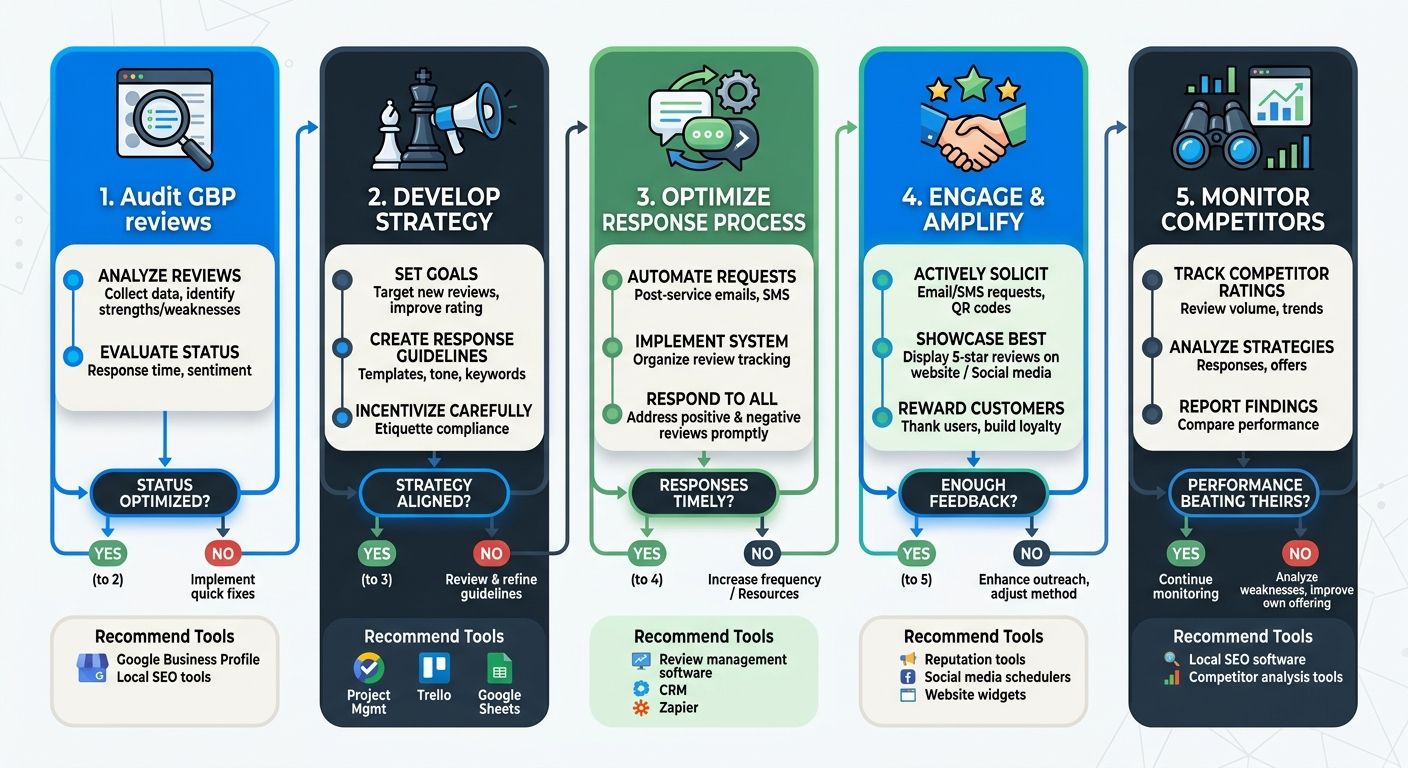
Here's my five-step GBP review optimization process:
Audit your current review profile: Count total reviews, average rating, review velocity over the past 90 days, and percentage of reviews that received a response. This is your baseline.
Create a direct review link: Google lets you generate a shortened URL that takes customers directly to the review submission form. Put this link in email signatures, on receipts, in SMS follow-ups, and on thank-you pages.
Implement a response protocol: Respond to every review within 24-48 hours. Positive reviews get a personalized thank-you. Negative reviews get a professional, empathetic response that moves the conversation offline. This engagement signals to Google that you're an active, responsive business.
Diversify review keywords naturally: When prompting customers, ask specific questions like "How was the installation process?" or "Did the product meet your expectations for durability?" These prompts encourage naturally keyword-rich responses without scripting them.
Monitor competitor review velocity: Track how many reviews your top 3 local competitors receive monthly. Your velocity should match or exceed theirs.
Industry context matters here, too. Verticals like finance and legal have unique reputation dynamics. Finance SEO agencies often build review strategies specifically around trust and compliance language, while law firm SEO companies focus heavily on client testimonial management because of ethical advertising rules that vary by state bar.
Search Engine Land's GBP audit framework emphasizes that between ads and AI Overviews, staying proactive with your GBP strategy is the only way to keep leads flowing from the map pack. Reviews are central to that proactivity.
The Technical Trap: Non-Indexable Review Widgets
This is one of the most common technical SEO failures I encounter, and it's largely invisible unless you know to look for it.
Many review platforms load their widgets inside iFrames or render them entirely through client-side JavaScript. From a user's perspective, the reviews display perfectly. From Googlebot's perspective, the page might as well be blank. You've collected 500 detailed customer reviews, and Google can't see a single one of them.
If you're working with an agency that handles technical audits, this should be on their checklist. I've written before about how diagnosing invisible ranking losses requires looking beyond the obvious on-page factors, and non-indexable review content is a prime example of a hidden problem.
To check whether your reviews are indexable:
Use Google's URL Inspection tool in Search Console and view the rendered HTML
Run a mobile-first crawl test to confirm reviews appear in the DOM
Check that review content isn't hidden behind "load more" buttons that require user interaction
If your current review widget fails these tests, you have two options: switch to a platform that supports server-side rendering, or work with your developer to inject review content directly into the page HTML.
Integrating Reviews Into Your SEO Program
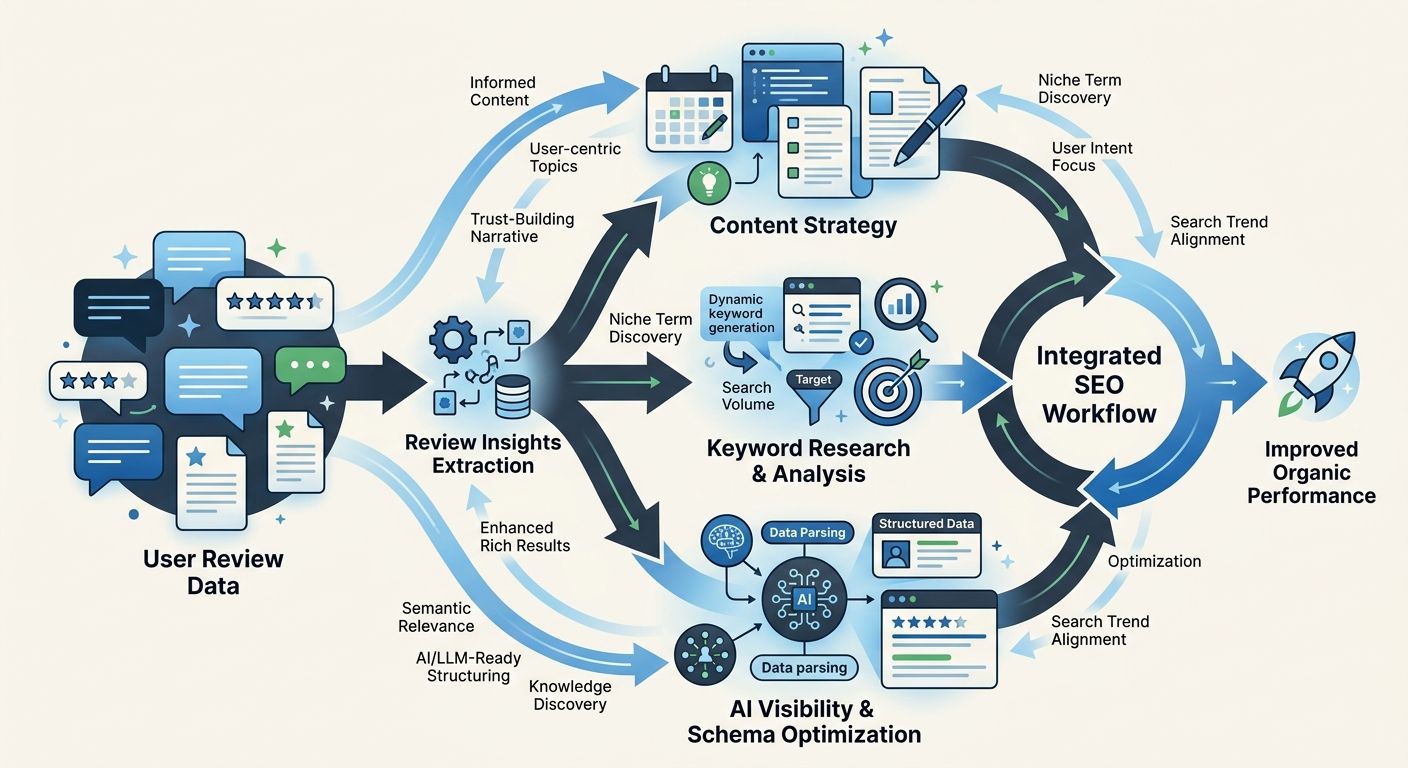
Reviews shouldn't exist in a silo. The most effective approach I've seen integrates review management into your overall SEO and visibility program.
For example, the keyword data inside your reviews is a goldmine for content planning. When customers repeatedly mention specific features, pain points, or use cases, those phrases represent real search intent. I've seen teams identify competitor keyword gaps just by analyzing the language their customers use in reviews versus what they're targeting in their content.
Similarly, as search shifts toward AI-generated results, the authentic voice in customer reviews becomes even more valuable. Generative search models pull from content that demonstrates real experience, and reviews are the most authentic form of that content. If you're thinking about how to adapt your SEO strategy for AI-generated results, your review strategy is part of that equation.
And for agencies managing clients across specialized verticals, review dynamics vary significantly. Manufacturing SEO agencies often deal with longer sales cycles and B2B review platforms like G2 or Capterra rather than Google, which requires a different collection and schema strategy altogether.
Your Review Strategy Implementation Checklist
Here's the practical checklist I give to every client:
Choose a review management platform that matches your budget and scale. Podium or Grade.us for local businesses, Yotpo or Bazaarvoice for e-commerce.
Implement JSON-LD review schema on every product and service page. Test with Google's Rich Results Test tool before going live.
Set up automated review request sequences timed 7-14 days after purchase or service completion. SMS outperforms email by a wide margin.
Respond to 100% of reviews within 48 hours, with personalized responses that naturally include relevant service or product terms.
Audit review indexability quarterly. Confirm Google can crawl and render your review content by checking the rendered HTML in Search Console.
Track review velocity against competitors monthly. If they're gaining 20 reviews per month and you're at 5, you're falling behind regardless of your total count.
Mine review language for keyword opportunities. Feed review text through your keyword tools to discover long-tail phrases your content isn't targeting.
The businesses that treat reviews as a core SEO function—not a customer service afterthought—are the ones dominating local packs and earning click-through rates that their competitors can't match. Your review profile is the one ranking signal where your customers do the work for you. Build the systems to support them, and the organic traffic follows.
Marcus Webb
Digital marketing consultant and agency review specialist. With 12 years in the SEO industry, Marcus has worked with agencies of all sizes and brings an insider perspective to agency evaluations and selection strategies.
Explore more topics