
SEO Pilot Review: Can This Tool Replace Expensive SEO Agencies?
A client came to me after spending $4,200 a month with an agency for eight months.
 Marcus Webb··7 min read
SEO Pilot Review: Can This Tool Replace Expensive SEO Agencies?
A client came to me after spending $4,200 a month with an agency for eight months. Their "deliverables" folder contained exactly three things: a monthly keyword ranking spreadsheet, a boilerplate audit PDF that looked suspiciously like Screaming Frog output with a logo slapped on it, and a handful of blog posts that read like they were written by someone who'd never touched their product. The kicker? Most of the technical issues flagged in month one were still unfixed in month eight. That's the reality of a lot of agency engagements. So when a $27 tool claims it can handle much of the same work, I pay attention. Here's my honest SEO Pilot review after spending two weeks putting it through its paces.
What Is SEO Pilot, and Why Is Everyone Talking About It?
SEO Pilot launched in early April 2026 as an AI-powered technical SEO audit and auto-fix tool. Created by Alex Krulik (the developer behind MagicSubmitter and RankSnap AI), it positions itself as a budget alternative to both premium SEO tools and agency retainers. According to multiple reviewer analyses, the tool scans websites in seconds, detects over 200 SEO issues, and provides actionable guidance even for beginners.
The core pitch is simple: instead of paying someone $100-$200/hour to run an audit and hand you a spreadsheet of problems, SEO Pilot identifies issues AND fixes many of them automatically. That's a meaningful distinction. Most tools I've used over 12 years tell you what's broken. Very few offer to fix it.
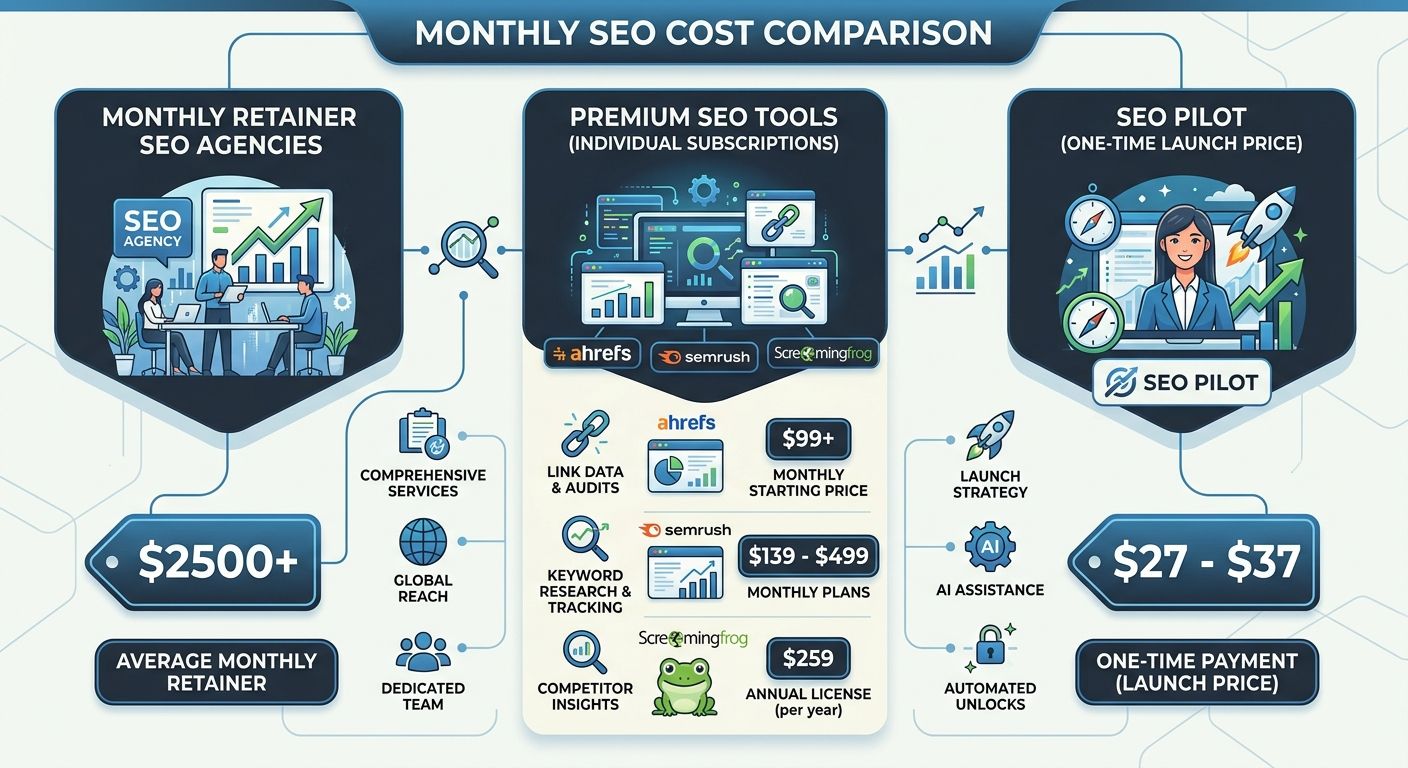
During its WarriorPlus launch window (April 2-6, 2026), the tool was available at a one-time price of $27 for a single site or $37 for up to five sites. It's likely transitioned to subscription pricing since then, but early adopters locked in lifetime access.
The Agency Pricing Problem SEO Pilot Is Trying to Solve
Before I assess whether this tool can actually replace agency work, let's ground the conversation in real numbers. According to WebFX's pricing survey of 500 U.S. marketers, the average SEO retainer sits around $2,500 per month, with hourly rates running $50-$100. And that's the median. OuterBox reports that rates range from $50 to over $250 per hour depending on the agency, with top-tier consultants like Neil Patel charging up to $5,000 for an initial consultation.
Here's what those retainer fees typically cover:
Technical SEO audits (quarterly or monthly)
On-page optimization recommendations
Content strategy and production
Link building and outreach
Monthly reporting and analytics
The uncomfortable truth, as agency owners themselves admit on Reddit, is that a significant portion of those retainers goes toward tool subscriptions that agencies pass through to clients. A smaller agency using selective tools or manual methods can deliver similar insights at lower cost. SEO Pilot essentially asks: what if you cut out the middleman entirely for the technical audit portion?
What SEO Pilot Actually Does Well
After testing the tool across three different sites (a local service business, an affiliate blog, and a small ecommerce store), here's what stood out:
Technical Audit Speed and Depth
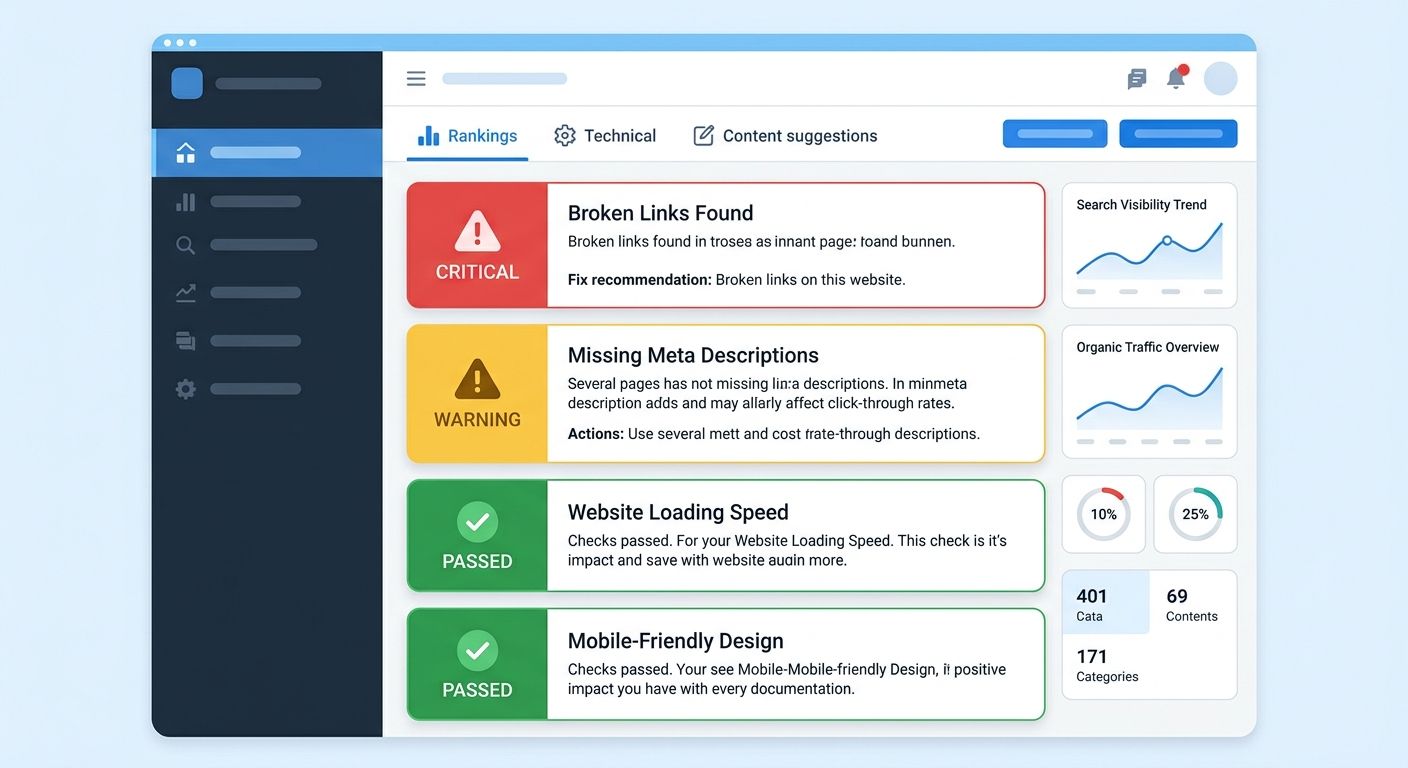
SEO Pilot runs 35+ technical SEO checks per page and flagged issues I genuinely cared about: missing meta descriptions, broken internal links, heading hierarchy errors, duplicate content flags, and schema markup problems. One site audit uncovered over 400 issues, which tracks with the case study reviewers cite of 1,092 issues found across a larger site.
The auto-fix feature is the real differentiator. The tool claims to automatically resolve at least 13 issue types with one click, and in my testing, it handled missing alt text, meta tag gaps, and heading structure problems quickly. This is work that would typically eat up 3-5 hours of a junior SEO's time at an agency.
Google Search Console Integration
The GSC sync pulls in real-time data on clicks, impressions, CTR, and average position. This matters because it lets you measure before-and-after impact. Most standalone tools give you a snapshot; SEO Pilot ties fixes to actual performance data.
AI Search Readiness
This is where I got genuinely interested. With AI-generated search results changing how visibility works, SEO Pilot includes optimization checks for AI citation factors: clean heading structures, proper schema, canonical tags, and entity clarity. That's forward-thinking. Many agencies I've evaluated are still figuring out their approach to generative AI search optimization, and here's a $37 tool already baking it in.
Beginner-Friendly Interface
The dashboard uses plain-English explanations rather than technical jargon. It tells you what's wrong, why it matters for rankings, and how to fix it. This is something I wish more enterprise tools would adopt. As someone who's explained "canonical tags" to approximately 400 business owners over my career, I appreciate any tool that does that work for me.
Where SEO Pilot Falls Short
And here's where my skepticism kicks in. Because no tool that costs less than a decent lunch is going to replace everything an agency does. Period.
No Backlink Analysis or Outreach
Link building is still one of the most valuable services agencies provide. SEO Pilot does nothing here. No backlink profile analysis, no competitor link gap identification, no outreach capabilities. If you're struggling to understand how competitor keyword gaps affect your visibility, this tool won't help you close those gaps through off-page strategy.
The Upsell Structure Is Aggressive
The $27-$37 base price gets you through the door, but the full feature set requires additional purchases:
OTO 1: AI SEO Optimizer ($47) for bulk meta generation, schema, and image alt text
OTO 2: Keyword Research Suite ($37) powered by DataForSEO
OTO 3: GEO & AEO Toolkit ($47) for AI Engine Optimization
OTO 4: Agency License ($97-$197) for client management and branded reports
Suddenly that $27 tool costs $265+ for everything. Still dramatically cheaper than agency retainers or premium tool subscriptions that start at $139.95/month, but the marketing implies you get more at the base tier than you actually do.
Manual Work Is Still Required
The auto-fix feature handles structural issues, but content quality recommendations, internal linking strategy, and topical authority building all require human judgment and effort. SEO Pilot's own documentation acknowledges this: "It won't replace consistent effort, quality content, or long-term strategy."
Not Built for Enterprise or Complex Sites
If you're running a 50,000-page ecommerce site or managing SEO across multiple international domains, this tool isn't designed for you. The comparison framework shifts entirely when you're evaluating enterprise-grade technical audit solutions versus DIY tools. SEO Pilot targets solopreneurs, bloggers, affiliate marketers, and small business owners.
So, Can This Tool Replace Expensive SEO Agencies?
Here's my honest breakdown after two weeks of testing:
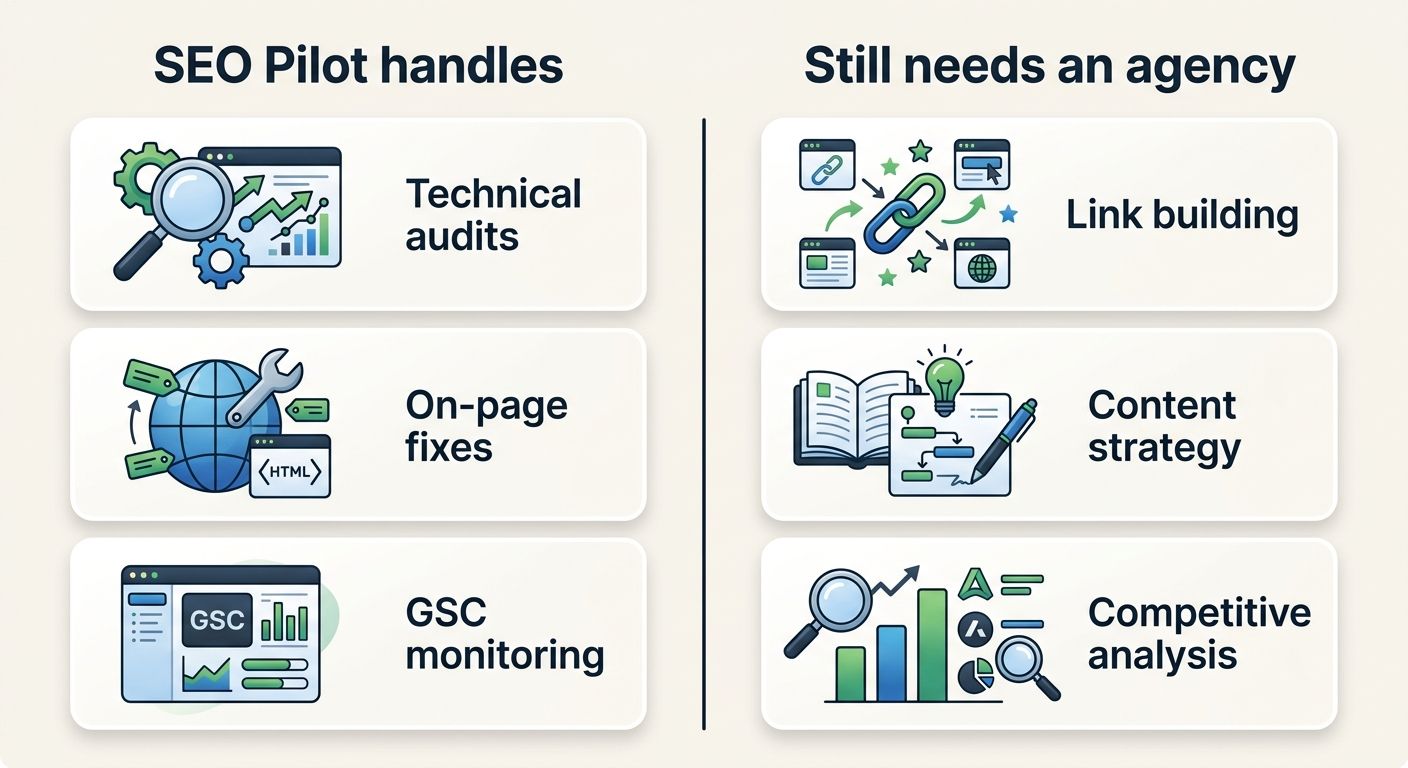
What SEO Pilot CAN replace:
The technical audit portion of most agency retainers (typically 20-30% of the monthly fee)
Basic on-page optimization fixes that agencies bill hourly for
Entry-level SEO consulting for small businesses who can't afford $2,500/month retainers
The "identify and explain" function of tools like Ahrefs or SEMrush at a fraction of the cost
What SEO Pilot CANNOT replace:
Strategic SEO planning and competitive positioning
Link building and digital PR
Content strategy, creation, and editorial management
Industry-specific expertise (if you need healthcare SEO companies or ecommerce SEO agencies, you need humans who understand those verticals)
Ongoing algorithm monitoring and adaptation
Cross-channel integration between SEO, paid search, and content marketing
The honest answer is that SEO Pilot replaces maybe 30-40% of what a good agency does. But here's the thing: for a small business owner paying $1,500-$3,000/month and only getting value from the technical audit and basic on-page work, that 30-40% might be the only part they actually needed.
Who Should Actually Use SEO Pilot (And Who Shouldn't)
Best fit for SEO Pilot:
Small business owners spending $0-$500/month on SEO who need a technical foundation
Bloggers and affiliate marketers managing 1-5 sites
Freelancers who want to add basic SEO services without paying for enterprise tools
Business owners currently doing nothing for SEO and needing a clear starting point
Anyone who's been burned by agencies that promise rankings and deliver spreadsheets
Stick with an agency if:
You're in a highly competitive vertical where technical SEO is table stakes, not a differentiator
You need link building, content production, and strategic guidance as a package
Your site has complex technical architecture (JavaScript rendering, international hreflang, massive product catalogs)
You're a SaaS company needing specialized SEO that accounts for product-led growth and feature-page optimization
If you're somewhere in between, consider a hybrid approach. Use SEO Pilot for ongoing technical monitoring and quick fixes, then allocate your remaining budget toward a specialized consultant for strategy and link building. I've seen this model work well for businesses in the $1,000-$2,000/month budget range.
My Verdict: Useful Tool, Not a Silver Bullet
After testing SEO Pilot and cross-referencing my findings with other reviews, I'd rate it a solid 7.5/10 for its intended audience. The technical audit capabilities are legitimate, the auto-fix feature saves real time, and the AI search optimization checks are ahead of where many agencies currently operate.
But I want to be direct: if you review this tool expecting it to replace a competent SEO agency that's delivering strategic value, you'll be disappointed. It replaces the commodity work. The technical checks, the meta tag fixes, the structured data validation. That's valuable work, and most businesses are overpaying for it through agency retainers. But it's not the whole picture.
Key takeaways:
SEO Pilot is best understood as a technical SEO maintenance tool, not an agency replacement
The base price is genuinely affordable, but budget $150-$265 if you want the full feature set
Auto-fix capabilities set it apart from traditional audit-only tools
Pair it with human expertise for content strategy, link building, and competitive positioning
If your current agency is only delivering what this tool does, you're overpaying for your agency
The smartest play I've seen? Businesses using tools like this to handle the technical baseline, then investing the money they saved into focused, high-impact agency work like link building or content programs. That's where the real ROI lives. If you're paying an agency $2,500/month and half of it goes toward work a $37 tool can handle, redirect that budget toward the strategic work that actually moves the needle.
Marcus Webb
Digital marketing consultant and agency review specialist. With 12 years in the SEO industry, Marcus has worked with agencies of all sizes and brings an insider perspective to agency evaluations and selection strategies.
Explore more topics