
AI Search Disruption for Local Contractors: Why Traditional Local SEO Benchmarks No Longer Apply in 2026
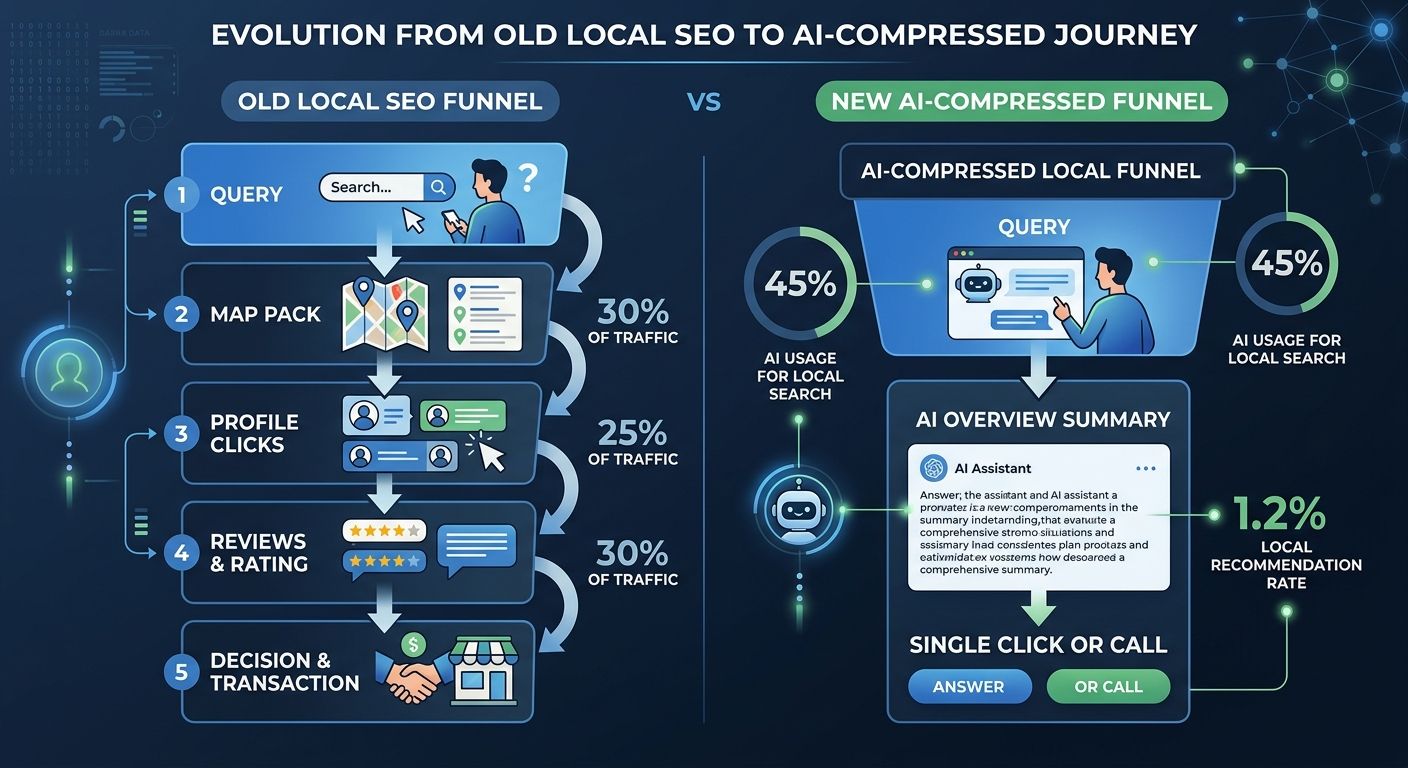
Forty-five percent of consumers now use AI tools to find local service providers, according to MarketingCode's April 2026 analysis, yet ChatGPT recommends only 1.2% of businesses in its responses.
 Marcus Webb··8 min read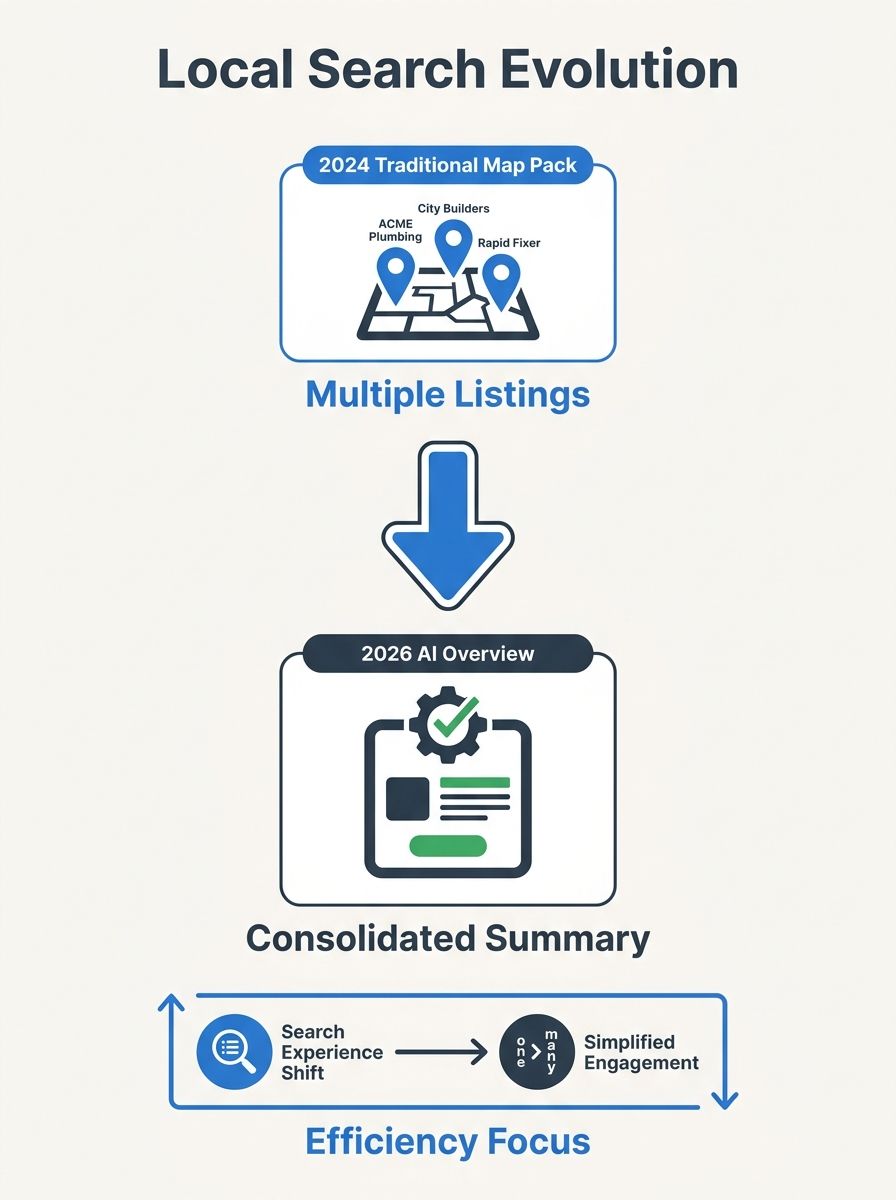
AI Search Disruption for Local Contractors: Why Traditional Local SEO Benchmarks No Longer Apply
Forty-five percent of consumers now use AI tools to find local service providers, according to MarketingCode's April 2026 analysis, yet ChatGPT recommends only 1.2% of businesses in its responses. That gap defines the crisis facing every plumber, roofer, electrician, and tree service company trying to generate leads through search.
The significance is hard to overstate. I've evaluated over 200 SEO agencies, and the reporting dashboards most of them send to contractor clients still track metrics that mattered three years ago: map pack position, keyword ranking for "[service] near me," and organic click-through rates. Those dashboards are measuring a game that fewer and fewer homeowners are actually playing. When nearly half your potential customers ask an AI for a recommendation instead of scrolling through blue links, your visibility inside that AI's answer set becomes the metric that counts. And right now, almost nobody is tracking it.
Google's April 2026 Profile Crackdown Accelerated the Shift
Google suspended thousands of Google Business Profiles this month for keyword stuffing violations, hitting contractors, locksmiths, and movers hardest. Business names like "Best Affordable Emergency Plumber 24/7 Dallas TX" that had gamed the map pack for years were pulled overnight. The sectors that relied most heavily on keyword-stuffed profiles are the same ones now most exposed to AI-generated results for local rankings.
This enforcement wave wasn't random. It coincided with AI Overviews expanding further into local service queries. Google appears to be cleaning the data that feeds its own AI summaries. Spammy listings that once cluttered local packs become liabilities inside an AI system trained to prioritize genuine, structured business information. The agency world I've worked in for over a decade saw this coming, but the speed caught most local SEO providers off guard. As we covered in our analysis of Google's spam crackdown and the end of bulk optimization, the signals were visible months ago for anyone paying attention.
Contractors in California, Texas, and Florida are feeling the pressure most acutely. These states have the highest concentration of competitive local service markets, and reports indicate that over 30% of local queries in affected industries have changed in both presentation and ranking behavior. The recovery window for suspended profiles runs about one to two weeks after corrections are made and appeals submitted, but the underlying problem persists: the old optimization playbook produced the exact kind of profile that Google is now penalizing.
How AI Overviews Compress Local Search Into Single Answers
The traditional local SEO funnel assumed a user would type a query, see a map pack with three results, maybe click into a few profiles, read some reviews, and make a decision. AI Overviews collapse that entire sequence into one answer block that appears before the user scrolls at all. Multiple signals get compressed into a single visible answer, often rendering individual listings irrelevant to the selection process.
For contractors, the competitive landscape has fundamentally changed. The question isn't whether you rank #1 or #3 in the map pack anymore. The question is whether the AI selects your business to include in its generated summary at all. And the selection criteria diverge sharply from traditional ranking factors.
Google's own documentation on AI features states that best practices for SEO remain relevant, but that framing obscures a critical shift in emphasis. The signals that AI Overviews weight most heavily for local service queries are:
Genuine customer reviews with specific service details and sentiment
Structured data markup (LocalBusiness and Service schema in JSON-LD format)
NAP consistency (name, address, phone) across every citation source
Service-specific content that directly answers common local questions
Geographic precision in business information, including coordinates
What's conspicuously absent from that list: keyword density in page titles, the number of directory backlinks, or the volume of thin city-specific landing pages. The entire service business SEO strategy has to shift toward machine-readable trust signals.
The Review Economy Just Got More Complicated
Here's a data point that should alarm any contractor relying on review volume as a differentiator: Google review usage among consumers dropped from 83% to 71%, per the same MarketingCode report. Consumers aren't reading fewer reviews overall. They're reading the reviews that AI surfaces for them, which means the AI's interpretation of your reviews matters more than the raw count.
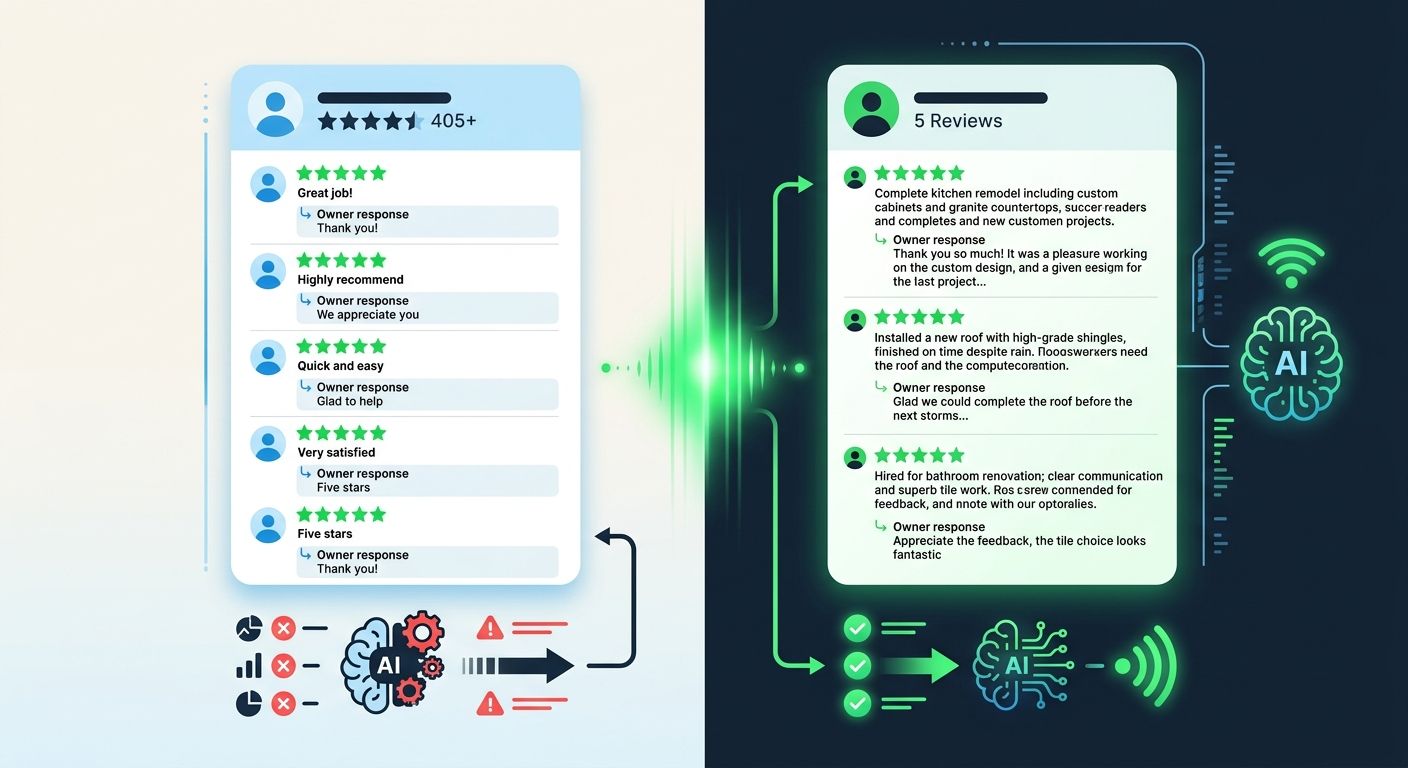
I've seen agencies charge contractors $500 to $1,500 per month for "review management" packages that amount to automated review request emails and templated responses. That approach generated volume. Volume used to correlate with map pack position. Now, AI systems parse review content for specific service mentions, response quality, and sentiment patterns. A contractor with 47 detailed, responded-to reviews describing specific projects will outperform one with 300 generic five-star ratings in an AI-generated summary.
The businesses handling this well are creating a feedback loop: thoughtful, detailed responses to reviews generate more detailed future reviews, which in turn give AI systems richer material to draw from when constructing local recommendations. We've explored how this review-to-rankings pipeline works in depth, and the core mechanics have only intensified under AI Overviews. AI search local SEO rewards specificity in customer feedback the way traditional SEO rewarded backlink volume.
Why Your Agency's Dashboard Probably Isn't Tracking the Right Things
The local SEO benchmarks 2026 demands look nothing like what most agencies report on. I audit agency reports as part of my consulting work, and here's what I still see on 80% or more of contractor client dashboards:
Keyword rankings for 10 to 20 target terms
Google Business Profile views and calls
Map pack position for primary service keywords
Organic traffic from Google Analytics
Number of new reviews per month
None of these metrics tell you whether your business appears in AI Overviews. None of them measure whether ChatGPT, Perplexity, or Gemini would recommend your company when a homeowner asks "who's a reliable HVAC contractor in [city]?"
The metrics contractors should be tracking (and that most agencies aren't equipped to provide yet) include:
AI Overview inclusion rate for target service queries
Structured data validation scores
Review sentiment analysis with service-specific keyword distribution
Citation consistency audits across AI training data sources
Competitor appearance rates in AI-generated results
If you're paying an agency $2,000+ per month and their reports don't include any AI visibility metrics, you're paying for a 2023 service at 2026 prices. And if they're guaranteeing you map pack rankings, that skepticism I've carried through 12 years of evaluating agencies has never been more warranted. The agencies that are adapting to AI search local SEO realities are the ones investing in new measurement tools and being transparent about how uncertain this landscape still is.
For a broader perspective on how this visibility shift is playing out across industries, the challenges facing enterprise teams losing visibility in AI-generated results mirror what contractors experience at the local level.
Structured Data Becomes Non-Negotiable for Google AI Overviews Contractor Visibility
Schema markup has been a "nice to have" in local SEO for years. For AI-generated results local rankings, it's now a prerequisite. JSON-LD structured data for LocalBusiness and Service types tells AI systems exactly what you do, where you operate, what hours you keep, and what specific services you offer. Without it, you're asking an AI to infer all of that from unstructured page content, and AI systems prefer explicit signals over inference every time.
The practical implementation looks like this: every contractor website needs Service schema that lists individual service offerings with descriptions, geographic service areas with proper geo-coordinates, business hours including emergency availability, and links to project galleries or portfolios. Your Google Business Profile title should be clean, 50 to 60 characters maximum, formatted like "Smith Roofing [City]" rather than "Best Emergency Roof Repair Free Estimates 24/7 Licensed Bonded Insured [City] [State]."
SearchX's analysis of 2026 AI search trends puts it well: local visibility isn't disappearing. It's being filtered through AI layers. A homeowner asking for the best commercial roofer near Charleston might follow up with questions about response times, project portfolios, and licensing. The AI needs structured, factual content to build answers for those follow-up queries. Contractors whose sites provide that information in machine-readable formats get selected. Those who don't get skipped. This aligns with what we've documented about how multi-intent content optimization works in AI search systems.
The Surprising Upside for Smaller Contractors
There's a contrarian angle here that deserves attention. Reusser's analysis of AI Overviews notes that the system levels the playing field in meaningful ways: if you provide a specific, authoritative answer to a precise local question, Google's AI might surface your business even if your domain has minimal SEO authority. The contractor who publishes a detailed page answering "what permits do I need for a deck addition in [county]" has a real shot at appearing in AI Overviews for that query, regardless of how many backlinks their site has.
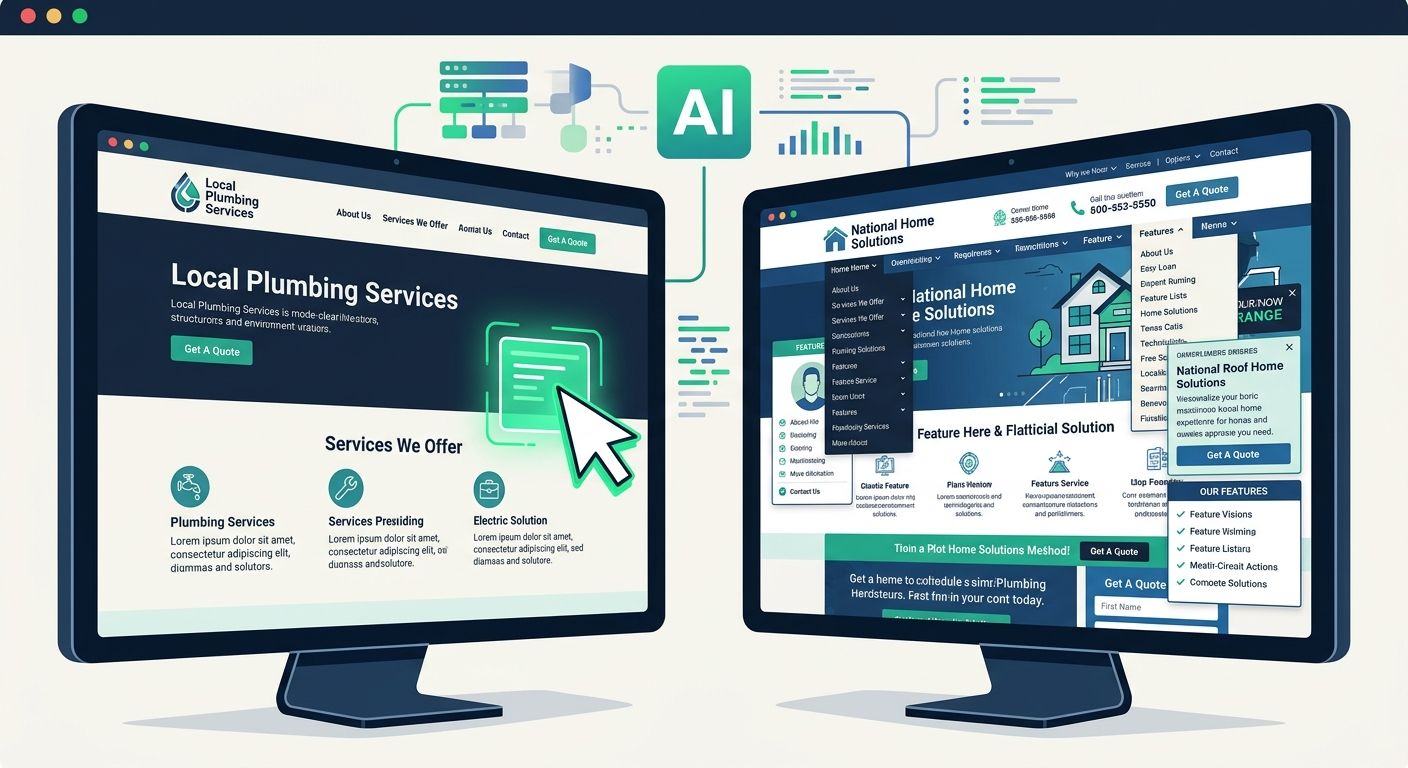
This dynamic upends the economics of local SEO. Large contractors who spent years building domain authority and acquiring hundreds of directory listings don't get automatic preference inside AI summaries. The selection criteria favor specificity and trust signals over raw domain metrics. A two-person operation with a well-structured site, legitimate reviews, and clear service descriptions can compete with the regional chain that outspent them on SEO for a decade.
I've talked to agencies that are recognizing this shift and pivoting their approach to generative AI search accordingly. The ones doing it right are rebuilding their local SEO packages around content clarity, schema implementation, and review quality rather than link volume and keyword targeting. The ones doing it wrong are slapping "AI-optimized" on their existing packages and charging 30% more for the same deliverables.
What Still Isn't Settled
Several big questions remain unanswered as this shift unfolds, and anyone claiming certainty about where AI search local SEO lands in six months is selling something.
Measurement is the most urgent gap. No standardized tool exists yet for tracking AI Overview inclusion rates across local queries. Google Search Console doesn't report it cleanly. Third-party tools are racing to fill the void, but their methodologies vary wildly, and accuracy benchmarks from Previsible show that even the latest AI models have declining accuracy for SEO-related tasks. The data contractors need to make informed decisions is still fragmented.
The ChatGPT and Perplexity variable adds another layer of complexity. Google AI Overviews get the most attention because Google still dominates search volume, but 45% of consumers using AI for local services includes users on non-Google platforms. The optimization strategies for appearing in ChatGPT recommendations versus Google AI Overviews versus Perplexity overlap somewhat (structured data and reviews help everywhere) but diverge in ways that nobody has mapped in full detail yet.
Then there's pricing. The SEO agency market for contractors currently runs $750 to $3,000 per month for local packages. AI visibility optimization requires different skillsets, different tools, and different reporting infrastructure. Agencies that invest in those capabilities will need to charge accordingly, and contractors will need to evaluate whether the ROI justifies the spend during a transition period where measurement itself is unreliable. I expect the market to shake out within the next 12 months, but right now, contractors are being asked to spend more on services that agencies themselves are still figuring out how to deliver.
What's clear is that the old local SEO benchmarks describe a search experience that's rapidly shrinking as a percentage of how homeowners actually find contractors. The contractors who adapt their digital presence to be readable, structured, and genuinely useful to AI systems will capture the growing share of AI-mediated discovery. The ones waiting for the old metrics to start working again will be waiting a long time.
Marcus Webb
Digital marketing consultant and agency review specialist. With 12 years in the SEO industry, Marcus has worked with agencies of all sizes and brings an insider perspective to agency evaluations and selection strategies.
Explore more topics