
Why Google's 2026 Local SEO Spam Crackdown Signals the End of Bulk Optimization Tactics
Google's SpamBrain system needed exactly 19.5 hours to reshape the local search landscape. The March 24–25 spam update, which completed rollout at 10:40 AM Eastern on March 25, was the fastest confirmed spam update in Google Search history.
 Marcus Webb··9 min read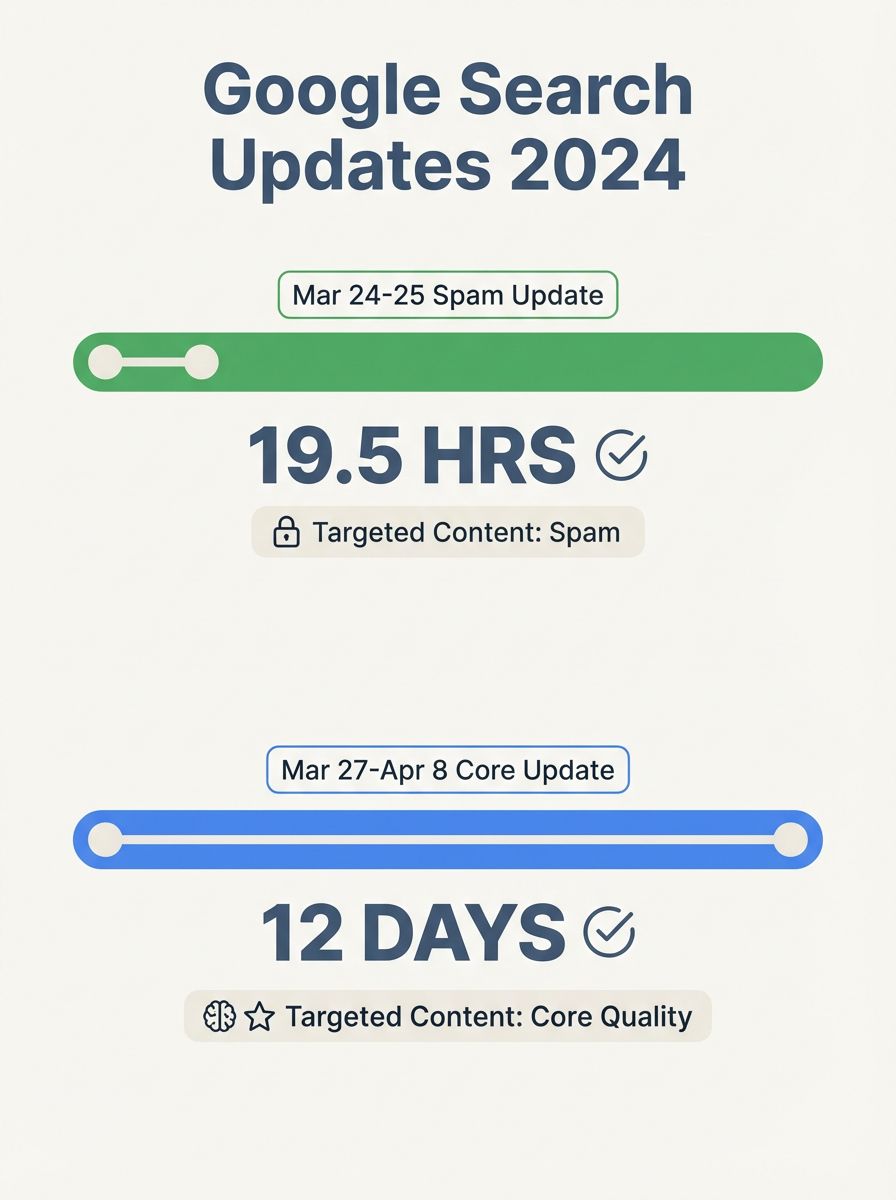
Why Google's 2026 Local SEO Spam Crackdown Signals the End of Bulk Optimization Tactics
Google's SpamBrain system needed exactly 19.5 hours to reshape the local search landscape. The March 24–25 spam update, which completed rollout at 10:40 AM Eastern on March 25, was the fastest confirmed spam update in Google Search history. Three days later, the March 2026 broad core update began its own 12-day rollout, finishing on April 8. By the time both updates settled, nearly 80% of top results had shifted positions. For local businesses that had been stuffing keywords into their Google Business Profile names for years, the combined effect hit like a freight train: suspended listings, vanished map pack rankings, and phones that stopped ringing.
I've spent the past two weeks fielding calls from agency partners and small business owners trying to understand what happened. The pattern is consistent enough that it deserves a full dissection. This is the case study of how Google's double-update in March 2026 dismantled the bulk optimization playbook that local SEO agencies have been selling for years.
The Fastest Spam Update Google Ever Shipped
To understand why this crackdown matters, you need to understand the mechanics. Google's spam update started on March 24 at approximately 3:20 PM Eastern and finished less than 20 hours later. Previous spam updates typically took days or weeks to fully roll out. This one was surgical.
The update was global, affecting all languages and regions. SpamBrain, Google's AI-powered spam detection engine, targeted several categories of manipulative behavior simultaneously:
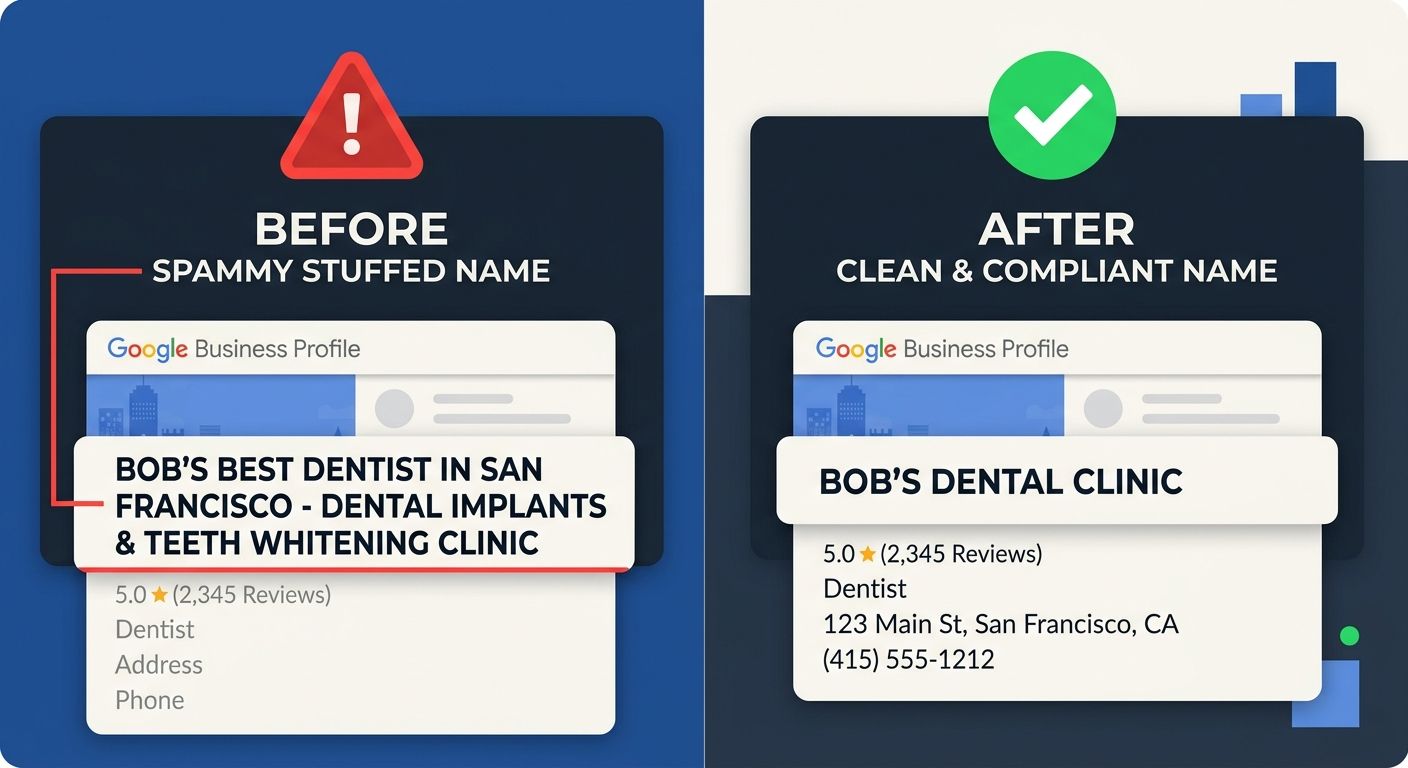
Keyword stuffing in GBP business names (e.g., "Mike's Plumbing | Emergency Plumber | 24/7 Plumbing Service Dallas")
Fake or inauthentic reviews
Low-value, mass-generated location pages that swap city names without adding unique content
Manipulative backlink profiles
Duplicate or thin affiliate content
The speed matters because it tells us something about Google's confidence level. When Google ships a spam update in under 20 hours, it means SpamBrain's models were trained on high-confidence signals with low false-positive rates. Google wasn't testing. Google was executing.
Then came the March 2026 broad core update, which rolled out from March 27 through April 8. While the spam update punished overt manipulation, the core update reassessed content quality across the board, emphasizing usefulness, specificity, and trustworthiness. The one-two combination meant that even businesses that survived the spam filter still had to pass a higher quality bar to maintain their rankings.
If you've been tracking algorithm changes over the years, you know that paired updates like this are rare. Google usually spaces them out to isolate their effects. Running them back-to-back was a deliberate choice. It compressed the window for recovery and made it nearly impossible for spammy operators to adapt between updates.
Locksmiths, Movers, and Contractors Lost Their Listings First
The industries hit hardest by Google Business Profile spam 2026 enforcement are the ones that have had the worst spam problems for years. Locksmiths. Movers. Contractors. Lawyers. These are sectors where a single local lead can be worth $500 to $5,000, and where the incentive to game GBP listings has always been strongest.
Reporting from Ad-hoc News and Zoomyourtraffic confirmed that Google has been suspending listings for keyword stuffing in business names. This is significant because Google historically took a lighter touch with GBP name violations. According to Sterling Sky's case study research, Google previously only sent warnings to stop keyword stuffing about 60% of the time, often letting stuffed names persist without punishment. The enforcement posture has clearly changed.
I've seen this dynamic from the agency side for over a decade. The agencies selling bulk GBP optimization would set up hundreds of profiles for franchise clients, each name stuffed with location and service keywords. "ABC Locksmith" becomes "ABC Locksmith | Emergency Lock Repair | Residential Locksmith | Commercial Lock Service | Atlanta GA." The math was simple: more keywords meant more visibility in the local pack, and the penalty risk was low enough to justify the gamble.
That math no longer works. A GBP suspension means the listing disappears from Google entirely. No map pack. No local finder results. No calls. As Digible's analysis put it, "you're in Google jail." And recovery from suspension requires a reinstatement process that can take weeks, during which your competitors absorb every lead you would have received.
The GBP suspension risks are particularly acute for multi-location businesses. If Google's enforcement systems detect a pattern of keyword stuffing across multiple profiles managed by the same account, the risk of bulk suspension increases. I've already heard from two agency contacts who had client portfolios of 30+ locations flagged within the same week.
Google's Proximity Filter Changed the Review Playbook
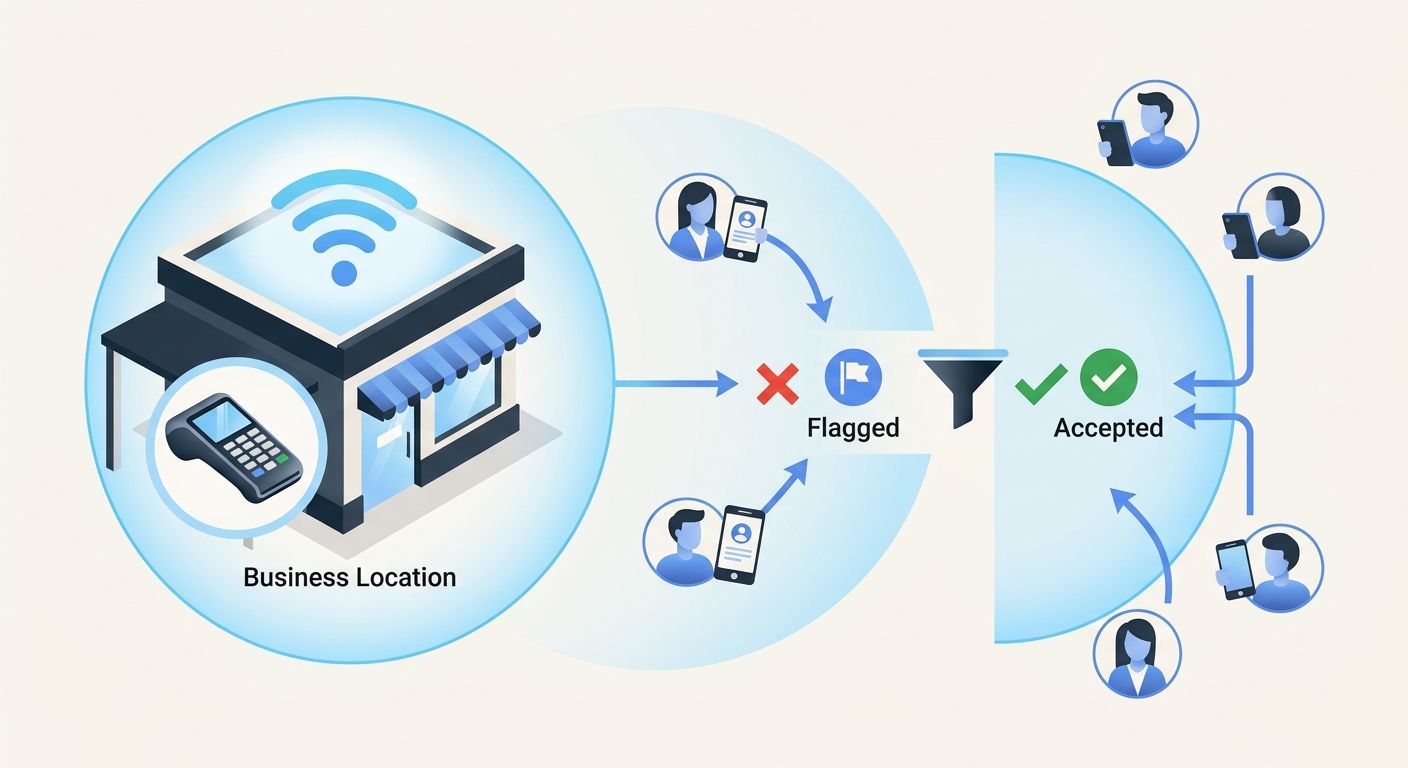
The spam crackdown wasn't limited to business names. Google's April 2026 review policy shift introduced what's being called the Proximity Filter, and it's catching businesses that never thought of their review practices as spammy.
Here's what's happening: if a customer leaves a Google review while connected to the business's Wi-Fi network, or while standing at the business's point-of-sale system, Google may flag that review as "Spam" or "Pressured." The reviews aren't always deleted outright. Sometimes they're suppressed or deprioritized in the review count, which means businesses see their visible review totals drop without any obvious explanation.
This is a direct hit on one of the most common local SEO tactics: asking customers to leave a review while they're still in the store. Every local SEO consultant I know, myself included, has recommended some version of this at some point. "Put a QR code at the checkout counter." "Have the receptionist ask happy patients to leave a review before they walk out." Those tactics now carry real risk.
The implications ripple outward from there. If you've been building your review-based SEO strategy around in-store review collection, your review acquisition pipeline needs restructuring. The safe approach is to follow up via email or SMS after the customer has left the premises and disconnected from your network.
And the review landscape is shifting in another direction simultaneously. According to research from Advice Local on 2026 ranking factors, behavioral signals have gained significant weight in local ranking algorithms. Click-through rates, time on page, phone calls initiated from the listing, and even how businesses respond to negative reviews all feed into ranking calculations now. A business that responds thoughtfully to a one-star review can actually benefit from it, because Google interprets that engagement pattern as a signal of legitimacy. Businesses that were gaming reviews were, in a sense, competing against themselves. The fake positive reviews crowded out the authentic engagement signals that now matter more.
Behavioral Signals Replaced Keyword Density as the Local Ranking Engine
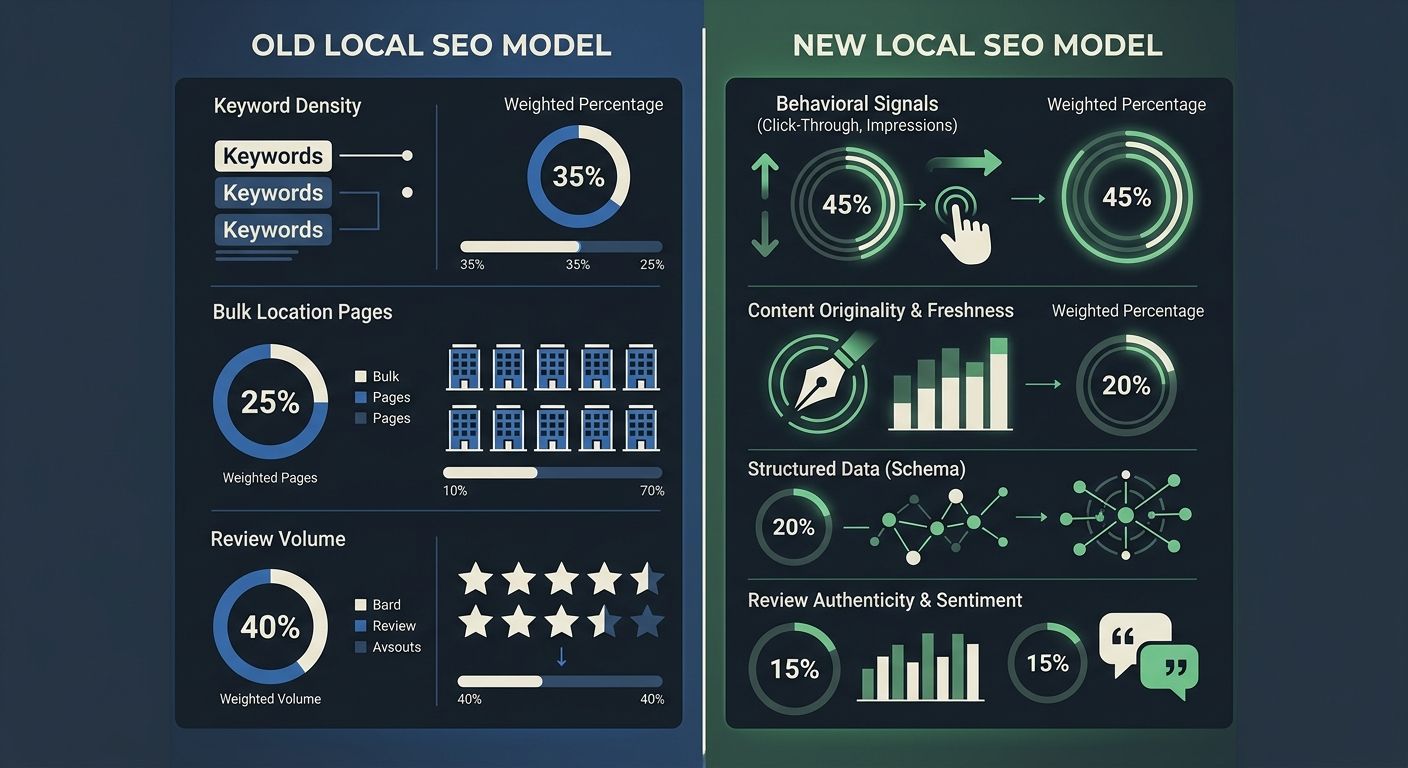
The shift toward behavioral signals represents the deeper structural change beneath the spam enforcement. Google isn't just punishing bad actors. The entire ranking framework for local search has moved away from the inputs that bulk optimization targets.
Scorpion's analysis of the March 2026 core update found that location pages swapping in city names without unique content were specifically demoted. These are the bread and butter of scaled local SEO. A plumbing company with 15 service areas gets 15 pages, each identical except for the city name in the title and H1. That playbook is dead.
The update also coincided with a sobering statistic for the local SEO industry: over 51% of searches now end without a click. The zero-click trend means that even if your listing ranks well, users increasingly get what they need from the search results page itself, especially with AI Overviews pulling structured data directly into search results. Content that gets filtered out by spam detection is also less likely to surface in AI-generated answers, which further compounds the visibility loss.
So what's replacing keyword density as the mechanism for local ranking? Based on Local Falcon's 2026 ranking factor analysis, the answer is a combination of:
Proximity and relevance accuracy: How precisely your GBP listing matches what the user is actually looking for, not how many keyword variations you've crammed in
Behavioral engagement: Click-through rates, calls from listings, direction requests, and dwell time on your website after clicking through
Review authenticity and response quality: Volume still matters, but the ratio of authentic-to-flagged reviews and the quality of owner responses now carry more weight
Structured data and schema markup: Local business schema that provides Google with clean, parseable information about hours, services, and service areas
Content originality: Unique service descriptions, genuine local expertise, and first-party information that can't be replicated by swapping city names
For agencies, this list represents a fundamental shift in what services they can sell. The bulk optimization model depended on repetition at scale. Create one template, replicate it across locations, and charge per-location management fees. That model worked because Google's enforcement was inconsistent enough to make the risk-reward calculation favorable. The March 2026 updates changed that calculation permanently.
I've been skeptical of agencies that guarantee rankings for years, and this crackdown validates that skepticism. Any agency that promised top-three map pack placement through "optimized" GBP listings was selling a service built on a foundation that Google has now explicitly undermined. If your agency contract includes ranking guarantees for local pack positions, this is the moment to scrutinize what tactics they're using. The vetting process for evaluating agency methods matters more than ever when the line between optimization and spam has narrowed this dramatically.
SpamBrain's 19.5-Hour Message to the Local SEO Industry
The speed and scope of the March 2026 enforcement actions tell a clear story about Google's direction. Local SEO keyword stuffing penalties are no longer occasional and inconsistent. They're systematic and fast. SpamBrain's models are trained, confident, and running at a pace that leaves no room for the "stuff it until they catch you" approach that defined local SEO tactics for the better part of a decade.
For businesses and agencies dealing with the aftermath, the practical checklist is straightforward:
Audit every GBP listing name against Google's spam policies. If the name contains anything beyond the actual legal business name, remove it before enforcement reaches your profile
Relocate review collection away from the business premises. Follow up with customers via email or SMS 24–48 hours after their visit, when they're on their own network and making a voluntary decision to review
Replace templated location pages with genuinely unique content for each service area. If your Dallas page reads like your Fort Worth page with a find-and-replace swap, both pages are now liabilities
Implement local business schema markup so that Google can extract structured data from your site without relying on keyword signals from your GBP name
Monitor behavioral metrics in Google Business Profile Insights, especially call volume, direction requests, and website click-through rates, which are now stronger ranking indicators than profile keyword optimization
The businesses that will come through this transition with their visibility intact are the ones that already treated their GBP listings as accurate representations of their business rather than keyword repositories. For everyone else, the window for proactive cleanup is measured in weeks, not months. Recovery from a GBP suspension can drag on for weeks or longer, and the leads lost during that period go directly to competitors who played it clean.
I've evaluated over 200 SEO agencies in my career. The ones I'd recommend to local businesses right now are the ones that never sold bulk GBP optimization in the first place. The agencies that focused on building genuine review strategies, creating original local content, and maintaining clean listing data are the ones whose clients aren't calling in a panic this week. That's the difference between an agency built for durability and one built for short-term ranking gains. Google just made that distinction visible to everyone.
Marcus Webb
Digital marketing consultant and agency review specialist. With 12 years in the SEO industry, Marcus has worked with agencies of all sizes and brings an insider perspective to agency evaluations and selection strategies.
Explore more topics