
Portfolio SEO Without the Text Trap: How Architecture Firms Can Rank Image-Heavy Websites in 2026
The standard advice architecture firms get from SEO agencies is backwards: wrap every portfolio image in three paragraphs of keyword-stuffed copy, and Google will reward you. It won't. That approach produces the opposite of what it claims.
 Marcus Webb··8 min read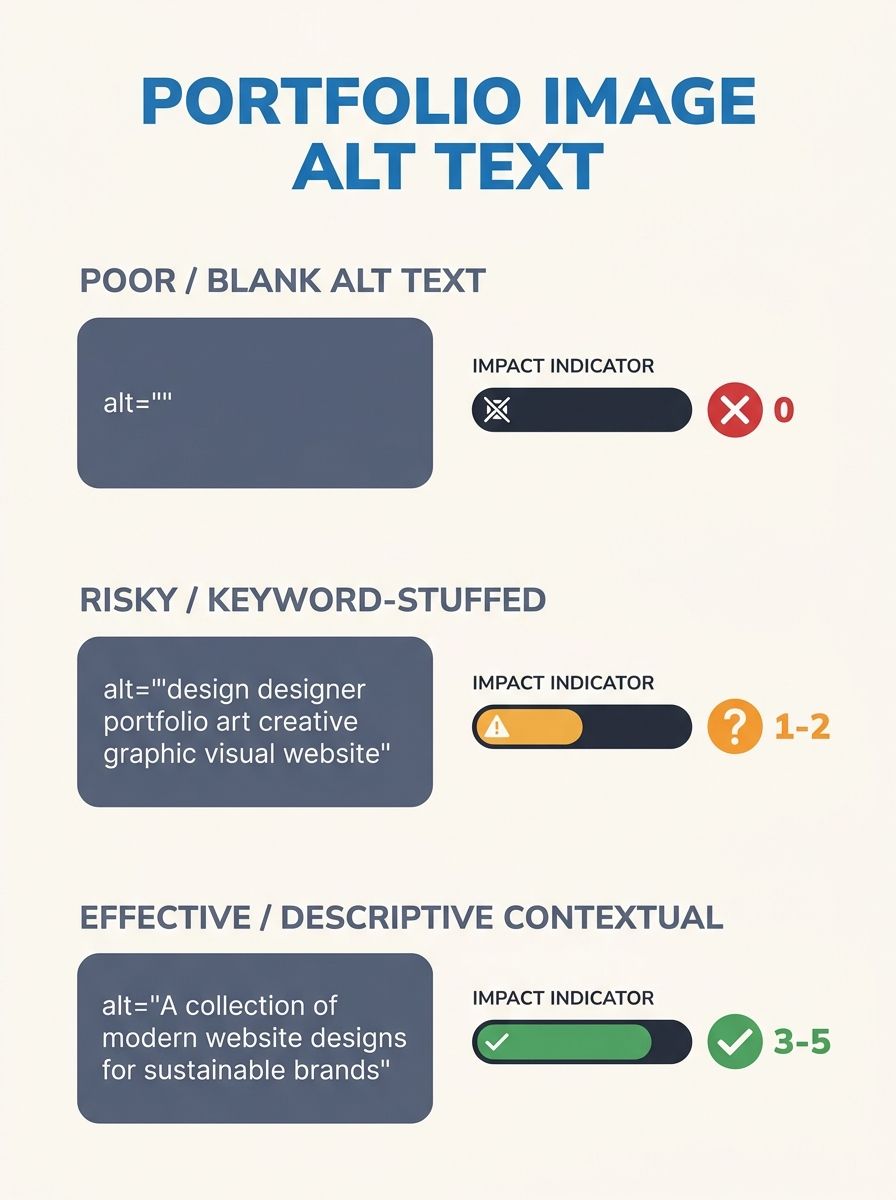
Portfolio SEO Without the Text Trap: How Architecture Firms Can Rank Image-Heavy Websites in 2026
The standard advice architecture firms get from SEO agencies is backwards: wrap every portfolio image in three paragraphs of keyword-stuffed copy, and Google will reward you. It won't. That approach produces the opposite of what it claims.
I've reviewed hundreds of architecture firm websites over twelve years in this industry, and the pattern is consistent. Firms that pad their portfolios with generic text ("our award-winning team created a harmonious living space using sustainable materials") see higher bounce rates and lower time-on-page than firms with clean, image-forward designs backed by proper technical SEO. Google has gotten dramatically better at understanding images through metadata, structured data, and surrounding context signals. It doesn't need 500 words of filler copy per project page. It needs the right 50 words in the right places.
Architecture websites featuring SEO-optimized images and detailed project portfolios achieve up to 65% higher engagement rates than those relying on text-heavy approaches without visual optimization. That engagement comes from images properly indexed and contextualized, not from keyword-stuffed paragraphs nobody reads.
Three technical strategies make this work. Each addresses a specific failure point I see over and over in architecture firm audits.
Alt Text Done Right Replaces Paragraph Padding
The single most impactful thing an architecture firm can do for image SEO for architects is write genuinely useful alt text. And the bar is low, because almost nobody does it well.
Here's what I typically find on portfolio sites: alt text fields left blank, or filled with filenames like "IMG_4392.jpg," or stuffed with keywords like "modern residential architect Chicago best luxury home design." All three approaches fail. The first gives Google nothing to index. The second is invisible in search. The third triggers spam signals.
The correct approach is closer to how you'd describe the image to someone who can't see it. As Wix's alt text guidelines explain, the best practice is to write commonly used words in your alt text, because anything too complex is less likely to match actual searches. A useful mental model: describe the photograph as if you're talking to a friend who cannot see it.
For a portfolio image of a completed residential project, that means something like: "Two-story glass and timber residence in Portland with cantilevered upper floor and native landscaping." That's specific. It includes location, materials, and architectural features. It maps to actual search queries people type into Google Images.
The practical checklist for alt text strategy across a portfolio
File names: Rename before upload. "portland-residential-glass-timber-facade.jpg" beats "DSC_0847.jpg" every time
Alt text: 8-15 words describing what's visible, including location and architectural style where natural
Title attributes: Optional, but useful for additional context like project name or year completed
Surrounding captions: One sentence of context per image. Not a paragraph. One sentence with the project name, location, and building type
Siana Marketing's portfolio optimization approach centers on descriptive alt text implementation paired with strategic image compression that maintains visual quality. That pairing matters: an alt-text-rich image that takes 8 seconds to load still won't rank.
The Reddit SEO community has discussed this at length, and the consensus among practitioners is blunt: use alt tags as they were supposed to be used. Google won't miscategorize your firm because one image has a specific descriptive tag. It reads your entire site's context. So be descriptive on every single image, and stop worrying about over-optimization at the individual tag level.
If you've already explored why architects and design firms need a different SEO playbook than general B2B companies, you know that portfolio website optimization is where the biggest gap exists between standard agency advice and what actually works for visual industries.
Technical Performance Outweighs Word Count for Rankings
The second piece of evidence against the text trap is purely technical: Google's ranking signals for architecture firm sites are far more influenced by Core Web Vitals than by word count on portfolio pages.
An architecture firm's typical portfolio page loads a dozen high-resolution images. If those images aren't compressed, lazy-loaded, and served through a CDN, the page takes 6-10 seconds to fully render. As one technical SEO analysis from April 2026 put it plainly: if your page takes 10 seconds to load heavy graphics, the user will close the window before seeing your first benefit. Google reads that high bounce rate as a clear signal the page doesn't deserve first-page placement.
The specific targets your site needs to hit:
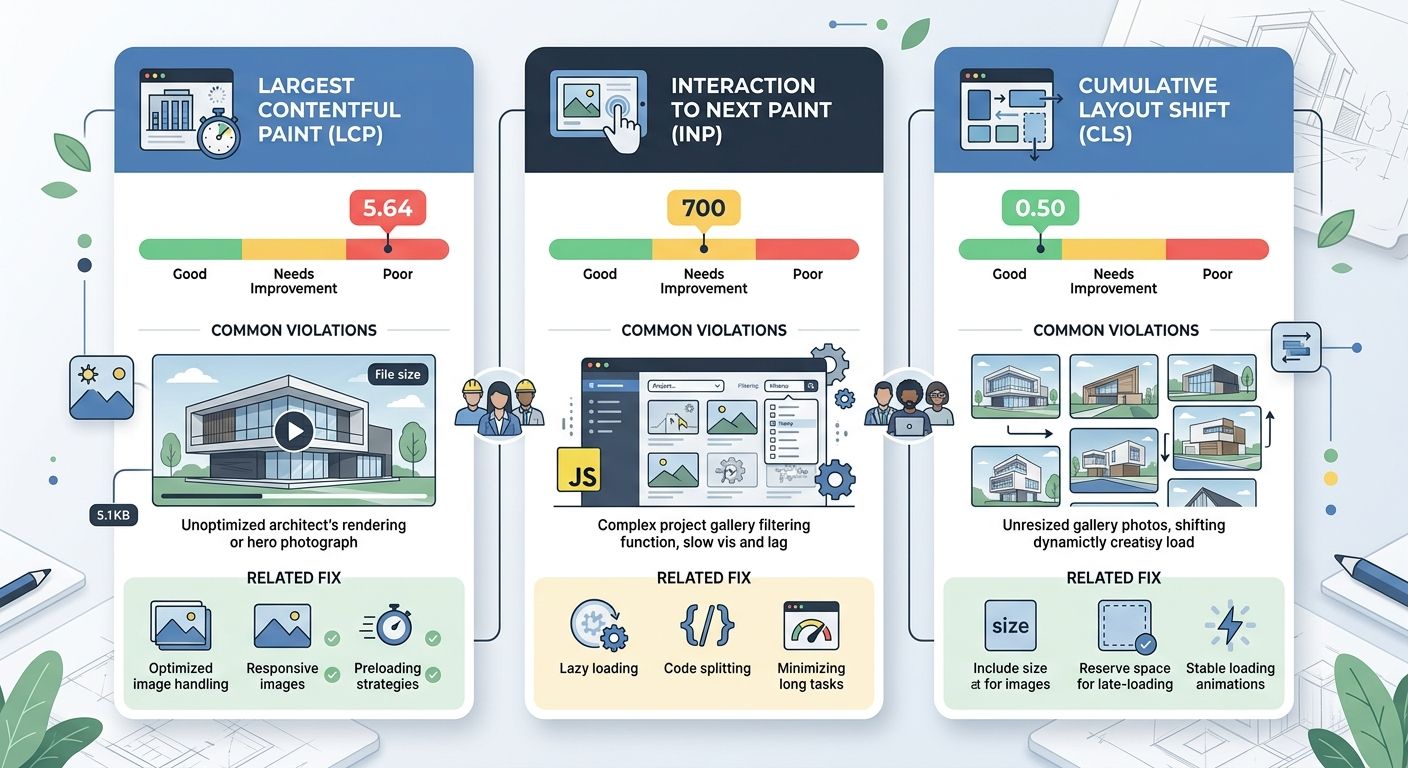
Largest Contentful Paint (LCP): Under 2.5 seconds. This is the metric that kills architecture sites most often, because the largest content element is almost always a hero image
Interaction to Next Paint (INP): Under 200 milliseconds. Heavy JavaScript from gallery lightboxes and animation libraries pushes this over the threshold
Cumulative Layout Shift (CLS): Under 0.1. Images loading without defined dimensions cause layout jumps that tank this score
Here's where the text trap creates an ironic problem: agencies that recommend adding 500+ words per portfolio page are actually making performance worse. More DOM elements, more reflows, more layout shifts as text and images compete for viewport space. The page gets heavier and slower, which directly undermines the ranking signals Google cares most about.
The better investment for architecture firm rankings is technical: implement WebP or AVIF image formats, configure proper lazy loading with height and width attributes on every image element, and serve images through a CDN with edge caching. I've seen firms improve their LCP from 5.8 seconds to 1.9 seconds through image optimization alone, with zero changes to their text content.
If your firm is considering a site redesign or platform migration, this technical foundation should be the priority. We've covered how 301 redirect strategies preserve organic growth during migrations, and the same principle applies here: get the infrastructure right first, or nothing else you do matters.
Server-Side Rendering vs. Client-Side Rendering
This is where many architecture firms unknowingly sabotage themselves. Portfolio sites built on React or Vue frameworks often use client-side rendering (CSR), where the browser has to execute JavaScript before any content becomes visible. Google can crawl JavaScript-rendered pages, but the process is slower, less reliable, and sometimes results in partial indexing.
Server-side rendering (SSR) or static site generation (SSG) delivers fully formed HTML to both users and search engine crawlers. For a portfolio site, this means every image tag, every alt attribute, and every piece of structured data is immediately available for indexing without waiting for JavaScript execution.
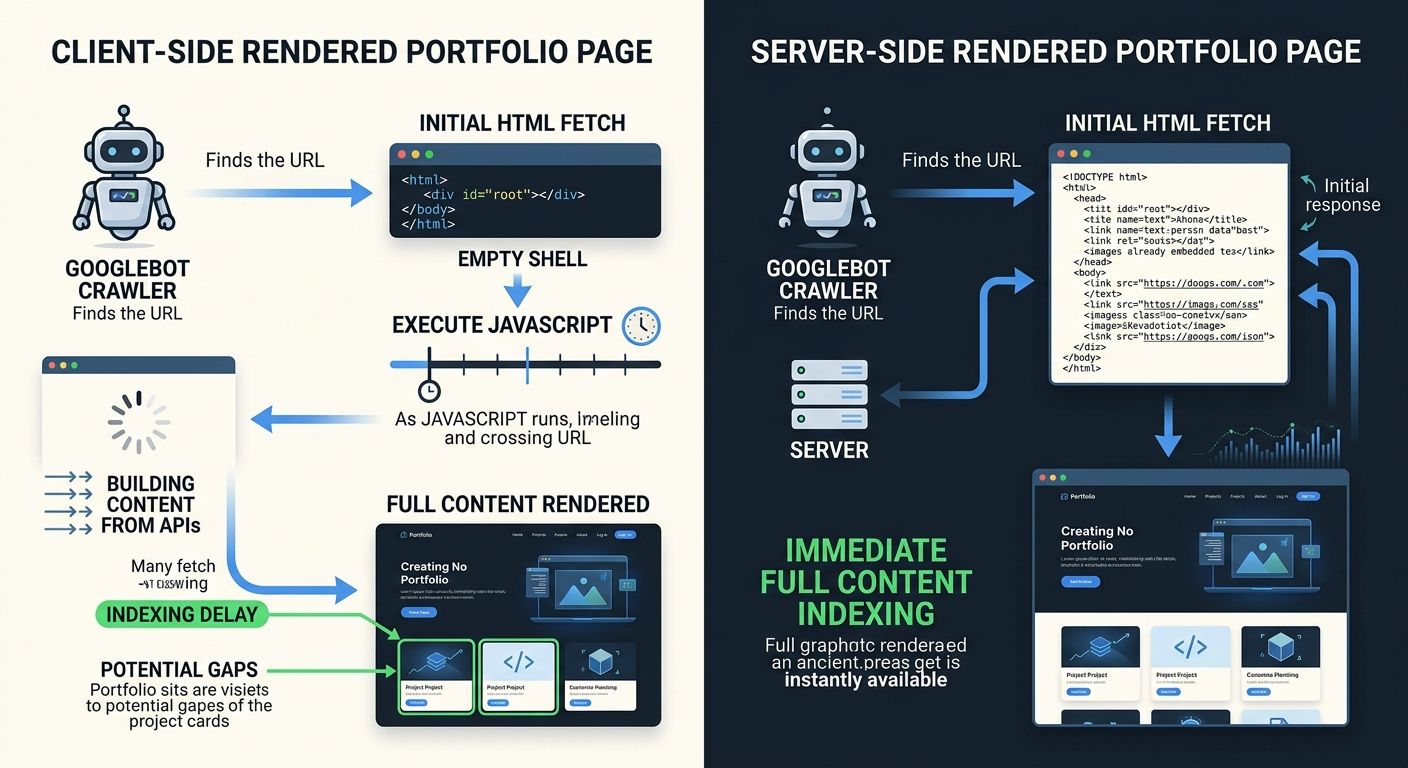
If your current site is built on a JavaScript framework, ask your developer whether portfolio pages are server-rendered. When the answer is "Googlebot can render JavaScript," that's technically true but practically insufficient. The rendering queue adds delays, and architecture sites with hundreds of portfolio images are exactly the kind of pages where partial rendering failures occur most.
Structured Data Gives Google What Text Padding Pretends To
The third evidence point is the most direct rebuttal of the text trap. Agencies add paragraphs of copy to portfolio pages because they believe Google needs textual context to understand what an image shows, what the project involved, and where it's located. Structured data provides all of that context in a format Google actually prefers, without adding a single visible word to the page.
For architecture firms, the relevant schema types include:
LocalBusiness: Firm name, address, service area, contact information
CreativeWork: Individual project entries with title, description, location, date, and image references
ImageObject: Technical image metadata including content description, license information, and creator attribution
When you implement CreativeWork schema on each portfolio project page, you're telling Google: "This is a residential project called Hawthorne Residence, located in Portland, Oregon, completed in 2024, designed by this firm, photographed by this photographer." That's more structured, more machine-readable, and more accurate than a paragraph of prose trying to convey the same information.
Anatech Consultancy recommends optimizing portfolio images with keyword-rich alt text, filenames, and schema markup to improve visibility in image-based search results. The schema piece is what most agencies skip because it requires developer involvement rather than copywriter hours. And agency billing models favor copywriter hours, typically at $100-$200 per hour for "content strategy" that could be replaced by a $2,000-$3,000 one-time schema implementation.
This structured approach also positions your portfolio for visual search optimization and AI-generated search results. Google's AI Overviews and generative search experiences pull from structured data far more reliably than from unstructured paragraph text. Firms that want their projects surfacing in AI-powered results should read about optimizing for both Google and generative engines, because the same underlying principles apply across industries.
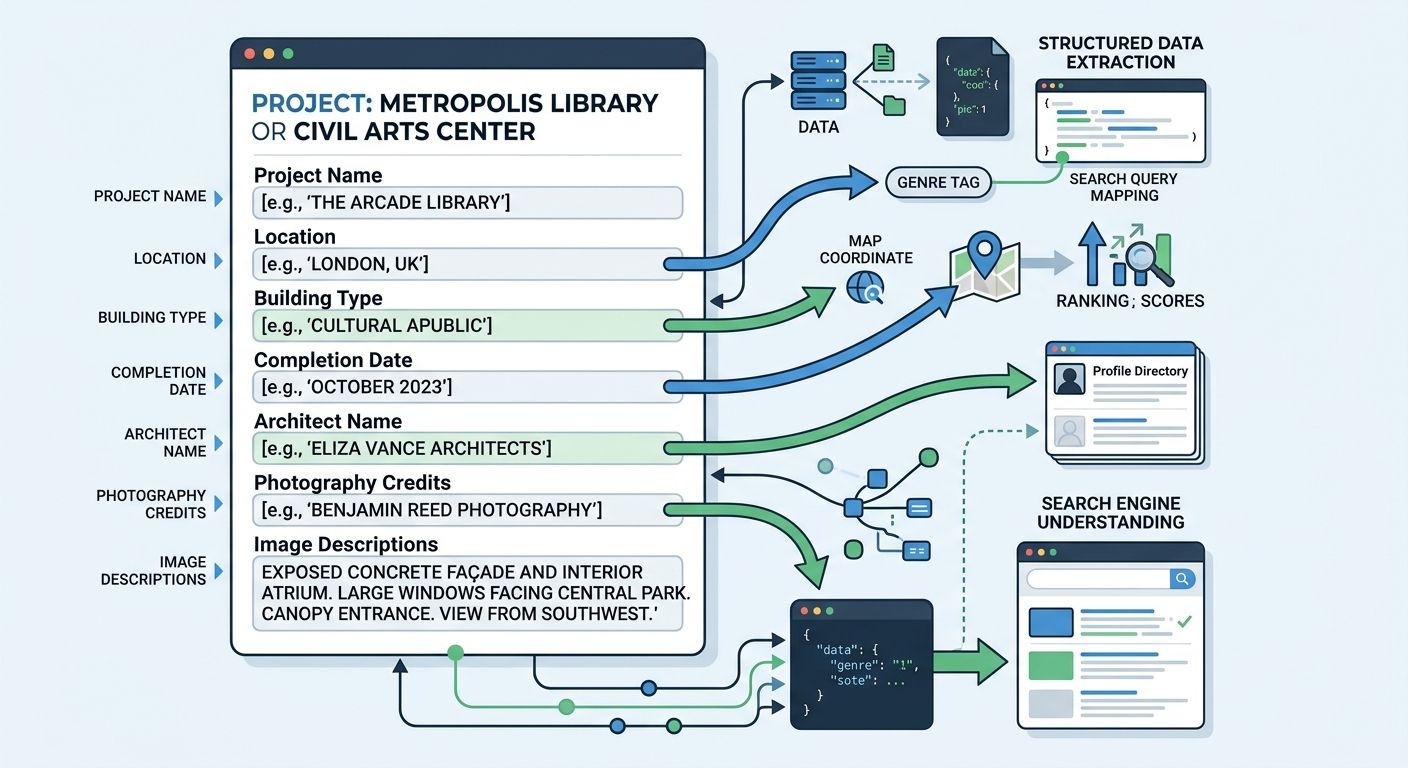
The April 2026 core update shifted ranking signals toward brand authority and entity recognition, and structured data is the primary mechanism through which Google identifies and trusts entities. Your firm, your projects, your architects, and your service areas all become discoverable entities when marked up correctly. Without schema, those entities exist only as pixel patterns in photographs that Google may or may not interpret accurately.
The Text Trap, Reconsidered
The claim I opened with is that architecture firms don't need to stuff their portfolio pages with text to rank well. After walking through alt text strategy for design firms, technical performance, and structured data, I want to add nuance to that claim rather than leave it as a blanket statement.
Text content still matters on architecture websites. Your service pages, your about page, your blog (if you maintain one), and your location pages all benefit from well-written, substantive copy. The problem is where agencies direct that writing effort. When a firm's SEO budget produces 12 paragraphs of copy distributed across portfolio project pages that nobody reads, those dollars are wasted twice: once on the writing, and again on the performance penalty the extra content creates.
The firms I've seen ranking well for competitive terms like "residential architect [city]" and "commercial architecture firm [region]" share a consistent pattern. Their portfolio pages are visually clean, technically fast, and backed by proper metadata and structured data. Their text content lives on dedicated service pages, case study pages, and blog posts that serve different search intents entirely. The portfolio itself stays visual, because that's what prospective clients came to evaluate.
Your portfolio is a visual asset, and it should be optimized as one. Get your alt text strategy for design firms in order, push your Core Web Vitals into passing ranges, implement schema markup on every project, and reserve your content budget for the pages where substantive writing actually serves a search intent. The data, the technical evidence, and your own analytics all point to the same conclusion: the text trap costs architecture firms money while delivering worse rankings than the technical fundamentals they should have prioritized from the start.
Marcus Webb
Digital marketing consultant and agency review specialist. With 12 years in the SEO industry, Marcus has worked with agencies of all sizes and brings an insider perspective to agency evaluations and selection strategies.
Explore more topics