
The Brand Signal Gap: Why SEO Benchmarks Miss What Google's April 2026 Core Update Actually Rewards
Google's April 2026 core update displaced 90.7% of top-10 search results across tracked queries, and 24.1% of pages that held top-10 positions fell completely out of the top 100.
 Marcus Webb··9 min read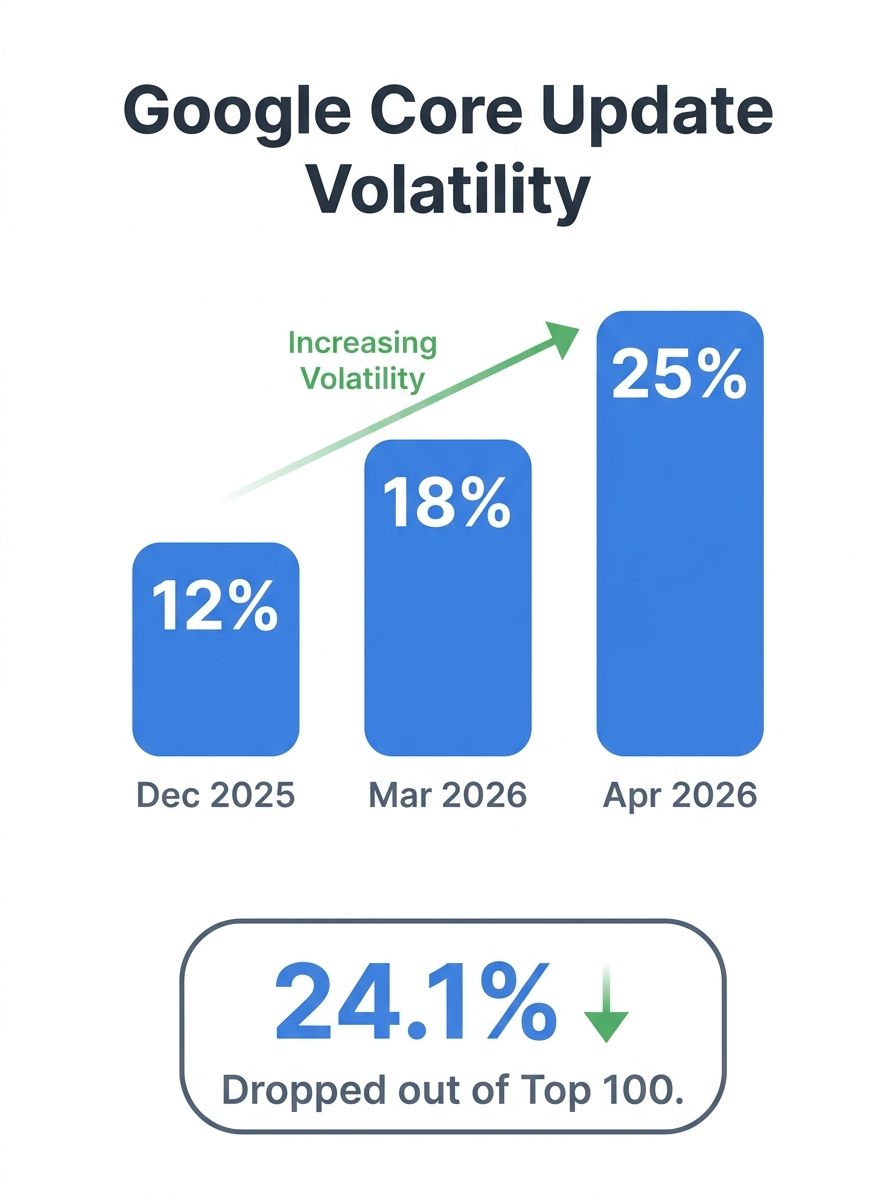
The Brand Signal Gap: Why SEO Benchmarks Miss What Google's April 2026 Core Update Actually Rewards
Google's April 2026 core update displaced 90.7% of top-10 search results across tracked queries, and 24.1% of pages that held top-10 positions fell completely out of the top 100. White-label SEO providers who built their reporting dashboards around keyword position tracking, backlink volume, and technical audit scores are now handing clients reports full of green metrics while organic traffic drops month over month.
That disconnect has a name in the industry: the brand signal gap. It's the distance between what standard SEO benchmarking tools measure and what Google's algorithm actually weights when deciding which sites deserve prominent placement. For white-label operations especially, this gap creates a dangerous illusion of performance.
The Volatility Numbers Tell a Specific Story
The March 2026 core update, which ran from March 27 through April 8, set the stage. SE Ranking data cited across multiple SEO publications showed that 79.5% of top-3 URLs changed positions, up from 66.8% during the December 2025 update cycle. Only 20.5% of top-3 URLs held their exact position. According to SEO Vendor's April 2026 update analysis, the update targets content quality, relevance signals, and user experience across all device types, and it has caused sharp ranking swings in competitive niches.
The April follow-up compounded these shifts. Sites that had recovered from March saw second-wave volatility. And the pattern of who gained versus who lost reveals something white-label reporting frameworks aren't designed to capture: the winners share strong brand recognition, verified authorship, and entity-level authority. The losers share thin brand presence, regardless of how clean their technical SEO looked.
What the Algorithm Actually Reweighted
Google didn't introduce new ranking factors in April 2026. It reweighted existing ones, and the reweighting hit brand signals hard. As one analysis from memorable.design stated bluntly: Google has fundamentally shifted its algorithm to prioritize brand signals over traditional SEO metrics.
Here's what that looks like in practice. Sites recognized as entities in Google's Knowledge Graph now receive what amounts to a trust buffer. They get indexed faster (minutes instead of 24-72 hours for unknown domains). They appear more frequently in AI Overviews. They recover faster from minor algorithmic fluctuations. And they can rank for keywords that don't even appear on the page, because Google associates them with deep topical authority.
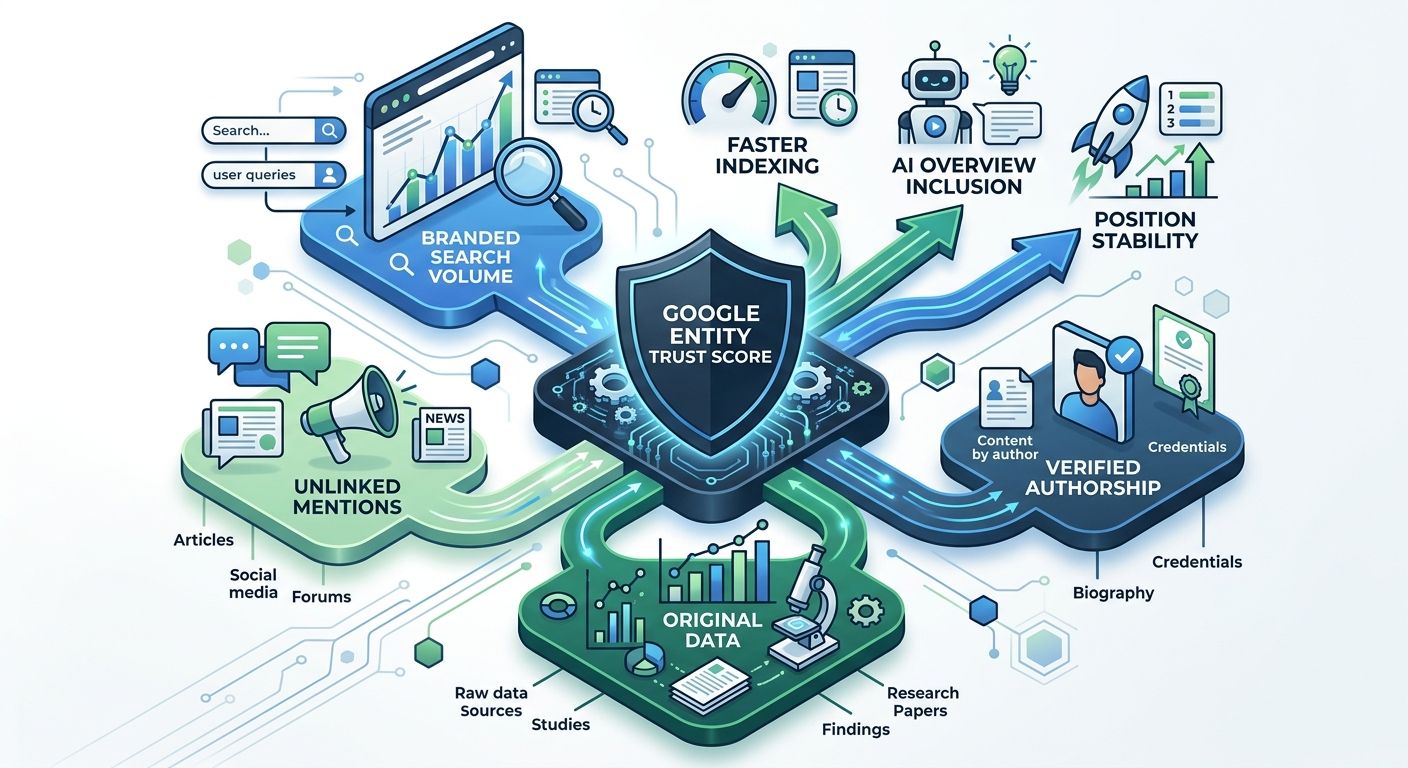
The specific brand signals carrying the most weight include:
Branded search volume: When users type your brand name into Google alongside a topic ("Moz link building," "Ahrefs competitor analysis"), Google interprets that as a vote of confidence. This signal has become one of the strongest authority indicators in the post-update landscape.
Unlinked brand mentions: Google's language models now treat mentions of your brand on authoritative sites as digital citations, even without a hyperlink. If a journalist references your agency in an article about SEO trends, that counts toward entity authority.
Verified authorship: Content published by "Admin" or an unattributed freelancer carries less weight than content tied to a verified expert with a digital footprint across LinkedIn, industry publications, and speaking engagements.
First-hand experience and original data: Google's "information gain" scoring favors pages that add proprietary data, original research, case studies, or first-person evidence that can't be replicated by scraping and rewriting existing content.
Where Competitor Keyword Gap Analysis Falls Short
Most white-label SEO providers run competitor keyword gap analyses using Semrush, Ahrefs, or similar tools. The standard workflow: identify keywords your competitors rank for that you don't, prioritize by volume and difficulty, create content to fill the gaps. This process still has value, but it misses the dimension that matters most after April 2026.
The gap analysis shows you keyword-level opportunities. It doesn't show you entity-level authority gaps. Two sites can target the identical keyword with similar content depth and backlink profiles, and the one Google recognizes as a trusted brand entity will outrank the other by several positions. Your white-label dashboards will flag this as a "difficulty" problem or a "backlink" problem when it's actually a brand recognition problem.
I've reviewed agencies that run thorough competitor keyword gap analyses with impressive rigor but still can't explain why their clients plateau at position 6-8 for commercial terms. The missing variable is almost always brand signal strength. The competitor sitting at position 1-3 has higher branded search volume, more unlinked mentions in industry publications, and stronger Knowledge Graph presence.
This is where SEO benchmarking mistakes 2026 become expensive. If you're a white-label provider billing $2,000-$5,000/month for SEO execution and your benchmarks don't account for Google brand signals ranking factors, you're optimizing around the wrong axis. Clients will eventually notice that technical improvements and content production aren't moving the needle, and they'll blame the execution when the strategy framework itself was flawed.
E-E-A-T Stopped Being an Audit Checkbox
The March 2026 core update made this painfully clear: websites without strong E-E-A-T signals lost rankings fast. April reinforced the pattern. But the way most white-label operations handle E-E-A-T in their reporting is still superficial.
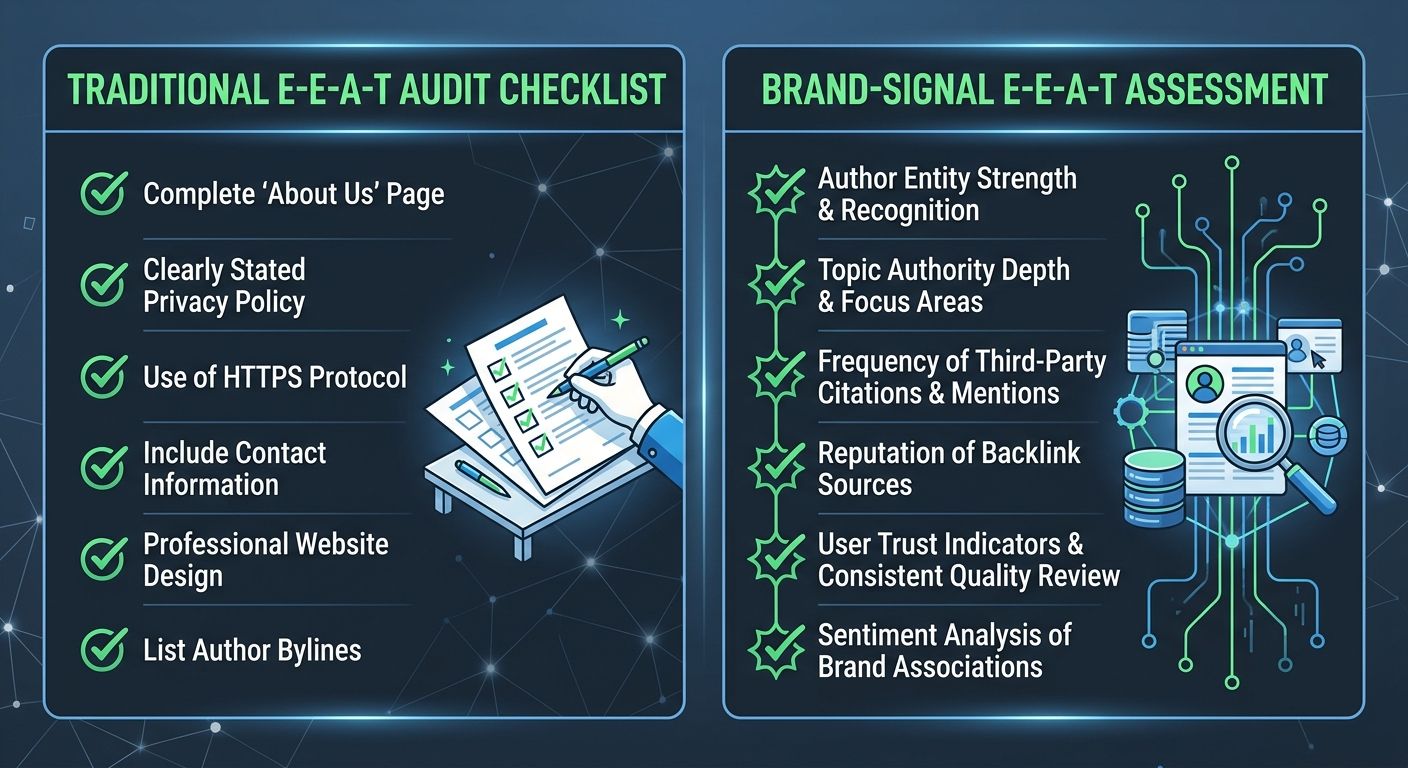
A typical white-label E-E-A-T audit checks boxes: Does the site have an About page? Are there author bios? Is there a privacy policy? Does the site use HTTPS? These are baseline requirements, not competitive advantages. They're the equivalent of confirming a restaurant has chairs and a menu. The audit doesn't tell you whether the content demonstrates genuine experience, whether the authors have verifiable credentials in the subject matter, or whether the site has earned trust signals from external sources.
SearchEngineLand's analysis of the global E-E-A-T gap highlights another dimension white-label providers miss entirely: authority doesn't travel automatically across markets or verticals. A brand with strong E-E-A-T signals in one niche can have zero trust signals in an adjacent niche. White-label E-E-A-T SEO benchmarks that treat authority as a site-wide property rather than a topic-specific one will consistently misjudge competitive positioning.
What a meaningful E-E-A-T evaluation should look like in a white-label report:
Experience verification: Does each content piece include evidence of first-hand experience? Screenshots, original photography, specific client results, process documentation?
Author entity strength: Can Google connect the listed author to external mentions, publications, speaking engagements, or professional profiles? An author who exists only on the client's website carries minimal signal.
Topic-level authority mapping: Does the site have depth in its claimed area of expertise, or is it spreading thin across unrelated topics?
Trust signal distribution: Are third-party sources citing, mentioning, or linking to the site in contexts that reinforce its expertise claims?
If your white-label reporting package doesn't address these dimensions, you're measuring the wrong version of E-E-A-T. Google's own guidance on creating helpful, people-first content makes clear that automated ranking systems prioritize content demonstrating expertise and trustworthiness through substance, not through page-level technical compliance.
How White-Label Reporting Needs to Evolve
The SEO performance metrics misalignment between what dashboards show and what drives rankings creates a specific operational problem for white-label providers. Your agency clients are presenting your reports to their end clients. When those reports show positive trends in metrics that don't correspond to actual search visibility improvements, everyone's credibility erodes.
Here's what I'd add to any white-label reporting framework given what the April 2026 update rewards:
Brand signal tracking as a standard module. This means monitoring branded search volume trends over time (Google Search Console data makes this straightforward), tracking unlinked mentions via tools like Brand24 or Mention, and noting Knowledge Graph panel status. If a client doesn't have a Knowledge Graph presence, that should show up in the report as a gap, not get ignored because it doesn't fit a dashboard widget.
Author authority scoring. For content-heavy clients, track the digital footprint of each content author. Are they being cited elsewhere? Do they have growing LinkedIn followership? Are they quoted in industry publications? This data is harder to automate, which is why most white-label tools ignore it. But it correlates directly with post-update ranking performance.
Entity-level competitor analysis alongside keyword-level analysis. When you examine why performance metrics alone don't predict SEO outcomes, the brand signal dimension often explains the variance. Include a quarterly entity authority comparison showing how the client's brand stacks up against competitors on branded search volume, unlinked mentions, and Knowledge Graph features.
Information gain assessment for new content. Before publishing, evaluate whether a piece adds original data, unique perspective, or first-hand evidence. ClickRank's breakdown of 2026 ranking factors confirms that authority compounds as you build a track record of experience-backed content, and new pages rank faster as a result. White-label content that merely matches competitor depth without adding original insight will increasingly underperform.
I'd rather see an honest conversation about capability limits than a dashboard that provides false reassurance. Clients who understand the gap between what's measurable and what matters are better partners in the long run than clients who've been lulled into complacency by green checkmarks.
The AI Overview Dimension
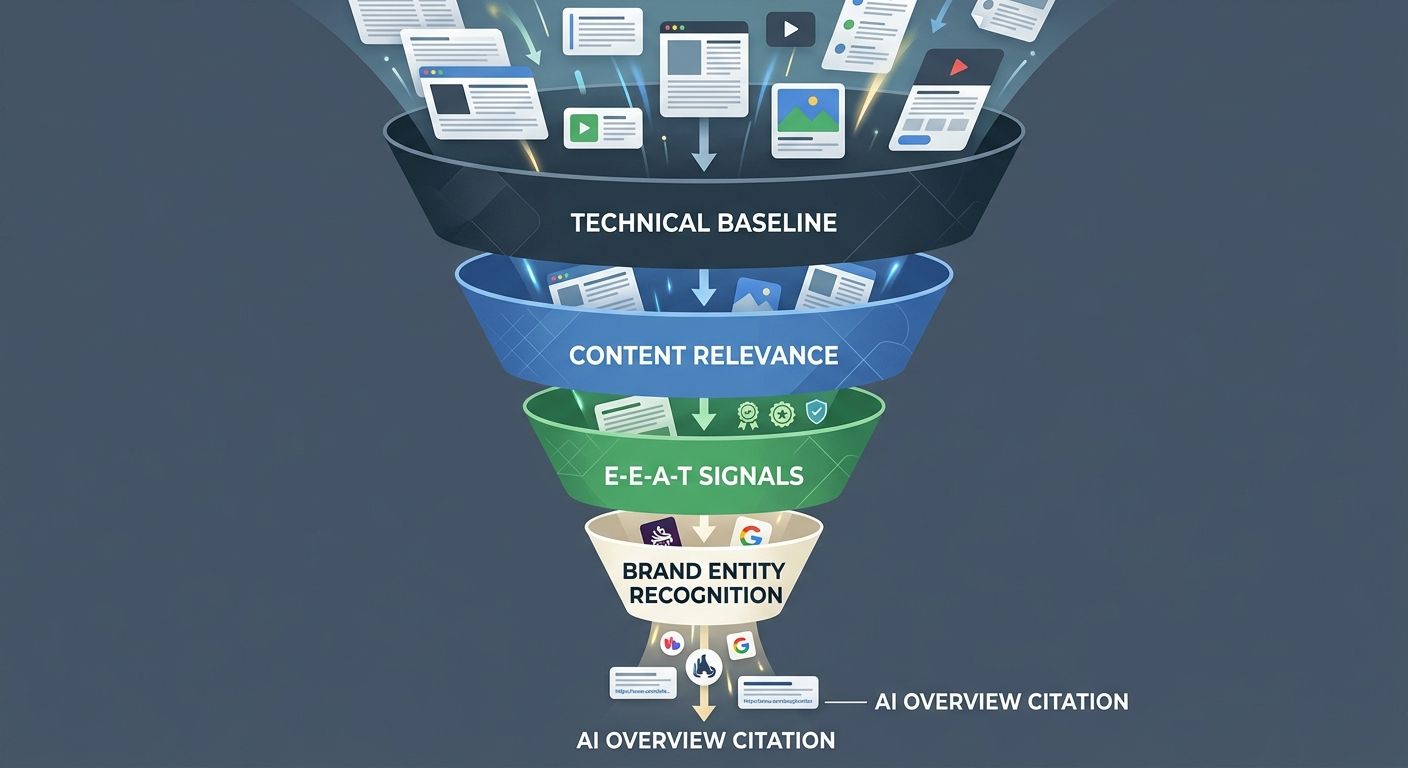
One factor accelerating the brand signal gap is how enterprise teams are losing visibility in AI-generated results. Google's AI Overviews pull from sources it trusts, and that trust determination relies heavily on brand authority signals. A white-label client whose content never appears in AI Overviews is losing an increasingly large share of search traffic, but most benchmarking frameworks don't track AI Overview inclusion at all.
Sites with strong entity recognition get pulled into AI Overviews at disproportionate rates. If your white-label benchmarks focus exclusively on traditional SERP positions (positions 1-10 on blue links), you're measuring a shrinking share of the actual search experience. AI Overview citations have become a distinct competitive axis, and brand signals are the primary determinant of which sources get cited.
This matters doubly for white-label providers because AI-generated content, which many white-label operations scaled aggressively in 2024-2025, is precisely the type of content Google's April 2026 update deprioritized. Generic AI-produced articles that lack author attribution, original data, and first-hand experience saw significant visibility drops. The agencies that recognized the transition earlier and adjusted their content strategies are better positioned now than those still running volume-first playbooks.
What Still Isn't Settled
Several questions remain open after the April 2026 core update, and white-label providers should be tracking them rather than assuming current patterns are permanent.
How much of the brand signal weight is permanent versus cyclical? Google has historically reweighted signals in one update and moderated them in the next. The March and April 2026 updates both pushed heavily toward brand authority, but a subsequent update could recalibrate. Building brand signals is still the right strategy because these investments compound regardless of algorithmic weighting, but treating the current signal balance as fixed would repeat the same benchmarking mistake in a different direction.
What happens to smaller brands with genuine expertise but low search volume? The current update cycle clearly favors established brands, which creates a bootstrapping problem for newer businesses. Google's stated goal of surfacing helpful content from any source doesn't fully align with an algorithm that gives a trust buffer to entities with high branded search volume. This tension will likely produce future adjustments, but nobody knows the timeline.
How quickly will SEO tools adapt their benchmarking frameworks? Semrush, Ahrefs, Moz, and other platforms are aware of the brand signal shift, but their core product architecture is built around keyword and backlink data. Adding entity-level metrics requires different data sources and different analytical models. Until these tools evolve, white-label providers will need manual analysis or supplementary tools to close the measurement gap.
Where does social engagement fit in the new signal hierarchy? Social signals aren't direct ranking factors, and Google has stated this clearly. But the cumulative effect of social engagement strengthens the brand signals that do count. A viral LinkedIn post about your client's original research drives branded searches, earns unlinked mentions, and builds the author's digital footprint. White-label reporting that ignores social metrics may be missing an important upstream driver of the signals Google does weight.
The honest assessment for white-label providers right now: the standard SEO benchmarking toolkit measures roughly 60-70% of what actually determines rankings. The remaining 30-40% lives in brand signals, entity authority, and experience verification that most dashboards don't capture. Closing that measurement gap is the most pressing operational challenge in white-label SEO, because you can't optimize what you don't measure, and you can't explain to clients why rankings aren't moving when your reports suggest everything is working. The providers who build brand signal tracking into their reporting stack will hold onto clients. The ones who keep shipping the same dashboards will find themselves having increasingly uncomfortable conversations about why the numbers don't add up.
Marcus Webb
Digital marketing consultant and agency review specialist. With 12 years in the SEO industry, Marcus has worked with agencies of all sizes and brings an insider perspective to agency evaluations and selection strategies.
Explore more topics