
The SEO Agency Transition Playbook: Running Parallel Campaigns Without Tanking Your Rankings
Switching SEO agencies is the business equivalent of changing the engine on a moving car.
 Marcus Webb··9 min read
The SEO Agency Transition Playbook: Running Parallel Campaigns Without Tanking Your Rankings
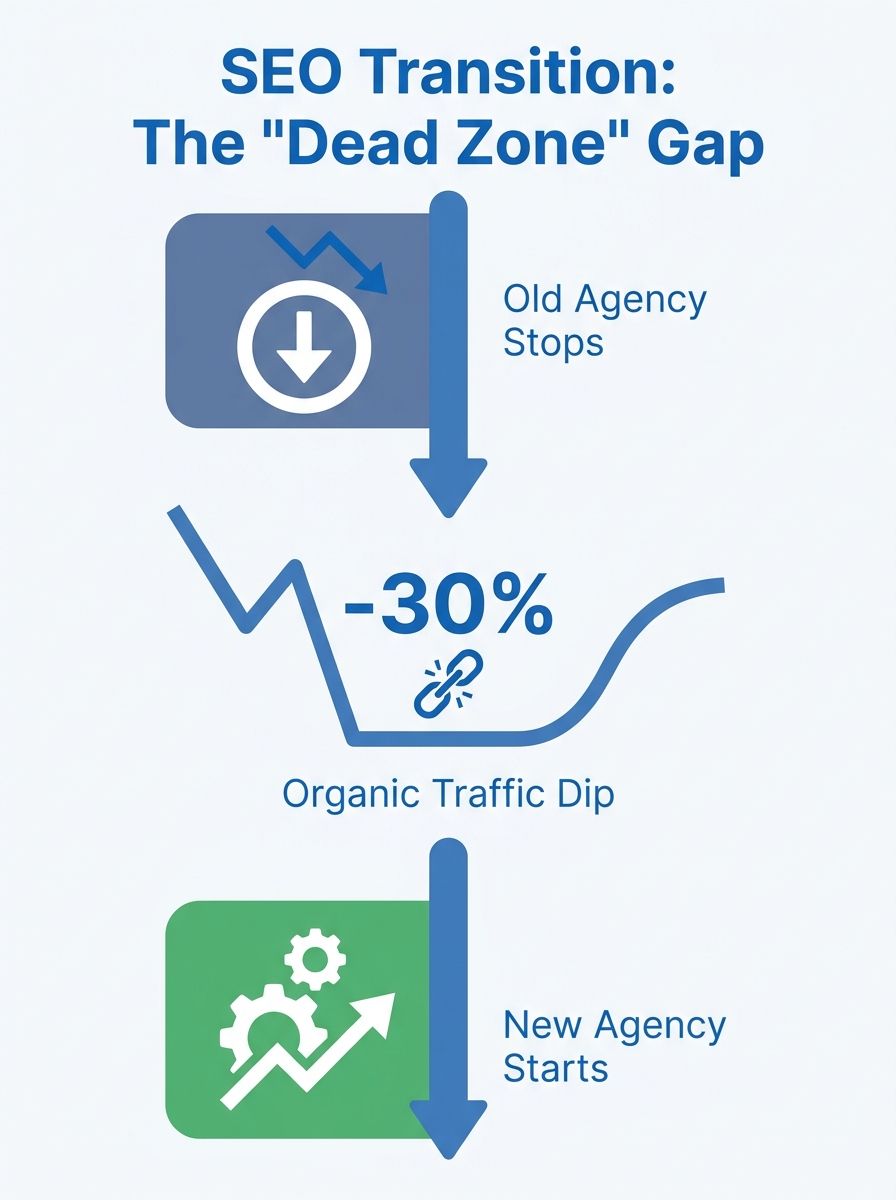
Switching SEO agencies is the business equivalent of changing the engine on a moving car. The contract with your outgoing agency typically includes a 30- or 60-day termination window, and what happens inside that window determines whether your organic traffic survives the handoff or drops 20–40% while the new team figures out what the old team was actually doing. I've overseen or audited more than 30 agency transitions across my career, and the pattern is depressingly consistent: the client assumes the new agency will "pick up where the old one left off," the old agency goes quiet the moment they receive the termination notice, and nobody is running the store for weeks.
There are three viable approaches to managing an agency transition SEO strategy, each with real tradeoffs in cost, complexity, and risk to your rankings. The right choice depends on your budget, your internal SEO knowledge, and how much of your revenue depends on organic search.
Approach 1: The Cold Turkey Switch
This is the most common method, and the one most likely to damage your rankings. You terminate Agency A, sign with Agency B, and hope the gap between them is short enough that nothing breaks.
How it works
You give notice to the outgoing agency per your contract terms. During that notice period, you negotiate access transfers: Google Search Console, Google Analytics, any third-party tools like Ahrefs or Semrush, CMS credentials, and documented backlink profiles. On a defined handoff date, Agency B takes over all SEO responsibilities.
Where it goes wrong
The gap between "Agency A stops caring" and "Agency B understands your site" is almost always longer than clients expect. Marcel Digital recommends allowing at least three months for any meaningful SEO migration or transition, and an agency switch qualifies. Most cold turkey transitions try to compress this into four to six weeks.
The outgoing agency has zero incentive to document their work thoroughly once they know the relationship is ending. I've seen agencies refuse to hand over custom dashboards, proprietary keyword research, and link-building contact lists, arguing these are "agency intellectual property." One client of mine lost access to a Screaming Frog crawl archive spanning 18 months because the outgoing agency ran it from their own license and deleted the shared workspace on the termination date.
There's also a less obvious risk. As noted in a Quora thread on switching SEO agencies, your performance shouldn't drop during a switch unless the outgoing agency undoes work you paid for. That's rare, but what's common is the outgoing agency simply stopping all maintenance: no new content, no link outreach, no technical monitoring. Four to six weeks of inactivity is enough to stall momentum, especially in competitive verticals.
Cost and risk profile
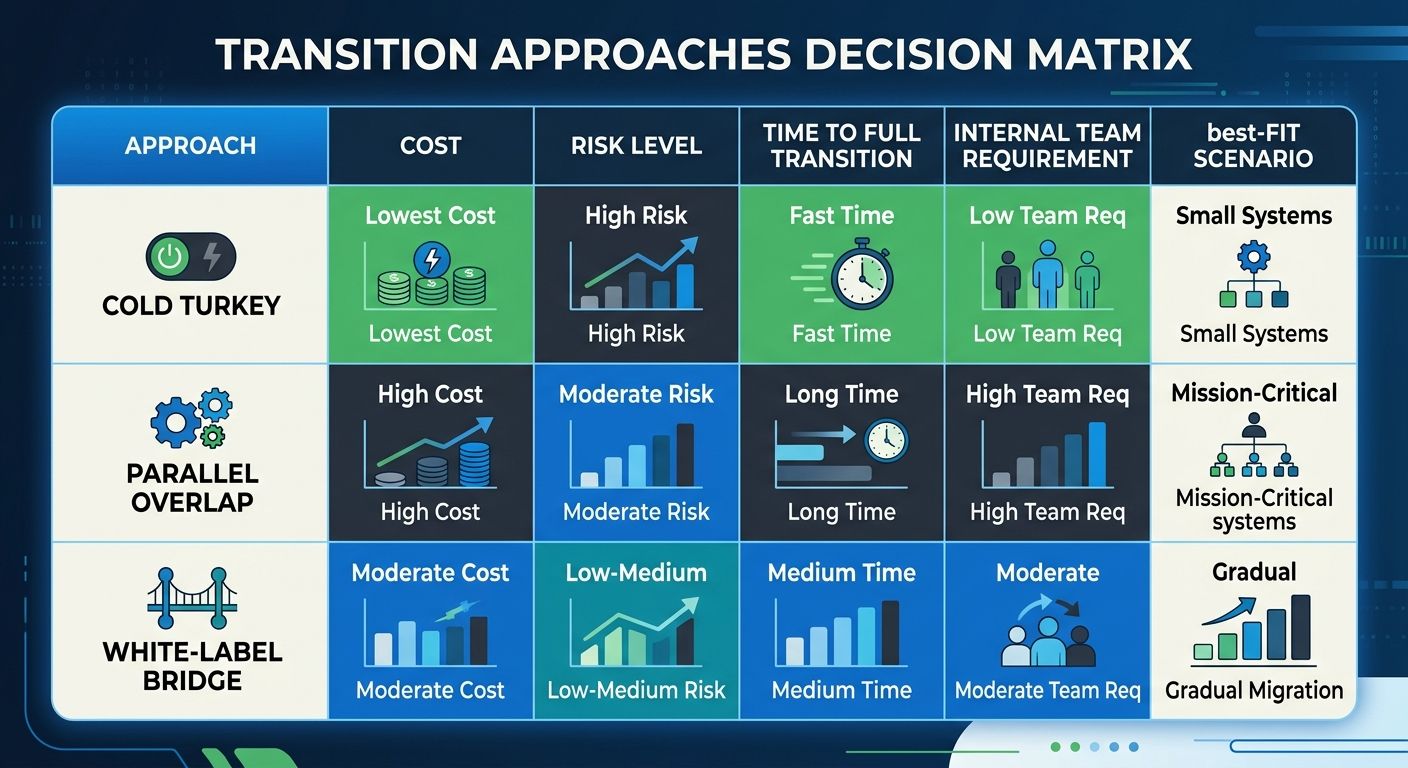
Cost: Lowest upfront. You're paying one agency at a time.
Risk: Highest. Expect a 3–8 week period where no one is actively managing your SEO. Rankings for competitive keywords can slip during this window, and recovery takes longer than the initial decline.
Best for: Businesses where organic search drives less than 20% of revenue, or where internal marketing teams can cover basic SEO tasks during the gap.
If you're evaluating whether your current agency's work is even worth preserving, the trust verification audit framework can help you separate real SEO value from vanity reporting before you make the switch.
Approach 2: The Parallel Overlap
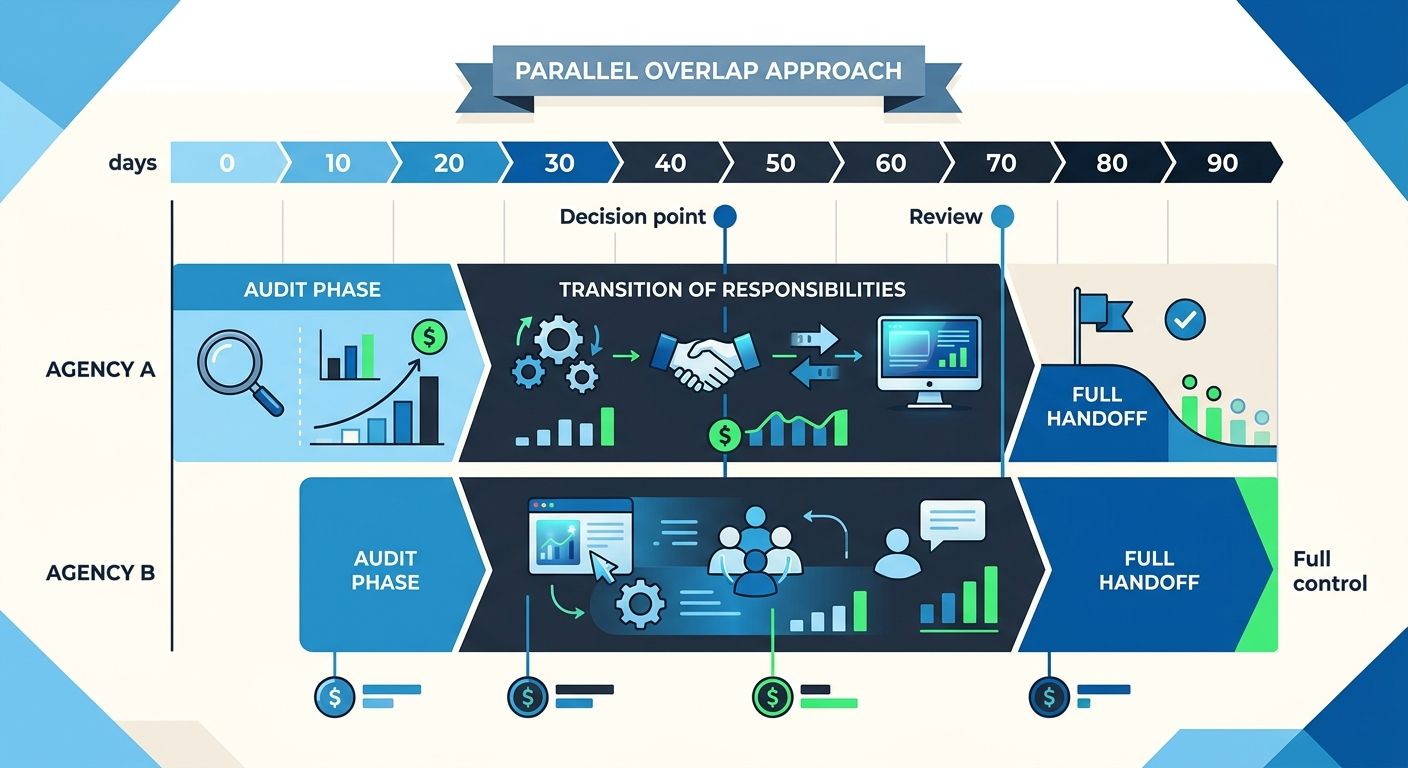
Running parallel SEO campaigns means keeping your outgoing agency on retainer while simultaneously onboarding the new one. Both agencies are active on your account for a defined overlap period, typically 60–90 days.
How it works
You negotiate a reduced-scope retainer with Agency A for the overlap period. They continue maintaining existing campaigns: monitoring rankings, maintaining link profiles, handling technical issues. Agency B, meanwhile, gets access to all assets and begins their audit, strategy development, and initial implementation. The overlap gives Agency B time to understand your site's architecture, backlink profile, content strategy, and technical debt before they're responsible for performance.
Why this is the gold standard for high-stakes transitions
A strong incoming agency will run pre-migration audits, test in staging environments, and use tools like Screaming Frog and log file analysis before touching anything in production. That audit phase is where they discover the outgoing agency's redirects, the orphaned pages nobody told them about, and the disavow file that hasn't been updated in 14 months. If Agency A is still maintaining the site during this period, nothing falls through the cracks.
The parallel overlap also creates accountability on both sides. Agency A knows Agency B is watching their work, which discourages the "quiet quit" behavior that plagues cold turkey transitions. Agency B knows their audit will be compared against Agency A's reporting, which keeps their initial assessments honest.
The complications
Running parallel campaigns requires clear scope boundaries. If both agencies are building links to the same pages, you'll get duplicate outreach and confused prospects. If both are optimizing the same title tags, you'll see competing changes in your CMS history. You need a single point of contact—usually an internal marketing lead—who defines which agency owns which workstreams during the overlap.
There's also the political dimension. The outgoing agency will often resist sharing information directly with their replacement. Structure the overlap so that all data flows through your internal team, not between the two agencies. You own your Google Search Console data, your Analytics account, and your content. Make that explicit in both contracts.
Cost and risk profile
Cost: Highest. You're paying two agencies simultaneously for 60–90 days. Expect the outgoing agency to charge 50–75% of their normal retainer for reduced-scope maintenance. Total transition cost premium: $3,000–$15,000 depending on your monthly spend.
Risk: Lowest. Rankings are actively maintained throughout the transition. The new agency has time to understand your site before being held accountable for performance.
Best for: Businesses where organic search drives 30%+ of revenue, e-commerce sites with seasonal traffic peaks, or any company that's been burned by a bad transition before.
This approach works especially well when your incoming agency passed a rigorous pilot test before you committed to a full engagement. If they've already demonstrated competence on a limited scope, expanding that scope during the overlap period becomes a natural progression.
Approach 3: The White-Label Bridge
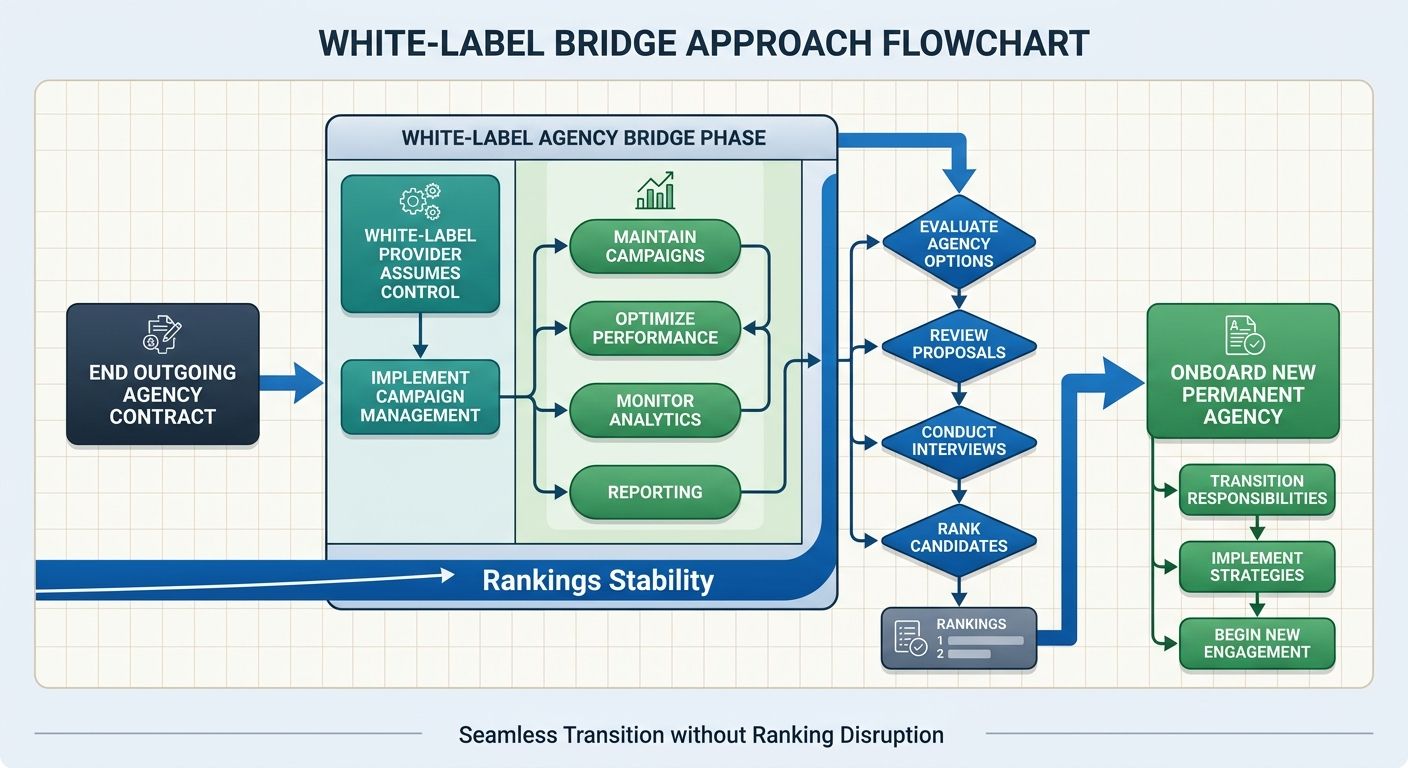
This is the approach most businesses don't know exists, and it's particularly relevant for companies that work with smaller or boutique agencies. Instead of transitioning directly from Agency A to Agency B, you bring in a white-label SEO provider as an intermediary that maintains your campaigns while you evaluate and onboard your next agency.
How it works
White-label SEO providers are the behind-the-scenes operators that many agencies already use to fulfill client work. When you're in transition, you can engage one directly (or through a marketing consultant who manages the relationship) to handle ongoing technical SEO, content production, and link maintenance. The white-label team doesn't need to learn your brand voice from scratch because their role is explicitly operational: keep the technical foundation stable, continue publishing on your editorial calendar, and monitor for ranking disruptions.
You set alerts for major traffic or ranking shifts through the white-label provider while you take your time finding and vetting the right permanent agency. The search for your next agency happens without the pressure of declining rankings forcing you into a hasty decision.
The strategic advantage
The biggest mistake in switching SEO agencies safely is rushing the selection of the replacement because your rankings are already sliding. The white-label bridge removes that time pressure entirely. Your SEO maintenance continues uninterrupted while you spend 60, 90, or even 120 days evaluating candidates, running pilot tests, and negotiating contracts.
This approach also gives you something the other two don't: a neutral third party's assessment of your site's current state. White-label providers have no history with your account, no political baggage from the outgoing agency relationship, and no incentive to inflate the complexity of what they find. Their audit becomes a baseline you can use to evaluate Agency B's initial proposals.
The limitations
White-label providers excel at execution but rarely drive strategy. They'll maintain your content calendar, but they won't develop a new content strategy for an emerging keyword cluster. They'll monitor your backlink profile, but they won't pitch a creative digital PR campaign. The bridge works for maintenance, not for growth. If you're in a competitive vertical where standing still means falling behind, a three-month bridge period means three months without strategic advancement.
There's also the coordination overhead. Someone on your team needs to manage the white-label relationship, review deliverables, and approve content. If you don't have an internal marketing person with enough SEO knowledge to do quality control, the white-label provider's output may not match your standards. Understanding where to draw the line between handling SEO decisions internally versus relying on outside help becomes critical during this phase.
And pricing can be opaque. White-label SEO services typically range from $1,000–$5,000/month depending on scope, but the lack of standardized pricing means you need to negotiate carefully. Ask for itemized deliverables, not bundled packages.
Cost and risk profile
Cost: Moderate. Typically less than maintaining two full agencies, but more than a cold turkey switch. Budget $1,000–$5,000/month for the bridge period plus the eventual cost of onboarding Agency B.
Risk: Low for maintenance, moderate for competitive positioning. Your rankings stay stable, but you're not gaining ground while competitors may be.
Best for: Businesses leaving a long-term agency relationship (2+ years) where the transition needs to be deliberate. Also ideal for companies that have been through a bad agency experience and want to avoid the common data traps in agency selection by taking time to evaluate properly.
How To Choose Between These Three
The right SEO migration strategy depends on answering three questions honestly.
How much revenue rides on organic search? If organic drives less than 20% of your leads or sales, the cold turkey switch is defensible. The cost savings outweigh the risk of a temporary dip. If organic drives more than 30%, the parallel overlap or white-label bridge is worth the investment. A 25% traffic drop for six weeks could cost you more than the entire transition premium.
Do you have internal SEO capability? An in-house marketing team that understands technical SEO can cover the gap in a cold turkey switch by monitoring Search Console, catching crawl errors, and maintaining content publishing. Without that internal safety net, you need either the outgoing agency or a white-label provider keeping watch.
How urgent is the switch? If you're leaving an agency because of poor performance or practices that could trigger penalties, you may not want them touching your site for another 90 days. In that scenario, the white-label bridge is the safest option: you remove the problem agency immediately while maintaining operational continuity through a neutral provider.
One pattern I've seen repeatedly across transitions: the companies that treat the switch as a strategic project with a defined timeline, documented asset transfers, and a clear owner on their side consistently come through with stable rankings. The companies that treat it as a vendor swap—cancel one invoice, start another—are the ones who end up in my inbox six weeks later asking why their traffic fell off a cliff.
The parallel overlap remains my default recommendation for any business where organic search is a primary revenue channel. The cost of running two agencies for 90 days is almost always less than the revenue lost during a botched transition. But the white-label bridge deserves more attention than it gets, especially for businesses that recognize they rushed into their current agency relationship and don't want to repeat the mistake. Taking three months to evaluate candidates while a white-label provider keeps the lights on is a form of discipline that pays compound returns once the right permanent partner is in place. Whichever approach you choose, the principle is the same: continuous performance monitoring and regular reviews of KPIs during the transition period are what separate a managed handoff from an unmanaged disaster.
Marcus Webb
Digital marketing consultant and agency review specialist. With 12 years in the SEO industry, Marcus has worked with agencies of all sizes and brings an insider perspective to agency evaluations and selection strategies.
Explore more topics