
When Google Maps Kills Your Local SEO: Navigating Google's 2026 Trust Enforcement Rules
The March 2026 Core Update, which Google began deploying on March 27 and finished rolling out in mid-April, has already suspended hundreds of Google Business Profiles across the locksmith, moving company, and home contractor verticals.
 Marcus Webb··9 min read
When Google Maps Kills Your Local SEO: Navigating Google's 2026 Trust Enforcement Rules
The March 2026 Core Update, which Google began deploying on March 27 and finished rolling out in mid-April, has already suspended hundreds of Google Business Profiles across the locksmith, moving company, and home contractor verticals. The enforcement pattern is blunt: any business that stuffed keywords into its GBP name woke up to find its listing wiped from Maps and Search. Then, on April 16, Google deployed Gemini AI globally to police profile edits and fake reviews in real time, blocking spam before it even publishes. This is the most aggressive local SEO compliance crackdown I've tracked in twelve years, and based on what I'm hearing from agency contacts and seeing in client dashboards, the pace is picking up through May.
If you run a local business or manage GBP listings for clients, you need a set of clear rules to operate under. These aren't aspirational best practices. They're the operating constraints Google is actively enforcing right now, and violating any one of them can cost you your Maps visibility overnight. Here are six rules for surviving the Google Local SEO 2026 update without getting caught in the crossfire.
Audit your business name before Google audits it for you
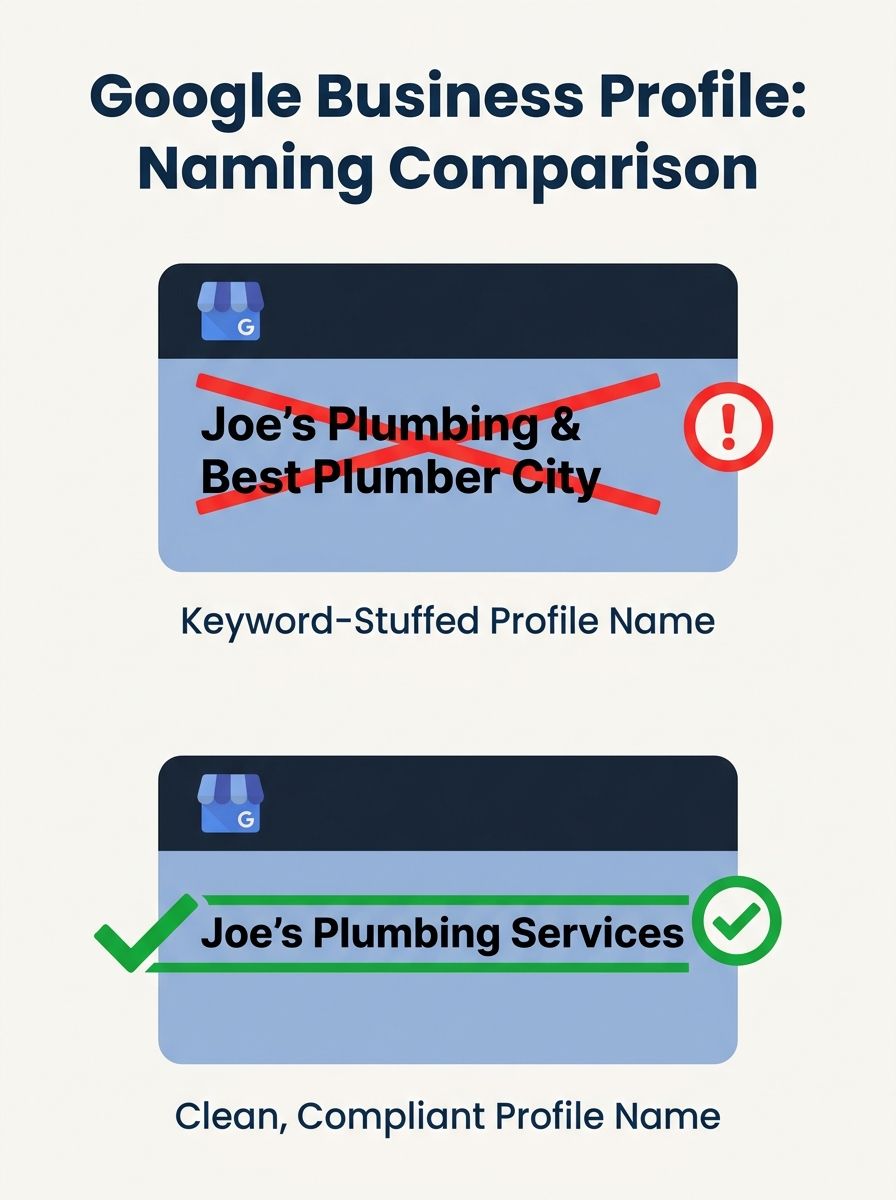
The single fastest path to a GBP suspension right now is a keyword-stuffed business name. Google's enforcement is specifically targeting names like "Best Locksmith Atlanta 24/7 Emergency Service" or "Pro Movers NYC Cheap Long Distance." The 2026 enforcement rules require ethical titles under 60 characters that match your real-world business name exactly as it appears on signage, legal documents, and business cards.
This sounds simple, but I've audited agency portfolios where 30-40% of client listings had some form of name modification. Common violations include:
Appending city names to the business name ("Smith Plumbing - Denver")
Adding service descriptors ("Smith Plumbing & Water Heater Repair")
Including promotional language ("Smith Plumbing | Best Rated")
If your GBP name doesn't match what's printed on your storefront, fix it today. Google is not issuing warnings on this. Profiles are going straight to suspension, and as I covered in my breakdown of the March purge and what to audit immediately, the review period for reinstated profiles can stretch weeks.
The rule breaks when your legal business name genuinely includes a service descriptor. If your LLC is registered as "Denver Emergency Locksmith Services," that's your name, and you can use it. But you'd better have the incorporation documents ready to upload during an appeal.
Treat review recency as the trust signal Google actually measures
Most businesses I work with obsess over their total review count and star rating. Those metrics still matter, but Google's algorithm has shifted its weighting dramatically toward recency, frequency, and owner responses. A 2026 GBP audit analysis confirmed that consistent and genuine reviews signal trust and improve local search visibility, with Google prioritizing frequency and recency over raw volume.
Here's what that means in practice: a business with 200 reviews but nothing new in six months will lose ground to a competitor with 40 reviews and three fresh ones from the past week. I've seen this play out across client accounts repeatedly since the March update. The businesses climbing in map pack rankings aren't the ones with the most reviews. They're the ones with the most recent reviews and owner responses attached to them.
The tactical implication is that you need a system for generating ongoing reviews, and it needs to produce a steady trickle rather than periodic bursts. Google has gotten much better at detecting review campaigns where fifteen reviews show up in a single week and then nothing for two months. That pattern looks manufactured, and the Gemini AI filtering layer is designed to catch exactly this kind of manipulation.
If you're evaluating how your review profile stacks up against competitors, the framework in our review benchmarking scorecard gives you a structured way to measure recency, velocity, and response rates across your category.
Add structured data to your website, not just your GBP fields
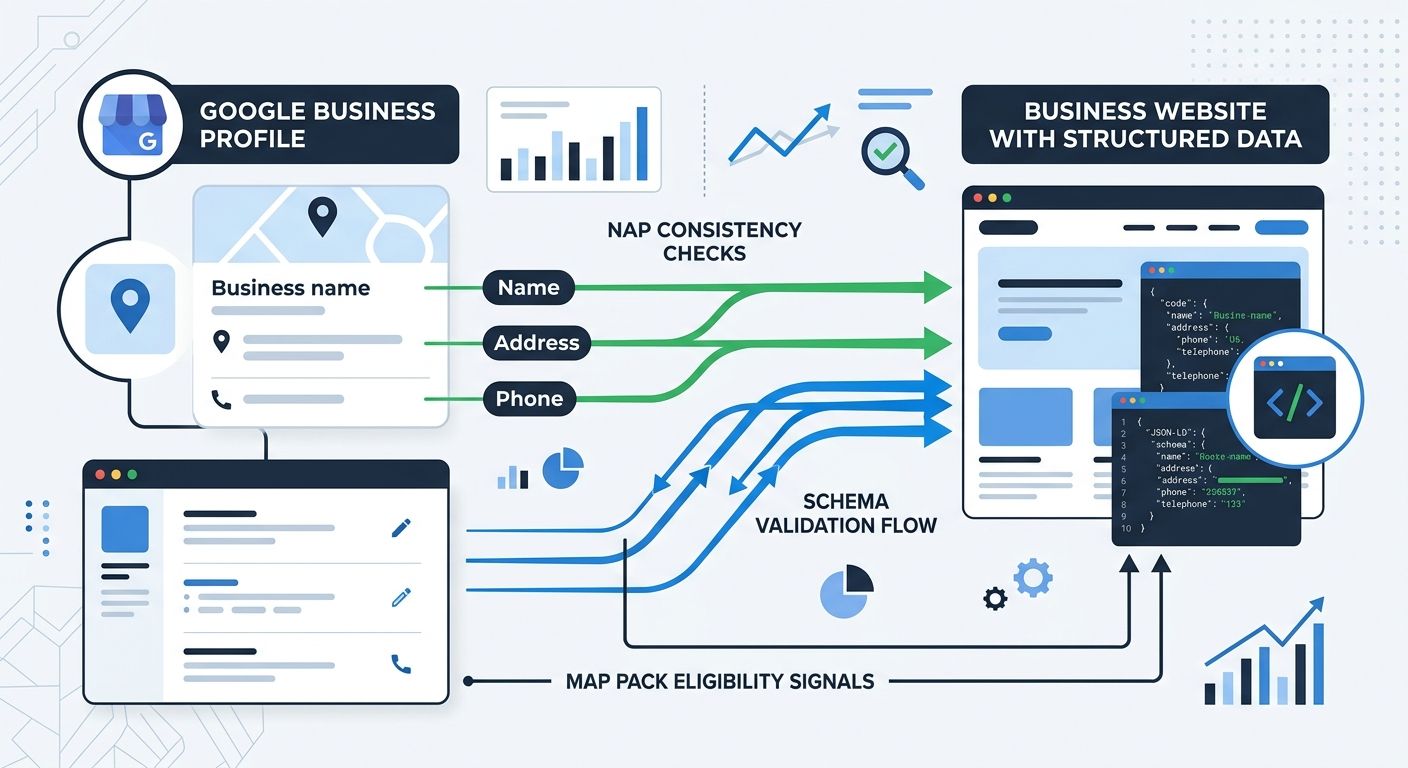
One of the less-discussed requirements in Google's 2026 enforcement framework is the growing importance of structured data markup on your actual website. Your GBP listing is the surface that appears in Maps, but Google is increasingly cross-referencing that information against the schema markup on your site to validate authenticity. According to reporting on the 2026 local SEO rules, implementing structured data enhances local relevance and improves eligibility for map pack inclusion.
The critical schema types for local businesses right now are LocalBusiness (or the more specific subtypes like Plumber, Locksmith, or MovingCompany), along with Review markup and FAQPage where applicable. Your Name, Address, and Phone number in schema should match your GBP listing character for character. Discrepancies between your website's structured data and your GBP profile are one of the signals Google uses to flag suspicious listings.
This rule applies universally. I haven't seen a single local business category where structured data implementation hurt rankings. The only scenario where it breaks is if you implement schema incorrectly, which can create worse problems than having no schema at all. Use Google's Rich Results Test to validate your markup before publishing.
Respond to every review within 48 hours
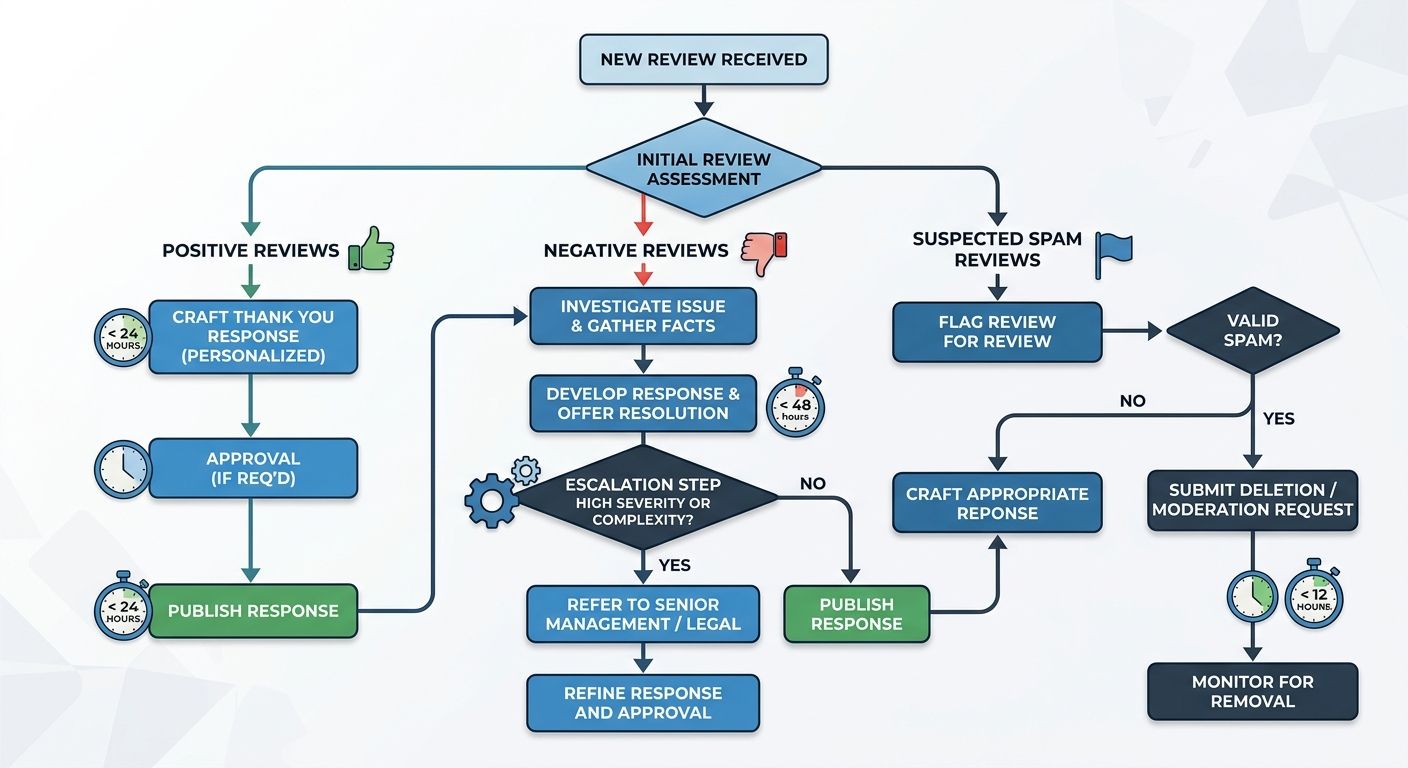
Google's trust signals for Maps rankings now explicitly include owner response rates. This has been a ranking factor for a while, but the March 2026 update appears to have increased its weight significantly. The logic is straightforward from Google's perspective: a business that actively engages with customer feedback is more likely to be a real, operating business than one that collects reviews passively and never responds.
The 48-hour window isn't a hard deadline published by Google, but it's the benchmark I recommend based on what I'm seeing in ranking data. Businesses that respond to reviews within two days consistently outperform those that batch-respond once a month. And the response itself matters. A generic "Thanks for your review!" copied across fifty responses looks automated and provides minimal signal value. Personalized responses that reference specific details from the review carry more weight.
Negative reviews deserve even more attention. I know this is uncomfortable advice for business owners, but a thoughtful, professional response to a one-star review actually strengthens your Google Maps trust signals. It demonstrates active management. The worst thing you can do with a negative review is ignore it or, even worse, try to get it removed through illegitimate means. Google's Gemini AI is now detecting and blocking coordinated fake review campaigns, including review extortion schemes where competitors flood your profile with one-star ratings. If you're hit by one of these attacks, the new system should catch it before publication. But if illegitimate reviews do get through, document everything and flag them through the proper reporting channel.
Our analysis of why review velocity outweighs total volume goes deeper into the mechanics behind this shift.
Build your suspension recovery file before you need it
GBP suspension recovery is one of the most stressful situations a local business can face, and the volume of suspensions from the March 2026 enforcement wave has created a backlog in Google's review process. According to Google's own support documentation, once an account restriction is lifted, you can submit an appeal for your Business Profile. But that appeal needs documentation, and scrambling to assemble it after the fact wastes critical time.
Build your recovery file now, while your profile is still active. It should include:
Your business registration or incorporation documents showing your legal business name
A photo of your physical storefront or office with your business name visible on signage
A utility bill or lease agreement showing your business address
Screenshots of your current GBP listing as it exists today
A record of any past edits you've made to your profile, with dates
If you've had fake or duplicate listings in the past, BrightLocal's suspension recovery guidance recommends removing those fake listings from your dashboard, attempting to remove them from Maps directly, and documenting the URLs. Transparency about past mistakes goes further in the reinstatement process than trying to hide them.
The agencies charging $500-$2,000 for "GBP suspension recovery" are mostly filing the same appeal you can file yourself, but with faster turnaround because they know which documentation Google's reviewers actually look at. If you've already assembled the file above, you can handle the appeal process directly. Our restoration playbook for suspended profiles walks through the step-by-step process.
This rule doesn't break. Every local business should have this file ready. The cost of assembling it is thirty minutes of your time. The cost of not having it, when your phone stops ringing because your Maps listing vanished, is measured in lost revenue.
Diversify your local presence beyond Google Maps
Android Police published a piece this week noting that Google Maps local discovery increasingly feels like advertising, making it difficult for users to find trustworthy results. This is a significant signal. When mainstream tech publications start questioning the reliability of Maps results, consumer behavior follows.
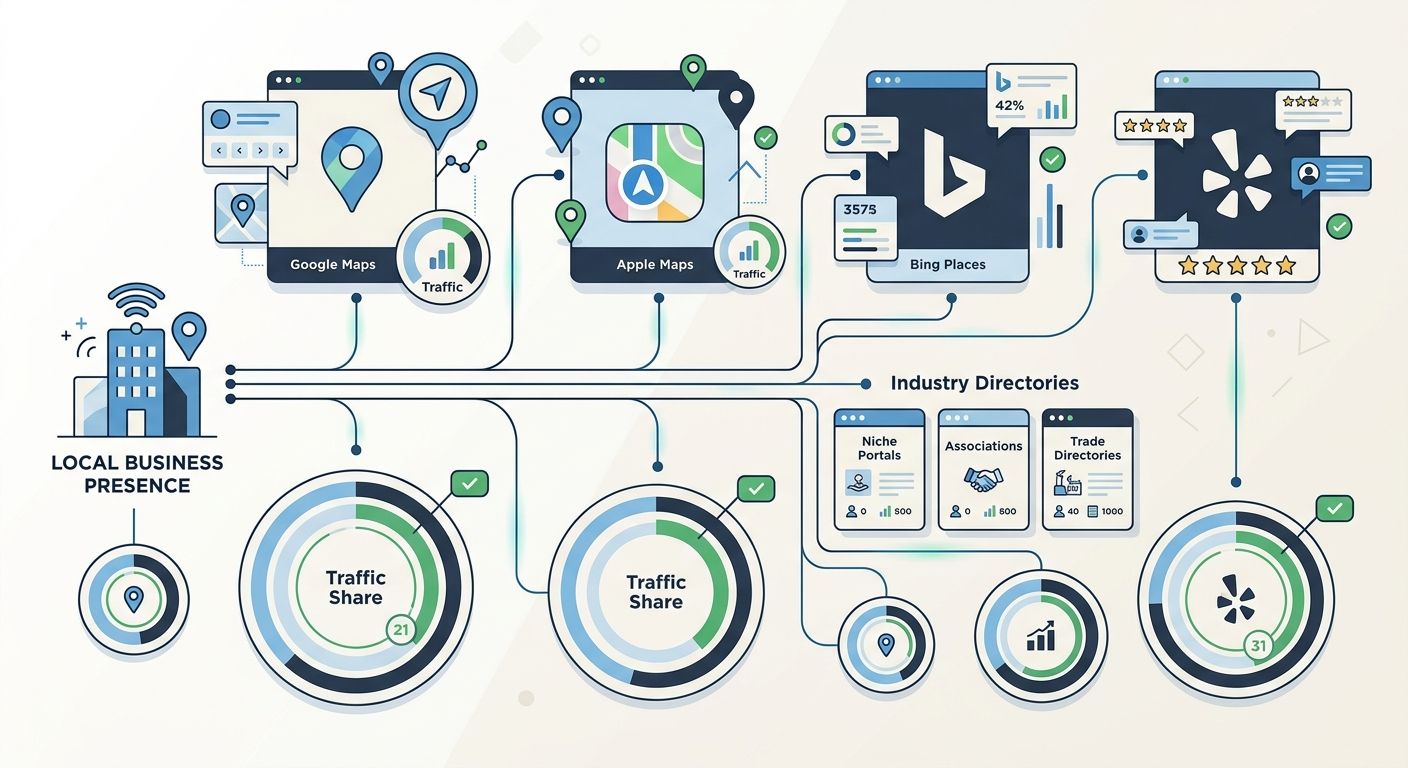
Smart local businesses are building presence on Apple Business Connect, Bing Places, Yelp, and industry-specific directories as hedges against Google Maps volatility. This isn't about abandoning Google. Google Maps still drives the majority of local discovery traffic. But if your entire local visibility strategy is a single GBP listing, you're one algorithmic enforcement action away from losing everything.
Apple Business Connect has been gaining traction among iOS users, and its verification process is less volatile than Google's. Bing Places sees lower search volume but also has less competition and more relaxed enforcement, which means your listing stays up more reliably. Industry-specific platforms like Angi for home services or Healthgrades for medical practices carry strong domain authority and often appear in Google's own search results.
The diversification rule weakens for businesses in categories where Google Maps completely dominates discovery, like restaurants and retail. For those verticals, Google is still where 80%+ of local searches happen, and spreading effort across five platforms may dilute your impact. But for service businesses like contractors, lawyers, and healthcare providers, multi-platform presence is increasingly a survival strategy rather than an optimization tactic.
When These Rules Break Down
These six rules cover the ground-truth requirements of Google's 2026 trust enforcement, but they assume a specific scenario: a legitimate business with a real physical location trying to maintain honest visibility. They don't address every situation.
If you operate a service-area business without a storefront, Google's verification requirements are stricter and the suspension risk is inherently higher. Service-area businesses have always existed in a gray zone within Google's guidelines, and the March 2026 update hit them disproportionately hard. Your documentation needs are greater, your appeal process is longer, and you may need to consider whether a virtual office address (which Google explicitly prohibits) is creating hidden risk in your profile.
If you're a multi-location franchise, the NAP consistency challenge multiplies with every location. A single rogue franchisee who keyword-stuffs their listing name can trigger scrutiny across your entire brand's profile portfolio. Tools like Uberall and LocaliQ exist specifically for this problem, though they'll run you $100-500 per location per month depending on the feature set.
And if you're working with an SEO agency that's promising to "get you back into the map pack" through techniques they won't fully explain, that's the clearest red flag in local SEO right now. Any agency worth its retainer should be able to walk you through exactly which of these compliance rules they're following and show you the documentation to prove it. The agencies that can't do that are the ones whose tactics created the suspension wave Google is now cleaning up. As the Google Maps SEO landscape in 2026 makes clear, optimization is no longer about filling fields. It's about aligning with search intent and user behavior under an enforcement regime that has real teeth.
The businesses that will maintain strong local visibility through the rest of this year are the ones treating local SEO compliance as an ongoing operational discipline, with the same rigor they bring to bookkeeping or regulatory filings. The ones treating it as a one-time optimization project are the ones filling out reinstatement appeals right now.
Marcus Webb
Digital marketing consultant and agency review specialist. With 12 years in the SEO industry, Marcus has worked with agencies of all sizes and brings an insider perspective to agency evaluations and selection strategies.
Explore more topics