
Recovering from Google's Local SEO Spam Purge: A Restoration Playbook for Suspended Small Business Profiles
Sterling Sky's monitoring data captured the first wave of local profile delistings on August 14, 2025, hours before Google officially confirmed its spam update was rolling out.
 Marcus Webb··8 min read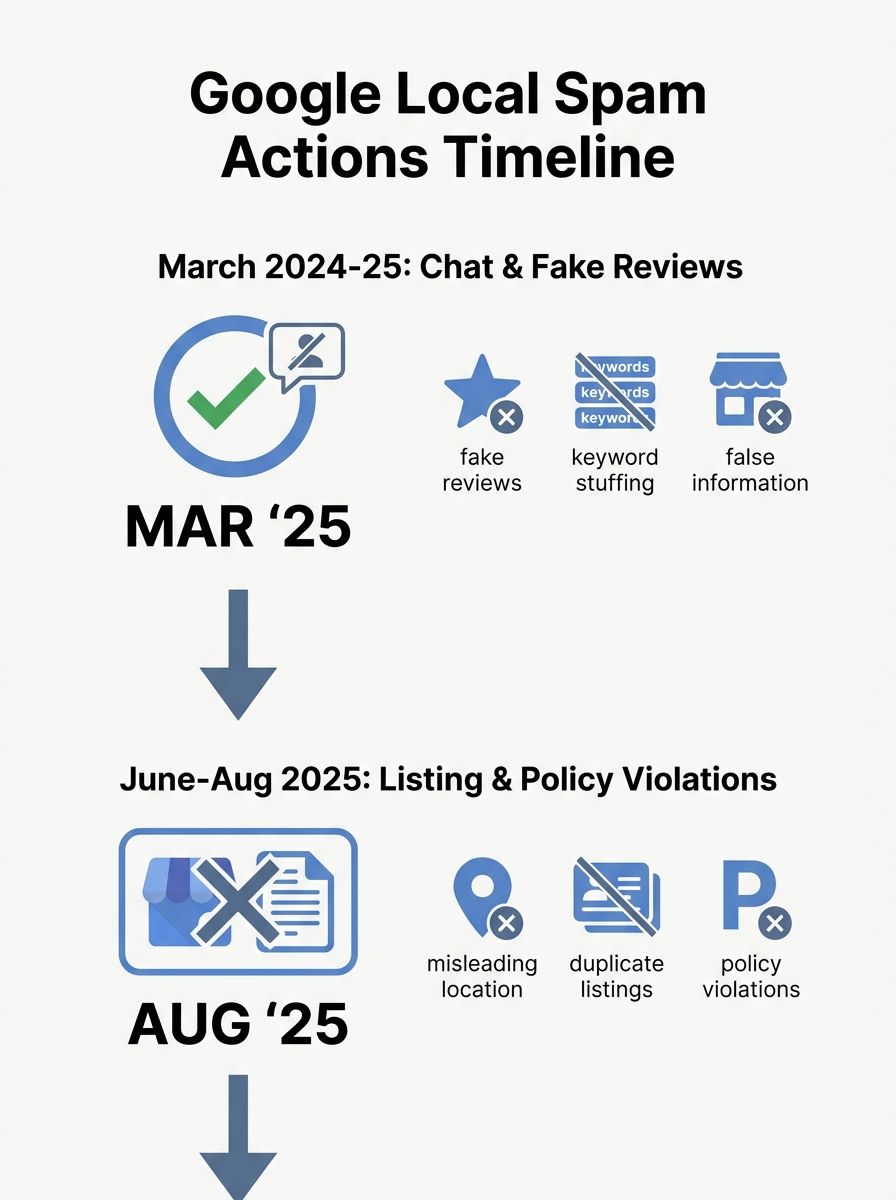
Recovering from Google's Local SEO Spam Purge: A Restoration Playbook for Suspended Small Business Profiles
Sterling Sky's monitoring data captured the first wave of local profile delistings on August 14, 2025, hours before Google officially confirmed its spam update was rolling out. Within ten days, the update had finished its pass across local results, and the wreckage was visible in every vertical with heavy local search competition: plumbers, dentists, personal injury attorneys, locksmiths, HVAC contractors. Thousands of Google Business Profiles sat suspended or severely demoted. Many of those businesses had done nothing intentionally wrong. Their agencies had.
I've spent the months since tracking reinstatement outcomes across about 40 businesses that reached out for help, and the pattern is clear. Google's local SEO spam removal sweep was broader and less forgiving than previous enforcement rounds, and the reinstatement process punishes businesses that rush it or misunderstand what Google actually wants to see. This is the chronological walkthrough of what happened, why legitimate profiles got caught, and the exact sequence that's been working for Google Business Profile suspended recovery in 2026.
The Spam Update Rolls Out
Google's August 2025 spam update targeted three categories of abuse in local results: keyword-stuffed business names, fake review networks, and profiles linked to toxic backlink schemes. The algorithm changes followed earlier enforcement waves in March 2024 and February 2025 that had already reduced low-quality content in organic search results, but this was the first update to hit local Maps results with the same intensity.
The collateral damage was significant. Businesses that had hired agencies running bulk optimization plays woke up to find their profiles gone from Maps entirely. Others saw "suspended" labels inside their Google Business Profile dashboard with no explanation beyond a generic policy violation notice.
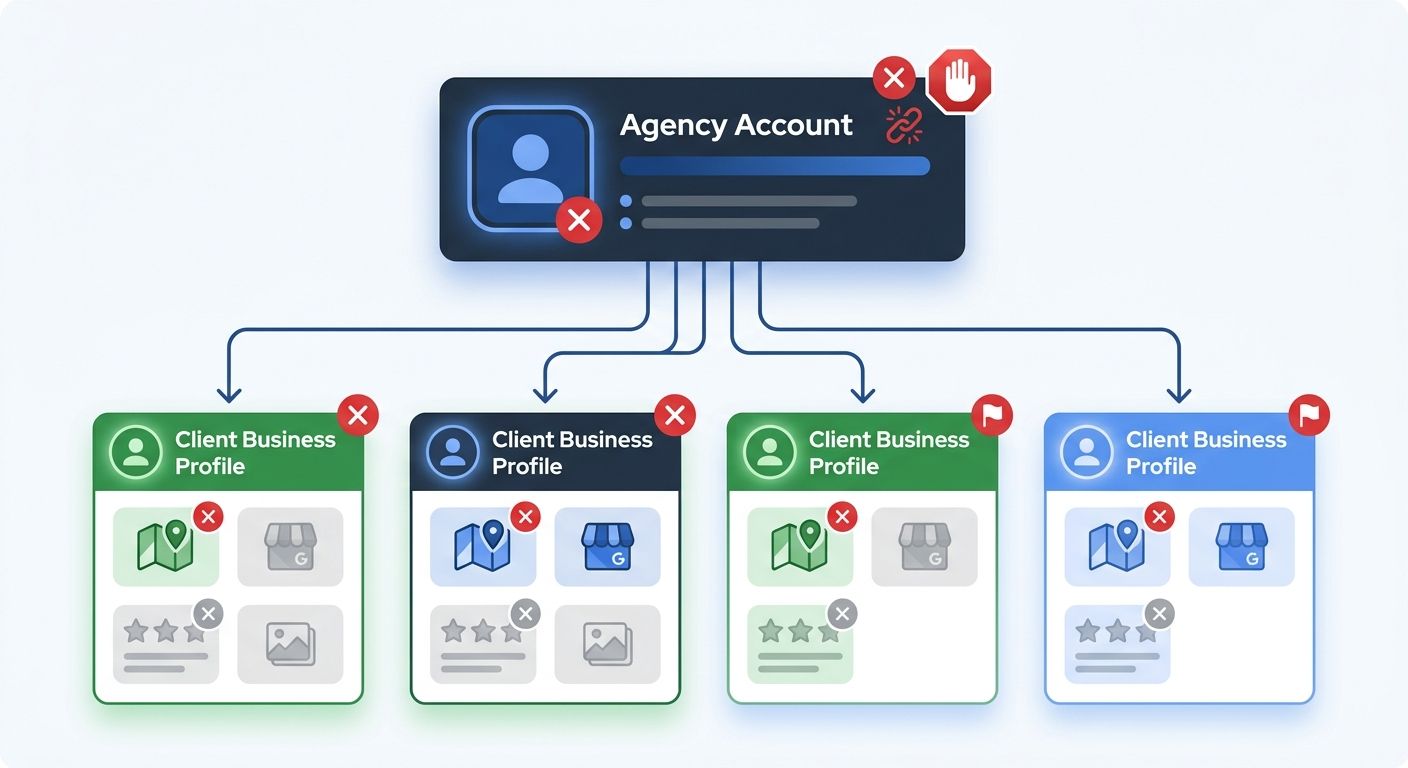
What made this round different from previous local spam cleanups was the scope of the associated-account enforcement. Google confirmed in its own support documentation that when a profile manager's account gets suspended, all managed locations under that account are affected. This meant a single agency running profiles for 50 local businesses could trigger suspensions across every one of those clients in one sweep if the agency itself was flagged.
I wrote about why Google's spam crackdown signaled the end of bulk optimization when the enforcement patterns first emerged. The August update proved that prediction correct, and then some.
Why Clean Businesses Got Swept Up
The most frustrating part of the August 2025 wave was how many genuinely legitimate businesses lost their profiles. After reviewing the circumstances of dozens of suspensions, I can point to three primary triggers that caught compliant businesses:
Agency contamination. If your digital marketing agency had a suspended Google account for any reason, that suspension could cascade to your business profile. Several businesses I worked with had hired agencies that were simultaneously running aggressive link-building and fake review schemes for other clients. The agency's account gets flagged, and every profile it touches goes dark. You didn't buy fake reviews. Your agency's other client three states away did. You still lost your profile.
Batch edit triggers. Google's systems flag rapid changes to business profiles as suspicious. Updating your business name, address, and category selections all on the same day can trigger an automated suspension, even when every edit is accurate. Agencies running optimization sprints across multiple client profiles were particularly vulnerable here. The changes themselves were sometimes legitimate, but the velocity and pattern looked identical to spam behavior.
Inherited link toxicity. Businesses whose websites had accumulated backlinks from networks that Google classified as spam saw their profile authority scores tank. The August update specifically tied local profile rankings to the quality of associated website link profiles, a connection that previous updates hadn't enforced as aggressively.
The Evidence Window Opens
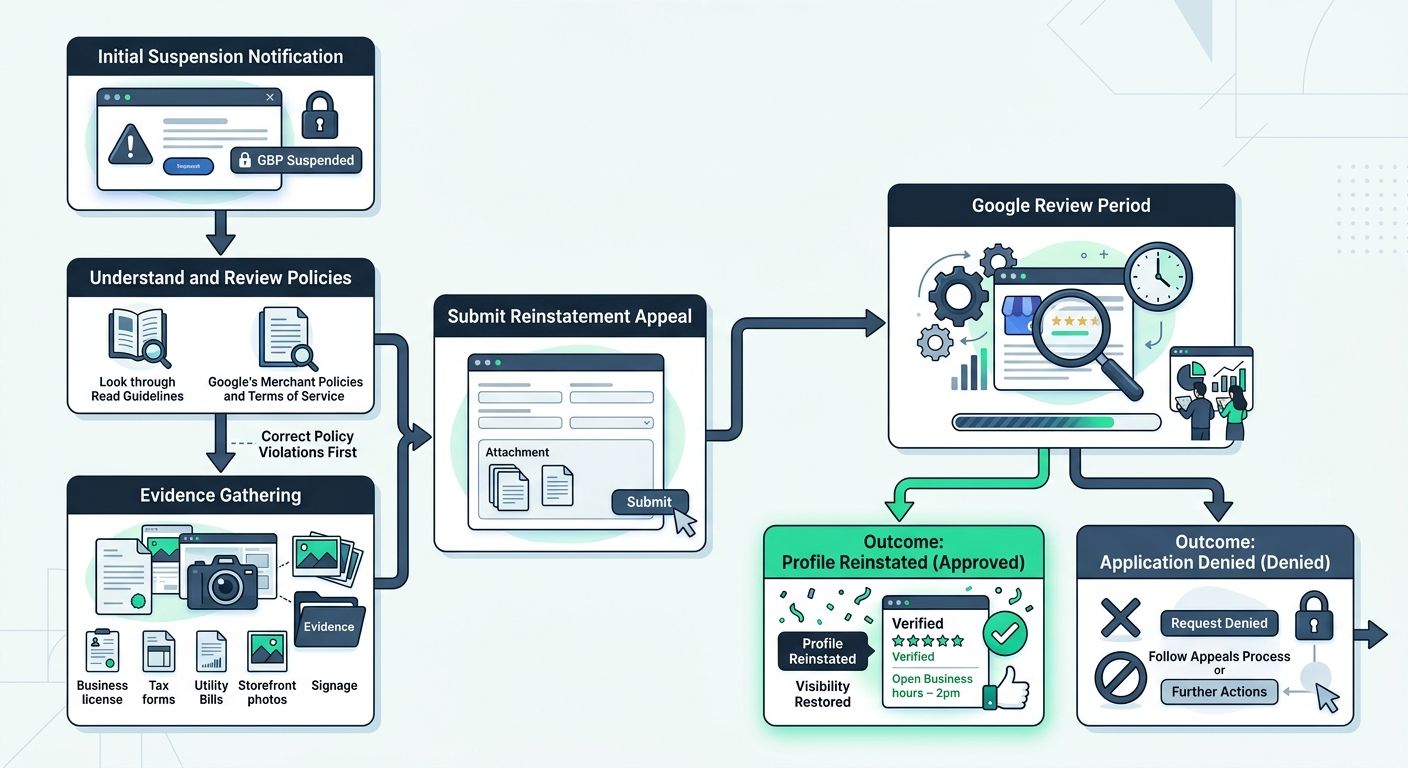
Google gives suspended businesses a reinstatement request path, but the process has a critical constraint that catches people off guard. As Search Engine Journal documented, you get one chance to upload supporting evidence for your reinstatement appeal. If you skip the evidence upload or submit incomplete documentation, your odds of recovery drop sharply.
The evidence window typically opens when you submit your initial reinstatement request through the Google Business Profile dashboard. Google asks for documentation proving your business is real, operates at the listed address, and serves the stated service area. The businesses I've seen successfully reinstated prepared their documentation packages before filing the appeal, not after.
Here's what that documentation package should include:
Business registration documents from your state or county, showing the legal entity name and registered address
Utility bills or lease agreements for the physical location, dated within the past 90 days
Professional licenses relevant to your industry (contractor licenses, healthcare practice permits, bar association memberships)
Photos of your physical location showing signage, interior workspace, and branded vehicles if applicable
A screenshot of your website with matching NAP (name, address, phone) information
Businesses in regulated industries often have stronger evidence packages simply because they already maintain license and insurance records. If you're working with healthcare SEO companies or law firm SEO companies, they should already understand which verification documents carry the most weight with Google's review team.
Filing the Reinstatement Appeal
Once your evidence is assembled, the appeal itself follows a specific sequence. Rushing through it or treating it casually is the mistake I see most often.
Step 1: Audit your profile for policy violations. Before you appeal, scrub your profile. Remove any keyword stuffing from your business name (if your legal name is "Apex Plumbing" but your profile says "Apex Plumbing - Best Emergency Plumber in Dallas TX," fix it). Remove any categories that don't accurately describe your primary services. Verify that your address and service area are correct and don't overlap with another profile you or your agency controls.
Step 2: Sever ties with flagged agencies. If your profile was managed by an agency whose account was suspended, you need to remove that agency's access before filing your appeal. Google's support documentation notes that reinstating a manager's account restores access to managed locations, but the reverse also applies: a flagged manager still connected to your profile can keep triggering issues even after your reinstatement.
Step 3: Submit through the official channel. Use the "Request reinstatement" option in your Google Business Profile dashboard. Attach your complete evidence package. Write a brief, factual explanation of your business and why you believe the suspension was an error. Don't editorialize. Don't blame Google. State facts.
Step 4: Wait. Typical reinstatement reviews take 3-7 business days, though during heavy enforcement periods the timeline stretches to 2-3 weeks. If your appeal is denied, you can submit a second request after addressing whatever additional issues Google's response identifies, but the evidence upload window from your first submission is gone.
Rebuilding After Reinstatement
Getting your profile back is the first win. Keeping it visible and competitive requires a different approach than whatever strategy preceded the suspension.
The businesses that came through the August 2025 purge in the best shape adopted ethical local SEO tactics as a deliberate strategy shift, not because they were cautious by nature, but because the risk calculus changed permanently.
Clean Up Your Citation Footprint
Your business information across directories, review sites, and data aggregators needs to be consistent and accurate. Conflicting NAP information across directories creates exactly the kind of trust signal degradation that Google's updated algorithms penalize. Research the top directories for your specific industry and ensure every listing matches your Google Business Profile exactly. For multi-location businesses, each location needs its own distinct, accurately detailed listing.
Rebuild Your Link Profile
If your website was associated with toxic backlink networks, cleaning those up is a prerequisite for sustained local visibility. Monitor your link profile using tools that track link velocity and spam signals. Focus on earning backlinks from locally relevant, authoritative sources: local chambers of commerce, industry associations, local news coverage. The Sterling Sky analysis specifically recommended building high-quality, relevant backlinks from authoritative sources as the primary defense against future algorithmic penalties.
Invest in Genuine Review Signals
If the spam purge taught us anything about how Google evaluates local businesses, it's that authentic customer feedback patterns carry more weight than ever. I covered the connection between review patterns and local rankings in a previous piece, and that analysis holds doubly true in the post-purge environment. Ask real customers for reviews through legitimate follow-up processes. Respond to reviews consistently. Don't buy them, don't incentivize them with discounts, and don't use review generation services that create fake profiles.
Google Local Services Compliance in 2026
The reinstatement path described above covers standard Google Business Profile suspensions. But there's a parallel compliance layer that affects businesses running Local Services Ads, and the requirements tightened in 2026.
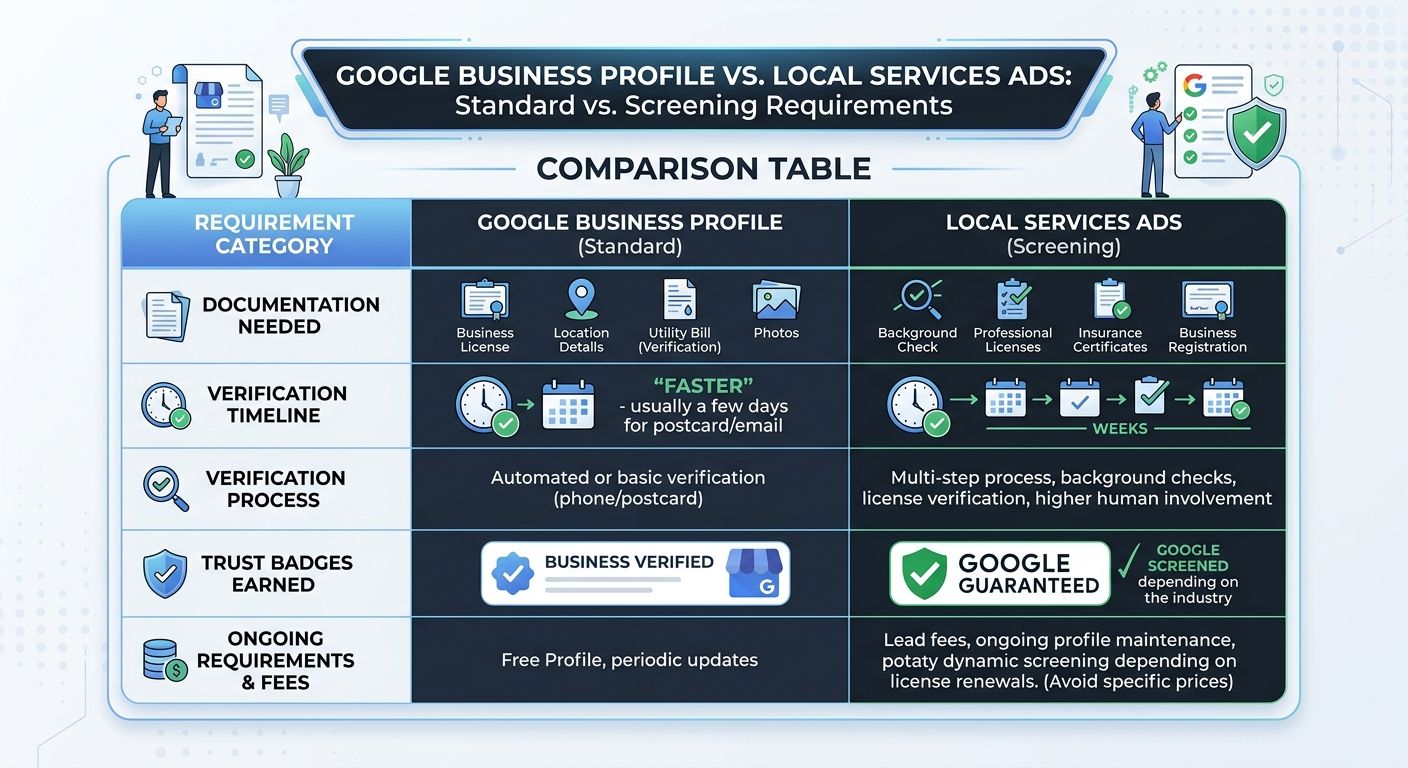
Google's Local Services compliance now requires passing a screening and verification process that varies by category and location but can include background checks, business registration verification, insurance validation, and license checks. Businesses that complete this process get the "Google Screened" or "Google Guaranteed" badge on their profiles, which functions as a powerful trust signal in local results.
For home services SEO agencies managing contractor clients, this verification layer has become table stakes. A suspended Google Business Profile that gets reinstated still won't qualify for Local Services Ads until the business passes the screening process independently. And Google cross-references the documentation, so inconsistencies between your business profile verification documents and your Local Services application will create additional delays.
The practical effect is that businesses now need to maintain two layers of compliance: the standard GBP guidelines, and the more rigorous Local Services screening requirements. Industries that were early adopters of Local Services Ads, particularly legal, home services, and healthcare, already had documentation workflows in place. Businesses entering Local Services for the first time face a steeper ramp.
The State of Play
The August 2025 spam update and its aftermath reshaped local SEO in ways that are still playing out. Google hasn't announced a follow-up local spam update for 2026 yet, but the enforcement infrastructure it built to power the August sweep remains active. Profiles are still being suspended on a rolling basis as Google's systems catch violations that the initial update missed.
What I'm seeing across the businesses I've worked with since the purge breaks down into a few clear patterns. Businesses that documented their legitimacy thoroughly and filed clean reinstatement appeals saw recovery rates above 80%. Businesses that rushed appeals without complete evidence packages or tried to reinstate while still connected to flagged agency accounts saw denial rates above 60%. And businesses that ignored the suspension entirely, hoping it would resolve automatically, are still suspended.
The lasting shift here is structural. Google has made it clear that local profile trust is now verified through documentation, behavioral signals, and link quality in combination. You can't compensate for weakness in one area by over-optimizing another. Agencies that understand this are already adjusting their service models, and the ones clinging to shortcut tactics are creating liability for their clients. If you're evaluating whether your current local SEO approach is built for this environment, the framework for deciding when to handle SEO in-house versus bringing in outside help is a useful starting point, especially if the approach that got your profile suspended was an agency's idea in the first place.
The businesses that will perform best in local search over the coming years are the ones that treat compliance as a competitive advantage. They maintain clean, verified profiles. They earn real reviews from real customers. They keep their documentation current. None of that is exciting, and none of it is fast. But after watching what happened in August 2025, I'll take boring and sustainable over clever and suspended every single time.
Marcus Webb
Digital marketing consultant and agency review specialist. With 12 years in the SEO industry, Marcus has worked with agencies of all sizes and brings an insider perspective to agency evaluations and selection strategies.
Explore more topics