
Why 90% of SEO Agencies Fail the Pilot Test: What Enterprise Clients Should Demand Before Signing
Five criteria separate a genuine enterprise SEO partner from a mid-market agency with a Fortune 500 logo collection on its website: retention and longevity, proven outcomes, technical scalability, governance readiness, and team depth.
 Marcus Webb··10 min read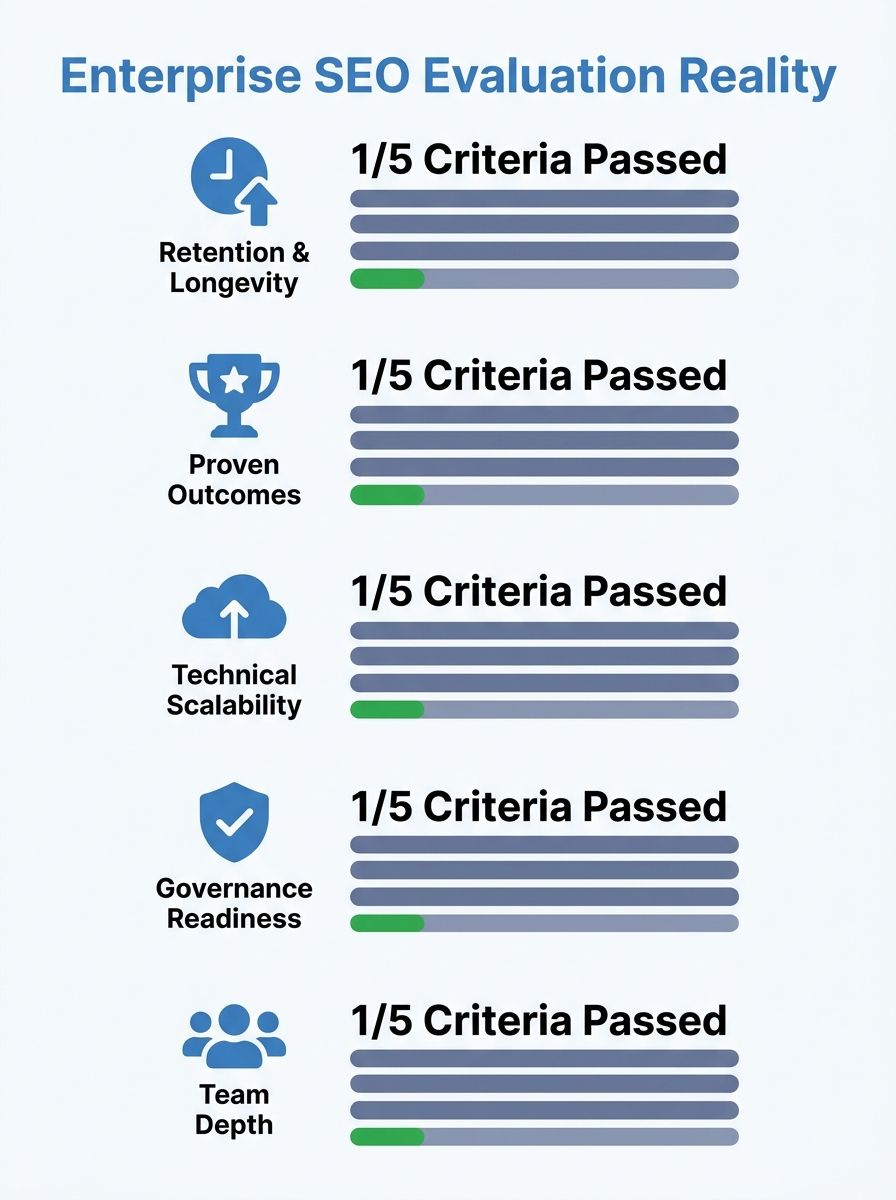
Why 90% of SEO Agencies Fail the Pilot Test: What Enterprise Clients Should Demand Before Signing
Five criteria separate a genuine enterprise SEO partner from a mid-market agency with a Fortune 500 logo collection on its website: retention and longevity, proven outcomes, technical scalability, governance readiness, and team depth. That's the evaluation framework from Searchbloom's 2026 enterprise agency assessment, and it mirrors what I've documented across 200+ agency evaluations over twelve years. The uncomfortable reality inside that framework is that agencies routinely score well on exactly one of those five criteria—proven outcomes, demonstrated through curated case studies—and fall apart on the remaining four. That collapse surfaces with remarkable consistency during a structured pilot engagement, which is why I've spent this year pushing enterprise procurement teams to demand one before committing to anything beyond 90 days.
The pilot test isn't a soft trial period. It's a controlled stress test designed to expose the gap between an agency's sales deck and its actual operational capacity. And when I say 90% fail it, I'm drawing on a pattern I've watched repeat across dozens of enterprise vendor selections: agencies that clear the RFP process, nail the pitch, negotiate favorable terms, and then stumble within weeks because their team structure, communication cadence, or technical depth can't support the complexity they sold.
The RFP Process Screens for the Wrong Things
Enterprise procurement teams are good at evaluating credentials. They verify certifications, review portfolios, check references, and score proposals against weighted rubrics. What they rarely test is operational execution under real conditions.
An agency's RFP response tells you what they plan to do. A pilot tells you what they actually do when confronted with your CMS limitations, your legal review bottlenecks, your 14-person approval chain for a single meta description change. I wrote about this dynamic in the context of why enterprise SEO strategies break down at the implementation layer, and the pattern holds true during vendor selection too.
The most common failure modes during pilots, according to an analysis from Growth Rocket, are operational rather than technical: miscommunication, inconsistent execution, and poor prioritization across client accounts. These problems don't show up in a capabilities presentation. They show up in week three when your primary point of contact goes silent for five days, or when the technical audit arrives as a generic template with your domain name pasted into the header.
What a Proper SEO Pilot Project Framework Looks Like
A well-designed pilot engagement runs 60 to 90 days and costs between $12,000 and $35,000 depending on scope. That range reflects the pricing I've seen across enterprise-tier agencies when the engagement is scoped correctly—long enough to reveal operational patterns, short enough to limit financial exposure if the agency underperforms.
The pilot scope should include three components, and each one is non-negotiable:
A prioritized technical audit with estimated hours per task and a measurement plan for the pilot window. As one agency selection guide puts it, the agency should return a prioritized audit, estimated hours per task, and a clear plan for how results will be measured. If the agency delivers a 47-page PDF with no prioritization or time estimates, they've already told you how they'll operate at scale.
A content strategy sample targeting two to four pages on your actual site, with keyword targeting rationale, internal linking recommendations, and a timeline for delivery.
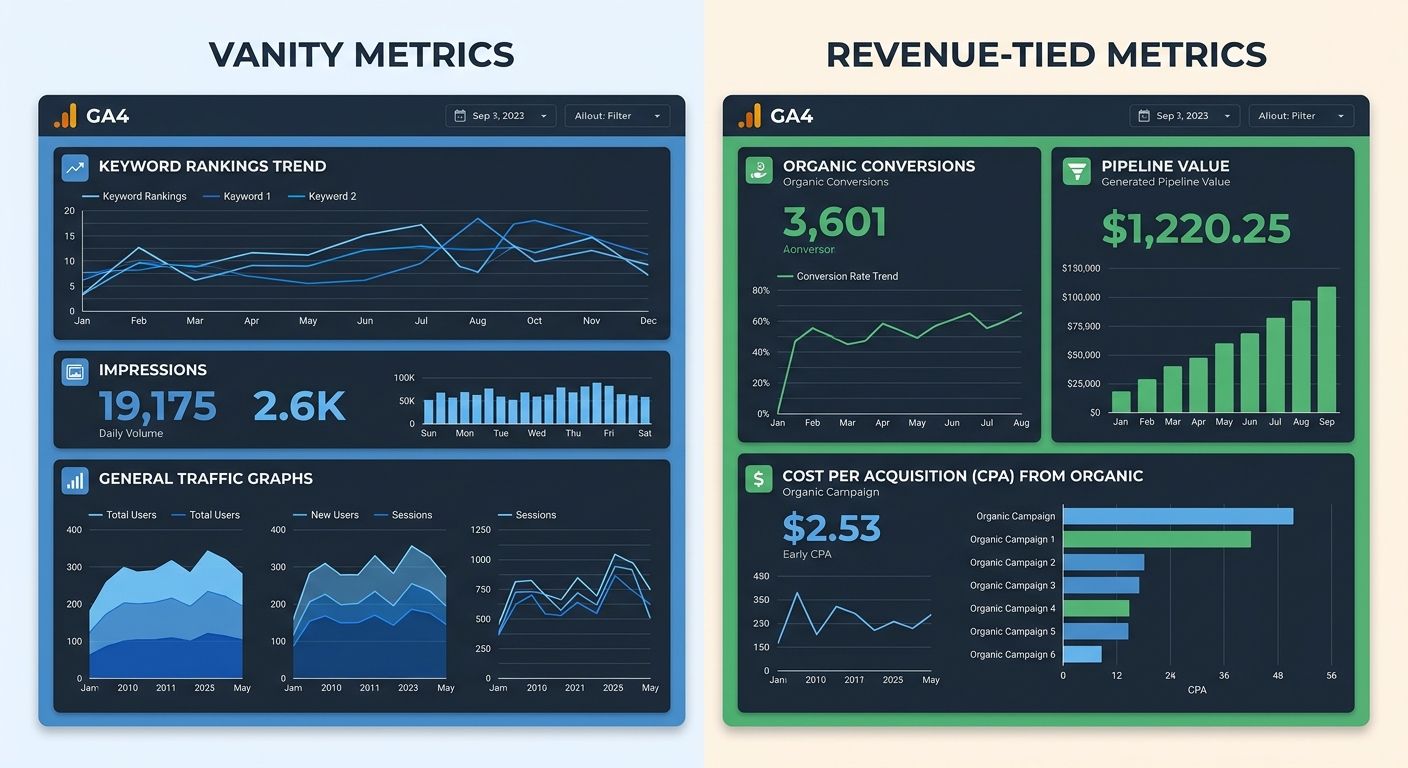
A reporting cadence established from day one, with agreed-upon KPIs tied to business outcomes rather than vanity metrics.
That last point deserves emphasis. The agencies that fail clients in 2026 tend to rely on vanity metrics, cookie-cutter strategies, and poor technical audits. A pilot is where you catch all three before signing a twelve-month contract with a six-figure commitment.
Structuring the 90-Day Window
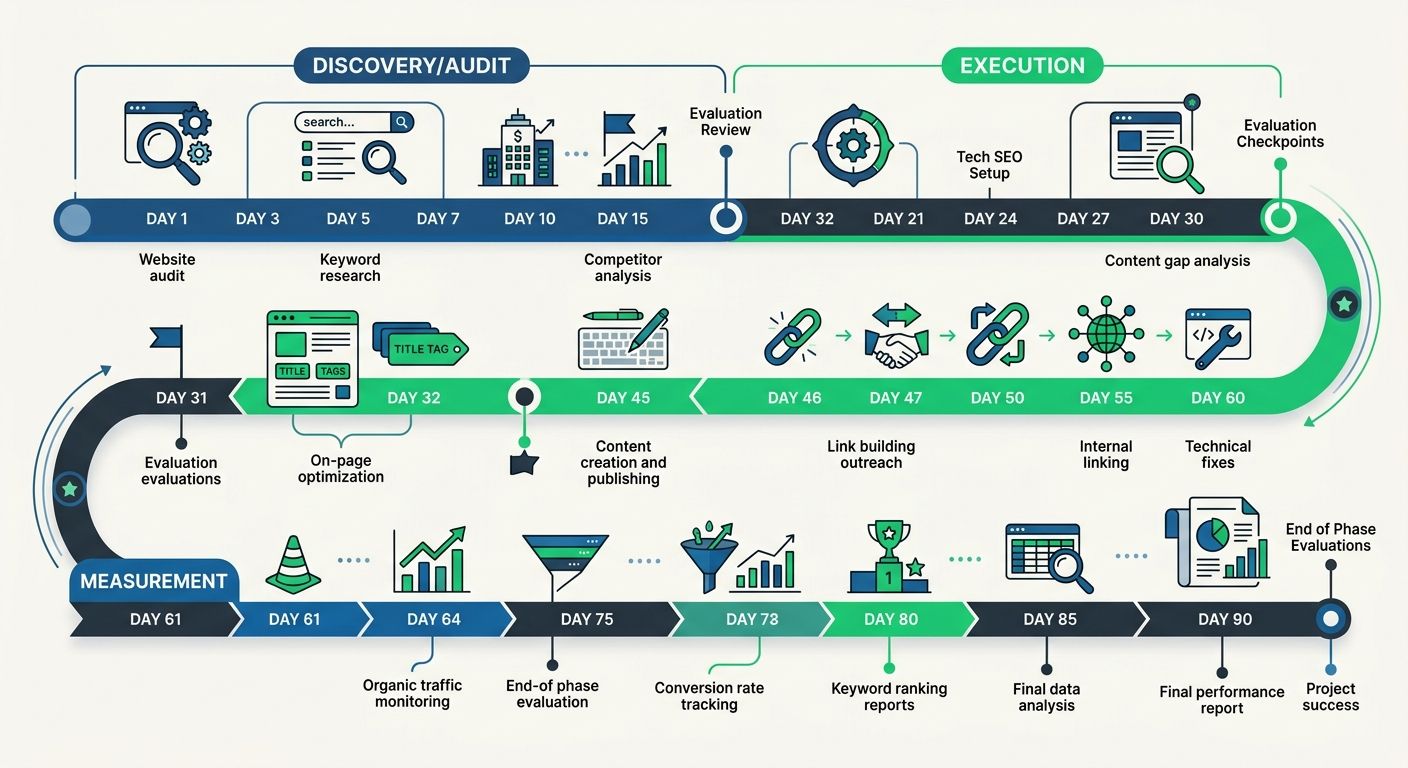
Break the pilot into three phases, each with a clear deliverable and evaluation checkpoint:
Days 1–21: Discovery and audit delivery. The agency receives read-only access to GA4, Google Search Console, and your CMS. They deliver a technical audit with prioritized recommendations, estimated hours, and projected impact ranges. Evaluate their audit against Over The Top SEO's 47-point enterprise audit framework to see whether they're covering structural, content, and authority gaps—or just running a Screaming Frog crawl and formatting the output.
Days 22–55: Execution on a limited scope. The agency implements their top three to five recommended changes on a contained section of your site. This is where you measure turnaround time, communication quality, and whether their team actually understands your tech stack. If they quoted Contentful expertise but keep asking your developers how to publish changes, you have your answer.
Days 56–90: Measurement and strategic recommendation. The agency presents a performance analysis using your GA4 data and Search Console metrics, with a forward-looking strategy for a full engagement. Pay close attention to whether their recommendations evolve based on what they learned during the pilot, or whether they hand you the same strategy deck they showed during the pitch.
GA4 Proof of Agency Performance Is the Minimum Bar
I've evaluated agencies that present beautiful custom dashboards while having zero access to the client's actual analytics. They pull data from third-party rank trackers, overlay it with estimated traffic numbers, and deliver reports that look impressive but can't be verified against reality.
Your enterprise SEO agency selection criteria should include a non-negotiable requirement: the agency must demonstrate performance using your GA4 property, with data you can independently verify. SE Ranking's guide to GA4 for SEO analysis outlines the right approach—formulate hypotheses, configure reports that answer specific questions, act on findings, then measure results. An agency that can't walk you through this cycle using your own data during a pilot isn't going to suddenly develop the capability at contract signing.
Here's what GA4 proof of agency performance should include during the pilot:
Organic landing page performance segmented by the pages they touched versus the ones they didn't. This is the simplest control test available, and any agency resisting it should raise immediate concerns.
Engagement metrics (engaged sessions, engagement rate, average engagement time) for modified pages, compared to the pre-pilot baseline. Rank movement alone is insufficient proof of anything.
Conversion event tracking tied to actual business outcomes. If your enterprise goal is demo requests, the agency should be reporting on demo request completions from organic traffic—not impressions, not clicks, not "brand visibility scores."
Search Engine Journal's analysis of why SEO KPIs fail businesses identifies a key problem: the accumulated cost of optimizing for performance indicators that no longer reflect how growth actually happens. During a pilot, you're testing whether the agency measures what matters to your CFO or what makes their monthly report look good.
This connects directly to the broader challenge of proving that an agency actually drives revenue rather than ranking improvements. Rankings are an input. Revenue is the output your board cares about.
The SEO Agency Vetting Checklist for Enterprise Pilots
Over twelve years and 200+ evaluations, I've developed a scoring system for pilot engagements. Every item below maps to a behavior I've watched agencies either demonstrate or fail during the pilot window. Use this as your SEO agency vetting checklist before converting any pilot into a long-term contract.
Communication and Team Structure
Did your day-to-day contact during the pilot match the seniority level promised during the pitch? (In roughly 60% of the pilots I've observed, the senior strategist from the sales process disappears after week one.)
Did the agency respond to requests within one business day consistently? Track response times—they tend to degrade predictably during months two and three of a longer contract.
Can the agency name every person who worked on your account during the pilot, their role, and their billable hours? If they can't, their project management infrastructure won't scale.
Technical Competence
Did the technical audit identify issues specific to your platform and architecture, or was it a generic crawl report? Enterprise sites running headless CMS configurations, multiple subdomains, or complex JavaScript rendering need audits that reflect those realities.
Did the agency's recommendations account for your development team's capacity and sprint cycles? Recommendations that ignore implementation constraints aren't recommendations—they're wishlists.
Did any technical recommendation come with a projected impact range (even a rough one) tied to a business metric?
Strategic Thinking
Did the agency's content recommendations reflect an understanding of your competitive landscape, or did they target keywords based purely on volume? This remains one of the fastest ways to identify whether an agency optimizes for the wrong metrics.
Did the 90-day strategy evolve based on pilot findings, or did it look suspiciously like the initial proposal with updated dates?
Can the agency articulate how their SEO strategy connects to your broader marketing and revenue goals? An enterprise SEO audit should align with organic traffic, pipeline, or revenue targets—not exist as a standalone channel exercise.
Contract Terms That Protect You After the Pilot
The pilot-to-contract transition is where enterprise clients lose negotiating power if they haven't structured the engagement correctly from the start. Here are the contract provisions I recommend building into the initial pilot agreement:
Pilot-to-contract conversion clause. The pilot agreement should specify the terms under which it converts to a longer engagement. I typically recommend a 6-month initial contract (not 12) with a 60-day termination notice provision. Agencies that insist on 12-month minimums with no out before month 10 are optimizing for their revenue predictability, not your flexibility.
Rate lock from pilot pricing. Whatever hourly or retainer rate the agency charges during the pilot should be the ceiling for the first contract term. I've seen agencies quote pilot rates at a discount and then increase rates by 30%+ at contract signing, justified by "expanded scope." Get the rate structure in writing before the pilot begins.
Named team guarantee. The contract should specify by name which senior strategists and technical leads will be assigned to your account. Include a clause requiring 30-day written notice before any team member substitution, with the right to approve replacements. This one provision alone has prevented more engagement failures than any other term I recommend.
GA4 and Search Console access retention. Confirm in writing that you retain full ownership of all analytics properties, Search Console access, and reporting dashboards created during the engagement. It sounds obvious, but I've seen agencies build custom dashboards on their own Looker Studio accounts, creating a dependency that makes transition painful if the relationship ends.
Pricing Benchmarks for Enterprise SEO Pilots
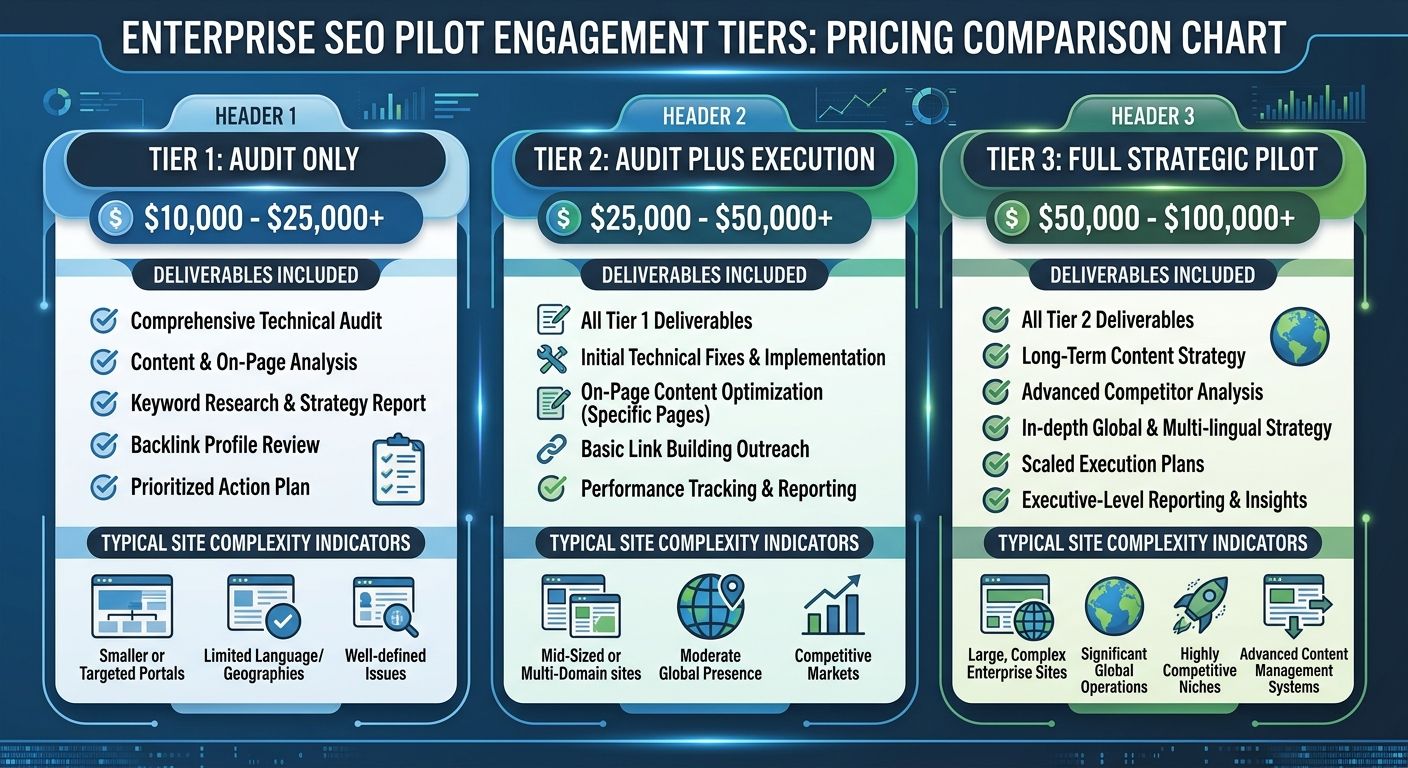
Transparency on pricing helps you evaluate whether an agency is scoping the pilot honestly. These ranges reflect what I've documented across enterprise-tier engagements:
Technical audit only (no execution): $5,000–$15,000 depending on site complexity. Sites with fewer than 10,000 indexed pages on a standard CMS sit at the low end. Sites with 500,000+ pages across multiple subdomains, international targeting, and custom rendering push toward the high end.
Audit plus limited execution: $12,000–$35,000 for 90 days. This covers the audit, implementation of 3–5 priority recommendations, and a measurement report.
Full strategic pilot with content: $25,000–$50,000 for 90 days. This includes everything above plus content strategy development, 4–8 pieces of optimized content, and a detailed forward strategy.
An agency quoting below these ranges for genuine enterprise complexity is likely either understaffing the engagement or planning to upsell heavily during the pilot. An agency quoting significantly above them should be able to justify the premium with specific resource commitments—named team members, proprietary tooling access, or documented methodologies that go beyond standard practice.
The question of how to tell whether you need agency help at all is worth settling before you spend pilot-level budgets. But once you've decided to engage an agency, skimping on the pilot is false economy. A $25,000 pilot that reveals an agency can't execute saves you $150,000+ on a failed twelve-month contract.
Questions a 90-Day Pilot Can't Answer
The pilot framework I've outlined here catches the majority of agency failures before they become expensive. It tests communication, technical depth, strategic thinking, and the ability to work within enterprise constraints. But it has real limits, and you should understand them.
A 90-day window can't measure long-term strategic consistency. Some agencies perform brilliantly during pilots because they over-resource new accounts to win the contract, then redistribute senior talent once the deal is signed. The named team guarantee clause helps, but it doesn't prevent subtle shifts in attention and priority that accumulate over quarters.
The pilot also can't fully test how an agency handles algorithm volatility. If your 90-day window happens to fall during a stable period, you won't see how the agency responds to a core update that tanks your traffic by 25%. Ask for documented examples of how they've navigated algorithm disruptions for comparable clients, and verify those examples independently.
And a pilot can't predict cultural fit over time. The relationship between an enterprise SEO team and an external agency involves dozens of touchpoints across multiple departments—legal, engineering, product, content, executive leadership. Ninety days reveals the surface-level dynamics, but the deeper friction points around governance, approval workflows, and strategic disagreements tend to emerge around month four or five.
What the pilot does provide is a minimum viable proof point. If an agency can't demonstrate competence, communication discipline, and GA4-grounded performance measurement in 90 days with a contained scope, extending the timeline won't fix the underlying problem. The data from a well-structured pilot gives your procurement team something concrete to evaluate beyond pitch decks and reference calls. It won't eliminate all risk from the agency selection process, but it reduces the most common and most expensive failures to a manageable cost before the real commitment begins.
Marcus Webb
Digital marketing consultant and agency review specialist. With 12 years in the SEO industry, Marcus has worked with agencies of all sizes and brings an insider perspective to agency evaluations and selection strategies.
Explore more topics