
Search Intent vs. Search Volume: Why Your SEO Agency Is Optimizing for the Wrong Keywords
The agency's monthly report showed 47 first-page rankings and a green upward arrow on every chart. The client's revenue from organic search had dropped 31% over the same period.
 Marcus Webb··8 min read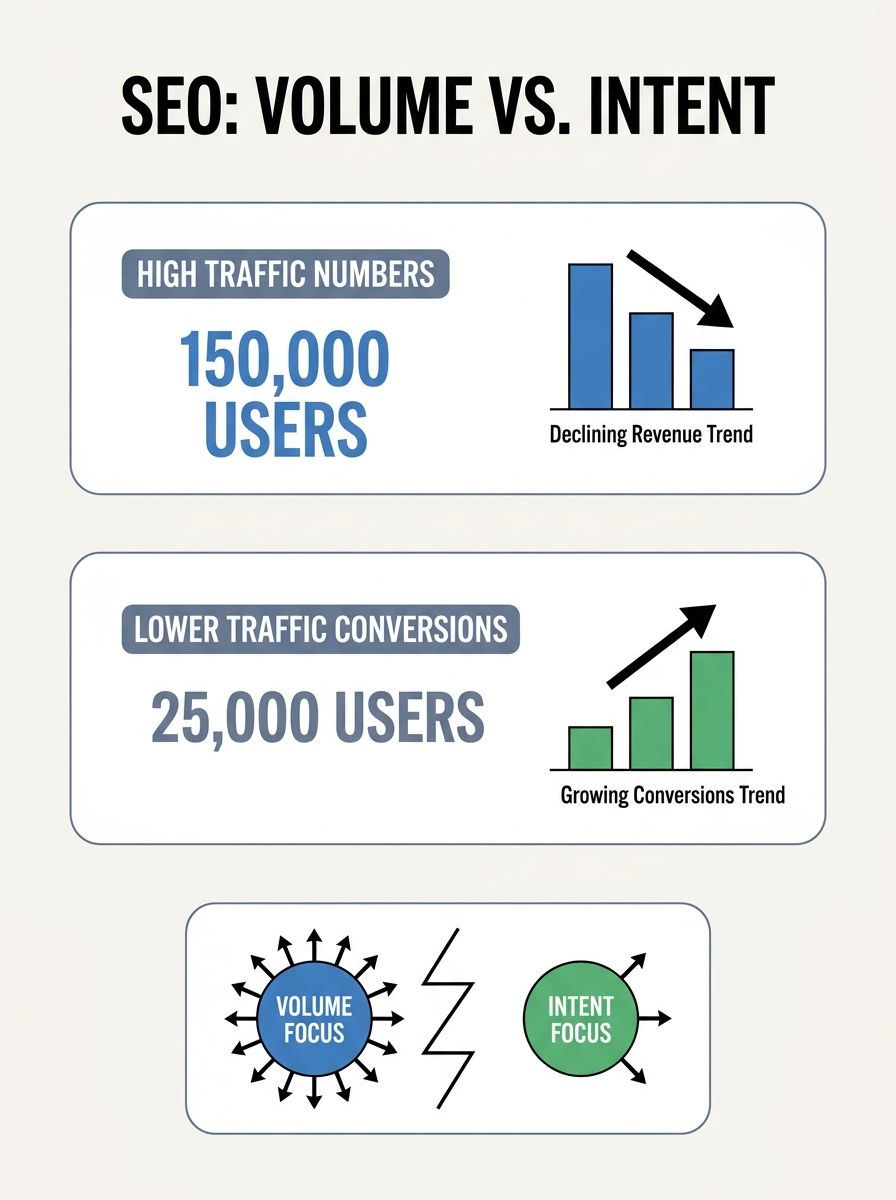
Search Intent vs. Search Volume: Why Your SEO Agency Is Optimizing for the Wrong Keywords
The agency's monthly report showed 47 first-page rankings and a green upward arrow on every chart. The client's revenue from organic search had dropped 31% over the same period. I've seen this exact disconnect in roughly 40 of the 200+ agency evaluations I've conducted, and the root cause is almost always identical: the agency optimized for search volume and ignored search intent entirely. What follows is a chronological look at how this keyword strategy mistake became so widespread, when the evidence started piling up against it, and where the industry stands right now on search intent optimization.
2018–2020: Volume as the Default Agency Sales Pitch
Rewind to the late 2010s. The typical agency sales presentation included a spreadsheet of keywords sorted by monthly search volume, highest to lowest. The pitch was simple: "We'll get you ranking for these 50 keywords that collectively have 200,000 monthly searches." Retainer pricing ranged from $3,000 to $10,000 per month for mid-market clients, and the deliverables were built around one core promise: traffic growth.
This made sense when Google's algorithm was less sophisticated about matching results to user goals. Agencies could target "running shoes" (200,000 monthly searches), create a reasonably optimized page, build some links, and watch traffic climb. The client saw more visitors in Google Analytics, the agency pointed to the chart going up, and everyone renewed the contract.
The problem was hiding in plain sight. As Hashmeta documented in their analysis of why keyword volume misleads without intent data, a keyword with 50,000 monthly searches might look like a goldmine, but if those searchers aren't looking for what you offer, that traffic becomes vanity metrics. A competitor targeting keywords with 500 monthly searches and crystal-clear buyer intent consistently outperforms on actual revenue.
During this period, I evaluated dozens of agency contracts that explicitly tied success metrics to ranking positions and traffic volume. Not one of them included conversion rate by keyword cluster as a KPI. The agencies weren't being dishonest — they were following the playbook everyone used. But the playbook was already outdated.
The Pivot Nobody Wanted to Make
Around 2021, Google's algorithm updates began rewarding pages that matched the reason behind a search query, and penalizing pages that technically contained the right keywords but delivered the wrong type of content. Blog posts targeting transactional keywords stopped ranking. Product pages targeting informational keywords got pushed to page three.
Agencies that had built their entire reporting infrastructure around volume metrics faced an uncomfortable choice: retool their keyword research process (expensive, time-consuming, requires retraining staff) or keep reporting the same numbers and hope clients didn't notice the revenue gap.
Many chose the second option. I reviewed an agency's client portfolio in early 2022 where they'd targeted "best CRM software" with a 2,000-word blog post. The keyword had 12,000 monthly searches. But the actual SERP for that query was dominated by comparison tables with pricing, feature matrices, and trial signup CTAs. The blog post never cracked page two because Google had correctly identified the query as commercial investigation, and the agency had published informational content.
This is one of the most common keyword strategy mistakes I still encounter in agency audits. The agency looks at volume, picks the biggest number, and creates content without checking what Google is actually serving for that query. If you're evaluating agencies and this sounds familiar, the data trap in agency selection often starts here — with metrics that look impressive in a slide deck but don't connect to business outcomes.
Four Intent Types and Where Agencies Keep Getting Them Wrong
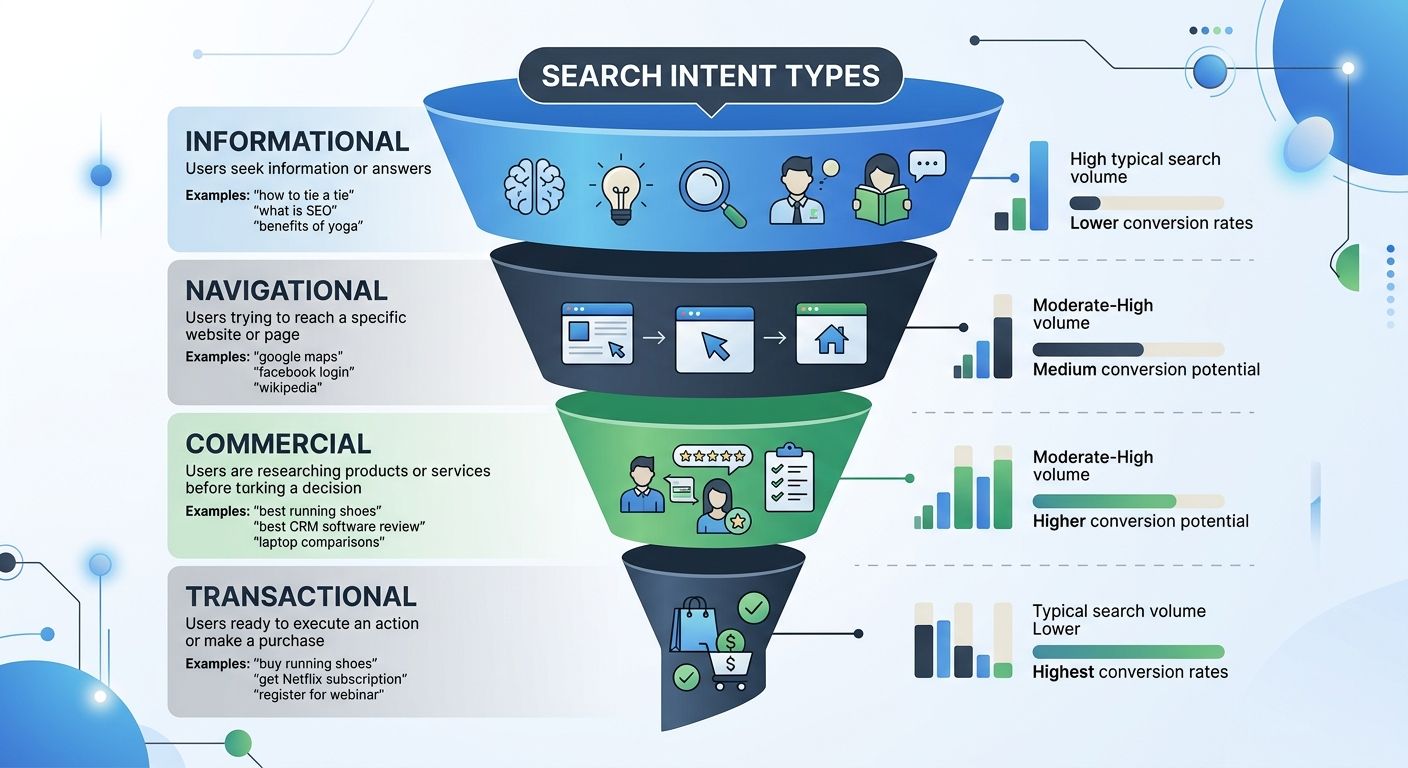
The intent classification framework that emerged from this period sorts queries into four categories: informational ("how does SEO work"), navigational ("HubSpot login"), commercial investigation ("best AI SEO tools 2026"), and transactional ("hire SEO consultant for law firm"). Each type demands a different page format, different content depth, and a different call to action.
As DashClicks' research on keyword intent and conversion rates explains, identifying whether the intent is informational, transactional, navigational, or commercial allows you to tailor your content strategy to address what users actually need. This alignment improves rankings and improves the user experience by delivering exactly what users are searching for.
Here's where SEO agency accountability breaks down in practice. I've reviewed agency keyword strategies where every target keyword was mapped to the same content format: a 1,500-word blog post. Informational queries? Blog post. Commercial comparison queries? Blog post. Transactional queries where the user is ready to buy? Blog post. The format mismatch tanks conversion rates regardless of how well the page ranks.
High-intent keywords typically include modifiers like "buy," "order," "pricing," "near me," or specific product names and models, according to research from Graas on identifying high-intent keywords. These terms often have modest search volume. An agency that systematically ignores them in favor of splashier numbers is optimizing for their own reporting convenience, not for your revenue.
2025–2026: AI Search Forced the Issue Into the Open
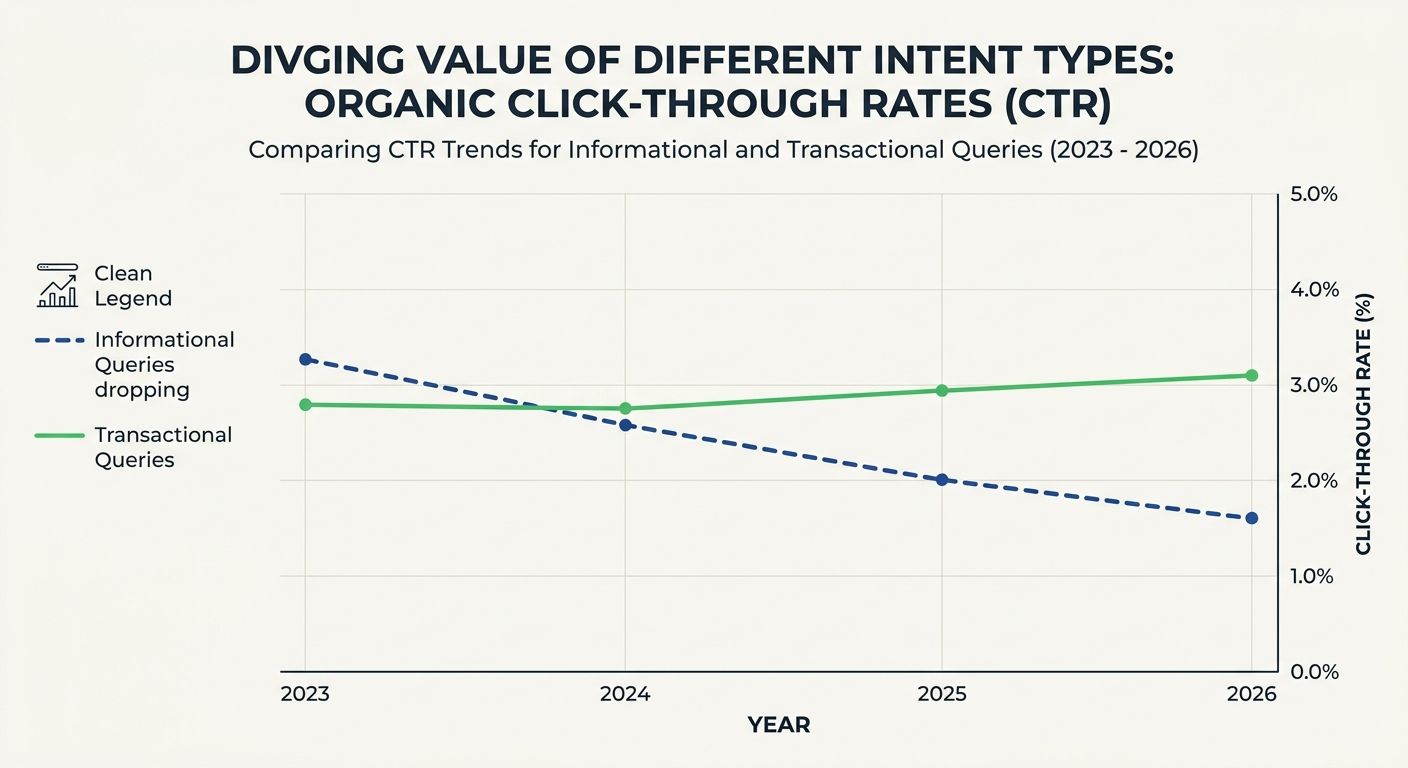
The rise of AI-generated search results made the volume-versus-intent problem impossible to ignore. According to Semrush's 2026 AI search traffic study, 60% of searches now result in zero clicks, as AI Overviews, Featured Snippets, and "People Also Ask" panels provide complete responses directly on the results page. This trend disproportionately affects high-volume informational queries — the exact keywords that volume-focused agencies love to target because the numbers look big in a monthly report.
Think about what this means for an agency charging you $7,000 per month to rank for "what is technical SEO" (8,000 monthly searches). Even if they achieve a first-page position, the majority of users searching that query get their answer from Google's AI Overview without ever clicking through to your site. The ranking is real. The traffic isn't. And the leads definitely aren't.
Meanwhile, a query like "hire SEO agency for law firm" (roughly 70 monthly searches) carries clear transactional intent. The person typing that query has budget, has timing, and has a specific need. AI Overviews are far less likely to fully satisfy this type of search because the user needs to evaluate options, review portfolios, and make contact. Every click from this keyword is worth exponentially more than a click from a high-volume informational term.
This shift has exposed which agencies actually understand intent-driven rankings and which ones have been coasting on volume metrics. As Digital Storyteller's analysis puts it, lower volume keywords often provide faster and more sustainable ranking opportunities. Traffic only matters if it aligns with your business. Irrelevant keywords may inflate visits but weaken performance and trust.
What I Look for in Agency Keyword Reports Now
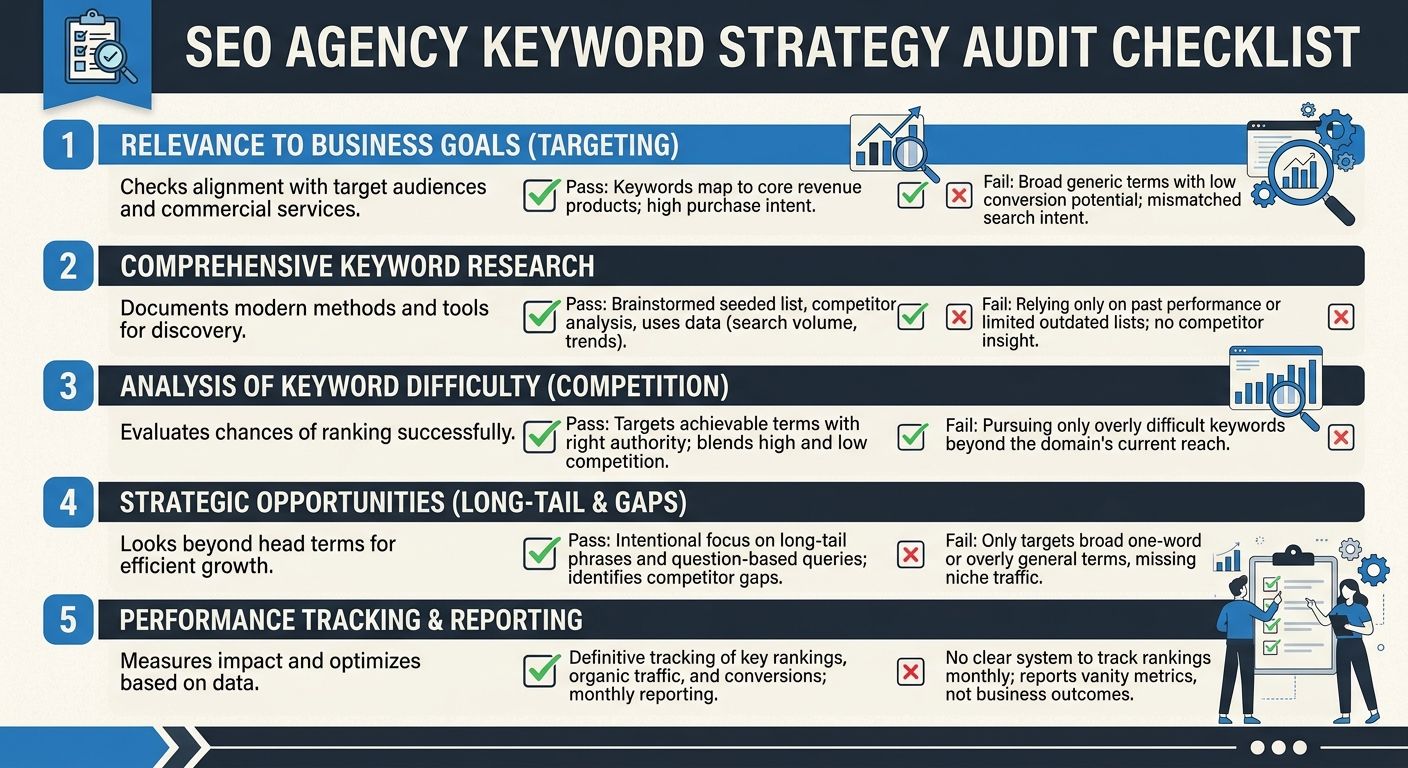
After evaluating agencies across e-commerce, SaaS, healthcare, and professional services — and having written about everything from choosing an SEO agency for SaaS to enterprise-level competitor keyword gaps — I've developed a set of specific audit criteria for keyword strategy. When an agency hands me their keyword plan, here's what separates the competent ones from the ones running on autopilot:
Intent classification is mandatory, not optional. Every target keyword should have a labeled intent type. If the agency can't tell you why a keyword is informational versus commercial, they haven't done SERP analysis. Hashmeta's research reinforces this: if the top rankings for "local SEO" all focus on small business applications rather than enterprise solutions, that tells you something critical about the dominant search intent. The specific words in a query provide intent signals that volume metrics completely ignore.
Content format matches intent classification. A keyword classified as commercial investigation should be mapped to a comparison page, not a blog post. A transactional keyword should point to a service or product page with clear conversion paths. I've seen agencies that understand this distinction outperform volume-focused competitors by 3x on lead generation despite having half the organic traffic.
The keyword mix includes low-volume, high-conversion terms. An agency targeting 50 keywords that all have 5,000+ monthly searches is probably chasing volume. A smart keyword strategy includes a substantial percentage of long-tail terms with 100-500 monthly searches and strong purchase intent. These are the keywords that enterprise agencies often miss entirely because they don't make impressive charts.
Measurement goes beyond rankings and traffic. As Epic Notion's research on intent-focused SEO measurement emphasizes, intent-focused SEO requires a broader measurement approach than tracking rankings for a handful of target keywords. You need to track performance across the full intent group: conversions, qualified leads, revenue per keyword cluster, and engagement metrics like time on page and bounce rate.
Contract terms reflect intent-aligned goals. The best agency contracts I've reviewed in the past 18 months tie at least a portion of their fee structure to conversion metrics, not just ranking positions. If your agency's contract exclusively measures success by "number of keywords on page one," the incentive structure rewards them for choosing easy, high-volume keywords that don't drive business results.
Where the Data Points Now
The gap between volume-optimized and intent-optimized keyword strategies has widened considerably since AI search features became standard. Agencies that restructured their keyword research around search intent optimization are delivering measurably better results for clients, even when total organic traffic numbers look modest by historical standards. Agencies that haven't made this shift are increasingly difficult to distinguish from one another in competitive pitches — they all present the same volume-sorted spreadsheets, the same traffic projections, and the same inability to explain why rankings aren't producing revenue.
From an SEO agency accountability perspective, the clearest signal of a well-run keyword program is the relationship between organic traffic trends and business outcomes. If both lines track together — traffic up, leads up, revenue up — the agency is probably targeting the right intent. If traffic climbs while leads stagnate or decline, you're likely funding a campaign built on volume metrics that look good in reports but don't reflect how your potential customers actually search.
The agencies I've rated highest in recent evaluations all share one operational trait: they start keyword research by analyzing the SERP for each candidate term, classifying intent based on what Google currently serves, and only then looking at volume as a secondary filter. Volume still matters — a 10-search-per-month keyword rarely justifies dedicated content — but it's no longer the primary sorting mechanism. The question has shifted from "how many people search for this?" to "what do the people searching for this actually want, and can we deliver it better than what's already ranking?" That shift, more than any algorithm update or AI feature, is what separates agencies that produce real business results from agencies that produce pretty reports.
Marcus Webb
Digital marketing consultant and agency review specialist. With 12 years in the SEO industry, Marcus has worked with agencies of all sizes and brings an insider perspective to agency evaluations and selection strategies.
Explore more topics