
The ChatGPT Review Audit: How to Extract SEO Value From Your Google Reviews in 90 Minutes
Reviews with 200 or more characters carry significantly more ranking weight in local search than shorter ones, according to practitioner data compiled across local SEO communities.
 Marcus Webb··9 min read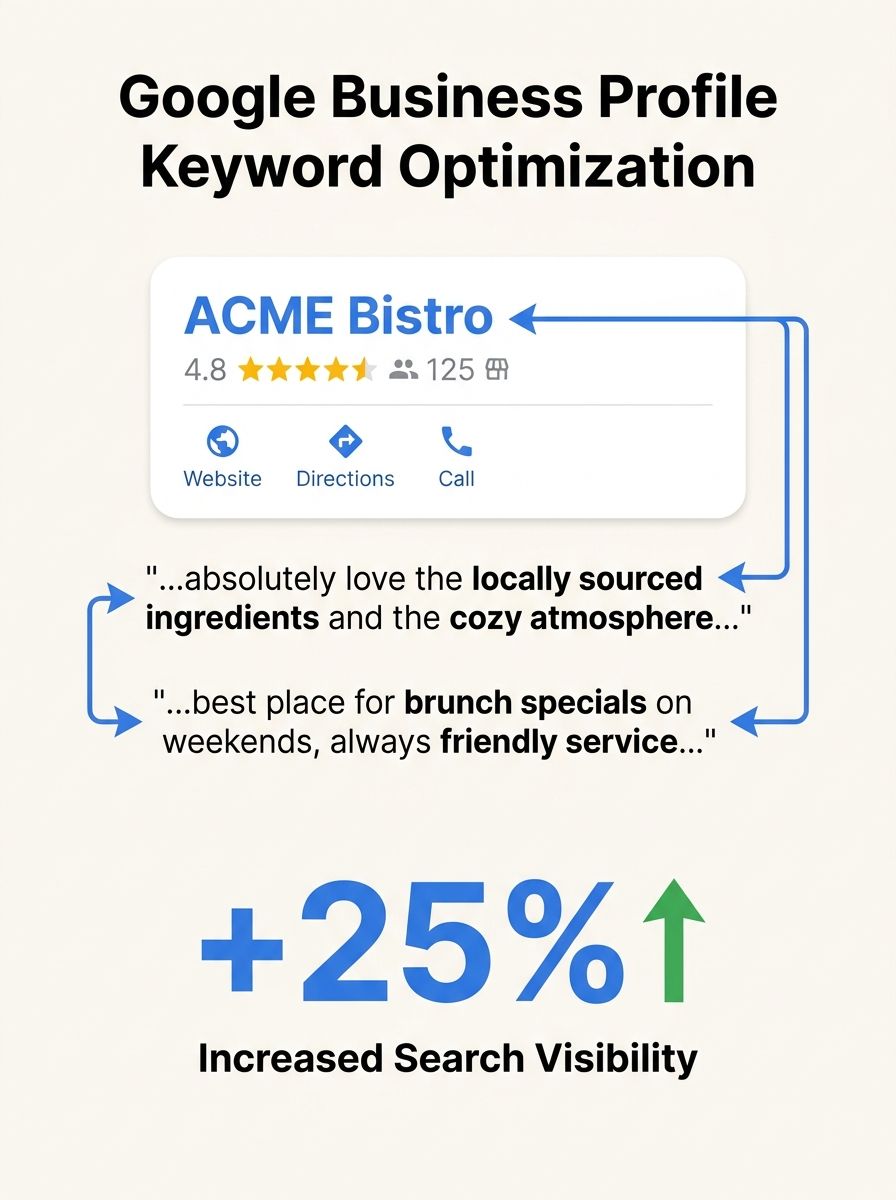
The ChatGPT Review Audit: How to Extract SEO Value From Your Google Reviews in 90 Minutes
Reviews with 200 or more characters carry significantly more ranking weight in local search than shorter ones, according to practitioner data compiled across local SEO communities. That same data shows that keywords customers naturally mention — service type plus location — directly influence visibility. And yet, in the 200-plus agency audits I've conducted over 12 years, review analysis almost never appears in the SEO deliverables. The entire review corpus gets reduced to a single screenshot of a star rating in the monthly report, and the actual language customers use gets ignored entirely.
That's the gap this process fills. What I'm going to walk you through is a 90-minute audit framework that uses ChatGPT to perform review sentiment analysis, extract keyword patterns, and turn your Google review data into actionable local SEO intelligence. If you run a white-label SEO operation or manage client accounts at scale, this process can become a repeatable deliverable you sell or bundle into existing retainers.
The SEO Signal Hiding in Plain Text
Google's Business Profile displays three review snippets below the address line, and it bolds frequently mentioned terms within those snippets. As Search Engine Land documented, this bolding draws users searching for those specific terms toward your profile, increasing click-through rates. The same keywords feed the Menu Highlights section for restaurants and the Place Topics section for service businesses, both of which influence rankings.
This means your customers are writing your SEO copy for you. They're using natural language that Google already recognizes as relevant, and they're doing it for free. The problem is volume. A business with 150 reviews has thousands of words of customer-generated content that nobody has read systematically. Reading every review manually and cataloging the language patterns takes hours. ChatGPT compresses that into about 30 minutes of actual prompt-and-analysis work.
A Springer Nature study on ChatGPT's sentiment analysis capabilities confirmed that the model handles contextual and complex information well when parsing customer reviews, including cases where negation terms flip the meaning of a sentence. That matters because reviews are messy. A customer who writes "greasy burger" might be complaining or celebrating, and as Search Engine Land's review guide notes, the third review snippet Google excerpts can surface exactly those ambiguous phrases. ChatGPT is good at catching the difference. Human scanning at speed is not.
The 90-Minute Framework, Phase by Phase
I've run this audit for white-label clients and my own agency partners dozens of times. The timing breaks down into four phases. You don't need any paid tools beyond a ChatGPT subscription.
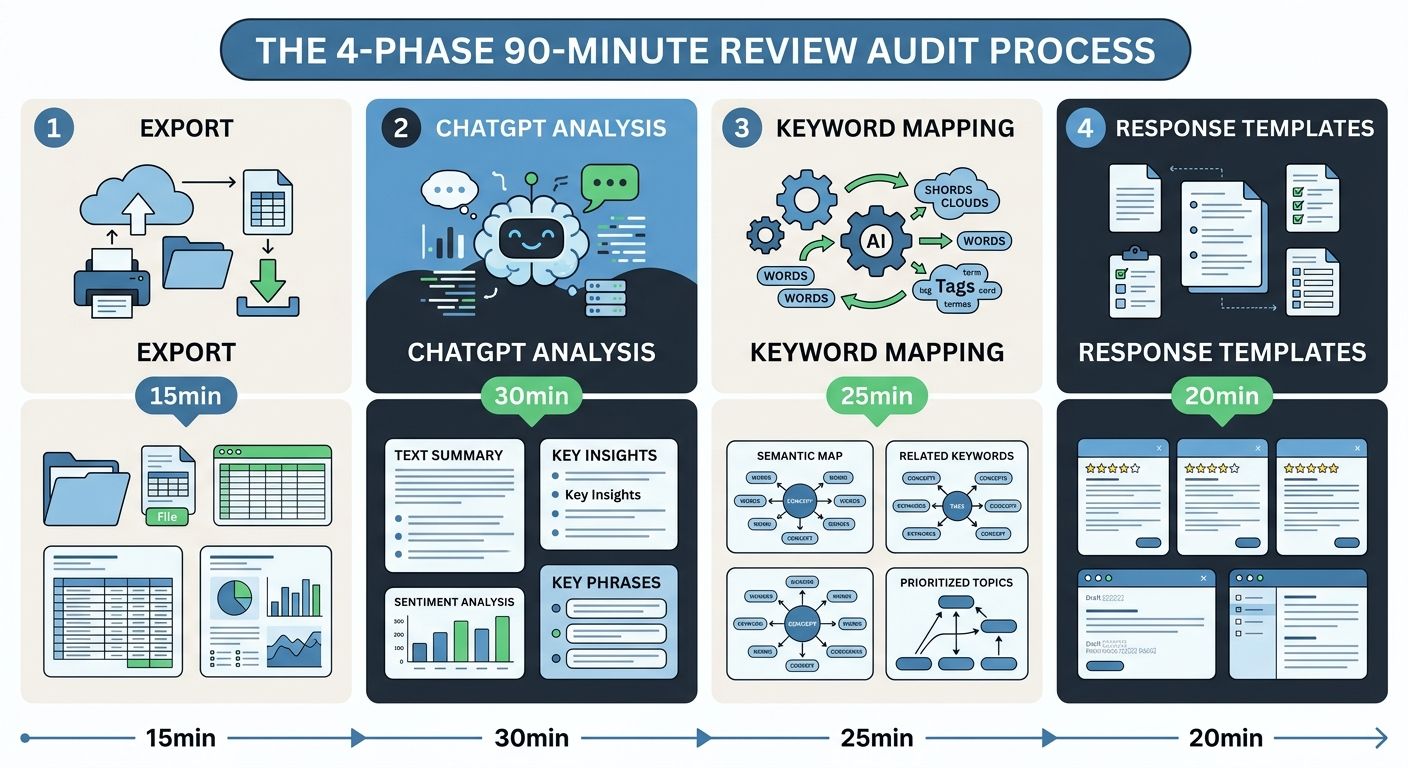
Phase 1: Export and Organize (15 Minutes)
Pull your client's full review dataset from Google Business Profile. If you're using a reputation management platform like Birdeye or GatherUp, most will export reviews to CSV. If not, you can copy-paste reviews in batches directly from the profile page into a spreadsheet. What you need for each review:
The full review text
The star rating
The approximate date
Whether the business responded
For audits with more than 300 reviews, filter to the last 18 months. Google weights recency, and reviews from 2021 won't reflect current ranking signals. Compile everything into a single text document or spreadsheet that you can paste into ChatGPT in chunks.
Phase 2: ChatGPT Keyword and Sentiment Extraction (30 Minutes)
This is where the customer review keyword mining happens. Paste a batch of 20-30 reviews into ChatGPT and use a prompt structured like this:
"Analyze these Google reviews for a [business type] in [city]. For each review, extract: (1) the primary service or product mentioned, (2) any location references, (3) the overall sentiment (positive, negative, mixed), (4) specific adjectives or phrases the customer used to describe their experience, and (5) any competitor names mentioned."
Run this across your entire review set in batches. ChatGPT will return structured data you can compile into a master document. The OpenReview evaluation of ChatGPT's sentiment capabilities tested the model across seven representative sentiment analysis tasks and found it performed well on standard evaluation, polarity shift detection, and open-domain analysis. That means it handles the tricky stuff: sarcasm, double negatives, and mixed reviews where the customer loved the product but hated the wait time.
After processing all batches, ask ChatGPT to consolidate: "From all the reviews analyzed, list the 20 most frequently mentioned service keywords, the 10 most common positive descriptors, the 10 most common complaints, and any location-specific terms that appeared three or more times."
That consolidated output is your Google reviews SEO analysis in raw form. I've seen this step surface keywords that didn't appear anywhere in the client's existing website copy, Google Business Profile description, or service pages.
Phase 3: Mapping Review Language to Your SEO Strategy (25 Minutes)
Now you turn the extracted data into recommendations. This is where the audit becomes a white-label deliverable worth real money.
Take the keyword list ChatGPT generated and cross-reference it against three things:
The client's Google Business Profile description. Are the top customer-used terms present? In many cases, I find businesses describe themselves in industry jargon while customers use plain language. A plumbing company's profile says "residential plumbing services" while every review says "fixed my water heater" or "unclogged my drain." Those specific service terms need to be in the profile description.
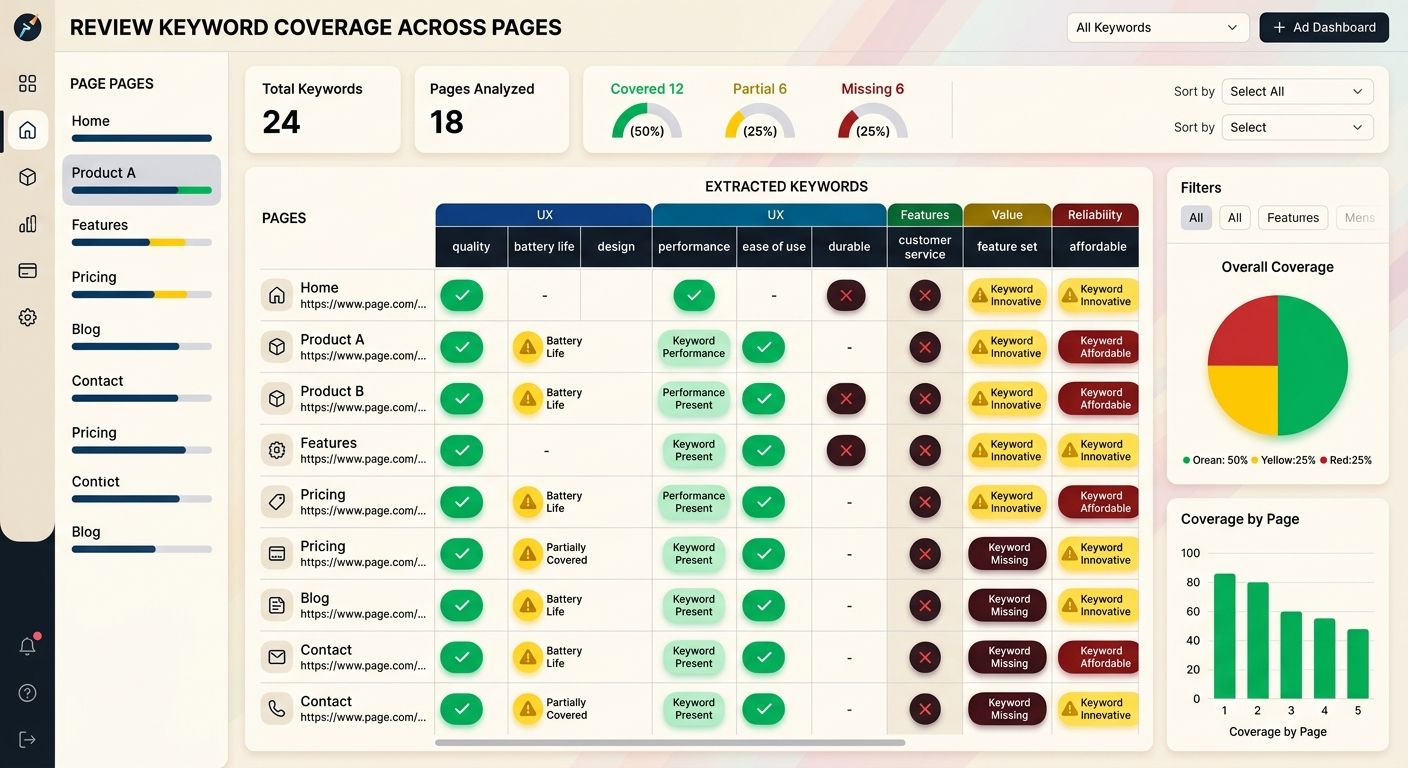
The client's website service pages. Map each high-frequency review keyword to a corresponding page. If customers keep mentioning "emergency AC repair" but the client's HVAC site doesn't have a dedicated page for emergency service, that's a content gap you've identified from real customer language.
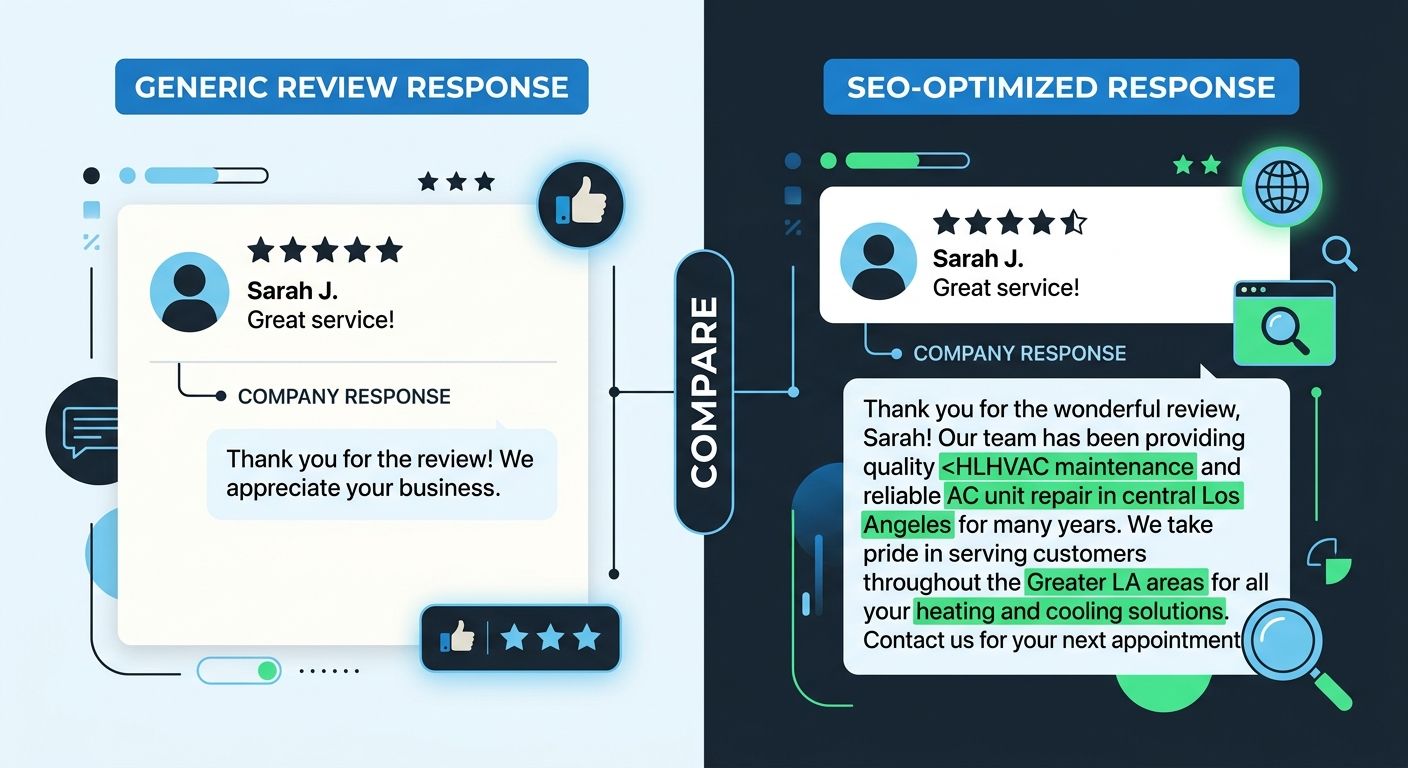
The client's review response history. EmbedSocial's analysis of review optimization recommends responding to all reviews promptly and handling negative feedback constructively. But the SEO angle is that your responses are additional indexable content. If customers mention "kitchen remodel in Scottsdale" and the business owner responds with "Thanks for the review!", they've wasted an opportunity to echo that keyword naturally.
This mapping exercise usually produces 8-15 specific recommendations. Some are quick wins (update the GBP description). Some feed into a broader local SEO review strategy (build a new service page around a frequently mentioned service). Some go directly to the client's operations team (customers keep complaining about parking, which is suppressing the star rating).
Phase 4: Building the Response Template Library (20 Minutes)
This is the phase most agencies skip, and it's the one that creates recurring value for white-label operations. Using the keyword data from Phase 2, ask ChatGPT to generate 10-15 review response templates that naturally incorporate the most important service and location keywords.
The responses need to sound human, not stuffed. A good template for a positive review of a Denver roofing company might read: "We're glad the roof replacement went smoothly for your home in Highlands Ranch. Our crew takes pride in clean job sites, and it's great to hear that came through." That response echoes "roof replacement," names a specific neighborhood, and sounds like a real person wrote it.
Build separate templates for:
5-star reviews mentioning specific services
4-star reviews with minor complaints
3-star and below reviews requiring service recovery language
Reviews that mention competitors by name
These templates become part of the white-label deliverable. Your client's team (or your own reputation management service) uses them to respond to every new review going forward, which means every response reinforces the keyword signals Google is already pulling from the review text.
Why This Process Scales for White-Label Delivery
I built this framework because I kept seeing the same failure pattern in agencies I evaluated. They'd charge $1,500-$3,000/month for local SEO management, and the review strategy section of their reports would be a paragraph that said "encourage more reviews." No keyword analysis. No sentiment breakdown. No connection between what customers were saying and what the agency was optimizing for.
If you're running a white-label SEO operation and want to understand how review signals feed the broader rankings pipeline, this audit fills a gap that most competitors aren't even aware of. You can deliver it as a one-time audit priced between $500-$800, or bundle it into quarterly reporting for ongoing retainers.
The 90-minute time investment means a single analyst can produce four or five of these audits per day. At white-label pricing, that's a high-margin deliverable. And because the output is specific to each client's actual review data, it doesn't look like a template report. Every audit surfaces different keywords, different sentiment patterns, and different strategic recommendations.
This approach also pairs well with the automation opportunities that exist across routine SEO tasks. The export and prompt steps can be partially templatized, and the ChatGPT analysis phase follows a repeatable workflow that junior team members can execute after one or two supervised runs.
For agencies managing clients who depend heavily on local visibility, particularly those in service industries affected by AI Overviews reshaping local search results, the review audit provides something tangible. Clients can see their own customers' words being mapped to specific optimization actions. That's a transparency advantage when so much of SEO feels abstract to business owners.
Turning Sentiment Data Into Operational Intelligence
One dimension of review sentiment analysis with ChatGPT that goes beyond SEO: the negative review patterns almost always reveal operational problems the business owner hasn't quantified. I ran this audit for a multi-location dental practice and discovered that 34% of their 3-star reviews mentioned long wait times, with the complaints concentrated at two specific locations. That data went to the operations team, not the SEO team. But fixing the wait time problem eventually improved the star rating at those locations from 3.8 to 4.3 over six months, which directly correlates with improved search rankings.
When you position the audit this way, it becomes more than an SEO deliverable. It's business intelligence extracted from unstructured customer feedback. That reframing justifies higher pricing and gets buy-in from stakeholders who don't care about keywords but care deeply about customer satisfaction scores.
As Local Visibility System's keyword research methodology argues, if you had to pick one source to anchor your local keyword research, reviews are the strongest starting point, followed by Search Console data, followed by exploratory ad campaigns. The language your actual customers use when describing their experience is more reliable than any third-party keyword tool's estimated search volume. When agencies building a local SEO review strategy skip this step, they're optimizing based on assumptions instead of evidence.
What The Data Doesn't Tell You
The 90-minute audit produces actionable intelligence, but it has blind spots worth naming.
ChatGPT's sentiment analysis, despite strong benchmark performance, still misses cultural context and highly localized slang. A review that says "this place is sick" will occasionally get flagged as negative. You need a human reviewer checking the output, particularly for industries with specialized vocabularies. The AI Multiple research on ChatGPT sentiment analysis examples demonstrates that the model handles negation terms well, but edge cases persist with industry-specific language.
The audit also can't tell you which keywords Google is currently weighting most heavily for your client's specific market. It tells you what customers say and where those words are missing from your client's digital presence. The causal link between adding those words and ranking improvement requires testing and measurement over time. Review velocity, star rating trends, and the age distribution of reviews all influence rankings in ways this audit captures descriptively but can't isolate causally.
And the biggest limitation: this framework works best for businesses with at least 50 reviews. Below that threshold, the keyword frequency data is too thin for reliable pattern extraction. ChatGPT will still produce output, but you'll be drawing strategic conclusions from a sample size that doesn't support them. For newer businesses, pair this audit with a review generation strategy that prioritizes detailed, descriptive reviews over simple star ratings, since that 200-character threshold for review weight applies regardless of total review count.
The numbers here are clear on the opportunity. They're less clear on the exact ranking mechanics behind the scenes. Run the audit, implement the recommendations, and measure the impact over 90-120 days before drawing conclusions about what moved the needle.
Marcus Webb
Digital marketing consultant and agency review specialist. With 12 years in the SEO industry, Marcus has worked with agencies of all sizes and brings an insider perspective to agency evaluations and selection strategies.
Explore more topics