
Why Your Enterprise SEO Strategy Fails at Implementation: A Case Study in Organizational Friction
Enterprise SEO strategies don't die in the audit.
 Marcus Webb··10 min read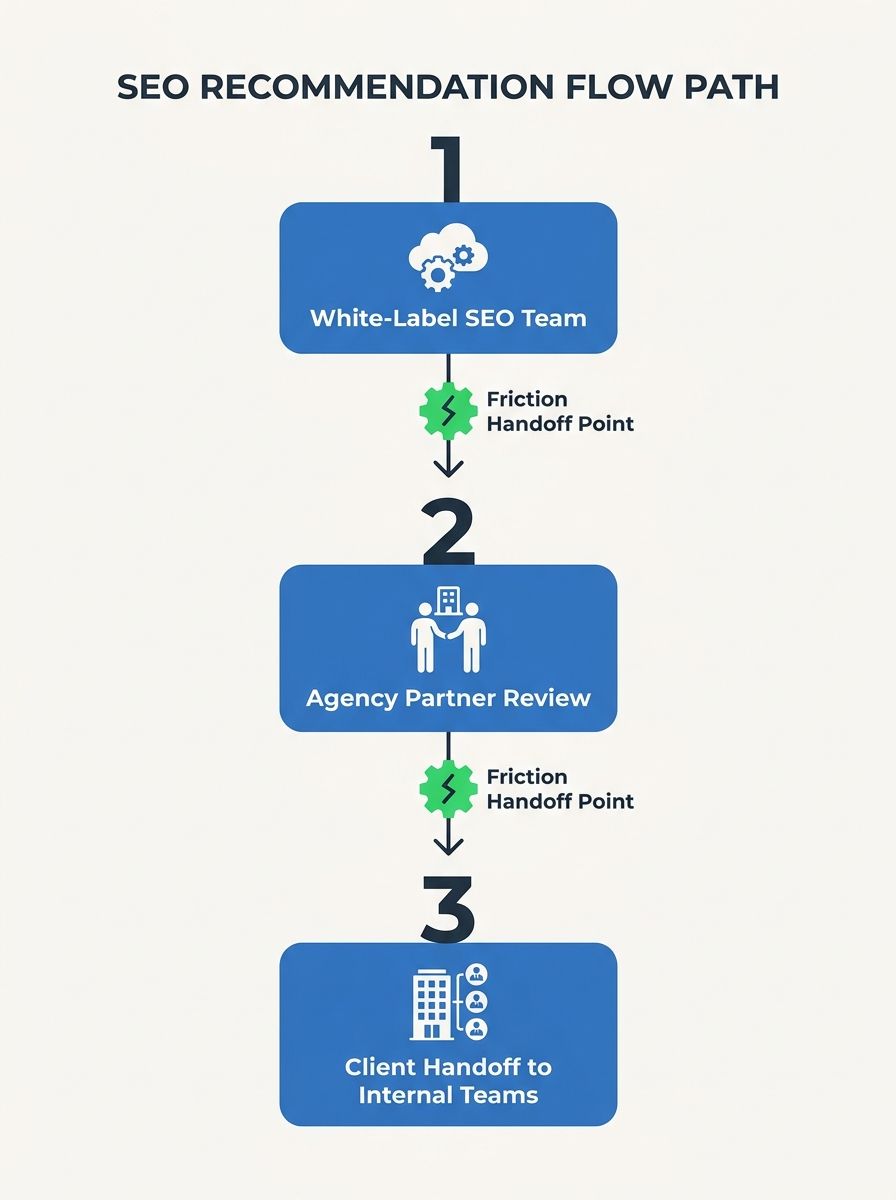
Why Your Enterprise SEO Strategy Fails at Implementation: 6 Rules for White-Label Teams Navigating Organizational Friction
Enterprise SEO strategies don't die in the audit. They die in the space between a white-label team's recommendations and the client's internal ticketing system, somewhere around week six, when the dev team finally responds to a Jira ticket filed by a marketing coordinator who doesn't fully understand what "canonicalization" means. I've watched this play out at companies managing 10,000+ URLs, companies with seven-figure ad budgets and dedicated SEO headcount, companies that should have every advantage. The strategy documents are excellent. The implementation record is catastrophic.
If you're running white-label SEO fulfillment for agencies serving enterprise clients, you already know the frustration. Your team produces technically sound audits, detailed content briefs, migration plans with every redirect mapped. And then the work sits in a queue for months. Or it gets partially implemented by someone who changed three of the seven items because "legal had concerns." Or the agency partner sends back a panicked Slack message because the client's VP of Marketing just reorganized the content team and nobody knows who owns the blog anymore.
According to Search Engine Journal's analysis of enterprise SEO operating models, the pattern is consistent across hundreds of global organizations: chronic underperformance that looks like a tactical problem but is actually a structural one. As a white-label provider, you're absorbing the consequences of that structural dysfunction while having the least organizational power to fix it.
These six rules won't eliminate enterprise friction. But after twelve years of watching enterprise SEO implementation failures unfold from the white-label side of the relationship, I can tell you they significantly reduce the damage.
Always map the client's internal power structure before scoping the engagement
The default white-label workflow starts with a technical audit or keyword gap analysis. That's backward for enterprise clients. The first deliverable should be an internal stakeholder map that identifies who controls the CMS, who approves content publication, who manages the dev sprint backlog, and who has the authority to override all of the above.
This matters because enterprise SEO strategy execution bottlenecks are almost never technical. They're political. A Fortune 500 technical SEO case study documented by MonsterClaw found heavy coding issues, design failures, and misplaced CTA buttons across 50,000 pages. The problems were identifiable within weeks. But resolving them required navigating relationships between engineering, design, and marketing teams that had competing priorities and separate reporting structures.
As a white-label provider, you're typically two degrees removed from these internal dynamics. Your agency partner may not even have full visibility into them. Before you scope a single phase of work, push your agency contact to get answers to three questions: Who has final sign-off on technical changes? What's the average time from approved recommendation to deployed change? And which department has killed or delayed SEO work in the past twelve months?
If you can't get clear answers, build an extra 60-90 days into every timeline estimate. You'll need it.
Demand a named internal champion with actual decision-making authority
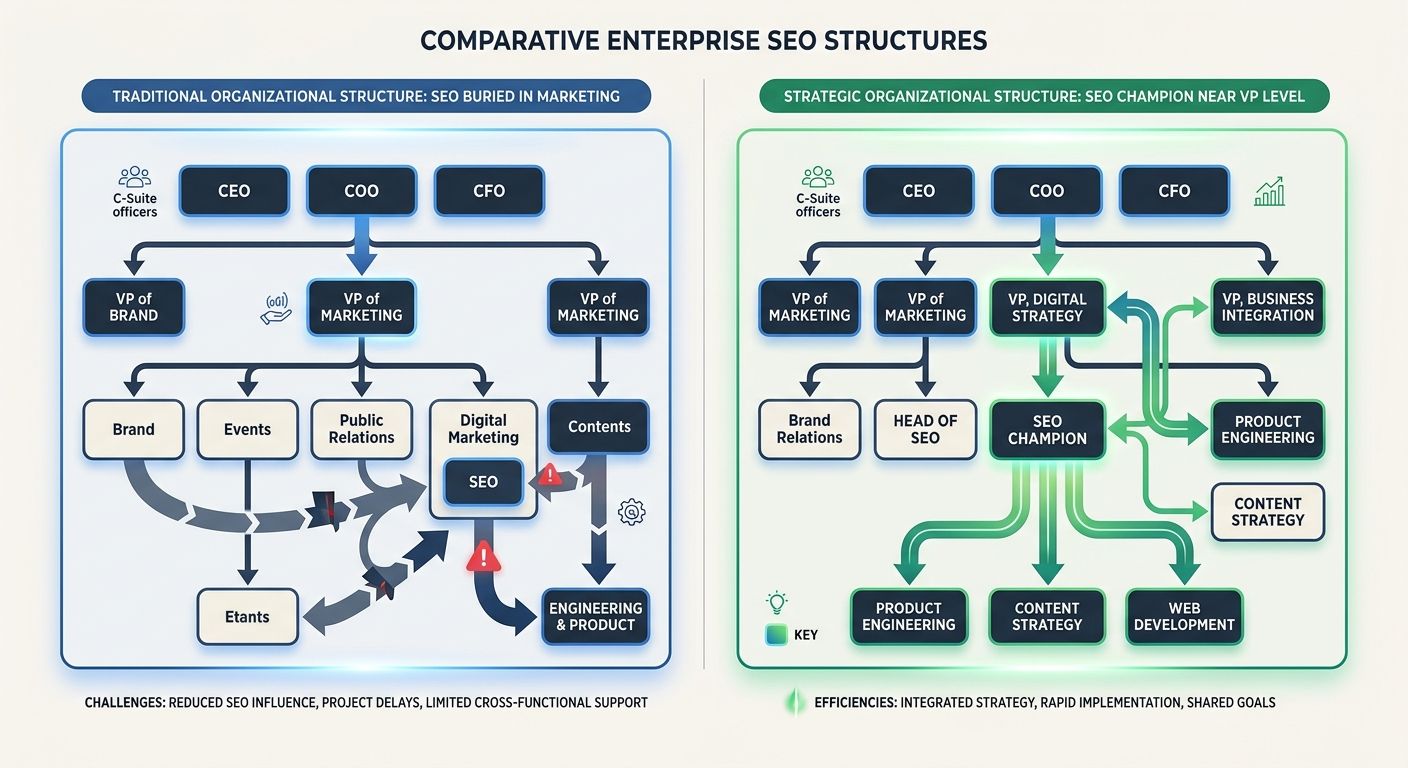
Every enterprise engagement I've seen succeed had one thing in common: a specific person inside the client organization who treated SEO as their responsibility and had enough seniority to push changes through. Every engagement I've seen stall had the opposite: distributed ownership where "everyone" was responsible, which meant nobody was.
Search Engine Land's reporting on enterprise SEO structural weaknesses found that where SEO sits on the org chart determines its effectiveness. When SEO is buried under marketing, IT, or product, it becomes reactive. The most successful implementations happen when SEO has VP-level endorsement and proximity to leadership decisions.
For white-label teams, this translates to a concrete requirement: your agency partner needs to identify and confirm an internal champion before the engagement moves past discovery. This person doesn't need to understand technical SEO. They need to be able to walk into a sprint planning meeting and say "these three tickets are priority one this cycle" and have that stick.
If the agency can't secure this, you're building a strategy that will collect dust. I've seen gorgeous 80-page enterprise audits sit untouched for a full year because no internal stakeholder had both the motivation and the authority to act on them. That's wasted labor for your team and a frustrated client for your agency partner. The piece we published on why enterprise SEO demands executive buy-in goes deeper into the dynamics of securing that sponsorship, and it's worth sharing with agency partners who push back on this requirement.
Treat the developer queue as your real deadline, not the strategy document
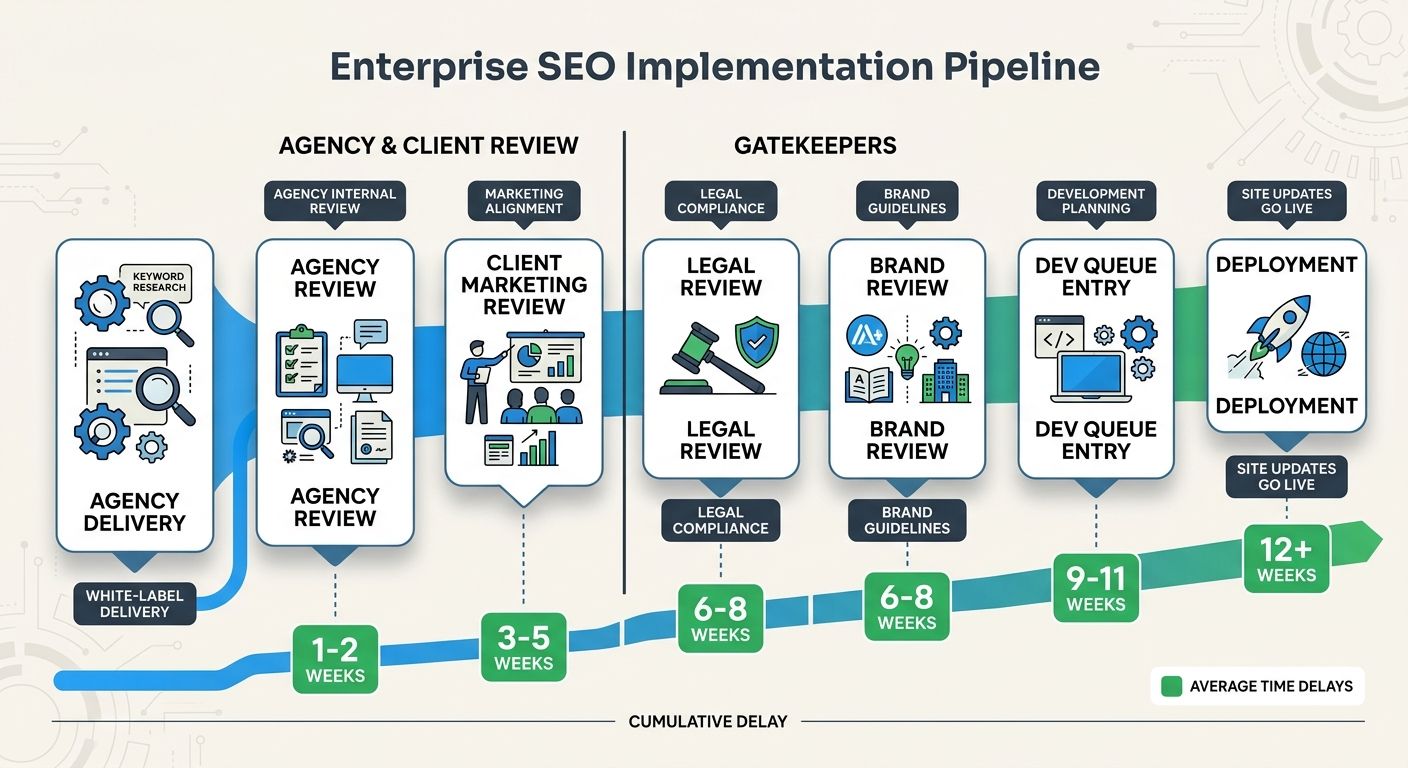
White-label teams tend to measure progress by deliverable completion. The audit is done. The content brief is shipped. The redirect map is finished. But in enterprise environments, the strategy document is maybe 15% of the actual work. The remaining 85% is implementation, and implementation lives in the development queue.
Cross-functional SEO collaboration research consistently identifies the same friction: SEO teams focus on page speed and keyword optimization, while design teams prioritize visual impact, and dev teams have their own roadmap that has nothing to do with either group. The result is that SEO tickets compete with feature launches, security patches, and executive pet projects for developer time.
If you're a white-label provider building recommendations without visibility into the client's dev capacity, you're essentially writing a wish list. And wish lists don't fix cross-department SEO coordination challenges.
Practical adjustment: structure your deliverables in implementation tiers. Tier 1 includes changes that require no dev resources (meta descriptions, content updates, internal link adjustments through the CMS). Tier 2 includes changes that need minimal dev time (schema markup additions, redirect implementations). Tier 3 is the heavy lift (site architecture changes, template modifications, JavaScript rendering fixes). Deliver Tier 1 items first so the agency can show early wins while Tier 3 items work through the queue.
Build deliverables around their approval chain, not your workflow
White-label teams have internal SOPs. Audit template, content brief format, reporting cadence, QA checklist. These workflows are optimized for consistency and efficiency inside the white-label operation. They're often completely misaligned with how the enterprise client processes, reviews, and approves work.
I worked with a white-label team that produced monthly technical reports with 40+ action items. Thorough, well-organized, technically accurate. The enterprise client's approval process required every change to be reviewed by legal, brand, and the regional marketing lead before it could enter the dev queue. Each approval cycle took three to four weeks. So by the time month one's report was approved, month two's report was already delivered, creating a permanent backlog that made everyone feel like they were failing.
The fix was unglamorous but effective: restructure deliverables to match the client's internal approval cadence. Instead of 40 items monthly, ship 10 items bi-weekly with legal and brand pre-clearance built into the brief format. Completion rates went from roughly 30% to over 75% within a quarter.
Scaling SEO across enterprise teams requires you to understand that your efficiency metric and their efficiency metric are different things. Your team measures output by deliverables completed. Their organization measures output by changes successfully deployed. If those two metrics diverge, you'll produce excellent work that generates zero results.
Automate the reporting layer so results survive organizational politics
Enterprise organizations shuffle leadership, restructure departments, and realign priorities with uncomfortable regularity. The VP who championed your SEO engagement in Q1 may be managing a different division by Q3. When that happens, the new stakeholder will ask one question: "What has this been doing for us?"
If the answer lives in monthly PDF reports buried in someone's email archive, you're in trouble. And if the agency partner has been inconsistent about forwarding your reports to the right people on the client side, you're in even more trouble.
Building automated, always-accessible dashboards that tie SEO activity to business metrics creates a political survival layer for the engagement. When someone new takes over and asks what organic search has contributed, the answer should be self-evident, updated in real-time, and tied to revenue or lead metrics that the new stakeholder cares about.
Consistent processes and automation help unify SEO initiatives and drive accountability across large organizations. For white-label teams specifically, this means investing in reporting infrastructure that your agency partner can white-label and present as their own, ensuring continuity even when internal contacts change. If you haven't already explored options for building a white-label tool stack without vendor dependency, that investment pays off disproportionately in enterprise engagements where political continuity determines contract renewals.
One data point that's convinced me: engagement churn for enterprise clients drops significantly when automated reporting is in place from month one. The engagements that rely on manual monthly reports have a much higher rate of scope reduction or cancellation after internal leadership changes.
Separate the strategy document from the implementation playbook
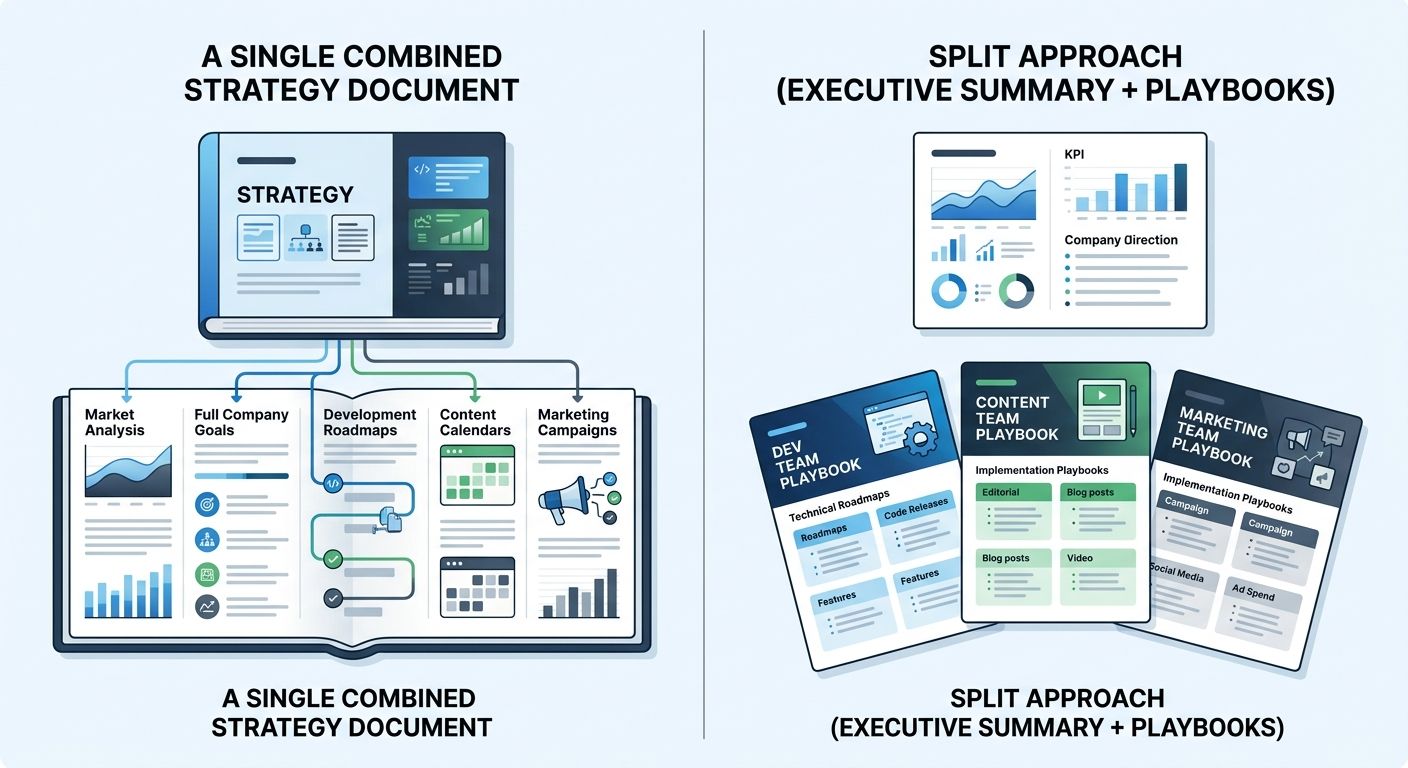
This rule sounds obvious and almost nobody follows it. The standard white-label deliverable is a strategy document that combines "here's what we found" with "here's what to do about it." For SMB clients, that bundled format works fine because the same person reading the strategy is often the one implementing it.
Enterprise clients have a completely different consumption pattern. The strategy document goes to marketing leadership. The implementation details need to reach project managers, developers, content producers, and sometimes regional teams in different time zones. A single document that tries to serve all audiences serves none of them well.
Split every engagement into two parallel document tracks. The strategy layer explains the "what" and "why" at a level appropriate for directors and VPs: competitive gaps, revenue opportunity, risk of inaction. The implementation playbook translates every recommendation into department-specific task lists with acceptance criteria, priority rankings, and estimated effort.
Monday.com's SEO planning research reinforces this split, noting that development, design, and content teams must collaborate on implementation, but each group needs information packaged for their specific context. A developer doesn't need to understand keyword cannibalization theory to fix a canonical tag issue. They need the exact pages affected, the correct canonical target, and a test to confirm the fix worked.
For white-label teams, this means more upfront work. But it also means you can ship the implementation playbook directly to the people doing the work, rather than depending on your agency partner to translate your strategy document into actionable tickets. That translation step is where an enormous percentage of enterprise SEO implementation failures originate. Removing it removes a major point of friction.
Consider whether automating repeatable portions of your SEO task workflow could free up bandwidth for this additional documentation layer. The time investment in creating department-specific playbooks pays back in implementation speed.
When These Rules Break Down
These rules assume a baseline of organizational functionality. Some enterprise environments are so deeply dysfunctional that no amount of process optimization on your end will produce meaningful results. Here are the signals that the engagement structure itself needs to change before implementation can succeed:
No internal champion exists and the agency won't push for one. If your agency partner treats the enterprise client as too important to challenge, your recommendations will enter a political vacuum indefinitely. You can package your work perfectly and it won't matter.
The client's dev team operates on quarterly release cycles with no exceptions. Some enterprises, particularly in financial services and healthcare, have change management processes that make rapid iteration impossible. If deploying a redirect takes 90 days, your standard playbook needs a fundamental rethink, not just a timeline extension.
Multiple agencies are working on overlapping scopes. I've seen enterprise clients with one agency handling "technical SEO," another handling "content strategy," a third managing "digital PR," and a white-label team behind one or more of those agencies. When three teams are editing the same pages without coordination, the result is chaos that looks like incompetence but is actually a governance failure.
The client measures SEO success by metrics that don't connect to implementation quality. If the quarterly review focuses entirely on ranking positions for a handful of vanity keywords, and nobody examines implementation velocity or technical health scores, the engagement will eventually be judged by outcomes your work can't control.
When you recognize these patterns, the most valuable thing you can do as a white-label provider is be transparent with your agency partner. Document the structural barriers. Quantify the implementation gap between what you've delivered and what's been deployed. Frame it in dollar terms whenever possible: "We've delivered recommendations that, based on the traffic opportunity analysis, represent $X in annual organic revenue. Implementation is at Y%, meaning approximately $Z is unrealized."
That framing shifts the conversation from "the SEO isn't working" to "the SEO is working fine, the organization is blocking its own growth." It protects both the agency's reputation and your white-label relationship, and it gives the agency partner concrete data to bring to the client's leadership team.
The uncomfortable truth about enterprise SEO is that the strategy is usually the easy part. Twelve years in this industry have taught me that the teams producing the work are rarely the bottleneck. The bottleneck is the organizational machinery that stands between a good recommendation and a deployed change. White-label providers who build their entire operation around navigating that machinery, rather than hoping it works itself out, are the ones who keep enterprise contracts for years instead of losing them after one frustrating cycle.
Marcus Webb
Digital marketing consultant and agency review specialist. With 12 years in the SEO industry, Marcus has worked with agencies of all sizes and brings an insider perspective to agency evaluations and selection strategies.
Explore more topics