
Google AI Overviews Cut Organic Clicks 38% in Randomized Field Study
A randomized field experiment shows Google's AI Overviews reduce organic clicks to external websites by 38% on queries where the feature appears, according to a working paper published this month by researchers at the Indian School of Business and Carnegie Mellon University. The study tracked 1,065
 Marcus Webb··3 min read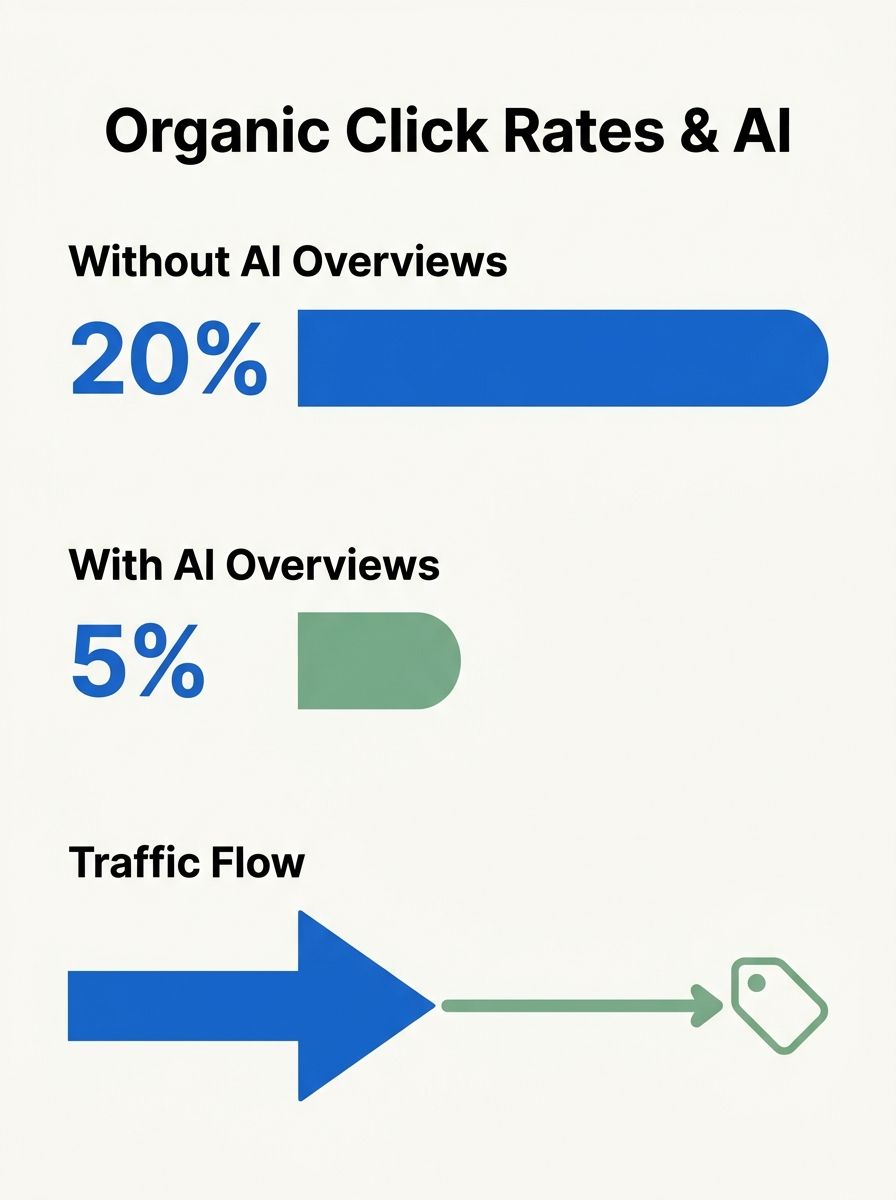
Google AI Overviews Cut Organic Clicks 38% in Randomized Field Study
A randomized field experiment shows Google's AI Overviews reduce organic clicks to external websites by 38% on queries where the feature appears, according to a working paper published this month by researchers at the Indian School of Business and Carnegie Mellon University. The study tracked 1,065 U.S. participants over two weeks, randomly assigning them to see AI Overviews, have them hidden, or be redirected to AI Mode.
The research marks the first randomized field experiment testing how AI Overviews affect user behavior in a real browsing environment, authors Saharsh Agarwal and Ananya Sen wrote in the SSRN working paper. The experiment ran between January and February 2026 and was pre-registered with the AEA RCT Registry before data collection began.
Field Experiment Isolated AI Overview Impact
Researchers built a Chrome extension that assigned participants to three groups. The control group saw Google Search normally. A "Hide AIO" group had AI Overviews removed in real time. A third group was redirected to Google's AI Mode for all searches.
Participants were recruited from Prolific and had to meet minimum browsing-history thresholds. Over 95% of users in the Hide AIO group did not detect any changes during the study period, the paper shows.
All participants used Chrome on desktop, so the findings reflect active desktop users rather than the full spectrum of Google Search traffic. The study ran for two weeks per participant.
Zero-Click Searches Rose From 54% to 72%
AI Overviews appeared on 42% of queries during the study period. Removing them increased outbound clicks from 0.38 to 0.61 per search, the data shows. Zero-click search rose from 54% to 72% when AI Overviews were present.
Effects were strongest when AI Overviews appeared at the top of the page, which occurred 85% of the time. Removing top-position AI Overviews nearly doubled outbound clicks, but lower-positioned summaries had no measurable effect on click behavior.
Sponsored clicks and search frequency remained steady across groups. The pattern indicates substitution between AI Overviews and organic visits rather than changes in overall search behavior or ad engagement.
User Satisfaction Scores Showed No Difference
The endline survey used a one-to-five Likert scale to measure participants' search experience. Responses from the control and Hide AIO groups were nearly identical across all measures, including satisfaction, information quality, and ease of finding information.
The researchers wrote that AI Overviews "divert traffic away from publishers without delivering measurable improvements in user experience." Google VP Liz Reid has claimed AI Overviews reduce "bounce clicks," but the company has not released data supporting user-benefit claims.
The AI Mode group showed lower satisfaction scores at endline compared to other groups. That group also had higher attrition, with some participants uninstalling the extension or finding workarounds, which may have influenced the results.
Study Adds Causal Evidence to Correlational Data
Previous measurements of AI Overview impact have relied on correlational approaches. Pew Research found users click 8% of the time with AI Overviews, compared to 15% without. Ahrefs analyzed Google Search Console data and reported a 58% drop in click-through rate for top-ranking pages when AI Overviews appeared.
This experiment differs by randomly assigning users to treatment groups, isolating the causal effect of AI Overviews on click behavior. The randomized design controls for confounding variables that correlational studies cannot address.
The shift mirrors broader changes in how Google Search operates, as the platform increasingly handles task fulfillment directly rather than routing users to external websites. The 38% reduction in organic clicks on affected queries represents a measurable acceleration of that trend.
What Happens Next
SEO agencies advising clients on 2026 strategy now have quantified data on AI Overview impact from a randomized controlled trial. The 38% organic click reduction on queries where the feature appears provides a benchmark for traffic forecasting and client expectation setting, particularly for websites competing in categories where AI Overviews appear frequently.
The paper remains a draft on SSRN and has not completed peer review. The authors indicated they will add more results in subsequent versions. Agencies monitoring AI Overviews' effect on local search visibility and site traffic should track whether the published findings shift as peer review proceeds.
The user satisfaction finding—that removing AI Overviews produced no measurable change in self-reported experience—challenges the assumption that the feature improves search quality. That gap between traffic diversion and user benefit may influence how agencies position SEO value propositions in client discussions, especially when justifying investments in ranking improvements that AI Overviews may obscure.
Marcus Webb
Digital marketing consultant and agency review specialist. With 12 years in the SEO industry, Marcus has worked with agencies of all sizes and brings an insider perspective to agency evaluations and selection strategies.
Explore more topics